Showing posts with label dick francis. Show all posts

Monday, February 11, 2013

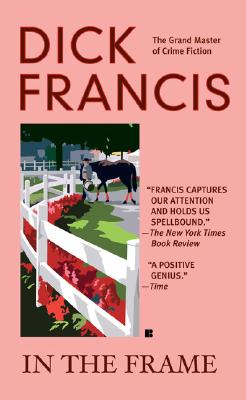
Review: IN THE FRAME by Dick Francis

in the frame cover

Charles Todd is a painter visiting his cousin Donald for a few days. When he arrives, he finds Donald's wife has just been killed interrupting a robbery at their house. Emotionally and financially, Donald is completely broken--and to add insult to injury, the police suspect Donald of the crime. To help his cousin get his life back together, Charles decides to find the real killers.

In the Frame is another great read from Dick Francis. To the Hilt was one of my favorite reads of 2010; and while In the Frame isn't quite as perfect as that book (seriously, I called To the Hilt perfect--you know I really loved that one), it is still really really good. I loved the characters, settings, the story was never ever boring, and the book was very emotional, as well. Donald's struggle with grief while being investigated for his wife's murder was just awful, and I really felt for him and Charles, who is extremely worried about him. Francis does a great job of making Charles' subsequent actions totally understandable.

This is also--I think--the first novel I've read that takes place in Australia (note to self: remedy this), and I LOVED the setting. You can tell Francis really thought about how the setting would work with the story and did a lot of research into it. Usually setting descriptions make my eyes glaze over, but in this case I thought they were just brief enough to let me paint a picture of the scene in my mind.

Like To the Hilt, the main character in In the Frame is a painter. I ADORE how Francis writes painters. Usually in books with painters, even the ones I like, the painter never actually works, or even thinks about painting. Not so with this book! Charles paints, a lot, and when he's not painting he's thinking and talking about art. I loved this exchange between him and his friend and fellow artist, Jik:
"Get that chiaroscuro," Jik said, as we sped into one particularly spectacular curving alley.
"What's chiaroscuro?" Sarah asked.
"Light and shade," Jik said. "Contrast and balance. Technical term. All the world's a chiaroscuro, and all the men and women merely blobs of light and shade."
"Every life's a chiaroscuro," I said.
"And every soul."
"The enemy," I said, "is gray."

"All the world's a chiaroscuro." Love that line! It seems like art is always on Jik's and Charles's minds, even when they're focusing on something else. Painting is a part of their personalities and how they view the world, like Shakespeare might have viewed all the world a stage.

One of the major differences between In the Frame and To the Hilt is that To the Hilt is very much a story modeled after Arthurian romances, with knights in shining armor fighting in the service of lords and ladies. In the Frame isn't like that at all--it reminded me more of those suspense novels by Mary Stewart, with a small cast of characters and a lot of traveling to exotic locales. There's only one major female character and, unlike in To the Hilt, there's no need to fight for her honor; she's not a damsel in distress by any means, although she is presented as a civilizing--and thereby stifling--force on Jik's personality and creativity. I did love the dynamic between Jik and Charles, though, because they're two sides of the same coin: Jik is an unpredictable, ambitious, flamboyant avant-garde artist, who only paints when he's in a dark mood. Charles seems like the exact opposite: he works steadily, paints marketable pictures of horses, and is always calm and friendly. In other words, he is the antithesis of someone who would go haring off to Australia to chase thieves and murderers, get shot at and beaten up (is it just me or are Francis's heroes always getting beat up?), steal things, or outsmart a bunch of crooks. Yet somehow his friendship with Jik makes him doing so entirely plausible.

Just as a side note, In the Frame is a bit dated--it was first published in 1976. It doesn't feel THAT old, but there are no cell phones, no internets, airport security is a free-for-all, no one outside of Australia has ever heard of Australian wine, and Charles is astonished at making an overseas phone call (the voice is so clear!). Other than those few technical issues, though, I found the story to be just as plausible today as it might have been in the past, and it's damn good mystery. Francis has definitely earned my admiration and I'm planning to read more novels by him in the future.


Further Reading:


Discus this post with me on Twitter, FaceBook, or in the comments below.

Wednesday, September 15, 2010

BBAW--Forgotten Treasures

to the hilt cover

Today's meme for BBAW involves books we don't think have been given enough face time on book blogs:  recently published books that have flown under the radar or forgotten classics. 

My favorite book that I've read this year so far has been To the Hilt by Dick Francis, which was suggested to me by the lovely Orannia from Walkabout

Dick Francis isn't exactly hip.  I know this.  But this novel was SO GOOD. 

Do you like Sir Walter Scott?  Novels of knights errant going to battle for their honor and the honor of their patrons?  Distant ladies who are both noble and brave?  Then you'll love this book, because that's basically what it is--a Camelot romance set in contemporary Britain.  It's smart and detailed and compulsively readable, and I can't recommend it enough.


Powered by ScribeFire.

Tuesday, July 13, 2010

To the Hilt by Dick Francis

to the hilt

This isn't the typical book I would pick up by any means, but the lovely Orannia from Walkabout was so excited when she recommended it to me that I thought I would give a try.  And then I just happened to run across it in the $1 shelves at a used bookstore, so I figured it was kismet.  And it was!  I freaking LOVED this book, and I'm so so happy I read it.

Alexander, or Al, Kinloch lives the idyllic existence of an artist in a stone cottage (or bothy) on the side of a mountain in Scotland, with no electricity, running water, cell phones, or intrawebz.  Then his peaceful paradise is shattered when four thugs appear, toss the bothy, beat Al up, and throw his barely-conscious self down the side of a cliff.  The only clue Al has as to why the men attacked him was the question they kept asking: "Where is it?"

Since his home is pretty much destroyed, Al decides to go to London to visit his mother and ailing father-in-law.  This is where he learns that Sir Ivan has entrusted him with his two greatest treasures, one of which was probably the "it" of the thugs' questioning.  On the plus side, Al is relieved to know they weren't looking for what he thought they were.  On the downside, he now has to save Sir Ivan's business from bankruptcy, protect his father-in-law's treasures from creditors, and keep an eye out for whoever hired the thugs to beat him up.  Things only get more complicated when someone dies.

This book tells a fabulous story.  Even though it's classified as a mystery, I think it's more accurate to call it a romance--but in the Arthurian sense of the word.  Al is the knight errant, called in to fight his lords' battles for honor and treasure--swords and chalices, no less.  He is ridiculously brave and honorable and true, and the villains are equally unreasonable and devious.  Instead of jousting or going on quests, Al plays golf.

One of the more interesting aspects of this book, which works into the Arthurian romance theme, are the female characters.  Some are honorable and brave, and meant to be protected (Al's mother, for example).  Others are villainesses, witches and dragons who do not make life easy for our noble hero.  Even the honorable women are meant to be treated with caution: "Men were right to be afraid of women, I concluded," Al thinks at one point, "the witch lived near the surface in all of them."  This may sound really sexist, but I actually didn't feel like it was at all.  Yes, the women are characterized according to types you can find in an Arthurian romance--but they're not reduced to sexual objects or denigrated, and all of them have several aspects to her personality.  They are for the most part minor characters, but well-rounded minor characters.  Overall the women in this book are depicted as powerful forces for good and evil, and the equals of men.  I think the fear Al refers to isn't misogyny, but respect.

Aside from that, I loved the details in this book.  Francis definitely knows how a painter thinks:  when Al looks at something, he can see it on the canvas, and thinks about how he would create it with layers of paint and different techniques.  I loved learning about how he painted his works, and how even supposedly pedestrian subject matter was illuminating and inspiring to viewers who really took the time to look at his paintings.  I also love Al himself--I really hope, though am doubtful, there are more books with him--and how the title has multiple meanings, and how the plot thickens.  I love it when the plot thickens!

The only thing I didn't like about this book was the ending, which kind of felt like a Deus ex machina.  I would have preferred it if Al had discovered the perpetrators on his own instead of them revealing themselves.  And I was all set for there a much bigger conspiracy and evil plotting than there was, so I was left hanging there.

All that is a minor quibble, however, for what for the most part is simply a perfect book.  Thoroughly enjoyable, smart, with great characters and a well-told story.  I can't recommend it enough!

So who has recommendations for another good novel by Francis?

Shop Indie Bookstores


Powered by ScribeFire.

LinkWithin

Related Posts Plugin for WordPress, Blogger...