Showing posts with label dystopian. Show all posts

Saturday, December 13, 2014

Review: INSURGENT by Veronica Roth

insurgent cover

After turning off and stealing the simulation that was forcing members of Dauntless to kill Abnegation, Four and Tris leave Chicago to escape the Erudite. But with Jeanine still alive and determined to control all the factions, they're quickly drawn back into the city, where Marcus wants to unveil the secret Jeanine was ready to kill for. Will he convince Tris she needs to risk everything to help him?

If that summary made a lick of sense to you, congratulations, you've likely read Divergent! (I know I should probably review these books in, like, order or something, but hey. It's my blog, I do what I want.) I immediately downloaded Insurgent after finishing Divergent, because hellloooooooo, I loved it. Divergent, that is. Insurgent was a bit of a letdown.

First of all, Four. In Divergent he was a total hottie, but in Insurgent there was no chemistry between him and Tris WHAT. SO. EVER. Their makeout sessions read like a microwave instruction manual. And I got sick of his constant whining pretty damn fast. Waaaah, you never tell me every single damn thing that's going on with you right away, waaaaaaahhhh. By the time the storming of the Erudite compound rolled around, I was rooting for them to break up.
the pity train has derailed at the corner of suck it up and move on

The ending in particular was SUPER annoying because there were several things that did not make sense:

  1. Why is Tris considered a traitor to Dauntless? It's not like she's siding with Erudite or helping Jeanine escape; she just wants to make sure the information in Erudite's computers doesn't disappear and innocent Erudites don't die. Where's the conflict with Dauntless here? She's working toward the same goal, just with different priorities.
  2. Why doesn't Tris tell Four about Marcus' plan? For that matter, why agree to help Marcus at all if she's so worried about Four's reaction, especially when Marcus never tells her exactly what he's doing or why it's so important, other than, "It's essential to the preservation of society"? As Tris herself pointed out, their society is already in ruins, so what exactly are they risking their lives and personal relationships to save? Seems unnecessary. And it's not as if Tris is THE ONLY PERSON IN THE WORLD who can help him. He can go pick on someone else.
  3. The big reveal at the end (which let me assure you was underwhelming) negates the messages and themes of Divergent, namely that people are more than the places they grow up in, or their families, or their jobs, or their major. You don't have to be just one thing. But the reveal shows exactly the opposite: they're breeding for divergence. In other words, the only reason Tris and the other divergents have different abilities is because their parents belonged to other factions. So that whole thing about people being more than the sum of their parts and free will? I felt like it went out the window.


Not to mention the fact that by the end, I wanted Four to throw himself off a cliff. Let's break down Worst Boyfriend of the Year's actions a bit, shall we?

  • Instead of supporting Tris when she gets into a fight with Peter, he tells her to calm down. AWESOME, WOMEN LOVE BEING TOLD TO CALM DOWN! Keep that up.
  • Instead of being understanding when he finds out Tris killed Will and that's why she's been freaking out lately, he tells her, "It's not easy being with you." Are you kidding me? Look in the mirror, buddy. LOOK IN A FREAKIN MIRROR.
  • Most hilarious (if by hilarious you mean awful) part: when Four breaks into Erudite and you THINK he's going to rescue Tris, but instead he tells her that he *could* break them out of Erudite at any time, except he needs to do yada yada some such to prepare for the Dauntless attack. So she should just hang in there with the mental torture for two more weeks, and then maybe probably he can get them out. Tris: "I don't think I can last that long, I really can't." Four: "You're a strong Mädchen, you can do it." [I may be projecting a bit here.] NO. Tris has to be rescued by fucking Peter. What is even the point of you, Four?
  • When Tris is caught as a "traitor," Four doesn't even attempt to talk to her or offer an explanation for her behavior that would, presumably, save her from being KILLED. To repeat: we're supposed to believe that Dauntless is ready to execute Tris, and because she was helping his dad, Four sees her dying as a completely reasonable outcome to not-exactly-being-a-traitor. For someone who keeps yelling at her to stop risking her life, he seems pretty copacetic with Tris getting executed and/or tortured.
  • Then, twenty minutes after Tris yells at him for being a jerk (finally), Four comes hop-skipping over and says, "You were right. I do know who you are. I just needed to be reminded." COOL STORY, BRA. At that point I would have been like, "I think we need to start seeing other people." BUT NO. Everything magically becomes happily every after ville again, and they kiss and make up. Literally.

i just threw up in my mouth a little bit

I want at least one scene of abject apologies and groveling. To the level that it's so pathetic, it's embarrassing.

Not to mention the fact that the writing style in Insurgent read VERY YA. Like Harriet the Spy. The number of conversations Tris eavesdropped on was ridic.

So yeah. I found this book to be EXTREMELY annoying. But I will say Veronica Roth can still spin a fast-moving story, even when it makes no sense.


Discus this post with me on Twitter, FaceBook, Google+ or in the comments below.

Monday, December 1, 2014

Review: MOCKINGJAY by Suzanne Collins

mockingjay cover

After I finished Catching Fire, I tried to read something that wasn't a YA dystopian novel... for about five seconds. Then I finally gave in to my obsession and started Mockingjay.

I knew going into Mockingjay that a lot people on the bookternet were disappointed by it, but I didn't know why or wheretofore. If only I could go back to that time of blissful ignorance. Now I understand completely, though there is no comfort in it. And I didn't even spend a year waiting for this book to come out, imagining way better scenarios than what actually happened!

Going into Mockingjay, here's what I was expecting would happen:

  • Katniss rescues Peeta from the Capitol.
  • She gets close enough to President Snow to kill him, but probably doesn't end up assassinating him. Maybe someone else (Peeta, the Unexpectedly Badass Baker?) does that for her.
  • Katniss and Peeta take on leadership roles in the new government, get married, and live more or less happily ever after.


Here's what actually happened: NONE OF THOSE THINGS.

Oh, and I guess I should say there's going to be spoilers out the wazoo in this review, although the book's been out four freaking years. If you haven't read it yet, and you were planning to read it, um... maybe you should get to doing that.

Okay kids, put on your seatbelts. It's going to be a bumpy ride.

Mockingjay starts out okay. Katniss has been "rescued" (or more like recruited?) by District 13, which also took in Katniss' and Gale's families after the Capitol burned District 12 to the ground (OR DID THEY? It would have been more interesting if they hadn't). Peeta is being held hostage by the Capitol and is begging for peace, which 13 interprets as a Benedict Arnold-type betrayal. So, to save Peeta from execution, Katniss agrees to be 13's poster child as long as Peeta is given immunity by the rebellion.

Okay, fine. I enjoyed the James Bond atmosphere of Katniss and Gale receiving fancy new weaponry and outfits, and I liked how Collins set up District 13 as being just as bad as the Capitol, or possibly even worse.

It was when Peeta is rescued from the Capitol that I started feeling little niggles of discontent. Here's how it went down: about halfway through the book, Katniss realizes the Capitol is punishing her by torturing Peeta. It takes her that long to come to this realization? Anyway, she freaks the hell out and 13's like, "If we want to keep using her on TV it looks like we're going to have to rescue Peeta." So they drug her into a stupor and Gale and some other people traipse on over the Capitol to get Peeta and the other Hunger Games contestants who were left behind at the end of Catching Fire. Then they traipse on back and plop him down in the middle of 13.

reading huh?


So just to sum up: They could have rescued Peeta AT ANY TIME, if Katniss had demanded it. But she conveniently didn't, so now Peeta's been brainwashed to kill her. And the whole rescue happened completely off-page while Katniss was unconscious. HOW FREAKING EXCITING.

There is no happy reunion between Katniss and Peeta. She can't deal with him calling her "a piece of work," so after taking more drugs (13 is very free and happy with the benzodiazepines–I found it hard to believe either Katniss or her family would be hunky dory with this considering her mother's refusal to give Gale morphine after he'd been whipped in Catching Fire, but apparently they are. And hey, why expect consistency?) she's off to do more war/TV stuff with Gale.

Time and preachy scenes about "panem et circenses" pass. Finally the rebels are set to take over the Capitol, and Katniss is determined to be part of the fighting. So there's a long section about training and she finally gets put on a unit with Gale and Finnick and some other people. Peeta is also part of Katniss' unit, because that's a great idea. Naturally things take a turn for the FUBAR and Katniss decides to lead the team into the heart of the Capitol to kill Snow. Pretty much everyone dies or is captured along the way, but Katniss manages to make it just outside the Capitol building where, presumably, President Snow lives. That's when her sister and a bunch of kids are killed by IEDs.

LAME, so lame. First of all, the fighting scenes read like Collins was describing one of those single-shooter video games. There was no sense of reality. Secondly, to paraphrase Alfred Hitchcock's comments on his movie, Sabotage, DO NOT BLOW UP THE INNOCENT LITTLE KID. The audience will never forgive you because you've crossed the line from narrative suspense into base shock value. I feel like that's what Collins did in Mockingjay by killing Prim. IT WAS TOTALLY POINTLESS.

Katniss goes into major freak out mode again (side note: I am so sick to death of female protagonists who start off really awesome and then collapse into emo can't-deal-with-it mode as soon as shit starts affecting them personally. coughOliviaPopecough). Katniss never makes it into the Capitol building to kill Snow, and the rebellion is won completely off page. AGAIN. Meanwhile, she wanders around crying and drugged up. When Katniss does find an opportunity to see Snow, he's like, "Hey, 13 arranged that entire thing with the bombs that killed your sister to expedite the end of the war," and Katniss is like, OH YEAH I forgot I didn't trust that bitch with the perfect hair. So she kills the president of 13 instead of Snow.

Okay, fine (again). But here's where I started getting really pissed off: Katniss is tried for the murder of 13's president, but we never see a single second of the trial, nor do we ever receive an explanation as to how or why she wasn't convicted. Was the defense temporary insanity? Justifiable homicide? Did anyone mention the whole thing with the bombs that killed the kids? I don't know! After the trial, she's shipped back to 12 with a "There, there now, little lady," pat on the head–metaphorically speaking, of course–which she accepts with nary a whimper of protest. In 12, she lives in the Victor's Village all by herself, wallowing in depression, until Peeta shows up. They have a bunch of kids and never leave 12 again. The end.

wtf book?


Seriously, what the freaking fuck????


  1. So basically at the conclusion of this nonsense, everyone is in more or less the exact same place they were in at the start of Catching Fire, except for Prim (who's dead) and Gale (who was the architect of the bombing that killed Prim). That doesn't make me feel like I wasted my time at all!
  2. Congrats, Collins, you just completely removed any agency from the main character of your novel who's supposed to be a "kick-ass heroine." You know what would be great? A book where the main character actually does stuff instead of wallowing in drugs and self-pity, or acting out emotionally instead of using her intelligence, or following that up by just doing whatever other people tell her to do. What a great message, keep this shit up.
  3. There was no emotional closure whatsoever. Sorry, I don't consider pushing babies out of your vagina closure. Katniss never acts proactively for her own happiness or fights for justice for Prim, and her confrontation with Gale over the bombing was lame. He was just like, "Did I have something to do with that? IDK. *shrug* So... this is going to be an issue between us now, right?" YA THINK. She also never confronts either Gale or Peeta for the numerous hurtful things they said about her during the course of the novel, for instance, "Katniss will pick whoever she can't survive without." What in the name of beejesus is that supposed to mean? I would have thrown a crowbar at both their heads.
  4. And speaking of Katniss choosing between Peeta and Gale, she never actually does! Gale gets some fancy-ass job in District 2 and never visits–which admittedly is understandable, since he killed her sister with his bloodthirsty warmongering, the asshat–and Peeta just kinda shows up. So the conclusion to their story is essentially: Hey, you're here, I've given up on life, let's have babies together.

The ending of Mockingjay was THE ACTUAL WORST. I'm not even being hyperbolic. I was so upset when I first finished it I couldn't sleep, and I was depressed for DAYS afterward. I have no idea what the hell Collins was thinking with this novel, but I feel like it betrayed every fiber of trust and time I invested in the series. I want to burn the shit out of it. I want to forget I ever read it. I want to rewrite the whole book into something that's actually decent.

After thinking about it for a bit, I realized that reason I had such a strong negative reaction to the end of Mockingjay was that, despite the supposedly "happy" ending, the novel is actually a tragedy, and a cynical one at that. On the micro level, it's the story of a woman who is systematically beaten down, used until she's completely empty and has lost everything: her friends, family, home; but even worse than that, her sense of self-identity, strength, and authority. In the technical sense Katniss survives The Hunger Games: Game On with a Vengeance, but in terms of her personality I feel like Katniss was completely erased, and no one noticed or cared.

On the macro level, the people who act without conscience or morals during the course of the novel, like Gale and Plutarch, are rewarded, while those who try to save lives or demonstrate caring for other people either die or are rendered completely powerless and irrelevant.

I mean the world's hard enough as it is guys. It's fucking hard enough as it is.


THE ACTUAL WORST.


Discus this post with me on Twitter, FaceBook, Google+ or in the comments below.

Sunday, November 30, 2014

Review: CATCHING FIRE by Suzanne Collins

catching fire cover

Welcome to The Hunger Games All Stars: the Peeta Bread Boy show! Having survived the Hunger Games thanks to some quick thinking on Katniss' part, Peeta is baking his feels and painting, because he's the sensitive artist type. Meanwhile, Haymitch is drinking his feels and Katniss... no one's quite sure what Katniss is doing. Luckily she has Peeta! Peeta makes everything better, as evidenced by this graph:

x y peeta graph


As you can see, the amount of time Katniss spends with Peeta is directly related to how likable she is, and in Catching Fire she and Peeta spend a lot of time together. So much time, because President Snow isn't convinced they're really in love. BUT THEY ARE YOU GUYS. They just don't know it yet.

Anyway. It took me a long time to read Catching Fire because I was meh about The Hunger Games–both the book and the movie–and then I discovered through a Sesame Street skit of all things that Peeta and Katniss go back to the Hunger Games. At first I thought they were joking, but then the Internet confirmed that they weren't. At which point I was just like, "Yeahhhhhhhhh. Nope."

Like seriously, back to the Hunger Games? The first time wasn't enough? It then took me a good long while to even work up enough fucks to watch the movie. I would consider watching it, and then I would remember they go back to the Hunger Games, and I would decide to do something else like wash the dishes. Surprisingly, however, I actually enjoyed the movie quite a bit when I finally did watch it; and when I hit on a I've-been-meaning-to-read-that jag recently, I decided to pick up the book as well.

Like the movie, Catching Fire the novel is a big improvement over The Hunger Games the novel. For one thing, there's a lot of Peeta in it. I've said before that Peeta's the heart of the series, and this book is probably the most emotionally resonant of the entire trilogy. Peeta's totally sweet and swoonable and I just want to hug his little face.

kiss you and love you and hug you to death


Aside from Peeta, there's a lot more wry humor in Catching Fire than I remember being in The Hunger Games. Here are some of my favorite quotes:

I find myself in the position to console them. Since I'm the person going in to be slaughtered, this is somewhat annoying.

Yes, it's great to have allies as long as you ignore the fact that you'll have to kill them.

I really can't think about kissing when I've got a rebellion to incite.

Good call. Remain focused.

"My nightmares are usually about losing you," [Peeta] says. "I'm okay once I realize you're here."
Ugh.

That last quote is my absolute favorite. It's the perfect summation of Peeta and Katniss' relationship.

There are also cool new characters introduced in Catching Fire, like Finnick and Johanna, who for some reason reminded me of Katy Perry (also, why is she the only person with a normal name?).

So yes, I finally get why everyone was so obsessed with The Hunger Games after Catching Fire came out. It tells a much better story (although there are some boring stretches when Peeta's not around), with more humor and personality. It doesn't feel stiff or mechanical like The Hunger Games did; it actually reads like a human being wrote it! I enjoy books by humans. And while most cliffhangers annoy me, this one's a killer.

Next up, my review of Mockingjay!


Discus this post with me on Twitter, FaceBook, Google+ or in the comments below.

Monday, June 9, 2014

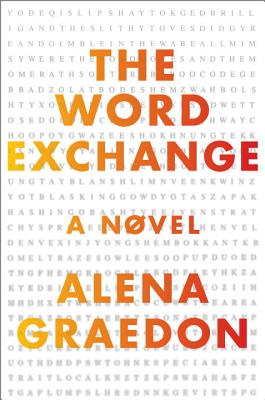
Review: THE WORD EXCHANGE by Alena Graedon

the word exchange cover

I received a copy of The Word Exchange from the publisher for review consideration via Netgalley. For more on my review policies, please see my full disclosure page.

In our not-too-distant dystopian future, the world is connected through Synchronic Memes, the next generation of smartphones that anticipate their owners' needs. Feeling sick? Your Meme will order a hot toddy for you in a restaurant even though you were planning on ordering water. Trying to come up with a specific word and drawing a blank? Simply look at your Meme and the word will pop up! Synchronic got all these words by buying up dictionaries and publishing companies; but when the editor of the last surviving dictionary in North America disappears just before Synchronic announces a new device that literally inserts into your brain, the editor's daughter, Ana, begins to suspect Synchronic's devices aren't as helpful and benign as they claim.

Guys, it took me soooooooooo long to read this book. Not that I wasn't enjoying it while I was reading it—if I hadn't been I would have DNF'd it—but by the time I got to the end I kinda felt like the time I invested in it wasn't worth it. So that was annoying.

Let me back up: I started The Word Exchange in a bit of a MOOD, but it immediately sucked me in. The story starts off with Ana immediately discovering her father is missing. She knows something's very wrong but she has no idea what. Then the point of view switches to Bart, her father's favorite employee, who is secretly in love with Ana. I absolutely loved Bart! The way he expresses himself is so unique—he uses a lot of really big and obscure words. It sounds tedious but it's actually really charming. Alena Graedon is super clever in the way that she uses Bart's speech patterns to give the reader a sense of how malignant and pervasive word flu is. There IS a lot of backstory at the beginning of the novel, but being so invested in Bart and his storyline, I didn't care.

It was around the middle of the book, after Ana discovers the Nautilus sweatshop, that my patience started to wane. There was a whole lot of wondering what was going on and not much explanation or investigation into discovering answers. Also, at that point I was getting pretty sick of the backstory. I may have started skimming a little.

Then came the end. WHAT A DRAG. Lots of explanation about stuff I didn't care about at all, drawn out for the longest possible time with little in the way of a satisfying emotional resolution. I could have skimmed like a mutha through the second half and still would have gotten the same result as far as closure is concerned.

That said, I still recommend this novel.

jon snow confused


I know, I know. Yes, a bad ending can completely ruin a book, but I think The Word Exchange is clever and well-crafted enough to check out anyway. If I hadn't been busy that month (yes, it took me around three weeks to finally finish this thing), it probably would have gone a lot faster (? Maybe. Initially my Kindle told me it would only take 6 hours to read, although how that's supposed to be possible when there's one chapter for each letter of the alphabet and each chapter takes an hour to finish, I don't have any earthly idea). Graedon takes numerous high-concept ideas and complicated theories and synthesizes them all into something that's easily digestible and approachable, with a relatively good story to boot. I thought The Word Exchange was going to be pretentious and annoying, but it's not—for the most part it's surprisingly fun and fast-paced.

Finally, there's just something so, so right about reading a book where smart phones destroy our civilization WHILE ON A SMART PHONE. Oh, the delicious irony.

The Word Exchange is a really good book, but not a satisfying one. If you're into literary thrillers or books about books, though, you should definitely give it a shot.


Discus this post with me on Twitter, FaceBook, Google+ or in the comments below.

Saturday, September 14, 2013

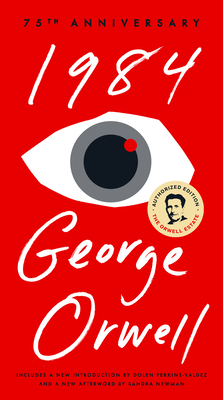
Review: NINETEEN EIGHTY-FOUR by George Orwell

1984 cover

Winston Smith is a lonely man living in the London of our dystopian future, with Big Brother watching every move people make and the Thought Police ready to take any dissenters down. Winston hates Big Brother and has a vague desire to join "the Brotherhood," a group lead by Emmanuel Goldstein, the Enemy of the State. But it isn't until Winston falls in the love that the Thought Police really come after him...

If Animal Farm is George Orwell's vision of communism, Nineteen Eighty-Four is his vision of totalitarianism. And just for the record, I'm already really annoyed at writing out "ninety eighty-four," so from now on it's just 1984. Okay? Okay.

I didn't enjoy 1984 as much as Animal Farm. Or, you know, at all really. There is sooooo much exposition about this and that and how everything works that it tried my patience. Winston is a misogynistic wet blanket and I had trouble caring about what happened to him, even when it was horrifying.

That's not say I think 1984 is a bad book, just that it's more about the world of the novel and ideas than story and characters. And some of the ideas are really brilliant! Things like Big Brother and the Thought Police are already part of the lexicon, but what I found fascinating was the concept of doublethink:

To know and not to know, to be conscious of complete truthfulness while telling carefully constructed lies, to hold simultaneously two opinions which cancelled out, knowing them to be contradictory and believing in both of them, to use logic against logic, to repudiate morality while laying claim to it, to believe that democracy was impossible and that the Party was the guardian of democracy, to forget whatever it was necessary to forget, then to draw it back into memory again at the moment when it was needed, and then promptly to forget it again: and above all, to apply the same process to the process itself. That was the ultimate subtlety: consciously to induce unconsciousness, and then, once again, to become unconscious of the act of hypnosis you had just performed. Even to understand the word ’doublethink’ involved the use of doublethink.

This, combined with newspeak, the language of Big Brother, allows people to say anything and mean nothing. There's no longer an opposite of good, because why use the word "bad" when you can just say "ungood"? The ultimate goal of newspeak is to eliminate most words altogether. After all, as long as the word freedom exists, people will remember there was such a thing.

Memory, both historical and personal, serves a major role in 1984. Government altering history and the short-term memory of its citizens was touched upon in Animal Farm, but in 1984 that loss of memory is a cornerstone of the narrative. Winston doesn't know for sure it's 1984, can barely remember his mother and sister or any incident from his childhood, and is eventually completely brainwashed into forgetting he ever hated Big Brother. The only reality is the one created by the state. Everyone is sharing in a delusion, their view of the world slightly twisted until they're all participating in massive "group think." Anyone who doesn't conform to the universal opinion isn't just wrong, but considered insane, even though they're only sane people in the bunch. This isn't just a case of looking at the world through rose-colored glasses, but of "two and two make five": it's not logic, it's not reality, but it's the truth because Big Brother says it is. It reminded me of the empty Obama chair from the GOP 2012 convention.

Anyway, an interesting book. I'm not sure I would universally recommend it like I would Animal Farm, but if you're into dystopian fiction, 1984's the mother of all dystopian novels. It's also the only one that's ever really sent a chill up my spine because not only could it happen, it nearly did.


Discus this post with me on Twitter, FaceBook, Google+ or in the comments below.

Saturday, September 7, 2013

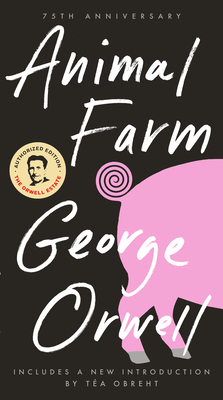
Review: ANIMAL FARM by George Orwell

animal farm cover
It took me a ridiculously long time to figure out that pink shape was a pig.

The animals of Manor Farm are miserable. They're overworked, underfed, the farmer takes away their children, and they're killed when they're no longer "useful" to him. Then they get the chance to oust the farmer and establish their own farm, the Animal Farm, where all animals are equal! Only some animals fancy themselves more equal than others...

This is my first read by George Orwell, and it's terribly clever. It's short—just slightly over 100 pages—and the premise is simple. That's the genius of it: Animal Farm could be a parable about any uprising from the French Revolution, to the Bolshevik Revolution, to the Egyptian Revolution in 2011. Perhaps even the American Revolution. It was chilling yet totally convincing.

That's not to say the book is all political talk. It's also about society and economics and technology. But more than that, it's a great story that makes you think, and the animal characters are surprisingly sympathetic. Right from the beginning you feel for them, even though it's obvious their dream of a utopian society is NOT going to work. From the vain pony, Molly, to the cynical donkey Benjamin, the animals feel like characters you can identify with. I spent the entire book on the edge of my seat hoping the noble workhorse Boxer wouldn't die, even though I KNEW he would. And when it did happen, it was even more awful and cruelly ironic than I anticipated.

I was also surprised by the message of the novel. When I first started it, I figured the moral would be that the animals' idealistic society was doomed to fail because animals (read: people) were inherently selfish and out for themselves, but that wasn't the case at all. The majority of the animals were good, or at least good up to a certain point; they worked hard just on the basis of hope for a better life and that someday it would pay off. The reason Animal Farm failed was actually because it was modeled directly off of the human world and Manor Farm. The pigs got all their ideas from human books, even applying war maneuvers from Ancient Rome! Pretty soon some of the pigs were acting like Roman Emperors. It's the culture and system itself that supported exploitation and oppression, which is why it was nearly impossible to change.

Animal Farm entertained me while making me think about things in a different way. Just see if I don't start shouting, "Four feet good, two feet bad!" the next time I see a pundit on TV. I would recommend this novel as a must-read to everyone.


Discus this post with me on Twitter, FaceBook, Google+ or in the comments below.

Monday, August 27, 2012

Movie Review: THE HUNGER GAMES


Originally released: 2012
Starring: Jennifer Lawrence, Josh Hutcherson, Stanley Tucci, Donald Sutherland, Woody Harrelson, Lenny Kravitz (all of whom get way more screen time than Liam Hemsworth, so I refuse to mention him)
Directed by: Gary Ross
Based on: the novel of the same name

Yay I finally saw The Hunger Games.

I read the book (review here) around the time of the movie's release, and while I enjoyed it and thought it was very well-written, the only character I liked was Peeta Bread Boy. So cute! And he bakes! (I'm German, so, you know... I'm really into my baked goods.) However, I could see how the book could rock in movie format because of the action and the fact that the Games basically is a TV show, anyway.

Apparently I was mistaken about that.

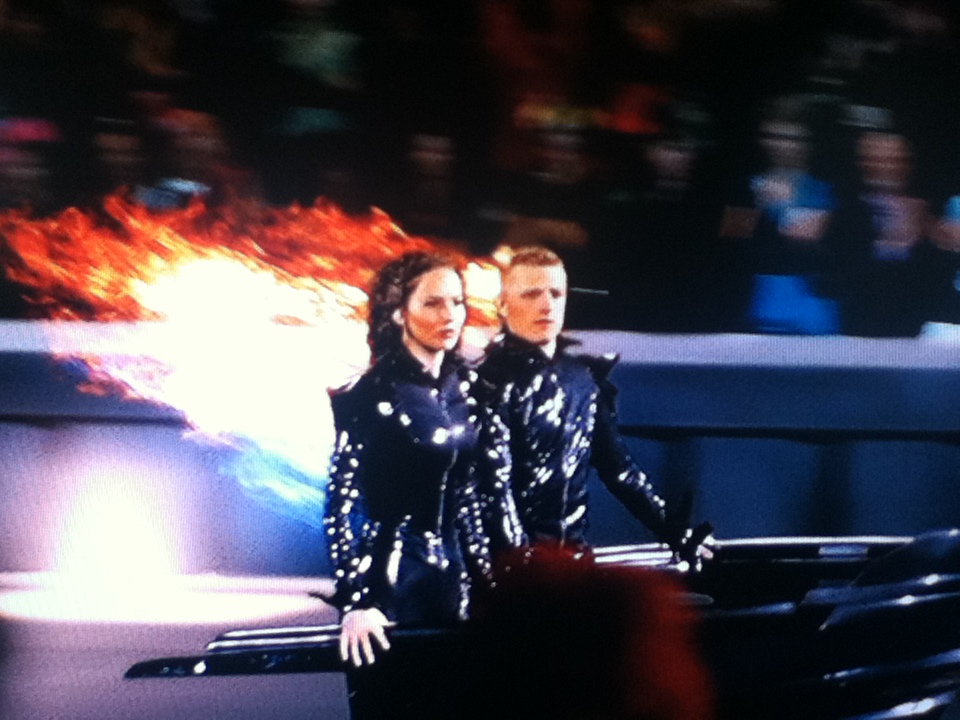
katniss obviously not really on fire
It looks so real...

My impression in the first few minutes of the film was that they were trying way too hard to make it "artistic," and I think that's the underlying problem of the whole movie. There was a lot of energy put into the stylistic elements, and the story and characters suffered for it. As I mentioned earlier, Peeta was my favorite character in the book, but he literally does NOTHING here. My mom didn't even know what his name was after watching the film! The other major characters seemed really dialed down, too. If any actor can hit Crazy Drunk as a character trope out of the park, it's Woody Harrelson, but Haymitch came across as weirdly bourgeois.

Also, as a reader I always think there are certain scenes that you really want to see on the screen in a book-to-movie adaptation, and as long as the movie nails those scenes, they can fuck the entire rest of the book up and it's still okay. In The Hunger Games, the two scenes I really wanted to see were the entrance into the arena and the interview with Caesar Flickerman. If I was a director, I would have poured every cent of my budget necessary into making the arena entrance eye-seeringly awesome, but instead it looked SO FAKEY and unimpressive. Like really, you had a chance to set someone on fire and race through an arena on a chariot, and THAT'S what you came up with? Katniss and Peeta looked like they were farting into Bunsen burners. And helloooooo green screen.

As for the interview with Flickerman where Peeta Bread Boy professes his secret love for Katniss, I think I wanted to see that scene particularly for two reasons: one, that's when I started to like Peeta; and two, I love how awkward it is for Katniss. It's one of the few times in the book where she shows vulnerability. In the movie, though, because Katniss isn't in front of the whole arena and the cameras like she is in the book, we don't see any of her embarrassment. I wonder if someone who hadn't read the book would even know the point of some of the scenes in the movie, since the emotional impact of them on the characters is never clearly established.

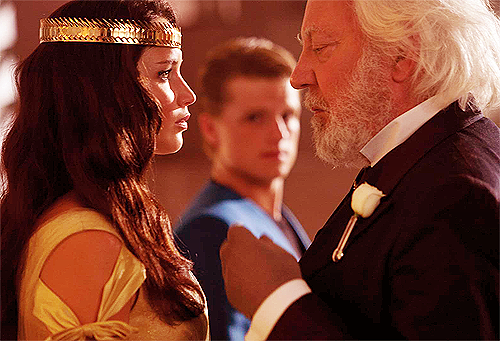
katniss and president snow
Yes, Donald Sutherland, I will marry you. Wait, what?

The movie isn't horrible--I actually think overall it's okay. The casting is brilliant, especially with Jennifer Lawrence--who does a great job--and Amandla Stenberg, who played Rue. And I love Donald Sutherland as the President, because he's my old man crush. Also, the art direction is great in how it references WWII and the Roman empire in a way that feels original.

There were excellent scenes in The Hunger Games--I cried during the district tribute scene and thought that was very well-done--they just weren't the scenes I was interested in seeing. The film felt kind of mechanical, as if someone had invented an algorithm to figure out what story elements would be popular with teenagers. I think that's because the heart of the story, which is Katniss and Peeta's relationship, was lost to the filmmaker's desire to be all fancy with the camera and show us "advanced technology." Do I really care how the Games are being produced? No, I DO NOT, but thanks for taking us out of the action there.

Still, if that arena scene had been kick-ass I'd be willing forgive a lot in this movie.

Friday, March 23, 2012

Review: THE HUNGER GAMES by Suzanne Collins

hunger games cover

Sixteen-year-old Katniss lives in a post-apocalyptic North America, where every district is required to send two teenagers to participate in the Hunger Games--an annual fight to the death broadcast on live TV. Like Highlander, there can be only one; but unlike Highlander, there are no kilts or Scottish accents. Naturally, Katniss becomes a Hunger Games tribute and has to fight her way through a bunch of people who want to kill her. Is she going to survive?! Considering there are two more books, I'm guessing yes.

Yes, I finally read The Hunger Games. What took me so long? It had mainly to do with the insane popularity of this book, and also because it's the type of thing I wouldn't normally read if it WASN'T popular. I have to say I'm happy I read it, since at last I can finally understand what people are talking about half the time on twitter.

First things: this is a very well-written book, and it only gets better as it goes on. The last quarter of The Hunger Games is especially good, with an interesting twist and lots of action and great emotion from the characters.

That being said, the novel wasn't really what I was expecting. It's billed as a dytopian novel, but Panem doesn't seem THAT bad. There are the Hunger Games, yes--but at least there seems to be racial and gender equality, so that's something! Also, when I think of a dystopian novel, I think of a critique of government or society. While there's definitely some of that in The Hunger Games, mostly it's about a tough-ass chick trying to out-fight or -think her way past mean humans and even meaner animal hybrids, including human-wolf mutants (hulves?), while protecting innocents. So in that respect the book reads more like an urban fantasy than a dystopian novel, and people who like UF will probably love it.

I, however, am notorious for not liking UF. So I had some difficulties. These were only compounded by the fact that I found Katniss to be really annoying, what with the whining about how terrible her life in District 12 is, the sullenness and temper tantrums, and the constant second-guessing of other people's motives.

Thank god for Pita Bread Boy, because he's the only likable character in the entire novel and without him I would have been bored out of my mind. He is WAY too good for Katniss. These two apples have fallen from different trees, and I honestly don't see them as having a future together. It's like when you go to a foreign country and you hang out with people you would never normally would hang out with, just because they speak the same language you do. That's Katniss and Peeta in the Hunger Games.

I'm not sure if I'm going to read Catching Fire or not. On the one hand, I am invested in the Peeta/Katniss storyline at this point (in case you couldn't tell) and want to find out what happens; but on the other hand, sometimes things are better left to the imagination. I'll probably break down and read it because I'm curious like that.

Bottom line: this is a good book, and I liked it; but I couldn't really get into it to the point that I know others have. If you haven't read it, you should, if only to find out what a Haymitch and Cinna are.


Musical notes: "Friends" by Bette Midler. Katniss needs someone to sing this to her.

Wednesday, December 8, 2010

The Soundtrack for Our Dystopian Future


Arcade Fire is a band known for their complex production and thematic albums. 2007's Neon Bible was seen as a biting indictment of the Bush administration. Win Butler, the lead singer of Arcade Fire, said their latest album, The Suburbs, is a love letter from the 'burbs. But I see it more as dystopian YA literature gone musical.

Take, for example, the video for the title track, directed by Spike Jonze (above). The video features teenagers bumming around what seems like your typical, middle-class suburb (it was actually filmed in Austin, Texas), until empty houses and the puzzlingly strong presence of law enforcement hint that this isn't contemporary reality, and all is not well in this world. The lyrics support Jonze's interpretation, too: "When the bombs dropped we were already bored... Sometimes I can't believe it."

Track five, the catchy "Rococo," is almost universally thought to be about hipsters and how they really don't know what the hell is going on despite their painfully laid-back-and-ironic dress code. Yet if one reads it in reference to the art period Rococo--where the wealthy French aristocracy teetering on the brink of revolution commissioned playful paintings about love and sex--the song seems more of a warning against living in luxury while the world is torn apart around you, all because you can't be bothered to educate yourself beyond your own daily existence: "The modern kids... will eat right out of your hand/using great big words that they don't understand.... They seem wild/but they are so tame." Rococo (the word, not the song) is often interpreted to mean something along the lines of a decorative shell in French, and indeed the kids in Arcade Fire's "Rococo" are the vanguard of a culture that's nothing but a shell, with no life behind it with which to bring meaning or consequences to the kids' actions.

The interactive video for "We Used to Wait" takes the viewer to his or her hometown street and destroys it with a mushroom cloud-like accumulation of hundreds of trees, nature taking back a settled landscape. Both "Half Light II (No Celebration)" and "Sprawl II (Mountains Upon Mountains)" talk about the death of wild places, dreams, and the imminent demise of their protagonists. Take this set of lyrics from "Half Light II":

Though we knew this day would come
Still it took us by surprise
In this town where I was born
I now see through a dead man's eyes

One day they will see it's long gone...


And, in the band's blog, the latest post contains a link to the Georgia Guidestones, a Stonehenge-esque monument inscribed with instructions, in several languages, on how to recreate civilization after the apocalypse (one quote from the Guidestones I just have share: "Prize Truth-Beauty-Love-" and books!?!).

I'm not a huge reader of dystopian YA, but I can see The Suburbs working as the soundtrack to Stephenie Meyers' The Host or The Adoration of Jenna Fox. Furthermore, Anaraug, who is very knowledgeable about such things, says that two of tracks reference William Gibson's Sprawl Anthology, which is a series of dystopian novels. But Arcade Fire's Suburbs talks about growing up in the suburbs even among its destruction, which gives the album a distinctly YA flavor of dystopia.


Do you know of any other bands or artists who have incorporated dystopian literature into their work?

LinkWithin

Related Posts Plugin for WordPress, Blogger...