Monday, February 11, 2013

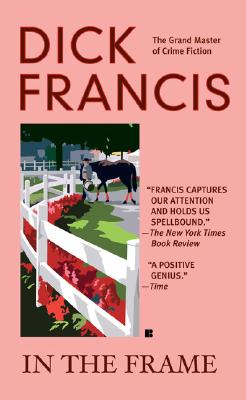
Review: IN THE FRAME by Dick Francis

in the frame cover

Charles Todd is a painter visiting his cousin Donald for a few days. When he arrives, he finds Donald's wife has just been killed interrupting a robbery at their house. Emotionally and financially, Donald is completely broken--and to add insult to injury, the police suspect Donald of the crime. To help his cousin get his life back together, Charles decides to find the real killers.

In the Frame is another great read from Dick Francis. To the Hilt was one of my favorite reads of 2010; and while In the Frame isn't quite as perfect as that book (seriously, I called To the Hilt perfect--you know I really loved that one), it is still really really good. I loved the characters, settings, the story was never ever boring, and the book was very emotional, as well. Donald's struggle with grief while being investigated for his wife's murder was just awful, and I really felt for him and Charles, who is extremely worried about him. Francis does a great job of making Charles' subsequent actions totally understandable.

This is also--I think--the first novel I've read that takes place in Australia (note to self: remedy this), and I LOVED the setting. You can tell Francis really thought about how the setting would work with the story and did a lot of research into it. Usually setting descriptions make my eyes glaze over, but in this case I thought they were just brief enough to let me paint a picture of the scene in my mind.

Like To the Hilt, the main character in In the Frame is a painter. I ADORE how Francis writes painters. Usually in books with painters, even the ones I like, the painter never actually works, or even thinks about painting. Not so with this book! Charles paints, a lot, and when he's not painting he's thinking and talking about art. I loved this exchange between him and his friend and fellow artist, Jik:
"Get that chiaroscuro," Jik said, as we sped into one particularly spectacular curving alley.
"What's chiaroscuro?" Sarah asked.
"Light and shade," Jik said. "Contrast and balance. Technical term. All the world's a chiaroscuro, and all the men and women merely blobs of light and shade."
"Every life's a chiaroscuro," I said.
"And every soul."
"The enemy," I said, "is gray."

"All the world's a chiaroscuro." Love that line! It seems like art is always on Jik's and Charles's minds, even when they're focusing on something else. Painting is a part of their personalities and how they view the world, like Shakespeare might have viewed all the world a stage.

One of the major differences between In the Frame and To the Hilt is that To the Hilt is very much a story modeled after Arthurian romances, with knights in shining armor fighting in the service of lords and ladies. In the Frame isn't like that at all--it reminded me more of those suspense novels by Mary Stewart, with a small cast of characters and a lot of traveling to exotic locales. There's only one major female character and, unlike in To the Hilt, there's no need to fight for her honor; she's not a damsel in distress by any means, although she is presented as a civilizing--and thereby stifling--force on Jik's personality and creativity. I did love the dynamic between Jik and Charles, though, because they're two sides of the same coin: Jik is an unpredictable, ambitious, flamboyant avant-garde artist, who only paints when he's in a dark mood. Charles seems like the exact opposite: he works steadily, paints marketable pictures of horses, and is always calm and friendly. In other words, he is the antithesis of someone who would go haring off to Australia to chase thieves and murderers, get shot at and beaten up (is it just me or are Francis's heroes always getting beat up?), steal things, or outsmart a bunch of crooks. Yet somehow his friendship with Jik makes him doing so entirely plausible.

Just as a side note, In the Frame is a bit dated--it was first published in 1976. It doesn't feel THAT old, but there are no cell phones, no internets, airport security is a free-for-all, no one outside of Australia has ever heard of Australian wine, and Charles is astonished at making an overseas phone call (the voice is so clear!). Other than those few technical issues, though, I found the story to be just as plausible today as it might have been in the past, and it's damn good mystery. Francis has definitely earned my admiration and I'm planning to read more novels by him in the future.


Further Reading:


Discus this post with me on Twitter, FaceBook, or in the comments below.

Saturday, February 9, 2013

The First Rule of Currently Reading is Don't Talk About What You're Currently Reading

fight club gif

Has this ever happened to you:

You start a book, and you're really enjoying it. Soon someone asks you about it, and you're all like, "Yeah, I'm really liking this book so far! Blah blah blah."

No sooner do you go to pick up the book again than you realize you're not enjoying it anymore. In fact, you hate the book! It's boring and you're going to DNF it!

Sometimes I really think reading books is like being in a relationship (I come up with a lot of relationship metaphors). And one of the most important rules of a relationship is don't blab about your relationship, and especially don't blab about how AWESOME your relationship is. I swear every celebrity couple I've seen do this has gotten a divorce. Do you ever see Tom Hanks discussing his marriage? No, and he's still married. Meanwhile, Heidi Klum and Seal went on Oprah to brag about how they're the perfect couple, and now they're divorced. Sure, that's random anecdotal evidence, but still.

Aside from the don't blab about your relationship rule, saying how much you're enjoying a book when you've only just started it is kind of like inviting Murphy's Law of Book Reading into your life. I never talk about the books I'm writing until I'm completely done with them for this very reason. Why don't I follow that rule with books I'm reading? Maybe I should. Maybe I should create a secret laboratory where I read books and don't tell anyone what I think about them until I'm finished. HAHA like that's going to happen. Still, it might be a good idea.

Do you like to talk about what you're currently reading?


Discus this post with me on Twitter, FaceBook, or in the comments below.
Wednesday, February 6, 2013

How To Find Good Books On Librivox

librivox gif

A lot of people ask me how I find time to read so many old books (I would call them classics but most of them are just old). Honestly, 80% of the classics I "read," I actually listen to on audiobook, and the vast majority of those audiobooks I download from Librivox.

If you're not familiar, Librivox publishes audiobooks of works in the public domain you can download for free. I've written about why I find Librivox more browser-friendly than Project Gutenberg before, but I also use Librivox a lot because I find it really convenient to listen to snippets of books while I'm doing routine tasks around the house or driving on errands. Since I only read one or two books at a time, audiobooks are a great way for me to balance two novels at once.

The problem with Librivox is that the quality of the audiobooks can be hit-or-miss. It's 100% volunteer, so some readers are professional and others could use some practice. This can make people shy away from trying their audiobooks; but I stumble across awesome audiobooks on Librivox all the time, and if you follow some basic guidelines (developed by myself through experience) you can make better choices in downloading books.

1. Start with short stories. Librivox has tons of short story collections, and they're a great place to start out. After you listen to some short stories, you'll probably come across a narrator or two that you really like. When that happens...

2. Look up the narrator you like and download all their stuff. Most narrators stick to particular subjects or genres, so this is a great way to discover books you might not have heard of before.

3. Books with multiple narrators are generally to be avoided. I've done the multiple narrator thing, and it's tough, even when you're enjoying the book. Right now I'm at the point where I simply won't download a novel with more than one narrator. It's better to have an okay narrator reading an entire book than a mix of excellent, okay, and not-that-great narrators together for one book. The latter makes it really difficult to follow the thread of the story.

4. Always download the latest version of a book. Sometimes you'll search for a book and come up with multiple recordings for it. ALWAYS download the latest. Chances are someone decided to create a new version because they thought the previous one was an insult to their literary sensibilities.

5. To find new books: Browse the list of recently cataloged books or just randomly search for keywords. Librivox used to have a list of the most popular downloads, but I can't find that link now. You can also try to find recs online. I like to check out GoodReads groups dedicated to audiobooks.

6. To make your life easier: In iTunes, highlight all the tracks in your audiobook, right click, go to Get Info>Options, and select Equalizer Preset>Spoken Word, Media Kind>Audiobook, Remember position>Yes, and Skip when shuffling>yes.

Questions? Comments? Have you listened to any audiobooks from Librivox you really liked?


ETA: Here is thread to a GoodReads discussion group about books people have enjoyed from Librivox. Sorry I'm posting it so late, but it took me forever to find it: Audiobooks>Good Librivox books discussion.


Discus this post with me on Twitter, FaceBook, or in the comments below.

Monday, February 4, 2013

Amateur Sleuths

amateur sleuths

Amateur sleuths--people who have no formal training, yet somehow solve mysteries--are a standard of the mystery genre. From very intelligent people who consult for free, like Sherlock Holmes and Peter Wimsey, to people whose only qualification is a good eye for human nature like Miss Marple, there are amateur sleuths all over mystery fiction.

For a long time I just assumed this was A Thing That Happens In Books But Doesn't Happen In Real Life, like I don't know, zombies? Instalove? We all know These Things happen in books, so I never thought much about it. But then I started reading classic mystery novels, and for some reason they made me think maybe amateur sleuthing was a real thing. For example, in The Man In Lower Ten by Mary Roberts Rinehart, there's a character whose hobby is solving crimes according to the philosophy of Arthur Conan-Doyle. And this is treated as an acceptable, relatively normal diversion (incidentally, hobbyist sleuths are also common in Alfred Hitchcock movies). This is basically when I seriously started to wonder if amateur sleuths actually existed.

There are organizations of people who are not detectives and solve crime (the Vidocq Society, for example), and amateur detectives often solves mysteries when it comes to missing persons cases or other crimes the police don't have the resources or background to investigate. There's even a "how to be an amateur detective" page on the interwebs.

Amateur sleuthing is actually probably a lot more common than you'd think, but by far the most common hobbyist detectives are... wait for it... mystery writers! Yes, Castle and Murder, She Wrote might not be as far off the mark as you'd think. Mary Roberts Rinehart herself was asked to consult on several unsolved cases by both police and victims. I'm not aware of any convictions or appeals happening as a result of her investigations, but she did "solve" many of these crimes by writing books about them. Lois Duncan of I Know What You Did Last Summer fame investigated the murder of her own daughter, and John Grisham was sued over his amateur detective activities, which involved obtaining confidential documents without permission (so badass). Other common modes of employ for amateur detectives, both on- and off-the-page, are lawyer, insurance investigator, and someone who works in a research field (i.e., librarian, archivist, historian, etc.).

So while the recurrent amateur sleuth may largely exist in the mind of mystery writers, sometimes they do make it off the page and into real life, especially when it comes to their creators!

Do you know of any real-life instances of amateur sleuthing?


Further Reading:


Discus this post with me on Twitter, FaceBook, or in the comments below.
Sunday, February 3, 2013

Bloggiesta Finish

bloggiesta finish line

Ole, mes amis! There I go, mixing my languages again. The mini-Bloggiesta is almost over and I finished all my tasks, yay!

Here were my goals:


  • Put a tag cloud back on my sidebar. I just miss that thing. This was the first thing I finished, and weirdly the task that took the longest.
  • Update my pages. This was a lot easier and less time-consuming than I thought it'd be.
  • Schedule some posts for the classics blog. Done! I don't know why I always put off scheduling posts on there, but I do.
  • Finish up a post I started last night. Done! I'm actually pretty happy with this post.
  • Read. This has nothing to do with blogging but I feel the need to put it on the list. Did, although not as much as I was hoping to.
  • Participate in the Twitter chat tonight. I missed the first half, but still got in for the second hour.


Hooray, that's a pretty successful Bloggiesta. Thanks to everyone who filled out the reader survey! I will leave it open until midnight and contact the winner of the drawing on Monday.

Thank you all for your patience while I tweaked the blog. Tomorrow we'll be back to our regular programming.


Discus this post with me on Twitter, FaceBook, or in the comments below.

Saturday, February 2, 2013

Bloggiesta + Reader Survey and Giveaway!

bloggiesta start line

Heys people. This weekend is another Bloggiesta, aka a blogging fiesta! Olé! (I know, I say that every Bloggiesta.) Please don't mind the dust as I make a few changes.

Since this is a mini-Bloggiesta, I only have a few goals:

  • Put a tag cloud back on my sidebar. I just miss that thing.
  • Update my pages.
  • Schedule some posts for the classics blog.
  • Finish up a post I started last night.
  • Read. This has nothing to do with blogging but I feel the need to put it on the list.
  • Participate in the Twitter chat tonight.


That's all! I probably won't participate in any mini-challenges, but we'll see how quickly I finish the above tasks.

ALSO... this may seem like a strange request, but I've been meaning to ask my readers to take a poll for a while now. This is meant to help me understand my audience a little better so I can improve my blog. All responses are voluntary and anonymous, but if you give me your e-mail I will enter you to win a copy of Gone Girl. Click here to take survey or use the embedded form below. Thank you so much!

Create your free online surveys with SurveyMonkey, the world's leading questionnaire tool.

Discus this post with me on Twitter, FaceBook, or in the comments below.

Friday, February 1, 2013

Greatest American Author

the greatest american writer

I heard about this Publisher's Weekly poll for who is the greatest American author from Kimberly. Naturally, this is a silly question. It's Edgar Allan Poe. More interesting: the results of the poll show that "Other" is winning by more than 2% over Mark Twain, and 15% more than Edgar Allan Poe (seriously, people?). In fact, nearly 1/4th of poll respondents decided to write in their choices for the greatest American author. This got me thinking, who are these write-in choices for? The possibilities are endless. For example:


  • Stephenie Meyer-This is particularly likely if a bunch of teenage girls saw the poll (incidentally, I actually do think there's a case to be made that Meyer is the most influential author of the last decade).
  • EL James-I would seriously laff my arse off if she won this poll. The fact that she's not American would just make it more perfect.
  • James Patterson-I've heard this guy is pretty popular.
  • A bunch of authors saw the poll and voted for themselves-I'm looking at you, Jeffrey Eugenides. Ha! Just kidding.
  • Stephen King-King has that rare combo of popular appeal AND critical rep. I would not be at all shocked if he got in a lot of votes.
  • Dan Brown-Kind of outdated as the author du jour, but you never know, he could still get some votes in.
  • Nora Roberts-Admittedly not very likely, since romance readers tend to avoid polls like this (I speak as someone who reads romance), but she definitely deserves some write-in votes. I mean, the woman has her own section in the bookstore.


Who did you vote for in the poll? Edgar Allan Poe, right?


Further Reading:


Discus this post with me on Twitter, FaceBook, or in the comments below.

LinkWithin

Related Posts Plugin for WordPress, Blogger...