Showing posts with label movie. Show all posts

Wednesday, September 2, 2015

Movie Review: CITIZENFOUR


Originally released: 2014
Starring: Edward Snowden, Glenn Greenwald, Ewen MacAskill
Directed by: Laura Poitras
Based on: real life.

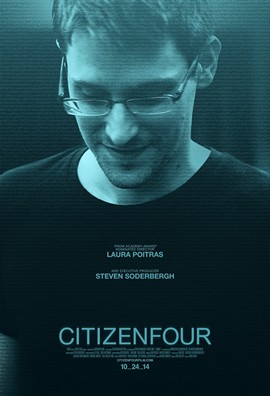
In January of 2013, Laura Poitras received an encrypted email from someone codenamed Citizenfour, who claimed to have documents proving a whole host of illegal spying was being perpetrated by the NSA, in violation of the US Constitution, domestically and abroad. Most of Citizenfour takes place over eight days in a Hong Kong hotel room, as the now-infamous whistleblower Edward Snowden divvied up NSA documents to different journalists and prepared for the shit storm that was about to be his life.
citizenfour


I had high expectations for Citizenfour, mainly because of Anachronist's review but also because it won the Academy Award for Best Documentary this year. I came away with mixed feelings on it. Is it an important documentary? Yes. But I was frustrated by the lack of concrete information.

My biggest issue with Citizenfour is that from the start, Snowden says he doesn't want this to be about him, he wants it to be about the information. Yet Poitras made a film that's basically all about him! And not just about him, but apparently designed to make him look as attractive and noble as possible. Do I admire Snowden? Yes. Do I think emphasizing the sacrifices he made in regards to his family and friends is important? Sure. Do I need the scenes where Snowden is swathed in white robes, all lithe and willowy and peering into the black screen of his laptop as if receiving messages from the great beyond? NOPE.

Furthermore, the information on NSA spying that Poitras is presumably supposed to be conveying in Citizenfour is vague at best. If you want to learn what was in the documents Snowden handed to journalists, and about the events leading up to it, best seek out Frontline's United States of Secrets and give Citizenfour a skip–or at least watch the former before the latter so you're already familiar with the context. And we're only fed the barest tidbits of information on the NSA spying. At the very least Poitras could have kept the camera on Snowden while he explained to Greenwald how to encrypt his emails ("It sounds really difficult but it's actually very easy") and then we would have actually learned something useful!

That kind of ties in to a small beef I have with all the reporting I've seen about the NSA spying, not just Poitras'. People say that Americans don't care the government is spying on them, but I don't think that's true. I think we just don't know what we're supposed to do about it, aside from living off the grid, and that's not going to happen. Keeping your information private online is overwhelming enough without throwing Big Brother into the mix. I'm not saying what Greenwald and the other journalists are doing isn't important and heroic in its own right, but I always get the impression their audience is other political journalists. Aside from concrete examples, like the US listening to every conversation on Angela Merkel's phone, this is not easily digestible information to the average person who just wants to play Candy Crush and check their Facebook timeline, you know what I mean?

Other thoughts:

  • I wonder how Snowden feels taking refuge in Russia, a country not exactly known for its human rights and free speech policies. The ironies of life are manifold, my darlings.
  • The connection between corporations and the government that's come out of the NSA's "program," if you want to call it that, is pretty chilling. To quote my American history prof, corporations will eat their own children if it means they get short-term profit out of it. Now, apparently, there's little to no line between corporations and the government. What a great combo.
  • I wonder if checking this movie out from the library puts me on the NSA's watch list. But then I was probably already on it for being a liberal independent who works in a gun store.
  • I didn't completely buy Snowden's explanation for why he decided to become a whistleblower. It seemed a little too simplistic and obvious. I wonder if the real reason was that he wanted to be like Marcus Yallow from the Cory Doctorow books (a copy of Homeland is prominently displayed next to Snowden's laptop–seriously, could this guy get any more adorkable??) but he didn't want to say that because he realized that was too geeky, even for him, so he went with, um, free communication and exchange of ideas is important and stuff. Yeah. That's it.


If there's one thing I came away with after watching Citizenfour, is that Snowden is a smart motherfucking cookie. I mean, I already knew that on some level, but Citizenfour really crystallizes it. If he'd just released all those documents online, he'd probably be rotting in a hole in prison somewhere like Bradley Manning. Instead he methodically planned out every aspect of the situation and sequence of events that he could in order to minimize the negative effects on the people involved–not just himself, but his friends, family, and reporters. Having the journalists vet the information instead of himself, in particular, was brilliant, and might be the only thing that allows him to return to the US someday (should he wish to). I do appreciate people who are thorough planners. He was also lucky, but mainly he was smart.

While I don't think Citizenfour succeeds as well as it could have in informing people about NSA spying, it is an important movie to watch, especially with an election coming up. This is definitely the most important issue of our time, and as a film designed to make people give a fuck, Citizenfour succeeds.


Discus this post with me on Twitter, FaceBook, Google+ or in the comments below.

Tuesday, August 4, 2015

Movie Review: MR HOLMES


Originally released: 2015
Starring: Sir Ian McKellen, Laura Linney, Milo Parker, Hattie Morahan
Directed by: Bill Condon
Based on: A Slight Trick of the Mind by Mitch Cullin

In post-WWII Britain, a 93-year-old Sherlock Holmes is losing his wits, because oldness. Desperate to remember the case that made him quit detecting forever, he travels to Japan to find a cure for his failing mental faculties. But the only thing that really helps is spending time with his bitchy housekeeper's son, Roger.

mr holmes movie poster


As I mentioned in my Sunday Snapshot, Mr. Holmes is all over the place. It jumps from 1947 Britain to 1920-ish Britain, to Japan, and back again, and the transitions can be rather abrupt. As a fan of all things Sherlockian, I did not find this movie enjoyable, although it did have some interesting ideas.

I don't think Mr. Holmes betrays the Sherlock canon, but there are several points where I feel it went it wrong. First of all, there's no Watson, nor any Watson character–the story is told through Sherlock's eyes. BIG mistake. I love Sherlock, but there's no way he can be a sympathetic everyman. That's Watson's (or Mary Russell's, or whomever's) job. Holmes' job is to be weird and not boring.

Secondly, the mystery element is miniscule. I was expecting way more detecting than whatever the hell else was going on in this movie. And while I enjoyed the mystery, there were moments when it was head-slappingly stupid. There was a sequence where Holmes followed a woman through London and his only method of subterfuge was to peek around the edges of pillars and the like. While wearing a top hat and a three-piece suit and tails, no less, as if he's going to the Ritz! Wasn't Holmes supposed to be a master of disguise? C'mon, movie makers. Try harder.

I also found it ironic that Holmes complained Watson's books were penny dreadfuls with ridiculous plots when Mr. Holmes has more inconsistencies than any of Conan Doyle's works. For example (these are spoilerific, just FYI):


  • If he needs a brain/energy boost, why doesn't Holmes just take cocaine instead of traveling all the way to Japan for prickly ash?
  • I'm supposed to believe that Holmes, or anyone really, would let some random lady move in with them after knowing her for less than hour? Right. Totally. Not.
  • Holmes feels guilty for killing said woman, as if he failed to warn her about a bus veering down the road or something, but she didn't just die. She made the choice to kill herself. He was like, "Hey, don't kill yourself, you have a lot to live for," and she was like, "Oh, you're right, I won't," and then she decided to just go ahead and do it anyway. If anyone should feel bad, it should be her Awful Person husband. I find it very difficult to believe Holmes would feel so guilty about this that he'd give up detecting, even if the two of them shared some sort of instantaneous metaphysical connection. Which I think is improbable.
  • Throughout the whole movie there's a "mystery" about what's killing Holmes' bees. Then Roger gets stung and Holmes is like, "Oh, it must be wasps!" THE WASP NEST IS LITERALLY RIGHT OUTSIDE THE HOUSE. Like three feet, and it's freaking huge. He didn't notice a bunch of wasps flying around when he was out there ALL THE TIME?
  • The oddest thing in this movie is when Holmes writes to Mr. Umezaki to tell him that his father didn't just abandon him and his mother, but decided to become an asset for Mycroft and the War Office, where he served with distinction. This is, presumably, a fiction on Holmes' part meant to make Umezaki feel better. But would thinking your father left you to spy for the Allies who just dropped two atomic bombs on your country *really* make anyone feel better? "Your dad betrayed his country. Hope this helps!"


Visually, the Japan sections of the movie were the most striking, but they had zippo to do with anything else in the plot. Their main purpose was to underscore what I think of as the ungrieved-for dead–a term from Anne Roiphe's memoir Art and Madness that she uses to describe the zeitgeist that infused post-War America.

And everywhere in Mr. Holmes there are dead people, from Glass Harmonica Woman's dead kids, to the woman herself, to the housekeeper's dead husband (whom she talks about at length on randomly and apropos of nothing, e.g. Housekeeper: "Your dad wanted to join the RAF instead of working on cars." Roger: "Sorry I said you could barely read." Cool talk, bro?), to dead Watson and Mycroft. Holmes' challenge is just to remember them and acknowledge their loss.

The final scene of Mr. Holmes seems to draw a loose parallel between the woman who committed suicide and the dropping of the atomic bomb on Hiroshima, as well as Holmes' subsumed guilt over the act and deliberate (or perhaps self-preservational) amnesia. An interesting theme to explore, but why use Sherlock Holmes to do it? That's what really confuses me about this story. Holmes is a symbol of Victorian London. Why is he being employed as a stand-in for the War Generation? I honestly have no idea, but I think pairing Holmes with this theme was misplaced and did not serve either the character or the story. It would have been much more poignant and believable if he'd been an average old guy.

I will say on the positive side that Ian McKellen, Laura Linney, and Milo Parker were fantastic in this. McKellen really has that old man face nailed down. I was also relieved Holmes didn't die at the end–at least the filmmakers knew not to do that much.


Discus this post with me on Twitter, FaceBook, Google+ or in the comments below.

Monday, April 27, 2015

Movie Review: THE IMITATION GAME


Originally released: 2014
Starring: Benedict Cumberbatch, Keira Knightley, Matthew Goode
Directed by: Morten Tyldum
Based on: (loosely) Alan Turing: The Enigma by Andrew Hodges

Guest review by Anachronist from Portable Pieces of Thought!

the imitation game


Synopsis:

Based on the real life story of legendary cryptanalyst Alan Turing, the film portrays the nail-biting race against time to break the code of Enigma.

During the winter of 1952, British authorities entered the home of mathematician, cryptanalyst and war hero Alan Turing (Benedict Cumberbatch) to investigate a reported burglary. They instead ended up arresting Turing himself on charges of 'gross indecency', an accusation that would lead to his devastating conviction for the criminal offense of homosexuality - little did officials know, they were actually incriminating the pioneer of modern-day computing. Famously leading a motley group of scholars, linguists, chess champions and intelligence officers, he was credited with cracking the so-called unbreakable codes of Germany's World War II Enigma machine.

My impressions:

It is one of these movies which seem to be aimed at ignorant people – the less you know about the historical Bletchley Park and breaking the code of the German encryption machine the more you will enjoy it. Some might call it easy entertainment I call it a dumbed-down, run-of-the-mill hogwash, at least when it comes to the historicity.

I grant it – the director had several good ideas. One of them was showing how in times of war ordinary people were forced to play God, deciding whether others should live or die. What is better: to doom the whole nation or the crews of several ships? How to measure the value of life? Few psychopaths enjoyed that insane power but the majority of ‘normal’ people, caught in it, were left scarred and disgusted by themselves permanently because the answer to such a dilemma is never clear or easy.

mark strong
Mark Strong enjoying a doorframe.


Another highlight was the fate of Alan Turing, played brilliantly by Cumberbatch - it proved again that if you know how to count, count on yourself only, your country won’t move a finger unless they need you very badly. What else? Mark Strong, playing the all-powerful MI6 director leaned against door frames in a very compelling manner. Oh, and I must add that children-actors in the flashbacks to Turing’s boarding school years (Alex Lawther and Jack Bannon) were wonderful. Now I can return back to carping and let me assure you, I hardly know where to start.

keira knightly


Should I bash the director for casting Keira Knightley, a lady whose facial expressions remind me strongly of Tom Marvolo Riddle a.k.a Lord Voldemort, the main baddie from Harry Potter books? As long as she doesn’t smile she looks lovely but when she smiles she sneers, there is no kinder word for it. Anyway she made Joan Clarke look shallow and vapid. Or maybe I should focus on the fact that this movie, set in a place where the majority of employees, about 75% or more, were women still somehow failed to pass the famous Bechdel test? When the movie Joan Clarke finally talks to one of her female colleagues in a pub they talk of course about men *rolleye*. Serious matters are just for their male counterparts. You see? Spoiled for choice, that’s what I am.

turing's cohorts


Turing's one-dimensional cohort of cryptographers was a compilation of cliches without one interesting feature (you get the cocky, handsome one, the nerdy, antisocial one, the intelligent, delusional Russian spy etc, etc). The screenwriter’s decision to employ a time-shifting structure contributed heavily to the film's been-there-done-that atmosphere, while the inclusion of needless obstacles within the narrative's back half served little purpose other than to pad out the already a bit overlong running time.

bletchly park codebreakers
Photo of actual codebreakers working at Bletchley Park.


Now the main lead. Turing was a brilliant mathematician, a crucial figure in the theorization and engineering of digital computing; and the biggest brain in Bletchley Park’s Hut #8, the unit in Britain’s World War II intelligence hub that succeeded in breaking the German’s Enigma code, thus shortening the war by as much as two years, give or take, and saving as many as twenty-million lives, perhaps more. Still the movie shows not enough of his thinking and reasoning, it focuses on his quarrels and romance with Clarke. Overall I felt the movie sentimentalized and simplified Turing, who, as far as I know, sometimes wished he was a machine and probably preferred the company of his digital creatures to any of his many lovers, whether casual or serious. That there is no sign of any of these lovers in the film is another failing – there are just empty accusations and an unbelievable confession, heard by a deus-ex-machina police detective (Rory Kinnear). How could the director dumbed down Turing so much? Had his character really told the detective what he did at Bletchley, he would have been guilty of a crime far more serious than homosexuality. He would have committed high treason for violating the Official Secrets Act. It was still a hanging offense.

In 1952 Turing was convicted of engaging in homosexual acts, for which he was sentenced to chemical castration (the option he preferred to two years in prison). As a result not only were his brain and body messed up by high dosages of estrogen, he also was barred from the government funding he needed to continue his life’s work on artificial intelligence. His death, just a few days before his forty-second birthday, from arsenic poisoning was most likely a suicide although possibly an accident or even an assassination. Instead of exploring the mystery of that tragic event the director decided to show a pointless, stunted investigation which led nowhere and a pair of cops whose role was to emphasize British prejudices.

Final verdict:

As much as I wanted to suspend my disbelief and take pleasure in the actors’ brilliance, I found The Imitation Game lacking credibility on every level. The historical accuracy was nowhere to be seen and the big emotional revelations at the story's conclusion fell completely flat. Pity.


Discus this post with me on Twitter, FaceBook, Google+ or in the comments below.

Tuesday, November 4, 2014

Movie Review: NIGHTCRAWLER


Originally released: 2014
Starring: Jake Gyllenhaal, Rene Russo, Bill Paxton, Riz Ahmed
Directed by: Dan Gilroy
Based on: the script by Gilroy

Lou Bloom is a petty criminal living hand-to-mouth in Los Angeles. His hobbies include ironing, watering his plant, and watching old movies. But Lou isn't bummed—he wants to better himself in life, and he has no doubt he can do it if he can just find the right venue. Soon, he does, and becomes the best ambulance chaser—aka "nightcrawler"—in LA.

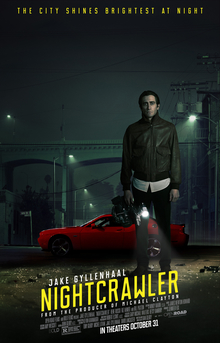
nightcrawler movie poster


Nightcrawler is a pretty good film, although I definitely wouldn't class it as an intentional crowd pleaser or blockbuster. That's not the filmmakers' goal here. Instead, Nightcrawler is a complex character study that makes you think and leaves you with a vague feeling of unease. The first half of the movie is slow, but by the second half, a murder and an increasingly complex plot deliver on the thriller aspects of the story.

The preview for Nightcrawler actually makes Gyllenhaal's character, Lou, seem much more sympathetic than he is in the movie. There is no redemption for this guy; he's a freaking psycho. His complete lack of morals and human sympathy, coupled with his dogged sense of persistence, are what make him the perfect ambulance chaser. It would be giving him too much credit even to call him despicable—he is completely unfeeling, cold, and self-absorbed. As the movie progresses, Lou is presented with opportunities to pull back and let go that any decent human being would take, but that's just it—he's nothing close to a decent human being.

It's pretty obvious even without watching the movie that TV news doesn't come off favorably in Nightcrawler, although the way Gilroy's script critiques modern news is more subtle and layered than I was expecting. My editor at Pulp Now is always talking about how mainstream news doesn't provide any context, and that's certainly the case in Nightcrawler. They not only don't provide context, they deliberately avoid it, because without context the world is more terrifying. IT COULD HAPPEN TO YOU, never mind that the home invasion was the result of a drug deal gone wrong, or that ebola's only killed one American so far.

But there's also a connection in Nightcrawler with the way news is consumed in the age of the internet—there's a constant barrage of images and information passing by our eyeballs everyday, and everything and everyone is a potential commodity. Like Claude Monet, Lou is just an eye; unlike Monet, he consumes and profits from what he sees instead of interpreting it into something else.

I was also surprised by the themes of corporate greed and irresponsibility that run through Nightcrawler. On paper, the movie's plot is a success story: a poor nobody who can't get hired to save his life moves to the big city and finds success. But the way that success is achieved is closer to something out of Citizen Kane than Forest Gump. Becoming a freelance "photojournalist" offers Lou a chance not just to be self-employed, but to employ other people. When he hires an assistant, it's with astonishing alacrity, and the person he hires is desperate: on the edge of being homeless, willing to do ANYTHING for money, including turn tricks. Lou initially tries to take Rick on as an intern (I think we all know what that means), and then reluctantly offers him $30 a week. The corporate nonsense that Lou spouts at Rick on an almost-constant basis, which will probably sound familiar to anyone who's ever been employed, is designed to differentiate the two of them and remind Rick of his place.

Even worse, to Lou, his employees are simply expendable objects—he'll pay them if he has to, but only as much as he has to. And when they outlive their usefulness or "take away his bargaining power"—i.e. pull the same stunts he does—he gets rid of them. Literally. By the end of the movie, when he's assembled an entire team and gives them a pep talk about how he'd "never ask them to do something he wouldn't do himself," it's cruelly ironic because we know that there's absolutely nothing he wouldn't do if it meant he'd turn a profit.

nightcrawler challenger car


As for the performances, I could talk about them—Gyllenhaal's ability to make his eyes go completely blank is riveting—but the real star of the movie is Lou's Challenger SRT8 392. That car looks downright delicious, let me tell you, and the chase scene near the end was absolutely amazeballs. I love it when filmmakers take a trope like a car chase and turn it completely on its head, which is what happens in Nightcrawler. Now that's entertainment.

Nightcrawler is definitely what I would call a thinking person's thriller. If you can handle a slow start and a completely unlikable and unsympathetic main character, you'll be in for a great payoff at the end.


Discus this post with me on Twitter, FaceBook, Google+ or in the comments below.

Tuesday, April 22, 2014

Movie Review: FROZEN


Originally released: 2013
Starring: Kristen Bell, Idina Menzel, Jonathan Groff, Josh Gad
Directed by: Chris Buck and Jennifer Lee
Based on: The Snow Queen by Hans Christian Andersen

Elsa and Anna are princesses in the northern kingdom of Arendelle. Elsa is cursed with the ability to create snow and ice, and one night she snaps, sending Arendelle into a deep freeze. Frightened, she scampers into the wild, only to have her sister, a wandering mountain man named Kristoff, and an adorable snowman chase after her to get her to melt the ice... around our hearts.

frozen movie poster


Here comes Tasha to hate on everyone's favorite movie. WHOMP WHOMP. Okay, I didn't hate it, I just thought it was really awful.

First of all, the script is an absolute mess. This movie has a ten-minute prologue. Normally prologues in movies don't bother me quite as badly as they do in books, but in this case the prologue told us information we could have figured out in three seconds without it! Completely unnecessary. Also, who is the protagonist of this movie? I was hoping it was going to be Elsa, but then it turned out to be Anna. The spunky redhead is the heroine—wow, I've never seen that before.

An even more pressing question is who is the villain of movie. Alfred Hitchcock once said that you can't have a great movie without a great villain, and if you think of the great Disney films that's borne out. Maleficent, Ursula, the Evil Queen and Gaston were all great villains in their way. Frozen not only doesn't have a great villain, THERE IS NO VILLAIN. Rightfully Elsa should be the antagonist, since it's her who's causing the problem the "heroine" (I kind of refuse to call her that) is trying to stop. But the directors spent too much time trying to make Elsa sympathetic. Not that I'm against a villain turning out to be a sympathetic character who's just trying to do the right thing, of course; but in order for me to care about that message, the character in the question has to actually start out as a baddy. In Frozen, we know from the start Elsa's thisclose to actually being the heroine of the movie, so it's impossible to buy into her as an antagonist or feel as if she poses any threat.

I also thought the music was really annoying. It seemed like throw-away music, honestly. Like the songs that were rejected for The Lion King and repurposed with the keywords frozen, cold, and snow. "Fixer Upper" in particular was enough to drive me to drink. Fortunately I had plenty of gin on hand or I wouldn't have lasted half an hour with this movie.

Yes, Olaf and Sven were cute and funny. But you know where else I can find cute, funny animal sidekicks? ANY OTHER ANIMATED MOVIE.

As for the twist at the end... EYE ROLL. Not only do I find the concept kiiiiiiiiiind of really unlikely, but I also thought the way it played out was incredibly lame. It makes no sense in the context of the story. If this was the directors' idea of creating independent female characters I would like to throw myself off a cliff now, thanks.

Basically, I thought Frozen was poorly-written, ill-conceived, and probably one of the worst Disney cartoons I've ever seen in my entire life, second only to The Brave Little Toaster.

Actually, now that I've written this post, I've realized that I lied earlier. I do hate this movie. WHOMP WHOMP AGAIN.


Discus this post with me on Twitter, FaceBook, Google+ or in the comments below.

Tuesday, March 18, 2014

Movie Review: PAPRIKA


Originally Released: 2006
Starring: Megumi Hayashibara, Katsunosuke Hori, Tōru Furuya
Directed by: Satoshi Kon
Based on: the novel of the same name by Yasutaka Tsutsui

Chiba is a psychologist and ice queen, but she's not a stone cold bitch—she's just sleep deprived. Every night she uses an experimental device called a DC Mini to traipse through other people's dreams as a manic pixie dream girl named Paprika. It's all in the name of therapy, of course, but unfortunately someone else at her corporation has also decided to misappropriate a few DC Minis. And unlike Chiba, they're not using their newfound abilities for good. Will Chiba (or Paprika) be able to restore the balance of dreams and reality?

chiba from movie paprika
Don't mess with me, bud.

I first heard about Paprika from Bridget at Portable Pieces of Thoughts. I was intrigued by the premise right from the start, mainly because I love animé and am always looking for good animé recommendations. But when Bridget described Paprika as making the movie Inception look like child's play, I knew I HAD to see it. I'm glad I did, because Paprika is an awesome movie—and it is a film, not a cartoon. I would not recommend parking your little kids in front of this one.

As Bridget said, Paprika has definite similarities to Inception: In both films, there are dreams within dreams within dreams, the characters are in danger of having a psychotic break between reality or even dying in the dream world, and people with DC Minis can implant ideas into someone's subconscious mind while they're dreaming. Yet for me, Paprika was more reminiscent of Alfred Hitchcock's Spellbound. Just as in Spellbound, you have a beautiful but royally uptight psychiatrist with an awesome old guy mentor, who uses dreams to help solve a mystery. Whereas Inception was an epic journey hidden inside a caper plot, Paprika is a coming-of-age story framed in a suspense plot. With, obviously, crazy-ass dreams.

paprika gif
Not the bendy floors!

The execution of Paprika is flawless. Not only is the animation gorgeous and hallucinatory, but I've seen movies with human actors that convey emotions less eloquently and have less chemistry than these animated characters do! For example, almost as soon as Chiba and Osanai appear on screen together you KNOW he has a thing for her. How I don't even know. And the moment Konakawa, a detective Chiba is treating, meets Chiba IRL for the first time and realizes she's Paprika is priceless.

I also thought the use of art in Paprika was interesting. Normally one would expect filmmakers tackling the subject of dreams and the subconscious to reference surrealism in some way, like in Hitchcock's Spellbound. Paprika doesn't, at least not overtly, and I applaud them for it. Not only is surrealist art in movie dream sequences practically a cliché at this point, but that would be redundant considering the film animation as a whole is very surreal. Instead, the filmmakers give a nice shout-out to the symbolists, who helped inspire the surrealists.

oedipus and the sphinx paprika
Paprika and Osanai entering Gustave Moreau's Oedipus and the Sphinx.

Other things I loved about Paprika:

  • The soundtrack for this film is awesome. I immediately downloaded it.
  • Points for creepiest use of a doll EVER.
  • The fact that the film touches on the similarities between dreams and the internet and movies, and then LEAVES IT AT THAT. I wasn't repeatedly hit over the head with it.
  • The ending! It was so unusual and sweet and happy-making, not to mention the type of conclusion that Hollywood would NEVER, not in A HUNDRED MILLION YEARS have the balls to put out there.


So, yeah. I enjoyed this one and recommend it. If you're a Prime member, you can stream it on Amazon for free. Thanks to Bridget for letting me know about it!

chiba/paprika running
Rush out and see it!


Discus this post with me on Twitter, FaceBook, Google+ or in the comments below.

Thursday, February 13, 2014

Movie Review: CHERI


Originally released: 2009
Starring: Michelle Pfeiffer and Rupert Friend
Directed by: Stephen Frears
Based on: The novel of the same name by the inimitable Colette.

Review by the lovely Bridget of Portable Pieces of Thoughts.

Synopsis:

France, the beginning of 20th century, just before the WWI. Lea de Lonval (Michelle Pfeiffer) is a beautiful but ageing Parisian courtesan, currently without court. She doesn't complain. As she’s been very successful and quite business-savvy, she managed to put a lot of money aside. Now she is financially independent, able to live like an aristocrat; still she is almost completely friendless. Small wonder, a prostitute, rich or poor, doesn’t really belong anywhere. Lea feels she is condemned to a company of her colleagues and former colleagues – not exactly friends, rather uneasy allies, like inmates. One of them, Charlotte Peloux (Kathy Bates) a one-time competitor and shameful gossip, has a young son, Fred nicknamed Chéri (“darling” in French). Charlotte and Lea have known each other for years as their careers have been very similar; that’s why Lea was constantly in the life of Chéri, being even his godmother. One day, Madame Peloux comes to her and asks her to take in the boy as a lover and teach him about life.

Chéri is far from being a virgin, but it is obvious he needs some reining in or he’ll turn into a blasé addict or worse. He also has to know how to treat a woman. Lea agrees to be his tutor without much reluctance – the boy is handsome enough to tempt even a courtesan. Despite the age disparity Cheri accepts Lea’s saddle quite willingly. What begins as simple lovemaking, no strings attached, quickly becomes a six-year long love affair. Lea and Chéri float in a perfumed world of opulent comfort, with the older woman paying all the bills so her darling boy has no worries in the world. Still the clock is ticking. How will it end? Not well – you might bet on it.

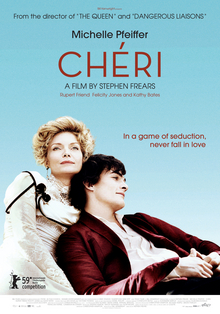
cheri movie poster

My impressions:

I wanted to see that movie so much and, even if I know it is not wise, I expected a real feast. How not to? Stephen Frears reteams with his Dangerous Liaisons (1988) screenwriter Christopher Hampton and supporting actress Michelle Pfeiffer for an adaptation of two novels from Colette, the famed French author I adore for her intelligence and sense of humour. What’s more, it’s a Belle Epoque drama set in Paris. Was I left disappointed? Not really but the movie was hardly brilliant.

The movie is based on two novels Chéri and La Fin de Cheri written by Colette, known for the air of describing familiar lives with detached regret and a good dose of humour. Her books seemed to reflect well the real-life experience of the author herself. After leaving an unfaithful first husband, Colette, already a successful novelist, supported herself also as a music hall performer because being a writer was never quite a profitable job. That’s how she knew many courtesans in the era of La Belle Epoque , being sometimes close to them. She had affairs with both men and women, shocked tout le monde with the first onstage kiss between two women like any demimondaine worth her salt. Then she married the editor of Le Matin and was divorced at 51 after she had an affair with his 20-year-old stepson. I bet she wrote Chéri as a kind of therapy - a confession and an explanation. In those times an older woman taking a younger lover was not unheard-of but much frowned upon. Enough about Colette and her problems, let’s asses the film itself.

In short I could say the success of Stephen Frears’ "Chéri" begins and ends with its casting. Near the beginning of Colette’s novel Lea gives her young lover a necklace with 49 pearls. We can imagine there is one pearl for every year of her age. Michelle Pfeiffer, as Lea de Lonval, is still a great beauty, but nearing that age when a woman starts counting her pearls if she is fortunate enough to have them. Her lover is 24 years younger than she. Six years pass and, in a way, the whole movie is about how 25 and 49 are not the same as 31 and 55, especially if a woman is the older part of that inequality Lea is much more intelligent than her friends and also tragically self-aware: while enjoying afternoon tea with some former colleagues, which tends to be an amusing, banter-filled affair, she shudders with revulsion at the sight of a portly woman of about her own age — although less well preserved — clutching what looks to be a teenager to her décolletage. It is obvious she doesn’t wish a similar fate but she can hardly fight her own heart.

cheri film still


Rupert Friend, playing Lea’s lover, the title Chéri, is 27 and looks younger. They are both accomplished actors, which is important, because "Chéri" tells a story of nuance and insinuation, concealed feelings and hidden fears. If you look for action, well, look elsewhere - it is not a rollercoaster movie. Kathy Bates as Charlotte, the robust mother of Cheri, delivers a performance that's almost exaggerated, but her spark and jibes are much needed and appreciated throughout – without them the movie would turn into a boring melodrama.

Lea knows sooner and Chéri later that what they had was invaluable and irreplaceable. Cheri is about learning to love and accepting one's age and the consequences of both once realization truly sinks in. However, I couldn't help but feel like the story was simply going through the motions, never really surprising me or moving me one way or another. I would have thought Frears would play up the romantic angle a little more, especially considering we are talking about the city of lights here.

Of course the point of the film is not necessarily about the romance between the two leads per se, but giving the audience a stronger emotional connection to the two of them would have only made the final minutes that much more effective, not to mention the rest of the movie on a whole. I also caught myself wishing to see more of the Belle Epoque settings. Lea’s residence was nice, but it was really strange that I never saw her go out and enjoy herself; I understand she wasn’t invited to private balls and official functions but what prevented her from going, for example, to a theater or an opera or even a cafe de nuit? When I come to think about it she never even went shopping. I suppose it was influenced by the budgetary limits and costs of preparing appropriate sets and it is a pity - in my opinion the movie would be better, more interesting to watch, if it included some of those scenes, as expensive as they go.

Final verdict:

Overall, Cheri is a perfectly enjoyable film, but one you probably won't take much away from or lose much sleep over discussing. Still I don't regret watching it - what does remain is an overall sense of beauty, both in the film and the face of Michelle Pfeiffer, a woman seemingly shot, at times, without a trace of makeup and still looking at least 10 years her younger. I kept thinking the director was definitely kinder to Lea than her creator, Colette – in her books the heartbroken prostitute aged with less grace, getting soon overweight and ugly to a point that, in the end, her beloved Cheri didn’t recognize her anymore.


Discus this post with Bridget on Twitter or in the comments below.

Tuesday, December 3, 2013

Virtual Advent: Favorite Not-Holiday Movies, 2013

bond's childhood home on fire
Chestnuts roasting on an open fire...

Back by popular demand, it's the fourth annual Favorite Not-Holiday Movies post! Every year I list some movies that I consider to be "holiday" movies, even though they have little if anything to do with Christmas, because I have a mental block when it comes to recognizing proper Christmas movies. For more not-holiday movies, check out my lists from 2010, 2011, and 2012 (and LA Confidential is still my favorite Christmas movie).

I actually didn't see many movies this past year, so I was surprised when I started itching to watch a fresh batch of not-holiday films this past week. I guess there's nothing like a good not-holiday movie to put one in the Christmas spirit! Without further ado, here's my not-holiday flick picks for 2013:


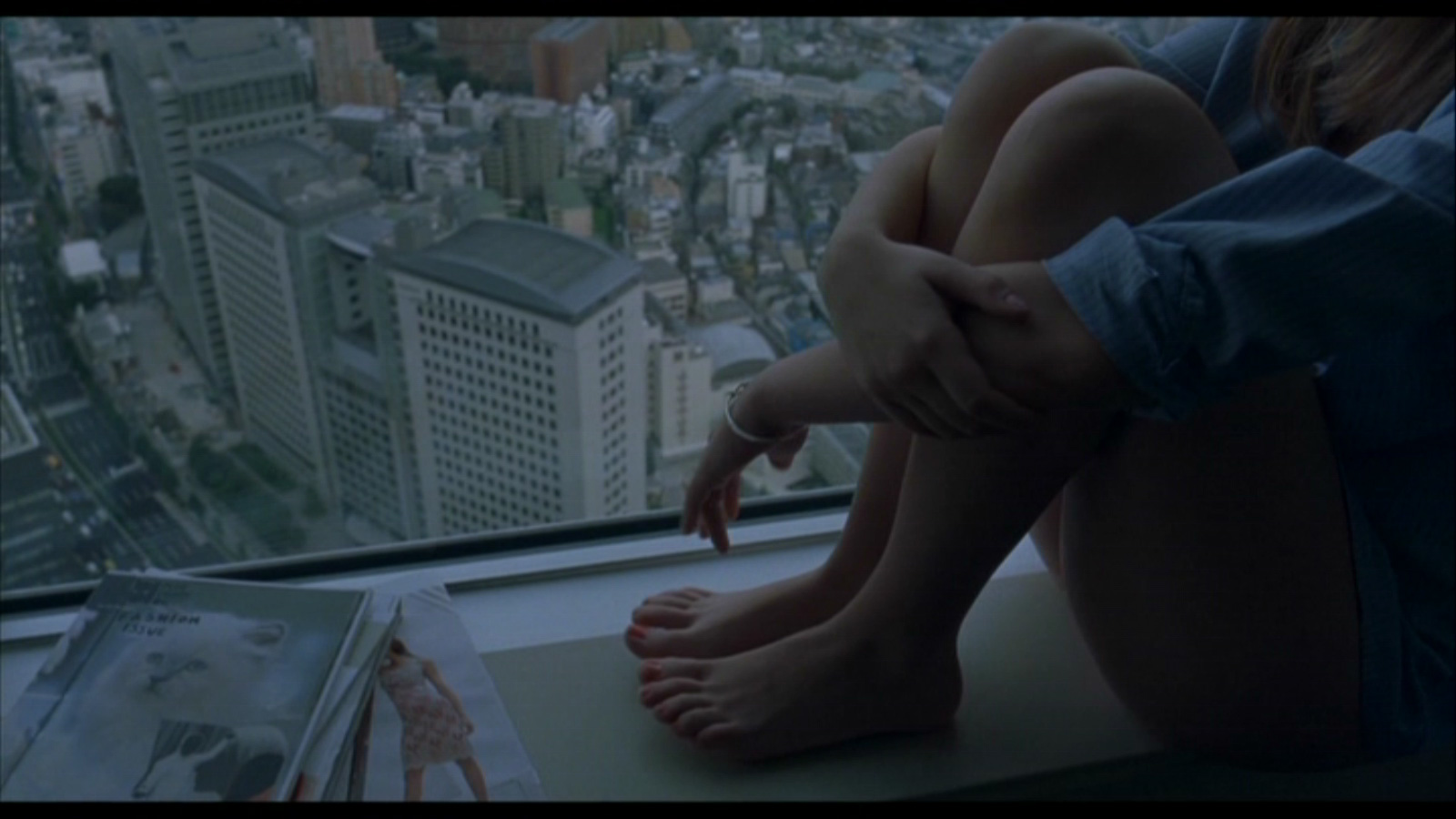
  • Lost in Translation—The lovely Bridget from Portable Pieces of Thoughts recommended this movie to me last year. I have to confess I wasn't expecting a lot from it, but I wound up enjoying it so much I actually bought it! It's romantic in the literary sense of the word, beautifully shot, and Bill Murray is hilarious and adorable. I have to watch this movie at least once a year or I will forget how awesome it is, and that would be sad-making.
  • Midnight in Paris—1920s Paris and Tom Hiddleston as F. Scott Fitzgerald. What more needs to be said? I'm also a total sucker for movies where people just decide, "Hey, I'm just gonna move to Paris. C'est la vie, suckers." Then they immediately find some French person to hook up with.
  • Ratatouille—For two years in a row now, I've DESPERATELY wanted to watch this movie right around Thanksgiving. Unfortunately it's always checked out at the library. ALWAYS. By the time I move far enough in the holds queue to get a crack at it, it's usually March. I should probably just buy it.
  • Skyfall—It's just not Christmas without Daniel Craig. SERIOUSLY, IT IS NOT. The Golden Compass made my not-holiday list in 2011, and Casino Royale made the list in 2012. This year the Craig holiday movie of choice is Skyfall, a beautifully shot film with a spy plot that doesn't totally suck. I'm not sure I'm going to feel right about the holidays until I see Bond's childhood home engulfed in flames.
  • The Hobbit, part the first—I'm pretty sure this movie has a subtitle, but damn if I can remember what it is. The Unexpected Sexiness of Dwarves? Who knows. I actually thought this film would suck hairballs, and I'm still kind of resentful that Peter Jackson turned at 180-page book into six hours worth of movie, but still. Hobbits! Wizards! You can't have Christmas without them.
  • My Week with Marilyn—Evangeline from Edwardian Promenade reminded me of this movie's existence the other night while we were breaking down Eddie Redmayne's many positive attributes, as you do. I'm pretty sure there's a Christmas scene in this film somewhere. But even if there isn't, several of the actors are Harry Potter alumni, which automatically makes it thisclose to a Christmas movie. And besides that, it's a great coming of age story. I need to see this film again!

virtual advent tour 2013


Have any not-holiday movies you like to watch at this time of year? Share them in the comments!


Discus this post with me on Twitter, FaceBook, Google+ or in the comments below.

Sunday, April 21, 2013

Movie Review: COMPLIANCE


Originally released: 2012
Starring: Ann Dowd, Dreama Walker, and Pat Healy
Directed by: Craig Zobel
Based on: the strip-search prank scam in Mount Washington, Kentucky


Review by the lovely Bridget of Books as Portable Pieces of Thoughts

Synopsis:

A very busy fast food joint, somewhere in one of the unnamed towns of the USA. The manager, a middle-aged woman called Sandra, is having a really bad day: due to a screw-up by her underlings, almost $1,500 worth of bacon has been ruined, and she is now conscious of needing some extra effort to please her bosses. All of a sudden she gets a call from a cool, authoritative man who identifies himself as Officer Daniels; he claims one of her employees, a pretty twenty-something blonde called Becky working on the till, has stolen some money from a customer's bag.

Very distressed and very busy, Sandra more or less meekly comply with every request of that man, although they are just talking on the phone. Afer all he wants her to avoid the worst - an unnecessary delay and scandal, tarnishing the reputation of the whole joint and herself as an efficient manager. First she search Becky's bag, then she strip-searches the girl and keeps her almost naked in the back office, under the 'surveillance' of several men. Becky is to be isolated and effectively imprisoned and helpless until the squad car arrives. The results of Sandra's decisions are disastrous. Soon most of the staff are involved in demeaning, humiliating and compromising activities. How will it end?

compliance film still

My impressions:

This chilling film, written and directed by Craig Zobel, is based closely on the true story of a serial phone-prankster sociopath in the US who, for a decade, got away with a bizarre repeated hoax. His daring escalated and in 2004 he brought off his masterstroke of insidious evil. The con trick was a very sadistic demonstration of the weakness and suggestibility of human nature, more devastating than anything in the well-known Stanford and Milgram experiments (testing individuals' response to authority in the 60s of 20th century) because real lives were wrecked.

From different optical illusions like Escher’s impossible labyrinths to unsolicited emails from rich and generous African officials who offer us a fortune for a very small favour, common sense has us hard-wired to reject the implausible. We should be able to do it in our best interest. Unfortunately sometimes we fail. Believe me, it is a movie which will drive a cruel punch to your gut far more effectively than any thriller or slasher because it will make you ask yourself: what would I do in such a situation? It is a cold, hard, shrewd film: satire with a drop of cyanide. The set and decorations match that : filth and grease set the scene for human sliminess.


That doesn't look good.

What Compliance shows, however, is how very important it is that "Officer Daniels" targets a fast food chain. A fast food joint is a place to lower your guard as well as your standards. Here is where the real degradation can flourish because a chain is always conscious of a menacing corporate authority somewhere above them: branch managers, regional managers, people who might only reveal themselves as a voice on the phone. Obedience and badly suppressed fear are the order of the day, especially on the unthinkable subject of hurting your milking cow, a customer. Relinquishing your free will and simply going with the flow is part of the process for all concerned. So when some brazen authority figure on the phone knocks everyone with some new situation, submitting is the natural way to react. Your inner voice might nag you, suggesting that something is very wrong and yet at any time, in any period, when people supposedly in authority tell us what to do – more often than not we do it. Without thinking about the consequences. Without thinking at all.

One weakness of this low-budget film is that the characters — though realistically acted — are a bit too shallow and generic. It’s also a mistake, in my opinion, to keep cutting away to the prankster but without showing his inner self. I WANTED to know what made him tick and my questions weren't answered - not really. I also have to say it seemed to me that Zobel didn’t sell the idea, just the outrage: The more indignities and violations Becky endured at the hands of people who were supposed to be her friends and co-workers, the more it felt like a hollow provocation. As things went from bad to horrible, I got the urge to walk into that back room where Becky was being interrogated and start yelling, “What’s wrong with you people? Are you a bunch of puppets? Switch on your brains! Take a moment and call somebody, like the actual freaking police!”

Final verdict:

A competently crafted film, telling a very chilly story - undoubtedly one of the toughest sits of the movie year 2012. Still sometimes it is good to be reminded how we are programmed to do things that go against our natural instincts as long as we believe we have the law on our side.


Discus this post with Bridget on Twitter or in the comments below.

Tuesday, March 26, 2013

Movie Review: ANNA KARENINA


Originally released: 2012
Starring: Keira Knightly, Jude Law, Aaron Taylor-Johnson
Directed by: Joe Wright
Based on: the book of the same name by Leo Tolstoy

Anna is married to this guy named Aleksei, who is honestly kind of a prick. When she goes to Moscow to visit her brother, she runs into dashing cavalry officer, Count Vronsky. It's love at first sight! But Anna's a married woman and tells Vronsky to leave her alone. Instead, he stalks her for the next hour, and then Anna's hubby is all, "You're behaving improperly BLAH BLAH BLAH." So Anna figures if people are just assuming she's sleeping with Vronsky, she might as well sleep with him! And Vronsky bangs the brains right out of her head.

This version of Anna Karenina takes place almost entirely in a theater and is extremely stylized. It's a little strange at first; during the opening scene I was like, "What is this and why am I watching it?" But then I was totally sucked in and the theater setting seemed to work naturally with the themes of the story. I felt that by making the staging obvious, the story was allowed to dominate and I didn't have to sit through the typical explanations of what's going on that would have slowed the pace of the movie. Plus, IT'S A METAPHOR DUDE. A beautiful Russian metaphor.

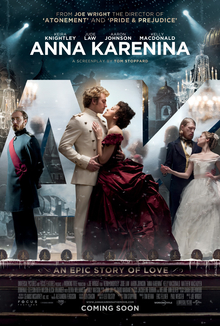
anna karenina poster

In addition to the gorgeous sets, you've got beautiful costume design (I found it really interesting that Anna wore black when she was "innocent" and white after she was a notorious adulterous--I thought that was a great way to demonstrate how appearances and reality never mesh with her) and perfect casting. I loved Matthew Macfadyen most especially, who plays Anna's brother, Oblonsky. He was hilarious! He was like Gaston's crazy uncle in Gigi, only Russian and married. It was great to see Macfadyen in a role where he wasn't being dour. I also loved Ruth Wilson as Princess Betsy. That is an awesome character!

As for Anna, I have SO MANY FEELS. For one, I LOVE her. I've seen other people call her selfish--and she is, especially at the end of the movie--but I also really admired her and thought that for most of the movie she was trying to make the best of a soul-sucking situation where she was miserable. But then on the other hand, I was also like, "Girrrrrrl, what were you thinking." I was totally with Anna up until right after she gave birth to her daughter. To me, this was the turning point in the movie, particularly when Aleksei asks her, "What do you want?" This is an honest question and deserves deep consideration, but I wasn't sure Anna knew what she wanted when she answered. She said she wanted Vronsky, but maybe she just wanted passion in her life. Of course, Aleksei's never going to give that to her; but on a practical level her decision to leave with Vronsky really made no sense. She loses everything for herself AND her child, and all she gains in return is him. Why would she choose Vronsky? And then the whole thing with them returning to Moscow and her INSISTING on trying to be accepted in society and going into a panic spiral when she's not... WHAT? Don't tell me you didn't see that coming, Anna. You had the guts to tell society to go fuck itself and I respected you for that; now have the balls to deal with the consequences. Basically I think Tolstoy fell in love with Anna as he was writing the book; but then he remembered he was trying to be moralizing, so he forced her to act in a way that made no sense in order to teach Team Vagina that if we cheat on our husbands, WE WILL DIE. PS, if you know of a 19th-century novel where the adulteress main character doesn't die, please let me know.

Aaron Taylor-Johnson as Vronsky
You know you want to lick that moustache.

Still, the central question of Anna Karenina seems to be, did Anna really love Vronsky? Not because if she did love Vronsky it would excuse her behavior, but because the message of the story is different depending on how you answer that question (I know we were spoon-fed a message about lust and all that, but I decided to ignore it). And honestly, I don't think it's a question that has a definitive answer. Personally, though, I believe Anna did love Vronsky, because unless he had some magical penis or something, I don't think Anna would give up her son just because she found a guy sexually attractive. Maybe her spiral into jealous crazy town was simply a result of her love not being shored up by faith and hope.

Anyway, even though I had some issues with the story itself, I thought Anna Karenina was a really, really good movie. I loved how stylized it was, while still being very emotional and focusing on the characters of the story. I haven't read the book, but I think this might be one of the best book-to-movie adaptations I've ever seen. I can't wait to watch it again.


Discus this post with me on Twitter, FaceBook, or in the comments below.

Sunday, December 9, 2012

Sunday Salon: It Was All a Dream

dorothy wakes up

At the end of The Wizard of Oz movie, Dorothy wakes up in her bedroom to find that the world of Oz was just a dream. Her subconscious substituted the characters and events from the real world to create a much more colorful fantasy world, but that's all it is--a fantasy.

I hate this ending. It's a total let-down. So I was quite happy to find out that the book the movie was based on, The Wonderful Wizard of Oz by L. Frank Baum (my review at PGP), doesn't have it. Dorothy does travel back to Kansas, but the land of Oz is just as "real" as Kansas (especially to Dorothy). And that isn't the only adaptation I've come across that does this: in The Nutcracker ballet, Clara wakes up on Christmas morning to find her journey to a castle with an enchanted prince was nothing but a dream. Depressing! Does this happen in the story Nutcracker and Mouse King by ETA Hoffman? Nope! Instead, Clara winds up traveling back to the prince's castle at the end (review here).

Obviously these are only two examples, but I have to wonder why the film and stage adaptions of these fantasy novels went that route. "Ooops, it was just a dream," is a TERRIBLE ENDING. Terrible! Personally I think it would make more sense for the world to remain a reality in the context of the story; but by saying it was just a dream, the adaptations kind of render what just happened irrelevant. It's not as if they didn't have an already-good ending at their disposal, yet they went out of their way to set the story firmly back in "reality."

One of my theories for this is that movies and plays are more "real" than books, in a physical sense. Everything that happens in a book happens in the reader's mind--which is one of the reasons two people can have such different experiences reading the same book. But movies and plays happen in real time and are experiences usually shared with a group of people in a theater. The objects on stage and in the movie take up actual space, and the characters are brought to life by real people. Maybe as a result, people who tell stories through plays and movies are more concerned with reality and making their movies "realistic." That still doesn't quite fit, though, because there are plenty of fantasy films that never reference reality of any sort.

Maybe it's because both Clara and Dorothy begin their stories in the "real" world, travel through a fantasy world, and then return to their normal lives, thus creating a permeable reality. Tchaikovsky and The Wizard Of Oz's studio didn't want to encourage escapist fantasies, which--fair enough. That's some dangerous stuff right there.

Can you think of any other book adaptations that turn a fantasy or adventure into a dream that didn't "really" happen? Why would anyone do that? Why?!


Sunday, December 2, 2012

Virtual Advent: Favorite Not-Holiday Movies

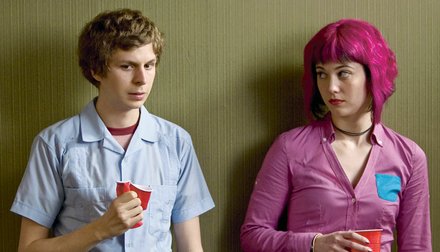
scott pilgrim

Hello, everyone! It's time for this year's edition of Favorite Not-Holiday Movies. These are films I think of as necessary viewing during the holidays, even though they have very little (if anything) to do with the holidays. Be sure to check out my list of not-holiday movies from 2010 and 2011 if you need a refresher on the other films I consider my not-holiday favorites.

  • Hugo--This is a beautiful film about a little boy in Paris who finds a family and discovers an old toy maker's secrets. Although I had some issues with Hugo (review here), overall it was a delightful way to spend two hours, and definitely heart-warming enough for any not-holiday movie.
  • Dark Shadows--Barnabus Collins, a vampire, returns to the family mansion to battle his evil ex, the witch Angelique. I know this movie is painfully dumb, and it seriously has NOTHING to do with Christmas, but for some reason I really enjoy it and it gives me the warm fuzzies. Maybe I just have a thing for Johnny Depp in make-up, who knows.
  • Scott Pilgrim vs the World--I wouldn't have called this a not-holiday movie last year, even though I really love it; but I've been feeling the need to watch it lately, which automatically qualifies it as being a "holiday" movie in my book. Basically it's about Scott Pilgrim, who has an awesome life, is 23 years old, and falls in love with a woman named Ramona. But to keep dating her, he has to battle her seven evil exes. It's totally hip.
  • Inception--Is there a more Christmasy movie than this labyrinthine mind fest of twisty turns? If there is, I can't think of one! Leonardo di Caprio plays a thief who descends into dreams to steal people's idears (my review here).
  • Casino Royale--You guys knew I couldn't have a not-holiday movie list without a few shootings and car chases, right? Plus Daniel Craig... rowl. And he's in a suit, so that's practically thisclose to getting dressed up for a holiday party.
Now it's your turn! What are some of your favorite not-holiday movies?


virtual advent buttonThis post is part of Virtual Advent. For more holiday-related posts, visit adventblogtour.blogspot.com.

Monday, November 26, 2012

Movie Review: LOST IN TRANSLATION


Originally released: 2003
Starring: Bill Murray, Scarlett Johansson
Directed by: Sofia Coppola
Based on: the script by Coppola

Once upon a time, there was a princess named Charlotte who lived at the top of a skyscraper hotel overlooking the city of Tokyo. Although the princess could leave her tower, she always felt isolated from everyone else, until an unlikely knight errant named Bob Harris crossed her path. He brought her down from the tower and helped her feel like a part of the world again.

lost in translation movie poster

The summary of Lost In Translation (not the one I just gave, the official one), always put me off. So basically it's movie about a pair of rich people who are bored and kind of get together but not really? FASCINATING. Not. Plus it stars Scarlet Johansson, who really annoys me (the only movie I can stand her in is Midnight in Paris because she's supposed to be annoying). But then Bridget at Books as Portable Pieces of Thought assured me it was a good movie, and that there was an awkward sex scene (yay?), so I figured I would give it a try, hate it, and then cleanse my mind with something else.

What actually happened was that I didn't hate Lost In Translation--I LOVED it! I think what Sofia Coppola was trying to do with this film was capture experiences. When you're living in a different country, you don't just miss your friends and family, you miss your entire culture. Things that you take for granted suddenly become problematic. What do you do for entertainment or to unwind at the end of the day? What if you get sick and need to see a doctor? How do you order from a menu when you don't read a language? Even the things from your own home are tweaked to local tastes so that they come out not quite right. Coppola did a brilliant job of showing us these experiences in the movie: the New York Bar with the cheesy lounge singer, Charlotte and Bob ordering at a restaurant, or going to the hospital.

But whether you hate or love the culture of the country you live in, you have to adapt to it. You have to listen to the music, eat the food, and learn to communicate with people in order to survive. After a while, although you're not truly a part of the culture you're living in, you're not a part of the country you're from, either. Your "home" might even start to feel like the foreign country. I think that was the point of the painful phone conversations Bob and Charlotte had with the people they love back in the US. I also think the Tokyo street scenes did a great job of conveying that feeling of being in limbo--physically being somewhere, but not really a part of it.

tokyo street scene


It's interesting to compare this movie to Marie Antoinette, also directed by Coppola. They're both about poor little rich girls who aren't sure how their world works or what their place is in it. I think Lost In Translation is more hopeful, though, because first of all it's really funny. I laughed my patootie off during the awkward sex scene, and all the cocktail lounge scenes are hilarious. I particularly enjoyed the rendition of "Scarborough Fair." And Bill Murray was adorbs; he has some great one-liners in this movie ("I don't get that close to the [whiskey] glass until I'm on the floor.")

Second of all, the film is really romantic. Not in a rom-com sort of way, but in the traditional Romanticism sense of the word, with an emphasis on emotion and experience, and the struggle of the individual to find their own way in the face of society. If Bob and Charlotte do have a romance between them, it's of a courtly kind.

Basically, this movie is REALLY good. It's entertaining and great to look at, but also stays with you and gives you a lot to think about. The take-away message I got from Lost In Translation is that Bob and Charlotte might be lost, but maybe that's a good thing--the only way they can ever see or find what they truly want. Thanks to Bridget for encouraging me to watch it!


Sunday, November 18, 2012

Movie Review: ABOUT ADAM


Originally released: 2000
Starring: Stuart Townsend, Kate Hudson, Frances O'Connor
Directed by: Gerard Stembridge
Based on: the ramblings of a syphilitic mind? I really have no idea.

Lucy Owens is a cheesy nightclub singer who just can't take any of the guys she dates seriously. Hm, I wonder why. Then she meets Adam, a mysterious beta male with a fancy car, and EVERYONE in her family loves him, including Lucy. Adam is pretty obviously a total horndog, and soon he's sleeping with all Lucy's siblings, including her brother. But now that they're engaged, is Lucy still really that into him?

about adam wedding

After my review of Bel Ami (post here), Evangeline from Edwardian Promenade told me I should watch About Adam. I suspect it was mainly because of the awkward sex scenes (apparently I'm Awkward Sex Scene Girl now), but About Adam is a gentler--and better--version of Bel Ami. What makes it better is basically two things: one, Stuart Townsend is a total hottie and I love him. He actually manages a balance between charm and devilishness to where you know he's up to something; but you can't really blame any of the other characters for falling for his dubious charms, even though anyone with even a hint of common sense would know men don't act like this unless they're conning you.

Two, About Adam is clever and funny. I'm not going to say it's SUPER clever and funny, but in comparison to Bel Ami it is. It's kind of fascinating how Adam just reels all the Owenses into his web; and the characters on their own are quirky and fun. Naturally I had a fondness for Laura, Lucy's bookish sister who's writing her PhD thesis on some obscure Victorian poem and likes vampire movies; but the older sister, Alice, and their mom is also fun. The mom had my favorite quote from this movie: "Boring men are the curse of the world, and there's just so many of them." The Gala Dalí philosophy of relationships, lovely. That always turns out well.

about adam dvd cover

Despite the fact that About Adam was better than Bel Ami, though, I'm not sure I would necessarily call it "good." First of all, the Irish accents from the non-Irish actors occasionally verged into Australian territory (I'm looking at you, Kate Hudson). The art direction is really questionable. And the sex scenes are super awkward. I believe I mentioned that, but it bears repeating, because there are a lot of them. I almost got a crick in my neck from shaking my head at the stupidity of the characters. Finally, I spent the WHOLE FREAKING MOVIE waiting to find out what Adam's endgame was--did one of the Owens' ancestors kill one of his ancestors or what?--and the explanation was basically, "People want things from me and I just can't help giving them what they want."

Mmkay. Is he an incubus or what, because I find it very difficult to believe he just happened to have the poem Laura was writing her PhD thesis on MEMORIZED. Also, he totally chases after alllll these characters. Suddenly the library is his favorite place to hang out? And it's not like Alice called HIM up to have phone sex. It's a completely unsatisfactory explanation for the entire plot of this movie.

Also, the symbolism of the car really bugged my brain. Adam owns a blue Jaguar and this becomes a BIG DEAL. The car basically sucks everyone in. He has tons of stories about his dad, and the car, and how he poured all this money into it, and it's a symbol of the family he lost, and blah blah blah. The mysteriously fancy blue car! At first I thought maybe the Jag was a metaphor for how he treated women, but now I think the car represents the character himself. Like a genie's bottle. And... that's it. That's all there is to know about his character: he's a sports car, and he likes giving people rides. IF YOU KNOW WHAT I MEAN.

Basically this movie was kind of awkward. I liked all the scenes where Stuart Townsend took his shirt off. The end.


Saturday, November 3, 2012

Movie Review: BEL AMI


Originally released: 2012
Starring: Robert Pattinson, Uma Thurman, Christina Ricci, Kristin Scott Thomas
Directed by: Declan Donnellan and Nick Ormerod
Based on: the novel of the same name by Guy de Maupassant

Georges is a poor young hoofer in 1890s Paris looking to make his mark. After meeting an old army buddy, he gets involved with a group of snooty bourgeoisie and a bunch of women who all want to hit that. His male colleagues hate him and treat him like a pussy, but that's probably because he keeps sleeping with their wives. Don't worry, though, Georges isn't just a hot piece of ass--he has a ridiculously complex Plan to get money so that he never has to watch cockroaches crawl around his apartment again.

I first heard about Bel Ami from Anachronist at Books as Portable Pieces of Thought, and it sounded so incredibly stupid that I seriously HAD to watch it. Bel Ami actually wasn't THAT bad, though (I probably would have enjoyed it more if it was), despite the fact that it contained some of the most awkward sex scenes I've ever seen. The cinematography and set design was gorgeous, and the movie did have some semblance of a plot (even if it didn't seem like it did for at least the first hour). I also thought the gender roles in the film were pretty interesting. As for Robert Pattinson... eh.

robert pattinson making faces in bel ami

I mean, it's RPatt, so he basically spends forty percent of the movie staring and another forty smirking, which is pretty annoying. But he did make Georges sympathetic. I was honestly kind of rooting for the guy, but I'm not sure I was supposed to be. RPatt has said that Georges is amoral, but that doesn't really come across, especially in comparison to the other characters. He seems more of a bumbling idiot than a master manipulator, and he does care what at least one person thinks of him--his true love, Clothilde. I'm not sure if this is a failure on the screenwriter's part or RPatt's, but if you want someone who embodies a sexually objectified male, he does fit the bill.

Anyway, gender issues! Bel Ami reflects the fin-de-siècle paranoia about degeneration and indolence. Men should Do Things On Their Own and Not Rely On Women and all that good stuff. Except Georges basically gets everything from women, and has no intention of doing any work himself. His dad did that and it was for the birds! He'd rather make money on his back (to be fair, it's probably the only thing he's good at, and he is pretty). Georges basically takes on the role of a woman sleeping her way up to the top (à la Nana--post here--or Camille), but he's a dude. And it does get super-awkward sometimes.

bel ami poster

Meanwhile, there are a lot of strong female characters in this film, most especially Uma Thurman, who plays Georges' wife, Madeleine. She smokes, drinks, plots to manipulate political elections through the press, and has no intention of letting anyone besides herself wear the pants in their marriage (side note: all the female leads in this movie should send thank-you notes to the cinematographer and director, because they looked freaking gorgeous). Wow, so many awkward sex scenes between those two. Even the other women Georges hooks up with come on to him first. Does Bel Ami pass the Bechdel Test? No way. But it does show women as independent, intelligent, and powerful. I would like to say this is interpreted as a positive, but instead it's more of a sign that civilization is going to the dogs--or at the very least, people like Georges.

When it came to the twisty, Les Liaisons Dangereuses-type plot, however, I thought the film really faltered. We get only the vaguest sense of what's happening at the newspaper Georges work at, or the political and financial manipulations Madeleine is a part of; and frankly Georges' plan to get the better of everyone makes no sense. Does it really take that much effort to infatuate a teenager? There are also a bunch of things left unexplained or that seemed kind of pointless.

Even with the interesting gender role reversals, I would say unless you have a particular love for Maupassant or the setting (which I do), you can skip Bel Ami. It's only minimally entertaining and kind of leaves a bad taste in one's mouth.


Saturday, October 27, 2012

Movie Review: CAPTAIN BLOOD


Originally released: 1935
Starring: Errol Flynn, Olivia de Havilland, Basil Rathbone
Directed by: Michael Curtiz
Based on: the novel of the same name by Rafael Sabatini

Peter Blood is a peaceful country doctor, until he's arrested for coming to the aid of a wounded Monmouth rebel. Convicted of treason, he's shipped off to Jamaica as a slave. But Peter Blood isn't fate's bitch--he arranges an escape and becomes a pirate captain!

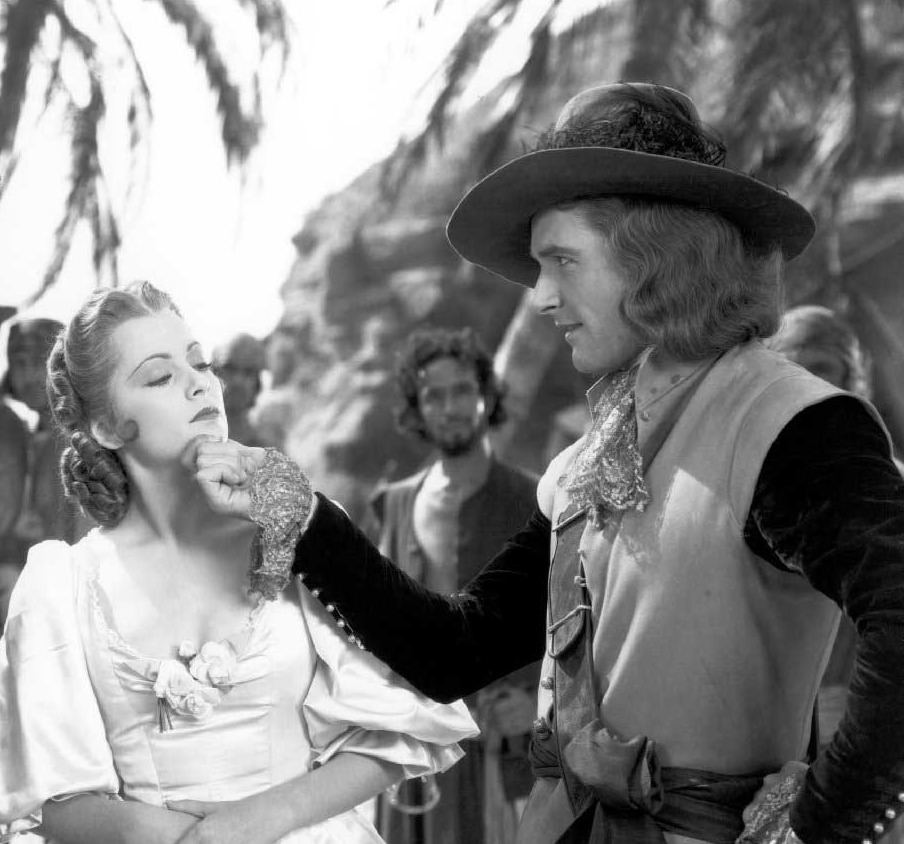
After I read Captain Blood (see my review at Project Gutenberg Project), everyone--by which I mean Ruth from Booktalk & More--wanted to know if I'd seen the movie. Well, I hadn't, but during an attack of the insomnias, I decided to give it a try. It was kind of strange watching Captain Blood after reading the book; usually I can separate a book and movie in my mind, but in this case it was almost like the book had come to life. It creeped me out a little, actually, but this movie is really really solid and sooo much fun.

errol flynn and olivia de havilland in captain blood
The hat definitely needs to be bigger.

First of all, the performances--can a more perfect person to play Peter Blood exist other than Errol Flynn? Talk about dream casting! He seriously IS this character. And Olivia de Havilland does a fabulous job of playing Arabella--she actually makes her almost completely not-annoying! Her and Flynn have amazing chemistry together. I loved all their scenes. Basil Rathbone deserves a mention for coming up with a very silly French accent.

Second of all, the cinematography: I loved the use of shadows in this film, it was so fun and super creative. The battle- and sword-fight scenes were also perfectly shot with original cuts and framing to put you in the middle of the action. Did you know Captain Blood was nominated for Best Picture, and Curtiz almost won for Best Director just through write-in votes? So totally not surprised by that.

captain blood poster

The movie is a little too long, and the plot becomes quite garbled near the end, but who cares. Sword fights! Pirates! Hats with feathers! Do you honestly need a comprehensible plot with all that going on? I know you don't, because you went to see the last Pirates of the Caribbean movie. And Captain Blood is much better.

I think I've actually talked myself into loving this movie. LOV-ing. I seriously cannot stop thinking about it. I definitely recommend checking it out.

Tuesday, October 9, 2012

Movie Review: THE FORBIDDEN KINGDOM


Originally released: 2008
Starring: Jackie Chan, Jet Li, Michael Angarano (the kid from Almost Famous), Yifei Liu
Directed by: Rob Minkoff
Based on: The Chinese classic Journey to the West (see review here)

Hey, readers! It's time for a new edition of Cheesy Movies Tasha Likes. I saw The Forbidden Kingdom playing on IFC really late one night and decided it sounded like the PERFECT MOVIE. Totally not shocking: I was right!

forbidden kingdom movie poster

Jason is a Southie who gets picked on by bullies and loves martial art films. One day he finds a staff and is transported to Ancient China. He discovers his destiny is to return the staff to its owner, the Monkey King (see my review of The Monkey King here) so he can defeat an evil warlord and return power to the Emperor.

The Forbidden Kingdom has two actors whom I love in the same face space: Jet Li (LOVE him, love love love) and Jackie Chan (did you ever watch that cartoon with Jackie Chan? It was just me? Okay then). Basically, you don't need any other reason to watch this movie, but I'll give you some more anyway: IT IS HILARIOUS AND AWESOME. Michael Angarano rocks the mullet-with-pony-tail combo, shows his "powerful staff" to the token female character, Golden Sparrow, way too many times; there's a woman with purple hair; and Liu Yifei almost makes out with every guy in this movie except Jackie Chan, all while playing a musical instrument.

jackie chan and jet li fighting it out

This movie caters to American tastes, for sure. There's little talk of Buddhism, which is the original message of the story of The Monkey King, and there's an almost self-conscious cheesiness to it, especially the Boston scenes. If you even casually watch kung-fu movies like Kill Bill or Crouching Tiger Hidden Dragon, the sets and set-up to the story will feel very familiar to you, but in a good way that really lets you appreciate the story.

The only thing that made me grimmace was when Jason decided to return to South Boston after having awesome adventures in Ancient China. WHY WOULD YOU DO THAT? But I suppose they had to end the movie somehow.

If you like kung-fu movies, especially cheesy kung-fu movies (but really any sort of kung-fu movie), you should definitely check out The Forbidden Kingdom. It is super-accesible and fun.


LinkWithin

Related Posts Plugin for WordPress, Blogger...