Showing posts with label women. Show all posts

Tuesday, February 19, 2013

Beware of Women Readers

the following cast

The Following is a new TV show about a former professor named Joe Carroll who goes crazy and starts killing women in honor of his hero and scholarly raison d'etre, Edgar Allan Poe. The show actually doesn't weave Poe into the story THAT much, which is kind of disappointing (seriously, one quote every other episode does not a literary take-off make); but I do find how it treats the female characters interesting.

One of the major characters on the show is Emma, a follower of Carroll's (why didn't he study Alice in Wonderland, one wonders) who appears sweet and innocent, but is one crazy bitch. Here's how she gets involved with Carroll: as a teenager she was a huge fan of his writing (so romantic and tragique! le sigh) and went to one of his signings. At the signing--which appears to be a bust since only she showed up--Emma is immediately attracted to Professor Suave, and he makes it clear he returns her attraction. Fast forward: because of her meeting with Carroll, Emma discovers her sexual power and independence, and as a result Carroll gains her devotion and loyalty.

The dynamic Carroll has his with fans/followers is interesting, and I think Emma is a great example of that. They're all devoted to him, but Emma seems to be the leader of the group because she's the smartest, and she has an emotional connection with Carroll--a connection that might be one-sided, but that Carroll nevertheless encourages. There's a sexual aspect to Carroll's relationship with all of his female followers that isn't necessarily present in his male followers. They seem to follow him because they're gutless wonders looking for a leader; the women in this group are definitely not sheep. They're fans.

I've blogged about how publishers use sex to sell books to women before while men are usually marketed to using their intellect. The same sensibility can be found in The Following's females--they're emotionally volatile and unpredictable, while the men (even the homicidal ones) appear to be more logical and sensible. Of course, Carroll, the author manipulating everyone, is über-intellectual, calm, and attractive.

A part of me wonders if Carroll's female fans in The Following--who are all total psychos--reflect a greater tension in our society over reading and writing being cast as a feminine activity, and the supposed rise of books by books by, for, and about women (if you don't think this is an issue, Google boys and books). I think in part it might be, because the show is really all about masculinity and Carroll trying to reassert his power: all his actions center on punishing his ex-wife, who slept with the man who put him in prison; and on removing his son, a physical embodiment of his virility, from his mother's influence and remodeling him in Carroll's own image. 19th- and 20th-century painters faced a similar dilemma, in that their profession was considered very "feminine," and so they often overcompensated by being chauvinistic assholes. In any case, Emma is the most powerful female character on the show because she's smart (see: reading), sexually manipulative, and emotionally unpredictable--a femme fatale trifecta.

Overall I find The Following to be pretty misogynistic. Yet I still watch it. What can I say, it's entertaining.


Further Reading:


Discus this post with me on Twitter, FaceBook, or in the comments below.

Sunday, September 23, 2012

TSS: She Said She Said

in the box mary cassatt
In the Box by Mary Cassatt, 1879

In the now-canceled TV show The Finder, the main character, Walter, said something that really pissed me off. He claimed he could tell the writer of a book was female because women use more pronouns when they're writing whereas men will use proper nouns.

Um, right. *eyeroll* I'm not going to harp on that, since I think it's been proven both anecdotally and scientifically that there is NO WAY TO JUDGE GENDER BASED ON WRITING STYLE and why on earth would this even be a goal, what is wrong people? What if they invented a test to judge ethnicity based on writing and were like, "Asians use more sentence fragments, now we know where they're hiding!" would that still be hunky-dory? But as I said, not discussing that. Nope.

What I really wanted to talk about was a very interesting chapter in Lawrence Block's Telling Lies for Fun and Profit about creating distance or intimacy with characters in fiction, and one of the things he said reminded me of that scene from The Finder. According to Block, one of the best ways to create intimacy with characters is to use more pronouns when you're talking about them instead of their names. For example, instead of using, "Silas thanked Melissa and walked to the store," you could use, "He thanked her and walked to the store," in which case there's an assumption you know something about each character, at the very least their names.

Another thing Block addresses in this chapter is using last names for characters instead of first names, which he says is another way to create distance from the character. But, he adds, women are almost never called by their last names in novels, and doing so might create unnecessary confusion for the reader.

All of which leads me to wonder, is there a presumption of intimacy when it comes to women? I know the phrase "intimate scene" is thrown around a lot when discussing the work of female artists like Mary Cassatt. Perhaps our own gender assumptions allow private lives for women, and public lives for men, but not vice versa. Or maybe women are not allowed the distinction of public and private personas, and their personal lives are always available for consumption. I was reading Mystery in Geneva by Rose Macaulay recently who commented, "women are, inherently and with no activities on their part, News... Profound questions are raised concerning them. Should they smoke? Should they work? Vote? Take Orders? Marry? Exist?" This certainly suggests there is no separation between personal and public activities when it comes to women--not in the news, anyway.

There definitely seems to be some correlation between what is considered "intimate" and what is considered "feminine," and I would argue that presumption drives us to view both art and literature of a more private or familiar nature as effeminate. Exactly or why this happens, however, I might never find out. Maybe the Beatles can tell us:

Friday, December 23, 2011

The Girl Who Slept

girl asleep
Johannes Vermeer, Girl Asleep, 1657

Have you ever noticed that women in romance novels sleep a lot? Naturally we all need sleep, but with something so ordinary it doesn't seem worth mentioning in a book unless there's a point, like going to the bathroom. So what's the point of all the sleeping? Tired writers? A zombified nation of near-catatonic workaholics who can only sympathize with people in a similar state of ennui? Or does it mean something?

While rereading New Moon last month, I couldn't help but notice that Bella kept passing out--or almost passing out--a lot. And not during entirely appropriate moments (like, you know, bed time), either. Of course, the story is based on Sleeping Beauty, so I figured that had something to do with it, and set the issue aside to think of it no more.

BUT THEN, since I was already thinking about it (despite my resolve not to), I kept noticing heroines in nearly every romance I picked up afterward had a similar problem! It seemed as soon as these women encountered an extremely tense, emotionally-wrought, or high stress environment, they decided they needed a nap because they were super duper tired. "Here I am, alone in the house of a rake who wants to ravish me. Snnnnooorrrrzzzzzzz." Really?

At first I guessed that it was some passive-aggressive way of avoiding conflict--kind of like how Scott Pilgrim runs off to the bathroom as soon as he's faced with a potentially awkward situation. But it seemed odd that so many heroines would fall asleep in different books and situations. "What purpose does this serve the story?" I wondered to myself (actually it went more like, "WHAT THE HEEEEEEECK?!?"). Reading about women who keep falling asleep isn't exactly exciting.

the nightmare
John Henry Fuseli, The Nightmare, 1781

It was an embarrassingly long time afterward that I remembered sleeping women in art history=SEX ALL OVER THE PLACE! Exclamation mark! The most famous example being Fuseli's wildly popular The Nightmare. Pointed toes, arched back, and expression of combined agony and bliss--that woman is totally having an organism. And what's being done to the horse behind that curtain? You don't know; and judging by its expression, I don't want to know.

Aside from the pulled-out chair and open doorway that suggests recently vacated company, Vermeer's Girl Asleep is, according to your friendly neighborhood symbologists, full of allegories for temptation, love, and intercourse. It also looks like there's someone under the table, and I don't think they're picking up silverware. IF YOU KNOW WHAT I MEAN.

In literature, too, a sleeping woman is often a symbol of passive sexuality--think of Sleeping Beauty and Snow White, for instance. Again, this is reflected in Twilight: there's a reason why the dynamics of Edward watching Bella sleep puts mamas' panties all in a twist. Or take the scene in New Moon when Jacob sneaks into Bella's room to tell her the Very Important Thing about him being a werewolf and she can barely keep her eyes open. Of course, the fact that she doesn't fall asleep while he's around could indicate that she's not as 'available' to him as he'd like her to be.

For hundreds of years, at the least, a sleeping woman has suggested a sexually available woman. Do I think romance novelists are deliberately using this imagery to make their heroines seem more sexualized? Perhaps--Meyer employs it very effectively--but I think at this point it's become such a part of our culture that we don't consciously take note of it, especially in contemporary-set novels. Most people aren't looking for allegories or subtext in books; if they were, it would make reading certain novels really uncomfortable (I'm looking at you, Lewis Carrol). Even if they aren't consciously aware of it, however, on some level it is clear that the heroine, while asleep, is more vulnerable to the hero. If she's dropping off to sleep, then obviously she trusts him.

elizabeth siddal
Elizabeth Siddal, 1860. Photo courtesy of lizziesiddal.com.

Have you ever noticed this narcoleptic heroine phenomenon? Do stories where the power dynamic is reversed and a woman observes a man who's sleeping have the same subtext?

Sunday, November 13, 2011

The Sunday Salon: A Literary Hard-On

the marriage plot billboard in times square
The billboard in Times Square for Eugenide's The Marriage Plot screams, "Ladies, lend me your panties!"

Do you all remember #pantyworthy? It was several years in the past, which is dinosaur years by interweb standards, and was a twitter hastag started by Rebecca from The Book Lady's Blog when she declared John Irving's books got her so excited he was worth tossing her panties at à la a fangirl at a Tom Jones concert. This started a twitter thread about authors who, as Rebecca put it, "had a certain je ne sais quoi" and spawned a series of photographs and a Readathon mini-challenge. You can read Rebecca's history of #Pantyworthy here.

The first comment from that post, by Bookybeck: "I still can’t shake the implications, though, and have trouble applying the tag to women’s book [sic]..."

Indeed. #Pantyworthy may have been just be a silly, fun thing on the intertubes, but it also excluded, by its very nature, women authors. It should come as no surprise that all of the authors Rebecca mentioned in that post were men. Fast forward to the present and you now have Jennifer Weiner, of #Franzenfreude fame (and also a very successful author, p.s.) yelling at #FridayReads and Book Riot (both of which involve Rebecca as a contributor) for being publishers' bitches and favoring male writers over female writers.

I get that sex sells, and that creative men are sexy. But in an industry where women outnumber men as both consumers and producers, the amount of attention men get in acknowledgment, promotion, and professional respect is noticeably disparate. JK Rowling may be one of the most famous and successful authors in the world (a smidge behind, along with everyone else, James Patterson), but her publisher made her use initials on her books instead of her name because they didn't think boys would read the series otherwise.

Interestingly, the only segment of the book industry that I know of where this isn't the case--where male writers are actually pressured to take on female nom de plumes and the male market is completely disregarded--is the romance genre, and I've already addressed my concerns over how romance is marginalized in both the market and in book blogging.

This is an extremely complicated issue that will probably never go away. I doubt we'll ever live in a "post-sex" society. And Weiner probably could have expressed her annoyance in a better way. But that doesn't mitigate the fact that she has a right to be angry and frustrated; what's amazing is that more female writers aren't equally so. This isn't about who writes better or worse, it's about institutionalized sexism. Somewhat like #pantyworthy, publishing was built to include certain people and exclude others, just like any other institution you run into. Unlike a twitter hashtag, however, once an institution takes on a rule or a tradition, it's hell on wheels to undo it.

Publishers use sex to sell to women all the time, quite successfully--and definitely not just with romance novels, as the billboard for Eugenide's The Marriage Plot in Times Square suggests--but if you're a female author writing what Eugenides or Irving does, and your audience is largely other women, there is no je ne sais quoi. Tossing your panties at or literary crushing on another woman is just awkward (especially if you're straight, but probably still even if you're not). And guys can't do the equivalent because then they'd be objectifying women (not that the publishing industry assumes men will read books written by women, anyway--see JK Rowling, above).

But I say unto you, oh publishers of books, why not market a female author to men the same way you would market a male author to women? Just to see what would happen. Sex her up like a bookish version of Angelina Jolie; try to give men as big of a literary hard-on as you try to give women, and then let's talk. I want to see a #whistleworthy hashtag in 2012!


Wednesday, July 20, 2011

Book Review: GLAMOUR--WOMEN, HISTORY, FEMINISM by Carol Dyhouse

glamour cover

Say the word glamor, and immediately images spring to mind of Hollywood starlets in black and white photographs, wearing furs and gowns of silk and satin, with dark eyes and even more darkly painted lips. But glamour was a Scots word originally meaning magic; and the photographers and cinematographers of early Hollywood intuited the link between the magic of movies and the fashion and lifestyle of their stars so well, that eventually the two became inextricably linked in the American mind. Magazines like Glamor (US) started out selling sewing patterns based on the clothes seen in movies, and quickly moved to presenting the entire Hollywood lifestyle in its pages: fashion, cosmetics, hair, potions and lotions.

jean harlow
Jean Harlow. Photograph by George Hurrell.

As Dyhouse points out in this excellent book, glamor isn't always fashionable, and sometimes is quite unfashionable; but it and the start of beauty consumer culture are inextricably linked. For numerous reasons, but mostly thanks to old-timey Hollywood. Does this quest for beauty and glamor represent female empowerment, or the patriarchy of the male gaze? Are the women who actively participate in it laboring to achieve an unhealthy ideal of feminine perfection? Dyhouse addresses these complex questions through a study of glamor's visual and material culture from the early 1900s to the twenty-first century.

princess von furstenberg
Princess Ira von Furstenberg. Photograph by Cecil Beaton.

Although I focused on American glamor in the paragraph above, the majority of this book discusses British glamour. While both countries were influenced by Hollywood, in the UK glamour was regarded with more suspicion than in the US. The upper-classes had a long tradition of favoring reserve and conservatism in fashion, and the middle- and lower-classes likewise were partial to dressing with respectability and modesty (this explains so much about British fashion). Glamour was seen as lurid, the stuff of pin-up girls and pulpy romance magazines, and the complete opposite of English respectability--though luxurious and attractive, nonetheless. Think of the film Rebecca--British in all but its producer--and how the elusive title character is seen as a glamorous, ideal woman by the insecure and young protagonist. "I wish I were a woman of 36, dressed in black satin with a string of pearls!" she says at one point. But by the end of the film, Rebecca's glamor and beauty are revealed to contain only a heart of stone and the morals of an alley cat.

judy garland
Judy Garland. Photograph by George Hurrell.

In fact, it's surprising how unorthodox and non-conformist glamor's consistently been portrayed in the last century. In the '50s and '40s, it was associated with open--one might even say aggressive--sexuality; in the '60s, the decade of youth culture, it was seen as middle-aged; in the '80s, nostalgic. It's always been associated with beauty and fashion, but is much more abstract than either, and therefore can be more broadly applied. Whereas concepts of the former often exclude minorities and lead to "white washing," glamour tends to apply to women of all national and ethnic associations. It also seems to go hand-in-hand with feminism, although this is a problematic relationship--Dyhouse describes one Suffragette who wanted women to be less focused on their looks, but believed that in gaining legal and social autonomy they had become more so. There are also many modern feminist scholars who think glamor debases women.

marilyn monroe
Marilyn Monroe. Photograph by Cecil Beaton.

This study as a whole is really fascinating and well-written. Dyhouse takes a complex subject and analyzes it in a very clear, logical tone. Although it is super-repetitive, I didn't really get bored, possibly because the subject itself is so interesting and very pertinent to women today. How important should beauty and conforming to society's definition of an ideal woman be? This is something every woman must struggle with on a daily basis, as we grow up and as we get older. Dyhouse, however, concludes that whatever body or identity issues women have, glamor is not to blame. It is, first and foremost, about aspiration. Luxury, escape, and perfection can all exist within the enchantment of glamor, something many working-class women appreciate. It's all a temporary illusion, but an illusion that allows a woman to manipulate the world so that it sees her as she wants to be seen. In the end, glamor--even of the pedestrian cosmetic type--is still a kind of magic.

I highly recommend this book to anyone who is interested in the subject of 20th century visual culture or women's history! Thanks to Inbooks, Zed Books, and Three Pipe Problem for sending me a copy to review.


Musical Notes: "Which?" by Jeri Southern


Thursday, March 4, 2010

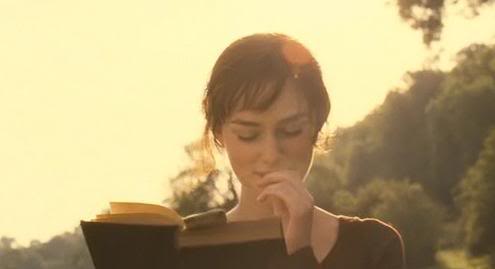
Novels & Gender

Elizabeth Bennet reading

While reading the introduction of Lorna Doone, I was struck by the author, Sally Shuttleworth (say that ten times fast), comparing Lorna to Jane Eyre, and both books being viewed as "women's novels," even though Lorna Doone was voted the favorite novel of men at Yale in 1906.  This was before, as the author put it, "polarized, gender-specific notions of appropriate reading matter which have emerged in the second half of the twentieth century."

But haven't there been gender divisions and assumptions of suitability in reading and books all along?  It seems from the start of "the novel," they've been for women while men read facty non-fiction.  Mr. Darcy might applaud Lizzie for reading, but you don't see him curled up with The Mysteries of Udolpho, now do you?  And certainly there were ideas about what was and wasn't appropriate reading for women from day one. 

Also, I recall seeing a conversation on Twitter--I can't remember who exactly was involved, sorry--where someone pointed out that a HUGE percentage of classic novels have portraits of women on the covers.  Is that because a lot of them have females as the central characters, or is it assumed that they will only appeal to women?  Lorna Doone itself has a portrait of a woman on the cover (or at least my copy does), even though the narrator and central character is a man.  One could say this is a bald attempt to market the novel to women; but why would it be assumed that a classic novel is more appealing to a woman than a man?


Do you agree with Shuttleworth that gender-specific novels are a recent development? 
Do you think classics are being marketed to women instead of men?


Powered by ScribeFire.

Tuesday, June 23, 2009

The Bachelorette & Male Solidarity

Bachelorette party with guys

So I've been watching The Bachelorette lately, and if you keep up with the show at all, you know that one of the guys has mentioned he has a girlfriend back home, and is only on the show to promote his musical career (pssst... it's Wes).  Even though several of the guys have mentioned this to Jillian (Bachelorette), none of them will tell her who the guy is.

Now that's interesting.

If this was The Bachelor, you know the women would be telling all and sundry who said what and when, and explaining to the guy exactly what he should be doing about it.  There is no freaking way they would keep that information to themselves.  But with the menz, apparently "group think" and solidarity trump everything else, even being kicked off the show while another man who clearly doesn't deserve it gets to stay on.

I can't help but wonder if this is an example of why it took women so long to long to get equal rights (well, takes, since not all women have equal rights yet).  I think we've all known girls who will cheerfully throw other women under the bus, especially if there's a man involved--maybe some of us are that kind of girl.  And then there are all the women who dictate how a "proper" woman should behave or act.

This kind of adds to a personal theory I've had for a while that women are not, for the most part, subjugated by men but by themselves.  Do men really care what we do?  No, they don't.  There are have been plenty of powerful women in history, but do they help other women obtain the same power?  Heck no!  Some of them, like Queen Victoria, even make it a point to hold other women down.  And is it a coincidence that women's suffrage only started to gain a foothold when women-only groups began forming in the late nineteenth century?

Meanwhile, the men folk apparently keep up a wall of solidarity, even when it results in personal cost to them.  No wonder they've managed to maintain a power base for thousands of years!  Strength in numbers, my friends.

Do you think men have more of a group mentality than women do?  Or am I completely off-base in my pop-sociological assessment of this reality TV show?


Powered by ScribeFire.

LinkWithin

Related Posts Plugin for WordPress, Blogger...