Showing posts with label nineteenth century. Show all posts

Monday, September 6, 2010

What Alice Knew by Paula Marantz Cohen

alice cover

Immediately after I requested this book for review from Sourcebooks, I had a long pang of doubt--in my experience, novels that use Jack the Ripper in the plot are to be avoided.  However, I'm happy to say this book is an exception.

The unlikely hero of this tale is writer Henry James, who, along with his brother, William (a professor at Harvard and an early expert in psychology), and his sister, Alice, helps to investigate the Ripper murders.

This book is so much fun, mainly because of Henry.  One wouldn't expect someone like Henry James to be funny, but he really is--in a cute, bumbling sort of way.  Alice is another great character--she's smarter than both of her brilliant brothers (as she says at the end of Chapter 4, "I will review what you gather... and solve the case." There are a bunch of awesome one-liners in this book, btw), but remains largely bed-bound, viewing herself as an island of reason in an insane world.

Jack the Ripper has been done and re-done to death in books, movies, graphic novels--just about any format you can imagine.  In What Alice Knew, however, it doesn't even feel like the Jameses are investigating Jack the Ripper, because Cohen brings such a fresh spin to it.  And she uses the investigation to showcase numerous people and subjects: John Singer Sargent, Oscar Wilde, women's suffrage, photography, art (both academic and avant garde), social class, bigotry, religion, dinner parties, laudanum, theater, and just about anything else you can think of.  In fact, it reminded me of Drood in the way it seemed to submerge the reader completely in the world of the Victorians (except it's much better because it's about 500 pages shorter).

That being said, once the siblings' investigation got underway in earnest, the book ironically became a lot less interesting.  This was because the main suspect was so obvious, you knew he couldn't be the Ripper; but there really weren't any other leads to follow, which made the whole thing seem rather pointless.  The last one hundred pages seemed to drag by.  There were also two romances involving both Alice and William, respectively, which were absolutely delish in their Victorian subtlety and unspokeness; even though I enjoyed them, though, I think William's romance especially seemed like a tangent to the central plot of the book and slowed the narrative wayyyyy down. 

I also hated the ending.  While I can see, I think, where the author was going with it, it didn't feel supported by the rest of the book.  Cohen was trying to fit the ideas that you can never truly know another human being, all situations are about context, and did-they-catch-the-killer-or-didn't-they (?!??) into the last 10 pages of the book, and for me it really didn't work.

Overall, though, this was a very good novel--definitely one of the best Victorian-set historicals I've read in a long time, and the kind of book I would recommend unhesitatingly.  When I finished, I felt like the cloying atmosphere of Victorian London was physically clinging to me, and I do admit to still missing Henry.  If you're a nineteenth-century geek, you really, REALLY have to pick this one up!


Powered by ScribeFire.

Saturday, August 7, 2010

When Art Meets Life--and Murder

what alice knew cover

What Alice Knew by Paula Marantz Cohen "stars" Henry James and his two siblings, William and Alice, as the main characters.  It also prominently features their friend, John Singer Sargent, and several other artists and writers.  While reading the book I couldn't help but wonder which of the characters and paintings were real and which weren't.  This is just a small sampling of what I found.

henry james

Henry James (above) is obviously a real-life someone.  He and Sargent were great friends, but he had to have his portrait painted twice because the first one pleased neither the artist nor the subject.  I would love to get my eyes on that rejected work, but I have yet to find it.

I actually remember this painting from the first-ever art history course I took, although I didn't know it was of Henry James at the time.  The instructor used it as an example of Sargent's skill--to make the links in the watch chain, for example, he dipped half his brush in bright yellow paint, and the other half in a dark gold, then just painted the links--simple! 

I think this is a great portrait of James--you can see that he's always thinking and trying to be serious, but has an intrinsic humor; it looks like he's trying hard not to smile.  I kept picturing James like this in my mind while I was reading the book.

Alice James

I also really wanted to find a picture of Alice James, Henry's sister.  She spends most of her time in bed due to incapacitating headaches.  Unfortunately, I couldn't--but I did find a painting of William James' wife, who was also named Alice.  Doesn't she just look... yeah.  Poor woman.

Ellen Terry

The portrait above is of Ellen Terry, a famous dramatic actress in the Victorian era.  By painting her in the persona of Lady MacBeth, Sargent was following in the footsteps of famous eighteenth-century portraitists like Sir Joshua Reynolds.  The scene where Sargent paints this work is actually in What Alice Knew, and is so much fun!

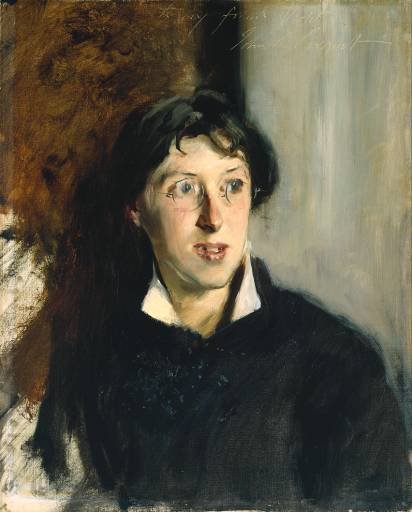
Vernon Lee

Another great scene in the book is the dinner party Henry and Alice throw to lure one of the murder suspects into questioning.  Among the other guests is famous actress Fanny Kemble, Constance Fenimore Cooper (whom I'm guessing is Constance Fenimore Woolson?), and Vernon Lee, whose portrait is seen here.  Her real name was Violet Paget, but, as the book put it, "had lately, in rebellion against her femininity, renamed herself Vernon Lee").  How cool is that?

Vernon Lee's portrait is actually one of my favorite Sargent portraits, just because you can practically see her personality, almost as if she's right there in front of you.  I also like it because Sargent painted it after he had sworn off portraiture, so you can tell it's a portrait of friendship and everything he likes about Vernon--who apparently was quite the irrepressible character.

daughters of edward darley boit

Another very interesting character in the book is Ella Abrams, the daughter of a prominent Jewish businessman.  I thought for sure she and her family were real historical figures, but so far I haven't been able to find them.  In the book she was painted several times by Sargent, as was her family.  I immediately thought of this work, The Daughters of Edward Darley Boit--probably just because it's one of his most famous pieces, but I also thought the familial atmosphere of the Abrams in the book and Boits in this work was very similar.

walter sickert

One person I did NOT expect to be a historical personage was Walter Sickert, mainly because he was the most obvious murder suspect in the book.  But, surprise, he was a real Victorian painter!  Here we see a photograph of him from 1911, around the time of the book's epilogue.  Does he look like a murderer to you?

jack the rippers bedroom

I was also surprised to find out the real Walter Sickert was tangentially involved in the Ripper murders--or so he believed--and that he's been accused of being the Ripper several times.  He claimed to have roomed with the Ripper briefly, based on some incidents related by his landlady, and painted a work he titled Jack the Ripper's Bedroom (pictured above).  Several writers have used this as a jumping-off point to argue he was the actual killer, including Patricia Cornwell, who supposedly bought up nearly all of his paintings and then destroyed them in the search for his DNA.  She denies this--although she does claim to have samples of Sickert's DNA, and that it matches samples found on the Ripper letters, soooo... how'd you get those samples, Cornwell?  Just sayin'.

camden town murder

More than likely, Sickert was simply a sensationalist capitalizing on the Ripper murders, just as he did with this painting, Camden Town Murders.  It was exhibited during a later period of London-based serial killings (c. 1911).  This work appears in the very last scene in What Alice Knew, along with the observation, "Perhaps Jack the Ripper is back."


What Alice Knew is an excellent book that's very well-researched and will submerge you completely into Victorian London.  It comes out September 7th--check back then for my review!


Powered by ScribeFire.

Saturday, October 31, 2009

Creepy Art

the crying spider The Crying Spider by Odilon Redon

In honor of Hallowe'en, M from Alberti's Window has a great post up on her blog about Goya and his creepy paintings.  Although I tend to avoid anything Hallowe'en-related like the plague, I thought it would be fun to take a page out of M's book and write about a few of my favorite creepy artists.

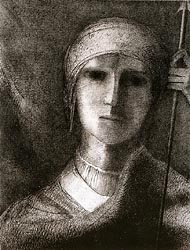
Odilon Redon was a French Symbolist who, like many 19th-century artists, took inspiration from Edgar Allen Poe and Goya.  He wanted his paintings and lithographs to appear mysterious so as to inspire the unconscious mind.  One of my favorite works by him is Parcifal, because if you look at the painting one way, it appears to be a man; but if you look at it another, it looks like a woman.  Why, you might ask?  Because Parcifal was considered to be androgynous and the Symbolists were all about that.  And also because he first wanted to make a druidess, but she didn't turn out well; so to salvage the plate he just decided to change her into a guy. Art!

Butterfly Catcher by Remedios Varo

Another one of my favoritest artists of all time is Remedios Varo, a Surrealist who was (also) very inspired by Goya and Bosch.  And also Redon, funnily enough.  Varo's work is very clever, with a wry sense of humor, and is really more fantastical than scary--unless you consider being a woman trapped in a male-dominated society scary, in which case, yes, her paintings can be pretty creepy.

severed heads Severed Heads, Géricault

Finally, I lurrrrv Théodore Géricault because he was morbid as heck.  It all started with The Raft of the Medusa, a painting based on a true-life event that Géricault researched out the wazoo--talking to survivors, building a model of the raft, and so on.  At one point, he decided he needed to sketch dead bodies so his depiction of the tragedy would be "accurate."  After that, he had random body parts lying around his studio all the time!  He even (according to legend) would collect heads freshly severed from the guillotine.  In the above painting, one head is real and one is fake--the creepy part is that the one that's been collected from the guillotine looks more alive than the fake one.  In his later years, he also enjoyed sketching portraits of the insane.  Gotta love a guy like that!


Do you have a favorite creepy or disturbing work of art?


Powered by ScribeFire.

Saturday, October 3, 2009

The More You Wish You Didn't Know: Savonarola Chairs

savonarola chair from Pelazzo Vecchio

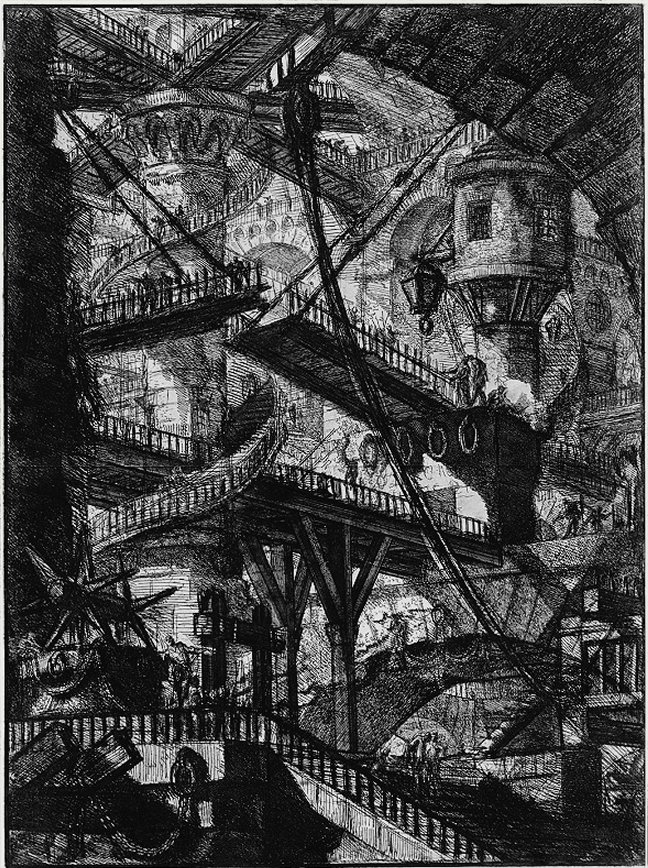
In The Lost Symbol by Dan Brown, the bad guy, Mal'akh, lives in a house with "a Piranesi etching, a Savonarola chair, a silver Bugarini oil lamp."

What the heck is a Savonarola chair???

Savonarola: Crazy priest who lived in 15th-century Florence, known for burning "immoral" books, dresses, and paintings.  That is, at least until the Florentines got tired of him and executed him.

A chair: Something you sit in.

How do these two things go together?  Well, it turns out they actually don't; the Savonarola chair is a fold-up wooden chair that dates back to Roman times and has been popular throughout Europe at various times.  But it was especially popular in Italy during the Renaissance, so it somehow acquired the "Savonarola" moniker.  They're also called Dante chairs or X-chairs.

As for the other items--Piranesi is a 19th-century artist famous for etching imagined prisons, or carceri, scenes; and Bugarini was a famous Italian silver smith who made neo-classical oil lamps, also during the 19th century.  So I guess the point of that sentence is... this guy is moneyed.  And also enjoys all things Italian.

the more you wish you didn't know

Next time... curious codes!


Powered by ScribeFire.

Thursday, September 3, 2009

And the Moonbeams Kiss the Sea

And the Moonbeams Kiss the Sea

See! the mountains kiss high heaven,
And the waves clasp one another;
No sister flower would be forgiven
If it disdained its brother;
And the sunlight clasps the earth,
And the moonbeams kiss the sea: -
What are all these kissings worth,
If thou kiss not me?
~Percy Bysshe Shelley, Love's Philosophy


I like mystery books, but I LOVE mystery shows; and last week's And the Moonbeams Kiss the Sea, the first episode in the second season of Inspector Lewis on Mystery! (or Masterpiece Mystery or whatever the hell they're calling it now) was a great piece of television:  entertaining, intense, mysterious, and fascinating.

inspector lewis and ds hathaway

If you don't keep up with Mystery, here's a quick run-down:  Inspector Lewis started off as the Detective Sergeant on a previous series, Inspector Morse (which I've never watched).  Then Morse died, and now Lewis is the inspector in his own series, aided by the "dishy" Det. Sgt. James Hathaway. 

Lewis and Hathaway are part of Thames Valley Police, whose environs include Oxford University.  The central mystery of And the Moonbeams Kiss the Sea revolves around one of the university's most famous students, Percy Shelley.  It all starts when several volumes of rare 19th-century literature is discovered in the flat of a murder victim and janitor at the Bodleian Library, arguably one of the most famous libraries in the world.  After getting a peek at the inner workings of the Bodleian, Lewis and Hathaway are led, strangely, into the world of gambling and fine art.  This isn't exactly a whodunnit story (it's obvious fairly early on who the baddies are), but the mystery lies in raveling why the murderers killed their victims.

First of all, let me just say that Hathaway is my favorite part of this series.  He is super-smart, quiet, funny ("Do I get to play at being a policeman, then?" Philip, suspect number one, asks at some point in the show.  "Why not?" Hathaway mutters in response.  "We do it all day."), and very intuitive.  Not to mention dishy!  And did I mention he plays music?  It's, like, Ren Fair jazz or something, but still.  He's totally swoon-worthy.  Thus I was the complete opposite of bothered by the fact that he recited Shelley's "Love's Philosophy" so many times during the course of this episode I now have it memorized.  He can recite poetry as much as he wants as far as I'm concerned.

Anyway, back to the point (assuming I have one), what I really found fascinating about this episode was, of course, the way it treated art and artists.  One of the murder victims is an art student who does conceptual pieces like videos of paint drying.  Philip, her friend and the initial suspect, is a painter with a photographic visual memory.  Lewis and Hathaway, of course, being no-nonsense policemen and blah blah blah, are completely perplexed by Nell's contemporary art pieces--works like video of paint drying and trying to bomb a building.  However, the show itself didn't treat Nell's work dismissively--on the contrary, she's called original, imaginative, and creative several times in the course of the episode.

Not so with Philip, a painter and fan of JMW Turner and John Constable, the gods of English landscape painting.  The university gallery manager calls him, "Just an eye," and Philip himself says he doesn't have ideas.  Because he paints what he sees, he's portrayed as a mere copyist--literally.  Not only that, but he's sexually and emotionally emasculated.  At the same time, however, his "copyist" powers of observation give him an almost Sherlock Holmes-esque ability to help solve the case.  Apparently, mimetic art is good for deductive reasoning and recording, but does not qualify as creative or original.  One wonders where that puts photography, then.

I also love how academics are portrayed in this series (hint:  it's not flattering).  They're snobby, completely out of touch with reality, and either abuse their specialities for personal gain or hate them--or both.  Academidiots are such easy targets.

Overall, I thought this was a great episode, but I was a bit bothered by how art was portrayed in it.  The "good" pieces were incomprehensible--which fits way too much into this myth that there is any such thing as originality, let alone that that contemporary art is the sole possessor of it.  Talk about academidiots--that's total bull crap.  But then I'm a 19th Century person, so obviously I would favor Turner over watching paint dry.

If you want to read more about And the Moonbeams Kiss the Sea, check out Ruth's excellent review of it at Booktalk & More!


Powered by ScribeFire.

Saturday, August 8, 2009

Manga Review: EMMA by Kaoru Mori (Vols. 1-7)

Emma cover vol 1Emma cover vol 2Emma cover vol 3
Emma cover vol 4Emma cover vol 5Emma cover vol 6
Emma cover vol 7

Emma by Kaoru Mori, Volumes 1-7

Emma was the only book I managed to finish on vacation (if you consider all the books in a series to be one book, which I sometimes do--especially when I read them all at once).  I love manga, but I usually stick to vampire romances.  However, I'd heard such good things about this series; and my library managed to get the entire set in literally hours before I left, so I decided I to give it a try.

Emma is about a maid named Emma and her adventures.  One would be tempted to call it a historical romance, but it's really more in the style of penny dreadful novel or a Dickens story.  There are lots of characters and different sub-plots running through all of class-conscious, nineteenth-century English society; not to mention abductions, runaways, secret engagements, parental twists, dancing girls, and random nudity (that last one must be for the menz).

The central plot, though, is a love story between Emma and the wealthy bourgeois, William Jones.  They meet when he goes to visit his old governess.  William is immediately attracted to our bespectacled heroine, who serves him tea, and he maneuvers to meet her in public.  Meeeeanwhile, his super-serious dad wants him to mingle with the debutantes and choose a wealthy society girl to be his wife.  Not to mention Emma is being chased after by every male between Covent Garden and Brighton.

The first volume was okay, but I didn't start getting into the series until the second volume.  In that book, William takes Emma to the Crystal Palace, and it's awesome.  And they kiss!  And is sooooo well done and romantic and different the way Kaoru Mori depicts it.  It was during volume the second that I started to get a feel for the characters, who I loved.  William lives with his father, two younger sisters, and younger brother; plus his unforgettable guest and BFF, Hakim the Indian prince, who magically travels (+ elephants and dancing girls) between England and India in the blink of an eye!  At first Will seems a little bland, but his character starts to come out when he's surrounded by his family and friend and interacts with them.

Emma is mainly a passive character all through the series.  I like the girl, but she loves to clean, which makes me question her sanity; and she seems mainly content to let the status quo remain intact.  The major tension in the books comes from wondering whether or not Emma will take a chance a break the class barriers that separate her and William so they can be together.

Mori obviously put a lot research into the historical setting, and I loved the clothes, food, and architecture she treats us with as the story goes on.  Although that's not always consistent.  There was one scene in the first volume where William is playing with a model airplane--hellooooo, nineteenth century!  But overall I was impressed with the sense of historical time and place that the books had.  The clothing especially was fabulous.

Not that this series is all about the tortured love affair between Emma and Will--c'mon, this is manga!  These things can go on indefinitely.  There are plenty of sub-plots and other affairs winding their way through the books, from Will's fiance (not Emma), to his fiance's sister, a little girl who finds his hat, his parents' stories, his siblings, and all the servants in the house Emma works in. 

Basically these books are just fun and entertaining, on occassion completely ridiculous, and totally addictive.  I dragged through volume seven because I didn't want the series to end!  And then the ending resolved nothing, and I was all, "What the hell?!"  But fortunately, a quick search on Amazon revealed that, even though volume seven is supposed to be the last issue, there are actually two more available and a third to be published.  Hooray!

I would heartily recommend Emma, especially if you love anything related to the nineteenth century.  And now back to vampire romances.


Powered by ScribeFire.

Saturday, July 11, 2009

The Male Gaze

pont l'europe by caillbotte Caillebotte-Le Pont de l'Europe

I was reading a post at Alberti's Window the other day, and it made me think about The Male Gaze. 

The male gaze is one of those terms that art historians throw around a lot, but never really define.  It's used in both Freudian and feminist contexts and generally connotes the sexual objectification of women in various media, including print, fine art, and film.

In the Loge Mary Cassatt Cassatt, In the Loge

Rarely mentioned in art history (or anywhere else) is that "the male gaze" is not a modern invention of feminism; it's an actual idea and practice that emerged in the nineteenth century.  Most women in the twenty-first century take their right to be able to go out in public and look at things for granted; but nineteenth-century women were supposed to keep their gazes down and shielded as a display of proper respect and modesty.  And under no circumstances were you ever supposed to look at a man who wasn't related to you in public.  You hussy, you!  The only places where women could let their gazes wander freely were at art exhibitions like the Salon (ironically enough), or at the Opera.

The reason for this was because the gaze was very sexualized in the visual-hungry culture of the nineteenth century.  A man claimed something as his own by looking at it, and that included women.  The power to see, to walk freely through a city like Paris and observe in cafes and on streets, was considered a purely male perogative.  That's why Caillebotte's paintings of Paris are considered so masculine, and why paintings from female artists like Cassatt and Morisot are mostly of other women in a private setting.  Cassatt wouldn't have been allowed to visit the cafes that Manet and Degas did, even if she had tried to do so (which she actually did).  A woman's gaze--especially if she was of a middle- or higher-class--was very restricted.

Olympia by manet Manet, Olympia

If you were of a lower-class and lower morals, however, it was another matter entirely.  That was part of the reason why people assumed Manet's Olympia was the lowest class of prostitue:  she dares to meet the viewer's gaze.

This why art historians make such a big deal out the male gaze, and gazes in general--it was a historical idea that truly affected artists and how they chose to represent the world.  And, despite the fact that women no longer have to restrict their gaze to just the home, we still live with the legacy of The Gaze in movies, television, and print.


Powered by ScribeFire.

LinkWithin

Related Posts Plugin for WordPress, Blogger...