Showing posts with label art history. Show all posts

Wednesday, May 8, 2013

The Salon: A Continuing Investigation

spirit of the dead keep watch by paul gauguin
Paul Gauguin's Spirit of the Dead Watching shows his Tahitian wife, Tahura.

For several years, I've been following the activities of a cabal organization known as The Salon. It all started when I read the graphic novel The Salon, by Nick Bertozzi, which takes place in pre-War (World War I, that is) Paris and is about a group of people—Alice B. Toklas, Erik Satie, Picasso, Georges Braque, Guillaume Apollinaire, etc.—who drink a special absinthe that allows them to enter paintings. It's all fun and games until Paul Gauguin's fourteen-year-old Tahitian wife, Tehura, uses the absinthe to travel OUT of the paintings and into the real world, where she wreaks vengeance! against Gauguin and his asshole friends for sexually objectifying her. In response, The Salon develops Cubism, which relegates its subjects to two-dimensions.

I know you're probably thinking this is just fiction. That's what I thought, too, until a woman attacked Gauguin's painting Two Tahitian Women at the National Gallery, screaming, "This is evil!" and told police that Gauguin, "was evil and the painting should be burned," the exact method The Salon used to destroy the paintings with Tehura in them. Coincidence?! Add to that the fact that no one seemed to know who the woman was and the whole incident smacked definitively of The Salon.

grimm kiss of the muse
An artist's studio filled with portraits of the same woman.

Since then The Salon has been keeping a low profile, but last night on the TV show Grimm, they appeared again. The episode, titled "Kiss of the Muse," was about a woman who, because she's a magical Wesen creature (work with me here) naturally attracts artists. Only to drive them insane to the point that they start killing one another and themselves in order to be with her. It's revenge for objectification all over again.

But that's not all. During the episode we learn more about this Wesen creature, and it turns out SHE WAS THE REASON GAUGUIN AND VAN GOGH SPLIT UP AND VAN GOGH WENT CRAZY ZOO CRACKERS. You see, Van Gogh and Gauguin were hanging out in Arles, happy as one massively egotistical and narcissistic artist and one really sweet and sensitive artist could be, until Van Gogh saw this "musai," or muse, and started obsessively painting her. When Gauguin showed up, Van Gogh perceived him as a threat to his exclusive relationship with his muse and threatened Gauguin with a razor blade. After Gauguin left, Van Gogh's spiral continued, and he eventually cut off his own ear.

grimm kiss of the muse portrait
Massive portrait of the artist's muse. Crazy colors show he's on the edge!

I know what you're thinking—if that's true, where are the paintings of this muse of Van Gogh's? THE SALON DESTROYED THEM, obvs! The more interesting question is, why would The Salon reveal itself on a TV show like Grimm? Answer: I think The Salon is trying to tell us something. It wants us to beware of all representational art and sexual objectification, because muses are more dangerous than you think. Even with The Salon's promotion of abstract art, people still like to represent things.

Does The Salon know something we don't? Has another muse escaped her painting to cause death and destruction? I will post more details as they become available.


Discus this post with me on Twitter, FaceBook, Google+ or in the comments below.

Friday, January 4, 2013

Manet's OLYMPIA in Books and TV

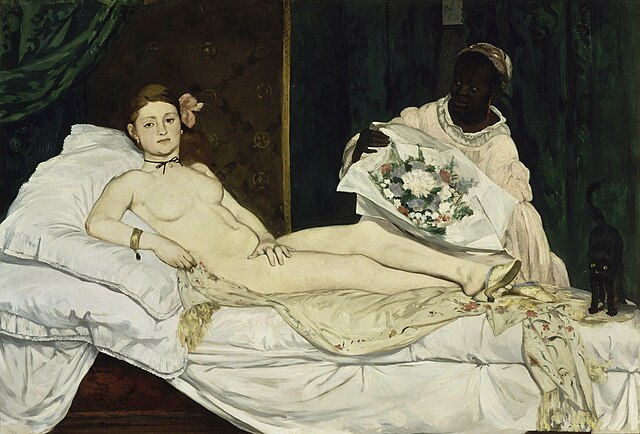
manet's olympia
Olympia, Edouard Manet, 1863, Musée d'Orsay, Paris.

Ahoy, mateys! Major rant ahead...

Edouard Manet is one of my favorite historical crushes. Just check out the interview I did with him if you don't believe me. A nineteenth-century avant-garde artist, Manet inspired the Impressionists and was one of the first modern artists. But he's definitely not as famous as any of the Impressionists, including his bestest frenemy, Edgar Degas. And that's perfectly fine with me. Manet is my historical crush; get your own!

It's kind of weird that in the past few months, I've seen Manet's Olympia given the art history shout-out treatment twice: once on TV and once in a book. And both times it was totally anachronistic. The first instance was on the BBC America series Copper, which is about the NYC police department during the Civil War. On the show, the wealthy Elizabeth Haverford has Olympia hanging in her drawing room. Okay, it's not the ACTUAL Olympia (I can just imagine what they'd have to pay the Musée d'Orsay to get away with that), it's just "very reminiscent of" Olympia according to the show's own blog.

elizabeth haverford's painting from copper
Screenshot of Elizabeth Haverford's painting. C/o BBC America blog.

I don't have a problem with a TV show creating its own version of a famous painting, but I do have a problem with Copper using Olympia. It's horribly anachronistic and drove me crazy. Yes, Copper is set in 1864 and Olympia was painted in 1863, but:

  1. Manet didn't exhibit it--in Paris--until 1865, so how would Elizabeth have gotten her hands on it, hm?
  2. Even ignoring the whole exhibition thing, seeing how the painting isn't "really" Olympia, in order to get a painting like it, Elizabeth would have had to travel to Paris. In the middle of the Civil War? I don't think so.
  3. When Olympia was first exhibited it was WAY avante-garde. It took the French public nearly 30 years to accept Olympia as a masterpiece. The US was generally about twenty years behind Paris in the visual arts (at least in the 19th century), so by my calculations there is no way an American would have anything resembling Olympia until the 1910s at the earliest. BUT...
  4. When I say "Americans" I actually mean American men, since if you haven't noticed there's a naked prostitute in that there picture (that's what made the painting scandalous, by the way--also, it's pretty badly painted). Not the sort of thing a respectable woman would own, let alone have hanging in her drawing room. Even William Bouguereau's Nymphs and Satyr was considered too risque for women to look at, for heaven's sakes!

For the above reasons, although I of course love Manet, I found the presence of Olympia on Copper very annoying. Whenever I saw the painting in Elizabeth's house I was thrown out of the story. Fortunately Corky got pissed off and slashed the painting near the end of the first season, so I won't have to look at it in season two. Yay!

The second instance was in The Importance of Being Wicked by Miranda Neville, which I'm currently reading. Naturally one cannot see paintings in a novel, but I'm pretty sure the portrait described at the beginning of the book is Olympia. It's of an "almost naked [later "stark naked"] woman, reclining on a satin-draped divan." The figure has short, red hair and a bold, direct gaze. Also: Caro wears a ribbon around her neck like Olympia. But most of all, the painting is modeled after a Titian. A Titian like this, for example?

the venus of urbino
The Venus of Urbino, Titian, 1538, Uffizi Gallery, Florence.

BOOM. Manet totally modeled Olympia after The Venus of Urbino. This is the only Titian where the subject is 1. a female nude who is 2. lying down, 3. a ginger, and 4. looking at viewer, so it must be the Titian Caro's husband bought and her friend Oliver later copied, using her as a model.

Again, while I enjoy art history shout-outs, this is pretty anachronistic. The Importance of Being Wicked takes place in 1811 at the latest (likely earlier), and again there's no way a woman of the time would have a painting like that hanging in her drawing room, no matter how daring she was.

What I wonder is, why Olympia? It's a pretty famous painting--even if you don't have an art history degree you've probably seen it--so it's not as if no one would recognize it. I get it, Elizabeth Haverford's a whore (like every single other female character on Copper) and that's why there's this ugly painting of her in the drawing room; but I'm pretty sure there's only about a bazillion paintings out there that could convey that fact more cleverly and effectively than Olympia AND be historically appropriate. Even a Madame X type of portrait would make more sense than Olympia.

With The Importance of Being Wicked, I don't have to look at the painting while I'm reading, so that makes it less annoying than Copper. But the characters show an anachronistic tendency towards "modern art" (term actually used in the book) by reviling the dramatic poses and allegorical works that were popular at the time. That just doesn't shake out in the context of the time period: what we consider "natural posing" doesn't make sense without photography. Not to mention, since the novel IS set in the late 18th century, that London was the Scandalous Portrait Capital of the World! For realz, it's not as if the most famous women in English history at the time had their portraits painted when they either wanted to become famous or shock their family, or both. OH WAIT they all did that, my bad. Modeling a portrait off one of the (many) paintings of Kitty Fischer, Sarah Siddons, Lady Sarah Lennox, or Lady Hamilton would make much more sense. It's not as if there isn't a lot of options to chose from.

Art is a reflection of its place and time, and thus is a great tool for writers and filmmakers to enhance the setting of their story and add depth to their characters (a great example is the use of the Bird Lady on True Blood). But not if the art used is inappropriate! In that case all one winds up with is a sad mess that doesn't mean anything to anyone, least of all to the people who might appreciate the reference the most (such as myself).


Further Reading:

Friday, December 23, 2011

The Girl Who Slept

girl asleep
Johannes Vermeer, Girl Asleep, 1657

Have you ever noticed that women in romance novels sleep a lot? Naturally we all need sleep, but with something so ordinary it doesn't seem worth mentioning in a book unless there's a point, like going to the bathroom. So what's the point of all the sleeping? Tired writers? A zombified nation of near-catatonic workaholics who can only sympathize with people in a similar state of ennui? Or does it mean something?

While rereading New Moon last month, I couldn't help but notice that Bella kept passing out--or almost passing out--a lot. And not during entirely appropriate moments (like, you know, bed time), either. Of course, the story is based on Sleeping Beauty, so I figured that had something to do with it, and set the issue aside to think of it no more.

BUT THEN, since I was already thinking about it (despite my resolve not to), I kept noticing heroines in nearly every romance I picked up afterward had a similar problem! It seemed as soon as these women encountered an extremely tense, emotionally-wrought, or high stress environment, they decided they needed a nap because they were super duper tired. "Here I am, alone in the house of a rake who wants to ravish me. Snnnnooorrrrzzzzzzz." Really?

At first I guessed that it was some passive-aggressive way of avoiding conflict--kind of like how Scott Pilgrim runs off to the bathroom as soon as he's faced with a potentially awkward situation. But it seemed odd that so many heroines would fall asleep in different books and situations. "What purpose does this serve the story?" I wondered to myself (actually it went more like, "WHAT THE HEEEEEEECK?!?"). Reading about women who keep falling asleep isn't exactly exciting.

the nightmare
John Henry Fuseli, The Nightmare, 1781

It was an embarrassingly long time afterward that I remembered sleeping women in art history=SEX ALL OVER THE PLACE! Exclamation mark! The most famous example being Fuseli's wildly popular The Nightmare. Pointed toes, arched back, and expression of combined agony and bliss--that woman is totally having an organism. And what's being done to the horse behind that curtain? You don't know; and judging by its expression, I don't want to know.

Aside from the pulled-out chair and open doorway that suggests recently vacated company, Vermeer's Girl Asleep is, according to your friendly neighborhood symbologists, full of allegories for temptation, love, and intercourse. It also looks like there's someone under the table, and I don't think they're picking up silverware. IF YOU KNOW WHAT I MEAN.

In literature, too, a sleeping woman is often a symbol of passive sexuality--think of Sleeping Beauty and Snow White, for instance. Again, this is reflected in Twilight: there's a reason why the dynamics of Edward watching Bella sleep puts mamas' panties all in a twist. Or take the scene in New Moon when Jacob sneaks into Bella's room to tell her the Very Important Thing about him being a werewolf and she can barely keep her eyes open. Of course, the fact that she doesn't fall asleep while he's around could indicate that she's not as 'available' to him as he'd like her to be.

For hundreds of years, at the least, a sleeping woman has suggested a sexually available woman. Do I think romance novelists are deliberately using this imagery to make their heroines seem more sexualized? Perhaps--Meyer employs it very effectively--but I think at this point it's become such a part of our culture that we don't consciously take note of it, especially in contemporary-set novels. Most people aren't looking for allegories or subtext in books; if they were, it would make reading certain novels really uncomfortable (I'm looking at you, Lewis Carrol). Even if they aren't consciously aware of it, however, on some level it is clear that the heroine, while asleep, is more vulnerable to the hero. If she's dropping off to sleep, then obviously she trusts him.

elizabeth siddal
Elizabeth Siddal, 1860. Photo courtesy of lizziesiddal.com.

Have you ever noticed this narcoleptic heroine phenomenon? Do stories where the power dynamic is reversed and a woman observes a man who's sleeping have the same subtext?

Monday, April 4, 2011

The Salon Strikes Again?

two tahitian women
Paul Gauguin, Two Tahitian Women, 1899

A few weeks ago, I reviewed The Salon by Nick Bertozzi, a graphic novel about a group of artists and cognoscenti--including Picasso, Apollinaire, Georges Braque, Gertrude Stein, and Erik Satie--who drink a special absinthe that allows them to enter paintings. The absinthe was discovered by the deceased Paul Gauguin, whose 14-year-old Tahitian mistress is using the absinthe to come out of his paintings and kill artists and collectors. The plot may sound silly and far-fetched, but was something I found to be powerfully metaphorical. As I argued in my review, Gauguin's mistress is wreaking vengeance against the Parisian art world and their sexual and colonial objectification of her, which led to her becoming a junkie whore and dying. The fear of their subjects coming back to haunt them as Anna did leads Picasso and Braque to create cubism, which effectively relegates objects to a two-dimensional surface.

Strange Concurrence

So imagine my reaction when I read this report (via the Washington Post) about a woman who attacked Gauguin's Two Tahitian Women at the National Gallery last week, screaming, "This is evil!"

Lack of Evidence

The Washington Post article implies the woman attacked the painting because of the figures' semi-nudity, but I have my doubts. After all, this is hardly the only work of art in the museum that depicts nude people. Why not attack something closer to the entrance? Secondly, why haven't we been told the woman's name? Very suspicious. Even court records have not been made available. Might it be because she's a member of The Salon????!?!?

An Associated Press article reports the woman, "told police the post-Impressionist artist was evil and the painting should be burned," the exact method Salon members used to destroy Gauguin's paintings in Bertozzi's novel ! ! ! !

Expert Opinion

Memory, who blogs at Stella Matutina and reviewed The Salon said of the book, "Me, I think it’s real, but alternate interpretations are certainly possible." When questioned about the Two Tahitian Women assault, she declared the attackeress was, "clearly a Salon member. Or at least someone who's read and been unduly influenced by the book."

I have to say, after reading the book, I can see how it might convince someone to link Gauguin's paintings with evil. Do we need to ban Bertozzi's dangerous vision of modern art in order to protect Gauguin's work? Or do we need to ban Gauguin's art to protect ourselves???? Unfortunately, I think the cat's out of the bag as far as Gauguin's paintings are concerned, so the mysterious woman's attack was essentially pointless.


Powered by ScribeFire.

Monday, March 21, 2011

THE SALON by Nick Bertozzi

the salon cover

Georges Braque is a typical starving artist in Paris, hoping to invent a new style of painting. After courting the favor of important avant-garde art collectors Gertrude and Leo Stein, he becomes embroiled in the salon--a group of the Stein's friends (including Pablo Picasso, Guillaume Apollinaire, Erik Satie, and Alice B. Toklas) who drink a special blue absinthe that allows them to enter paintings. Unfortunately, Gauguin's former mistress, Anna, has figured out a way to live in the paintings permanently, which has given her super-human strength; and now she's taking bloody revenge on the artists for being objectified, by ripping their heads off. Leo and Gertrude are certain they'll be next.

sample page

A part of me really loved this graphic novel--and yes, it was the art historian part. As soon as I saw Memory's review of it on Stella Matutina, I knew I had to read it. A good portion of my master's thesis involved the avant-garde in early twentieth-century Paris, including Apollinaire and Picasso, so it was soooo totally up my alley. That being said, the part of me that reads for pure entertainment value was disappointed. The only character with any personality in this novel was Picasso, and his motivations were pretty basic: food and sex. Everyone else seemed fairly interchangeable. The book feels edited down to the point of near-incomprehensibility, but at the same time it takes a looong time to read. The ending was kind of lame, and I didn't feel like I learned much of anything about this time period or the avant-garde.

But like I said, as a person who knows way too much about this shit, I did enjoy it. My favorite part of the novel was, surprisingly, Picasso. As some of you may know, I'm not a fan of Picasso. I think he's an overrated hack, in all honesty, so any book that presents Picasso as a lewd and unoriginal "little man" who fucks chickens (all true--okay, maybe the chicken part isn't) gets my vote. I actually warmed up to Picasso a bit while reading The Salon, just because he was so stupid. I also loved clever Apollinaire, even though he didn't get a lot of scenes, as a dashing bi-sexual playa playa.

Leo and Gertrude's storyline, on the other hand, seemed to go nowhere; nor was Georges Braque very interesting. This is unfortunate, since Braque's the hero of the story and the Steins are the main connection to Anna, the murderous blue woman.

gauguin's spirit of the dead watching
Paul Gauguin. Spirit of the Dead Watching, 1892.

Anna, meanwhile, was very interesting. In the graphic novel, Anna is the girl seen in paintings such Spirit of the Dead Watching--in real life, Gauguin's fourteen-year-old Tahitian wife, Tehura. In The Salon, he takes her to Paris, where they both become addicted to the blue absinthe that allows them to enter paintings. Anna starts to whore herself out for money to buy more of it. She becomes ill with a European disease (let's face it, probably syphilis) and dies, but Gauguin paints new bodies for them and they both become blue people living inside a paradise he painted. Only, Anna now hunts the streets of Paris, tearing the heads off of Gauguin's artist friends and collectors of his work.

This is why I say Anna is taking revenge for her objectification--Gauguin has taken away her humanity, literally regulated her to the status of a painted, sexual object forever. But not powerless--she takes control of Gauguin's blue image, trapping him inside his own painting, and kills those who would presume to possess her (interesting side note: the "spirit of the dead" that Gauguin referred to in the painting of Tehura was occasionally described as a blue spirit with sharp fangs). In that context, I found the conclusion of this sub-plot and how the salon winds up putting an end to Anna particularly interesting.

How does this all tie into Braque and Picasso and the invention of Cubism? It's not made explicit in the novel, but I think the move to non-representational art in the story is connected to Anna, in that little pieces of inanimate objects cannot come out of their paintings to attack you, as apparently Tahitian women can. Cubism is hailed in the novel as a new way of seeing whole objects in two-dimensional space, but it's also a safer representational method for the characters in the book--and crueler for their subjects. Picasso takes Gauguin's objectification of Anna to a new level and fucks her into oblivion until she's nothing more than disorganized facial features, an object unable to bite back, finally and truly relegated to two-dimensional space.

As for the art of the graphic novel itself, the panels mostly have two colors, and the change in them are used to signal different storylines. The colors are kind of garish, but it fits into the style of painting that was going on at the time (as you can see in Spirit of the Dead Watching, above). There are also some very elegant and well-done visual quotations from other famous paintings that made me smile, but didn't really play any significant role in the plot. If I were to be honest, I found myself missing the manga style of illustration, but c'est la vie.

The Salon has a lot of great ideas and is definitely worth checking out if you're interested in this time period. I do wish, however, that the characters were more fully realized and that the narrative flowed more smoothly. It has the feeling of an artistic vision that was restrained; I don't know if that's true or not, but I do have affection for this graphic novel and definitely appreciate what Nick Bertozzi was trying to create.

Musical Notes: Kathleen Edwards, "I Make the Dough, You Get the Glory"

Tuesday, September 21, 2010

Turning the Feather Around: My Life In Art by George Morrison As Told to Margot Fortunato Galt

feather cover

From Alexander of Abingdon to Salvador Dalí, artists frequently indulge in telling of their own story or explaining their philosophy of art in writing.  They're not the final word on criticism of their own work, by any means, but these autobiographies and manifestos can be entertaining and fascinating reading, as well as being useful source material.  Unfortunately, Turning the Feather Around is only marginally interesting and of limited use to scholars.

George Morrison was an artist who led an incredible life.  Born in the poverty-stricken Indian village of Chippewa City, Minnesota, in 1919, Morrison was infected with TB in his hip as a boy and had to go to St. Paul to receive treatment.  Here he interacted with other children, read books, and did art projects.  This visit opened up a much broader world to Morrison.  Eventually he left Chippewa City (now a ghost town) for New York City in the 1940's.  He hung out in Greenwich Village and palled around with Jackson Pollock, Willem de Kooning, and Frantz Kline; showed in tons of exhibits, and was pretty much livin' the dream.  But no matter how fun New York was, Morrison always wanted to return to Minnesota, which he eventually did, to much acclaim of "local boy makes good."

Oh, and P.S., he was an American Indian.

There is a curious affectation to Turning the Feather Around in that it is basically a transcript of Morrison recounting his life to Galt.  This may sound like an interesting idea, but it doesn't really work because there's no formative narrative for the reader to frame these incidents, so it takes on an aspect of, "First we did this, and then we did this, and then this happened."  These aren't stories--they rarely even manage to be anecdotes--and the information is all over the place: Morrison's art, his personal life, some random philosophical musing, people he hung out with, his dog, he likes a girl, he likes the dog better, back to artistic accomplishments, etc.  Plus, because Margot doesn't insert herself into the book at all, we have no idea what she was asking or why he's talking about these things, so it ends up reading like a one-sided phone conversation.

Galt does insert Morrison's ex-wife, Hazel Belvo, into the book, however.  In some ways this was an improvement, because at least you could get a sense of the interaction between her and Morrison; at the same time, though, her interjections are pretty pointless.  I wanted to write her a note saying, "Dear Hazel, What's up with you, woman?  Quit riding George's coattails and write and your own damn book.  Love, me."  That's the kind of nice person I am.

But then Morrison hasn't written his own book, has he?  He's told his story to a (white) woman who has then presumably edited his pearls of wisdom for this book.  My question--WHY.  Unless Galt is incapable of critical thinking, why am I not reading her biography of George Morrison?  Or why am I not reading Morrison's own autobiography?  He was perfectly capable of writing--he mentioned that he kept journals in Turning the Feather Around.  Those sound very interesting; why am I not seeing an annotated version of them?

Even though one could say Morrison is telling his own story here, I disagree.  It's being framed by a white point of view, one to which the most interesting aspect of his life and character is his American Indian-ness.  This is clear in the fact that Morrison repeatedly says the Indian aspect of his art is something other people have always looked for--and, coincidentally enough, seen--in his work, not something he ever purposefully brought to it; yet he spends a good half of the book, if not more, talking about how he felt as an Indian, how his work was received within the Indian community, how Hazel had to adjust to being married to an Indian.  For someone who considered himself and artist first, we spend an awful lot of time talking about his ethnicity and not a lot about his art.  Again, what kind of questions were being posed here?

There's something curiously emasculating about this book.  When one reads the writings of great artists--even female artists like Georgia O'Keeffe--they typically come across as full of bravado and machismo and stubbornness.  They could tell the entire world to fuck off--could and did--as long as they get to work the way they want.  I have a feeling Morrison had that attitude, as well, but you're only given hints of it here.  First his voice is filtered through Margot Fortunato Galt, and then his ex, Hazel, comes in and further obscures it.  He almost disappears into the background, a whisper.

Is this because Morrison was an Indian?  Is an Indian with the power and machismo of Pollock really that threatening?  Or was this simply a side effect of the method through which Morrison's story is conveyed?  Or is it more an issue of gender and the fact that Galt is a woman?  It's hard to say, but after reading this book I do think it's disappointingly non-critical, and I wish Morrison had written it directly or that Galt had simply taken their interview and used it to write a biography.  Not that either of those would necessarily have been more critical, but at least they might have been framed better so that the book would be more appealing to the average reader.


Powered by ScribeFire.

Saturday, August 7, 2010

When Art Meets Life--and Murder

what alice knew cover

What Alice Knew by Paula Marantz Cohen "stars" Henry James and his two siblings, William and Alice, as the main characters.  It also prominently features their friend, John Singer Sargent, and several other artists and writers.  While reading the book I couldn't help but wonder which of the characters and paintings were real and which weren't.  This is just a small sampling of what I found.

henry james

Henry James (above) is obviously a real-life someone.  He and Sargent were great friends, but he had to have his portrait painted twice because the first one pleased neither the artist nor the subject.  I would love to get my eyes on that rejected work, but I have yet to find it.

I actually remember this painting from the first-ever art history course I took, although I didn't know it was of Henry James at the time.  The instructor used it as an example of Sargent's skill--to make the links in the watch chain, for example, he dipped half his brush in bright yellow paint, and the other half in a dark gold, then just painted the links--simple! 

I think this is a great portrait of James--you can see that he's always thinking and trying to be serious, but has an intrinsic humor; it looks like he's trying hard not to smile.  I kept picturing James like this in my mind while I was reading the book.

Alice James

I also really wanted to find a picture of Alice James, Henry's sister.  She spends most of her time in bed due to incapacitating headaches.  Unfortunately, I couldn't--but I did find a painting of William James' wife, who was also named Alice.  Doesn't she just look... yeah.  Poor woman.

Ellen Terry

The portrait above is of Ellen Terry, a famous dramatic actress in the Victorian era.  By painting her in the persona of Lady MacBeth, Sargent was following in the footsteps of famous eighteenth-century portraitists like Sir Joshua Reynolds.  The scene where Sargent paints this work is actually in What Alice Knew, and is so much fun!

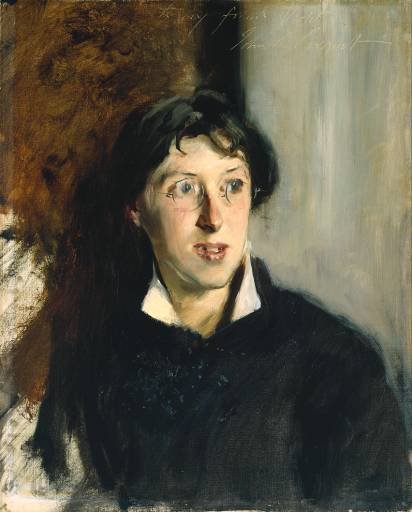
Vernon Lee

Another great scene in the book is the dinner party Henry and Alice throw to lure one of the murder suspects into questioning.  Among the other guests is famous actress Fanny Kemble, Constance Fenimore Cooper (whom I'm guessing is Constance Fenimore Woolson?), and Vernon Lee, whose portrait is seen here.  Her real name was Violet Paget, but, as the book put it, "had lately, in rebellion against her femininity, renamed herself Vernon Lee").  How cool is that?

Vernon Lee's portrait is actually one of my favorite Sargent portraits, just because you can practically see her personality, almost as if she's right there in front of you.  I also like it because Sargent painted it after he had sworn off portraiture, so you can tell it's a portrait of friendship and everything he likes about Vernon--who apparently was quite the irrepressible character.

daughters of edward darley boit

Another very interesting character in the book is Ella Abrams, the daughter of a prominent Jewish businessman.  I thought for sure she and her family were real historical figures, but so far I haven't been able to find them.  In the book she was painted several times by Sargent, as was her family.  I immediately thought of this work, The Daughters of Edward Darley Boit--probably just because it's one of his most famous pieces, but I also thought the familial atmosphere of the Abrams in the book and Boits in this work was very similar.

walter sickert

One person I did NOT expect to be a historical personage was Walter Sickert, mainly because he was the most obvious murder suspect in the book.  But, surprise, he was a real Victorian painter!  Here we see a photograph of him from 1911, around the time of the book's epilogue.  Does he look like a murderer to you?

jack the rippers bedroom

I was also surprised to find out the real Walter Sickert was tangentially involved in the Ripper murders--or so he believed--and that he's been accused of being the Ripper several times.  He claimed to have roomed with the Ripper briefly, based on some incidents related by his landlady, and painted a work he titled Jack the Ripper's Bedroom (pictured above).  Several writers have used this as a jumping-off point to argue he was the actual killer, including Patricia Cornwell, who supposedly bought up nearly all of his paintings and then destroyed them in the search for his DNA.  She denies this--although she does claim to have samples of Sickert's DNA, and that it matches samples found on the Ripper letters, soooo... how'd you get those samples, Cornwell?  Just sayin'.

camden town murder

More than likely, Sickert was simply a sensationalist capitalizing on the Ripper murders, just as he did with this painting, Camden Town Murders.  It was exhibited during a later period of London-based serial killings (c. 1911).  This work appears in the very last scene in What Alice Knew, along with the observation, "Perhaps Jack the Ripper is back."


What Alice Knew is an excellent book that's very well-researched and will submerge you completely into Victorian London.  It comes out September 7th--check back then for my review!


Powered by ScribeFire.

Wednesday, April 28, 2010

Zola: Photographer, by Francois Emile Zola and Massin

zola photographer

ETA:  Emile Zola was a famous French writer in the latter half of the nineteenth century.  Although I'd heard of Zola (it's impossible not to when you study the time period, especially since he hung out with famous artists like Cezanne and Manet), I'd always avoided reading his books because they intimidated me.  But after picking up Nana earlier this month, I found myself fascinated by all things Zola, and checked out several books from library both by and about him.

This book, which is out of print, was a disappointment for me.  Considering the famous people Zola knew, I was expecting pictures of them (especially my boyfriend, Manet).  But most of the book is filled with photographs of Zola, his wife, and their children.  While these portraits were very candid and sweet, I'm not sure they're of much interest to the average person--i.e., myself.

There were a few interesting sections, however, especially photographs Zola took of the Crystal Palace and London (it's startling how different London looks from Paris in the photos), and scenes from the 1899 World's Fair in Paris, when the Eiffel Tower was erected. 

As for the text, there's not that much of it, and what is there isn't exactly gripping or illuminating.  Not that one reads these types of books for the text, mind, but more quotes by Zola himself and context for the photographs wouldn't have been remiss.

One of the weirdest photographs is of Manet's portrait of Zola.  Pictures of pictures always leave me with a sense of irony, but the fact that Zola would do it for some reason just strikes me as bizarre and a little wrong.  It feels oddly funereal to look at:

zola portrait

The death of painting?

And that is what I learned from this book.


Powered by ScribeFire.

Tuesday, April 6, 2010

I Interview Edouard Manet

edouard manet.

On Monday I posted a blog that was about Nana--the book by Emile Zola, and the painting by Edouard Manet.  But little did you know that only a few days prior I got to interview Manet himself!  Yes, it's true; Colleen from Bookphilia taught me how to interview dead people.  And I was super-excited to get the chance to talk to Manet--you'll see why.


Heidenkind: Bonjour, Monsieur Manet.  Je suis trés contente que vous pouvez joindre à moi!

Manet: Enchanté, Mademoiselle Heidenkind.  Thank you very much for inviting me.

Heidenkind: You can speak English?!?

Manet: Yes, I learned.

Heidenkind: Oh. Phew! My French is a little rusty.

Manet: Naturellement. You speak very well... for an American.

Heidenkind: Um, thanks. Monsieur Manet, I have to tell you that you're one of my all-time favorite artists.  But I've always wondered, do you consider yourself a great artist?

Manet:  Que?!  Il ne fait aucun doute que! 

Heidenkind:  But a lot of your work wasn't really successful...

Manet:  Sacrilege!  Am I to judge my work by the standards of those... pointilleux academicians who never want their heads stimulated by a thought?!

Heidenkind:  Well, you submitted to the Salons every year that they were held, so clearly you did want your work judged by the Academicians and believed in the Salon system.

Manet:  Hmph.  I knew they would hate much of my paintings, vraiment.  But as I say, they had no imagination.

Heidenkind:  You didn't expect them to hate Olympia, did you?

Manet:  *glares* Mademoiselle, I was a great artist, and any misunderstandings the critics labored under was their misfortune.  Now, shall we change the subject?

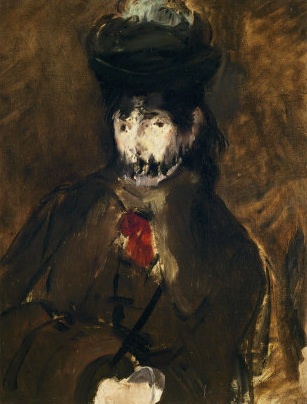
Heidenkind:  Very well.  What were your feelings for Berthe Morisot?

Manet:  *turning red* Brotherly affection, only!

Heidenkind:  Really?  Marni R. Kessler pointed out in an article in The Art Bulletin that your portraits of Morisot became increasingly unfavorable as her romance with your brother, Eugène, progressed; and your final portrait of her, created shortly after their engagement was announced, makes her face look like a skull.

Manet:  How very observant of this Monsieur Kessler.

Heidenkind:  I think it's a woman.

Manet:  Ha!

*long awkward pause*

Heidenkind:  Are you going to answer my question?

Manet:  I do not like to feed the romantic fantasies of young women any more than necessary; they are quite capable of doing that on their own, non?

Heidenkind:  Monsieur, I suspect that what you know about young women wouldn't fill a pin's head.  *smile smile smile*  Fine, what should we talk about next?  Your love/hate relationship with Degas, syphilis, or whether your adopted son was actually your son or your nephew or your brother?

Manet:  Mon Dieu, but you historiennes sont feuineuse!  How does one say--gossipy.  Why do you not ask me about my work?

Heidenkind:  Okay--why do so many of your paintings have such a sense of loneliness and isolation?  What was your message in Gare St. Lazare?  What do you think is your most important work?  Is The Absinthe Drinker a self-portrait?

Manet:  Are these the things you truly want to know?

Heidenkind:  Er, what do you mean?

Manet:  I can sense that you truly do not care about how I feel about my work, non?  You already have the answers to all your questions in your own mind.  So why, one must wonder, did you call me for this interview at all?  Perhaps you are interested in something else?

Heidenkind:  *blushing furiously*  How... why... uhmmmmmm....

Manet:  Please, mademoiselle, get to the point.  The afterlife is too short to beat around the bush.

Heidenkind:  *takes off glasses* Do you want to make out?

Manet:  *wolfish grin*

Heidenkind:  *swoon*


Okay, well, I don't think we need to see much more of that interview!  What, you never crushed on a dead person???


Powered by ScribeFire.

Monday, April 5, 2010

Nana and the Gaze

nana by edouard manet Nana, Edouard Manet, 1877


I've blogged about the Male Gaze before--today it seems like an intellectual term invented by feminist art historians, but it was an actual thing that existed in the late 19th century.  Men had the power to look, because by looking they owned what they saw, including women.  Women, meanwhile, were supposed to keep their heads down and be demure--but this rule didn't necessarily apply to those women who lived outside the rules of bourgeois society, namely courtesans and prostitutes.

Therefore it's no surprise that Emile Zola's Nana is full of looking--the men who feel free to look at every woman, and appreciate (read: lust over) Nana despite her lack of any discernible talent; the respectable ladies who are really only allowed to consume with their gaze at the Opera or Salons; and the courtesans/actresses who challenge male power by meeting their gaze full on. 

Nothing shows how the gaze equates ownership in Nana so much as some of the first scenes in the theater.  During intermission, the men discuss where they might have seen Nana before--on some street or cafe in Paris.  As readers, we assume that they probably haven't seen her--but by claiming that they have, they assert some ownership over her. 

This may all seem like a horrible objectification of women, and it is; but in Paris, this was the way a young woman could hope to gain wealth and fortune.  As critic Armand Silvestre said in 1888, "every woman who thinks herself beautiful imagines herself Semiramis or Catherine or Fredegonde or simply Olympia. The unfortunate adventure of Nana hasn't discouraged anyone."  Even Nana objectifies herself and her own beauty, owning it by looking at it, "absorbed in enraptured contemplation of herself."

Nana's avaricious gaze extends not just to herself and her audience, but at places--like the races--where any respectable lady would keep her gaze lowered.  Nana instead scans the field with a large pair of binoculars, and looks all the other ladies in the face.  Nana's gaze frightens and seduces men like Moffet, and threatens women like the Comtesse Sabine.

With all this talk about courtesans and looking, it's no wonder that artist Edouard Manet, the king of The Gaze, adored his friend Zola's Nana.  His most famous painting of a courtesan challenging the Male Gaze is Olympia (see the Silvestre quote above); but he also named a painting with similar themes after Zola's heroine.  The model is real-life grande cocotte, Henriette Hauser.  She stands in her underthings, applying make-up before a mirror while a gentleman (holding a cane in his lap--think cigars here, people) watches her in the mirror's reflection.  Nana--or Henriette--meanwhile, looks out at the viewer, the entire focus of the painting, seeming to defy the viewers' presumed right to observe her.  Even though women like Nana--as we see in the book--are seen as little more than sexual snacks, the woman in this painting dares you to objectify her--unless you want to be trapped in your own gaze, as the gentleman on the right seems to be.

Manet's Nana was rejected from the 1877 Salon, not surprisingly; in response, he displayed it in a gallery on the Boulevard des Capucines.  Not only that, but it was hung in a window, where the comely courtesan could gaze freely at every man, woman, and child who passed by on the busy street, thus causing more of a scandal than she probably would have in the Salon.

Even though prostitution was an accepted--desired, actually--part of Parisian society, it one that most of that same society refused to speak of.  Events like the theater, which we see in Nana, and the annual masked ball at the Opera (which Manet also painted) were well-known places where poor girls could hook up with wealthy gentlemen, all while said men-folks' respectable wives, sisters, daughters, and mothers mingled in the crowd.

As for the book, Nana, it's surprisingly enjoyable and readable.  Zola drop-kicks us into the middle of 1870's Paris, and you're suddenly surrounded by men in top hats, women with gigantic skirts, and the rush and insanity and craziness of the Variétés.  Can anything be better for a nineteenth-century geek like myself?  I can't believe it took me this long to try out Zola, and I highly recommend this novel for anyone with a passing interest in nineteenth century art or literature.


Powered by ScribeFire.

Friday, April 2, 2010

Botticelli by Frank Zoellner

botticelli cover

Find this book at an independent bookseller near you (via IndieBound).

This book is freaking HUGE.  It's two feet tall; the font is 1/4 of inch.  And it's filled with the most gorgeous reproductions of Botticelli paintings I've ever seen.

the birth of venus

The reason why I picked this book up is that I'm resolved to learn more about art work that really moved me as part of my art history challenge.  The moment I saw The Birth of Venus is one of the most memorable of my life.  It's such a canonical work in art history that it's almost cheesy; so I wasn't honestly expecting much.  But in person this piece is AMAZING, and it definitely deserves its rep as one of the most famous paintings in Western art.

The Birth of Venus straight-up comes alive when you see it.  I remember hearing the rush of the waves, feeling the breeze against my face, and seeing the water move.  It's honestly an entrancing work of art.

Like Donatello's Mary Magdalen, The Birth of Venus is something of a mystery.  Why and for whom Botticelli painted it is unknown (although it was most likely for the Medicis).  In fact, the painting itself is actually very ground-breaking for its time, since there wasn't a tradition of mythology scenes yet established.  Botticelli had to come up with his own visual vocabulary for the scene (which, if you've ever wandered around a fifteenth-century section of an art museum, was unusual all by itself--most artists recycled images endlessly).  At the same time, he was drawing inspiration from classical texts like Homeric hymns and famous ancient artists like Apelles--who was said to have painted Alexander the Great's mistress as Venus on a half-shell, only to fall in love with her--and Praxiteles, who created the most important sculpture in antiquity, Aphrodite of Knidos.  But for these pieces, Botticelli only had written descriptions or copies to go off of.  As a result, the imagery in Birth of Venus is very ambiguous--who are the figures to either side of Aphrodite?  No one really knows, although there are some good theories.

I think the Apelles and Praxiteles connection is the most relevant reference to this piece, because both of those artists were famous for making their work seem alive, and Botticelli's Birth of Venus definitely does that.  If he was looking to become "The Modern Apelles," I think succeeded in spades.  I never understood what the power of art really was until I saw this painting.

Anyway, I really like this book.  There's a lot of good information in it, and it's well-written--not painful to read at all.  Plus, as I mentioned, the pictures are spectacular.  This book is candy for the eye and mind, and I highly recommend checking it out if you're interested in Botticelli's life and work.


Powered by ScribeFire.

Tuesday, February 23, 2010

Searching for Donatello

donatello and his world cover donatello cover

Donatello and His World: Sculpture of the Italian Renaissance by Joachim Poeschke*

Donatello by Charles Avery*

A few weeks months ago, I finally resolved on a theme for my Art History Challenge--works of art that deeply moved me.  While I've viewed a fair number of artworks in my time, some of them more memorable than others, only a few have seemed to come alive and change the way I look at art, or the way I look at myself.  One of those pieces is Mary Magdalene by Donatello.  Check out the video for a good idea what the Mary Magdalene looks like:


This sculpture is ahmazing.  It's hard to describe how much like encountering a living person seeing it is.  It's like when you're walking down the street and there's a pile of trash on the side, but then all of a sudden the pile shifts and you realize you're looking at a human being, not a bunch of rags at all.  And then you lock eyes with the person and you feel slightly ashamed for thinking they were a pile of trash, and more than a little thrown, and you don't want to look away.

Yeah, that's exactly what seeing this statue for the first time was like for me.  In fact, I'm half-convinced Donatello performed some evil voodoo and there's a real woman trapped inside the Mary Magdalene somehow, trying to get out.

I don't have a lot of database resources at my local library, so I decided to go with some good ol' books to find out more about Donatello and the Mary Magdalene.  Little did I know how scant the scholarship is on Donatello!  Considering how famous he is, you'd think there would be A LOT more out there about him, but no.

First I started with Donatello and His World by Joachim Poeschke.  This is actually a fairly good introduction to Italian Renaissance Art for those that don't know anything about it, but the information about Donatello was merely cursory.  I didn't find out much about the Mary Magdalene beyond that fact that its origins are very mysterious (gawd, I hope I never leave tantalizing clues like that in my book without explanation, should I ever write one--so frustrating!).

So I decided to go with a promising-sounding biography of Donatello next (I also picked up another book in between, but I hated it and have already erased it from my mind), this one by Charles Avery.  This book was suuuuper-short.  Again, Donatello is one of the main figures of the Renaissance, so why am I having all this trouble finding books that go into detail about him???  I ask you.  Beyond that, I enjoyed learning gossipy things about the artist, like that he was the first bohemian and refused to dress nice.  That was all scrunched up in the beginning.  The rest of the book was dry descriptions along the lines of, "Donatello worked in X workshop and created Y artwork for such-and-such patron using Z technique."  LIKE ZOMG kill me now.  I'm all for facts, but writing like this gives art history a bad name.  What happened to writing with passion about art that you loved and getting people excited about it? 

Which leads me to another personal pet peeve of mine: making the Italian Renaissance seem as boring as possible.  I don't know how these guys do it, because it is a challenge to take all the interesting, combative, passionate personalities all scrunched into Rome and Florence at the same time and make it so dull anyone with half a brain wants to move IMMEDIATELY on to Bosch and Breughal, but somehow they do it!  I mean, this stuff is like reality TV, fifteenth-century style, and for some reason the major Renaissance historians of the last generation feel this need to make it as academic and uninteresting as possible.

Anywayyyy, as far as the Mary Magdalene was concerned, it was only mentioned in conjunction with another, earlier statue, as an example that Donatello's style isn't easily segregated into timely progressions.  KTHNX.

As you tell, I'm feeling a little frustrated with my quest for knowledge at this point, but I will perservere!  Although not with Donatello--him, I've given up on.


Have you seen the Mary Magdalene?  What did you think of it?


*These are Amazon Associate links & I got both of these books at the library.


Powered by ScribeFire.

Sunday, February 14, 2010

I Interview JMW Turner

Turner

Inspired by Colleen at Bookphilia, who did an awesome interview with Christopher Marlowe, I decided I wanted to interview my own dead person!  Joseph Mallord William Turner agreed to sit down and talk with me...

Heidenkind:  Hello, Mr. Turner.  Thank you for agreeing to do this interview with me!

JMW Turner:  'Allo, luv.  Don' be gushing too pre'y now, no' many people wot's wanting ta sit down wif brown bread fo'ks leik me.

H:  I find that very hard to believe, Mr. Turner--

JMWT:  Bill, me Cadbury, Bill! 

H:  Bill, you're considered the greatest British painter who has ever lived.  Is that what you set out to accomplish with your work?

Bill:  I woul'n' say I se' ou' ta accomplish it, no, alvough I am fin'in' i' a bi' gra'ifyin' tha' you're sayin' so.  I's simply tryin' to pain' wot I sees--in me loaf an' in me strawberry.

H:  Oookay.  How about your critics?  One said Slave Ship, which Simon Schama called the greatest British painting ever, looked like a kitchen accident.

Bill:  *laughs* Luv, if I lis'nd ta fose cab rankers, I woul' been a boa'man on fe Thames!  Cri'ics ain' nuffin'.  Bu' who is vis Simon Schama China, fen?

H:  He's a historian who likes to pretend he knows stuff about art, then makes crappy television shows about it. 

Bill:  Can' be too "crappy," seein' as 'ow ya knows abou' 'em.

H:  I guess.  You also wrote a poem to accompany Slave Ship and many of your other works. *clever book blog tie-in*  Do you think they help people understand your paintings better?

Bill:  We Cockneys do enjoy a gran' rhyme....  I woul'n' no' a'mi' ta li'era'y ambitions, bu' even I 'afe ta a'mit me poems were nuffin' bu' a pale reflection of me pain'in's.  An' fey neva be 'elpin' anyone un'erstan' 'em when I wars alife.

H:  Your work inspired the French Impressionist Claude Monet and arguably led to modern art.  Do you have an opinion on any modern artists?

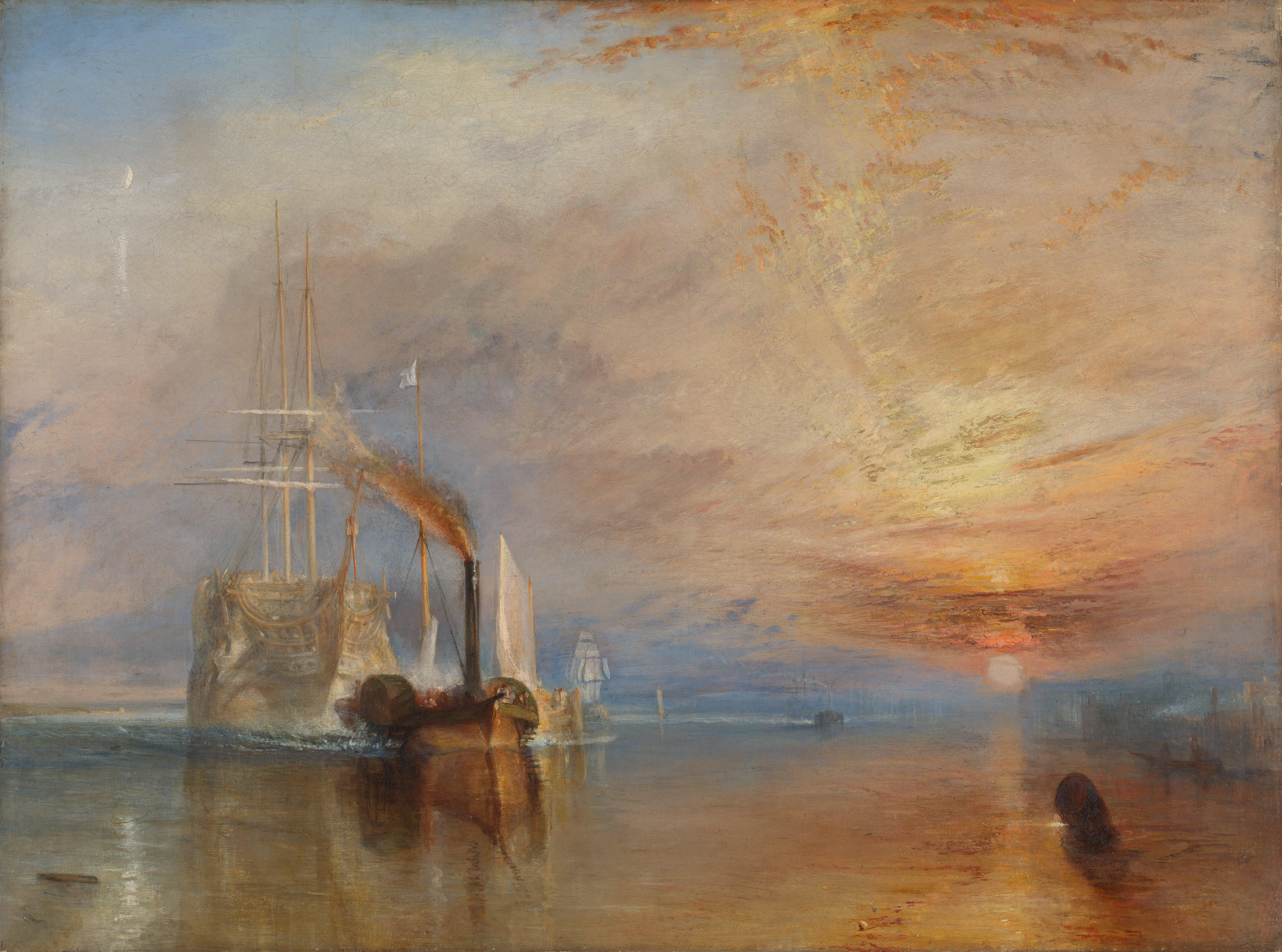
Bill:  Monet can kiss me Aris!  D'ye see fa' pain'in' 'e di'--Impression, Sunrise?  Wot a tea leaf!  I pain'ed work be'er fan tha' in me sleep!  An' exac'ly like, too.

H:  I know, it's eerily similar to The Fighting Téméraire, among other works.  But what do you think of other modern artists?

Bill:  I fink when one's an ar'ist, one ha' be'er follow 'is own vision--no' tha' ov cri'ics or family or fellow ar'ists.  uverwise, 'e risks losin' 'is chinese. *taps head*  Vere wore times when I fough' meself goin' the way o' me mum--bu' the work always saved me.  An' makin' no mistake, pain'ing is work, a craf' an' a discipline.  I can' tell ya 'ow many times a pride an' joy 'as asked me fo' a'vice on 'is ar', wi'ou' a mark on 'is lilly-whi'e 'ands.  Tha' ain' an ar'ist.  Ar' 'as no room fo' vani'y or cleanliness--i' takes ye by your nanny an' don' le' ye go.

H:  Is that why you've been connected to several women, but never married any of them?

Bill:  Ah, ducky, I ne'er tawk abou' me ladies!  Fey were nice rolls in the 'ay, nice to 'afe aroun', bu' me passion was always pain'ing.  When fey's go' too deman'in', fey'd 'afe ta go.  An ar'ist--a grea' ar'ist--lives an' breaves 'is ar'.  Like Raphael--ne'er allow a woman ta be ya weakness!

H:  Thank you so much for the interview, Bill.  I can't tell you how much I admire your work.

Bill:  Any time a'tall, lovey. 


Powered by ScribeFire.

Sunday, November 22, 2009

Why Have There Been No Great Women Artists?

women, art, and power cover

"Why Have There Been No Great Women Artists?" by Linda Nochlin, in Women, Art, And Power And Other Essays* (Westview Press, 1988), 147-158.

Linda Nochlin is considered one of the major feminist scholars in art history.  She's a great art historian (her article on Courbet's The Meeting blew my mind), but out of everything she's ever written, her essay asking why there have been no great women artists is the most well-known, and has had the biggest impact on the field.

I once read a review of this essay where the author said something along the lines of, "The question at the title of the article is facetious, of course."  I wonder if that person even read the essay.  Of course, one assumes the title question is facetious, particularly coming from a woman and a well-known feminist; and as feminists, I think our instinct is to brush off a question like this as ridiculous, or respond to it by pointing out female artists neglected in the study of art history.  Or looking at arts considered decorative, where women were the primary producers.  But Nochlin doesn't do this.  It was a serious question posed to her by a gallery owner, and she tries to answer it seriously--and I think that's the major strength of the article. 

Nochlin begins by looking at ways other people have attempted to respond to the question (mentioned previously) and says that, although each of these endeavors are valuable to the study of art history, they serve as mere excuses to hide the fact that there really hasn't been any great female artists.  There is no female equivalent of Michelangelo or Remembrandt, and no refocusing of scholarly study is going to change that fact.  In other words, the question of why there have been no great female artists is a valid one, and one that has implications far beyond feminism--after all, there haven't been any black or Chinese or Eskimo Michelangelos, either, at least not as far as the Western cannon is concerned.

So, why haven't there been any great women artists?  Nochlin's answer is two-fold:  first, the myth of artistic genius, which has been a part of art writing since Pliny, makes it seem that anyone with true artistic gifts would naturally make themselves known as a genius, preferably to some famous teacher, and then quickly surpass the teacher in skill.  The inherent genius inside these great artists always refuses to be kept hidden, despite their own lack of fortune or common sense.

This idea of artistic genius, says Nochlin, is a fantasy.  Art is rarely (and great art certainly never is) created solely by the artist for the purpose of personal expression.  Instead, if we look at art as the sum total of patronage and production and purpose, we see that there was a whole system in place that excluded women from creating the type of work that made artists like Michelangelo and Raphael famous.

Institutions--with which both art and art history have a long relationship--are built to include and exclude certain people, and that was certainly the case with the art academies of Europe for most of their history.  So even though Jacques-Louis David was a supporter of women artists, even he couldn't--and likely wouldn't--allow them into life drawing classes where they would sketch nudes--the basis upon which many artistic honors, like the Pris de Rome, where awarded.  So even though there was a plethora of female artists in Paris during the late eighteenth and early nineteenth centuries, it was a given that none of them would ever receive the insitutionalized awards and honors of their male counterparts.

One of my favorite parts of the article is where Nochlin points out that, instead of asking why there are no great women artists, we could just as well be asking why there are no great aristocratic artists.  Aristocrats have a long tradition of being involved in the arts and being trained in the arts, but there are no great artists who are born members of the artistocracy until Toulouse Lautrec--and he abandoned his ancestry to become a bohemian.  In other words, the question of women artists is not, in itself, a question of women artists at all, but one of art production.  To answer it, we have to look at a much wider scope than women, to the web of reality--not the linear legend--of how artists become artists.  I think an expanded version of that is true of many subjects in women's studies--the study of women, and the issue of women, isn't always just about women--it's about men, too, and institutions and families and societies, and all the other things that make life complicated.

In any case, it's a great essay, and one that has implications for other studies in the humanities, as well.  It reads just as relevant today as it was when it was first published twenty years ago--possibly because all of the problems Nochlin talks about are still problems!  You can read it for free online here.

women unbound button heidenkinds art history challenge button

I read this as part of the Women Unbound Challenge and Heidenkind's Art History Challenge.

*This is an Amazon Associates link.

Powered by ScribeFire.

Wednesday, November 4, 2009

Prehistoric Art: The Symbolic Journey of Humankind

prehistoric art cover

Prehistoric Art:  The Symbolic Journey of Humankind by Randall White

You might recall that a few weeks ago I resolved to read more textbooks to brush up on my knowledge of art history, should I ever teach an art history survey course again.  I decided to begin at the beginning with prehistoric art, which I find a very difficult subject to teach.

I generally don't find aesthetics very interesting because I think that it's largely self-evident.  Usually I teach about the social, political, and cultural implications of art.  And also all the gossip about the artists, because that's fun.  But with prehistoric art, there isn't much in the way of gossip or socio-political implications, because we don't know much about the culture that created it.  So all I'm left with to talk about is aesthetics:  the long neck is elegant!  Etc., etc.  Ergo it's a struggle for me to spread 40,000-ish thousand years of art history out over a whole week.

That's why I thought Prehistoric Art:  The Symbolic Journey... would be a good bet.  Symbolism!  That's always interesting.  White's goal with the books seems to be convincing us all that 1. we do know a great deal about prehistoric peoples (and by "we" I mean, you know, the giant brain that feeds on all our thoughts), and 2. because of this, We can make a good guess about the meaning of prehistoric art.  Unfortunately, I find the former statement questionable and was never convinced of the latter.

The thing is, this was a really strange book.  When I first got it, it seemed like one of those TimeLife coffee table books that you get mainly for the pictures (which were fabulous, btw); so when I started reading it, the academispeak kind of blindsighted me.  This is some serious, hardcore academic writing.  I have a feeling White was trying to make it more accessible to a general audience, but he didn't succeed very well.

Once I got adjusted to White's writing style, I was able to get into the book more.  And it is chock-full of information.  I really enjoyed chapter two, actually (the title of Emile Cartailhac's essay in which he admits that the Altamira caves are genuine made me laugh out loud), but then it started to lose me.  Like I said, there are aspects inherent to prehistoric art that simply don't interest me.  Although I did find the idea that cave art was placed to correspond to good musical acoustics intriguing, for the most part archaeology and the prehistoric art studies where everything has to be categorized and labeled and measured is 1. tedious 2. boring as heck 3. seems fairly pointless, and 4. sucks the soul and enjoyment out of everything.  And please don't ask me to explain it more than that, because just typing that last sentence was painful for me.  Pick up a book on rock art or cave art and you'll see what I mean soon enough.  If you enjoy putting things into boxes, rock art is the art for you!

Ironically, the one thing I really wish White had addressed was aesthetics (although to be fair, he might have done so and I just skimmed over it).  Often in books about prehistoric art one sees statements like, "These beautiful and amazing images...," which always makes me go, "Hur?"  I mean, they're all right, but amazing?  Don't you think any other image from ye olde art history tome survey textbook is just as amazing, if not more so?  Some day I would like someone to explain exactly what makes prehistoric art so special and lickable, other than the fact that it's older than Moses. 

art history 101 reading project

So, so far my reading project hasn't been very successful, since I learned next to nothing from Prehistoric Art (admittedly, this was my own fault).  I think I'm going to read a book about a non-European Art topic next, since that is another one of my major weaknesses (and also since I haven't found a good book about Ancient Near-Eastern Art yet).  I suppose the little kiddies will just have to put up with my sub-standard understanding of prehistoric art.  Oh well!


Powered by ScribeFire.

Saturday, October 31, 2009

Creepy Art

the crying spider The Crying Spider by Odilon Redon

In honor of Hallowe'en, M from Alberti's Window has a great post up on her blog about Goya and his creepy paintings.  Although I tend to avoid anything Hallowe'en-related like the plague, I thought it would be fun to take a page out of M's book and write about a few of my favorite creepy artists.

Odilon Redon was a French Symbolist who, like many 19th-century artists, took inspiration from Edgar Allen Poe and Goya.  He wanted his paintings and lithographs to appear mysterious so as to inspire the unconscious mind.  One of my favorite works by him is Parcifal, because if you look at the painting one way, it appears to be a man; but if you look at it another, it looks like a woman.  Why, you might ask?  Because Parcifal was considered to be androgynous and the Symbolists were all about that.  And also because he first wanted to make a druidess, but she didn't turn out well; so to salvage the plate he just decided to change her into a guy. Art!

Butterfly Catcher by Remedios Varo

Another one of my favoritest artists of all time is Remedios Varo, a Surrealist who was (also) very inspired by Goya and Bosch.  And also Redon, funnily enough.  Varo's work is very clever, with a wry sense of humor, and is really more fantastical than scary--unless you consider being a woman trapped in a male-dominated society scary, in which case, yes, her paintings can be pretty creepy.

severed heads Severed Heads, Géricault

Finally, I lurrrrv Théodore Géricault because he was morbid as heck.  It all started with The Raft of the Medusa, a painting based on a true-life event that Géricault researched out the wazoo--talking to survivors, building a model of the raft, and so on.  At one point, he decided he needed to sketch dead bodies so his depiction of the tragedy would be "accurate."  After that, he had random body parts lying around his studio all the time!  He even (according to legend) would collect heads freshly severed from the guillotine.  In the above painting, one head is real and one is fake--the creepy part is that the one that's been collected from the guillotine looks more alive than the fake one.  In his later years, he also enjoyed sketching portraits of the insane.  Gotta love a guy like that!


Do you have a favorite creepy or disturbing work of art?


Powered by ScribeFire.

LinkWithin

Related Posts Plugin for WordPress, Blogger...