Showing posts with label weekend cooking. Show all posts

Saturday, March 26, 2016

Weekend Cooking: Making Bread from Starter

bread made from starter instead of yeast

One of the things I learned from the Netflix series Cooked is that bread was not originally made with little packets of dried up yeast you buy in a grocery store and mix with warm water. I know, DUH. I may have wondered what people did before yeast packets, but I didn't wonder hard enough to look it up.

Anyway, before handy dandy little yeast packets, people made bread with starter–basically water and flower allowed to sit until yeast and bacteria started to grow. A little of the starter was then used to leaven, or puff up, the bread.

Why is this important? Because starter leavens bread more slowly than commercial yeast, giving the glutens in bread time to ferment and break down. Some think that the reason so many people have problems with gluten now is because commercial yeast doesn't break it down enough to be easily digestible.

Before watching Cooked, I had been thinking about getting back into the bread baking game, for the simple reason that the closest place to buy decent bread around here is an hour's drive away. However, I wasn't sure I could call my previous adventures in bread baking "decent." While they were mostly edible, the loaves of bread I made were invariably salty and dense, with a clump of dough in the middle that was honestly fairly unappetizing. Add to that the fact that I'd have to: 1. go to the grocery store and buy yeast; and 2. dig my pizza stone out of storage, and surprise surprise I never got around to baking bread.

BUT. Making bread from starter doesn't require buying yeast, or any other special ingredients. And it's healthier for you! So I decided to try making completely all-natural bread with starter.

oprah bread


I bought sourdough culture from Cultures for Health via Amazon (about $13 for one packet–a bargain when you consider that, if you take care of your starter, you'll never have to buy another culture again), but you can skip this step and just use flour and water.

The Cultures for Health starter came with directions for both activating the starter and baking sourdough, but they were a little confusing, so I was not feeling confident when it came time to bake my bread. I eventually decided to go with this recipe from The Kitchn, because it said I could just use a colander and not have to buy a proofing basket.

The Kitchn's recipe is much more complicated than the one from Cultures for Health. It's not difficult in terms of technicality or physicality, but it is time consuming. I basically felt like I was babysitting this bread dough for two days. If you do decide to go with this recipe, make sure you have two whole days blocked off for it, because you will need it.

all this for a loaf of bread


That said, as a reward I got the best loaf of bread I had ever baked in my life! It tasted like something a legit professional baker had made. The crust was crispy as all get out, the dough was super holey and spongy, but not too wet (although maybe a little wetter than it should have been–I erred on the side of damp dough since I live at high altitudes), and the flavor was superb.

So, the tl;dr version:

Pluses of making bread with starter

  • Healthier
  • Cheaper
  • More delicious
  • No kneading–With starter bread, kneading isn't necessary because so much gluten is built up through the starter. All you have to do is stretch out the dough a half dozen times and you're more or less done.
  • I want to say it's more fun?


Minuses of making bread with starter

  • TONS of time and attention.
  • Messiness–At one point my dad said to me, "That's a *EXPLETIVE* *EXPLETIVE* mess," and he wasn't wrong, friends. Starter has the consistency of wallpaper paste, so just imagine it getting... well, anywhere. Now imagine it exploding out of its container and running all over the counter.
  • If you're not already a well-equipped baker, you might have to buy some stuff like glass jars big enough to hold your starter, big bowls, a measuring scale, and a Dutch oven-type pot.


Conclusion
At the end of this process/experiment, do I think making bread this way is worth it? YES! However, given the energy required, it's not for everyone. I have the luxury of working from home most days, so it's not that hard for me to pop into the kitchen every thirty minutes to stretch dough. Even given that I probably won't bake bread any more frequently than once a week.

People who bake bread at home do it more as a hobby, out of a love for baking, than for economical reasons. If you're one of those people, I would definitely recommend looking into getting your own starter. There's certainly a learning curve, but it will improve your bread baking game by 1000%.


weekend cooking button

Weekend Cooking is a weekly meme hosted by Beth Fish Reads. To learn more and find links to other recipes and foodie posts, click here.


Discus this post with me on Twitter, FaceBook, Google+ or in the comments below.

Thursday, October 25, 2012

Weekend Cooking: JAMIE OLIVER'S GREAT BRITAIN

jamie oliver's great britain cover

The English are about as famous for their food as the French are for their music. I'm not saying British food is terrible, just that it has that reputation, especially in North America. But Jamie Oliver's Great Britain (or as I like to think of it, Jamie Oliver presents: Jamie Oliver's Great Britain) is a book that aims to heroicize traditional British foodstuffs, from pub dishes to pies and puddings.

As a cookbook, there is a lot that's problematic about Jamie Oliver's Great Britain. Beth Fish Reads mentioned editing and consistency issues in her review, and those are definitely present. The recipes read like Oliver dictated them into his phone and the person transcribing them couldn't always understand what he was saying. That, added to the fact that most of these recipes require really quite advanced cooking skills, means that the average person isn't going to be making most of the recipes in this book, especially if that person happens to not be British. Would I eat haggis? Wellllll... I might try it, if I was in Scotland. Would I make it myself, from scratch, in middle of the US? No I would not.

That being said, I honestly don't think the point of Jamie Oliver's Great Britain is to be a practical cookbook. Instead, it seems more like a love letter to UK food and culture. There are tons of color images, many of which are only tangentially related to food, giving it a scrapbook feel. And Oliver's focus seems to be more on telling us about the history of each dish and raising awareness of the richness, variety, and character of English (and Welsh, and Irish, and Scottish, etc.) food than giving detailed directions for beginners on how to make it. Even if you never plan on cooking a single dish in Jamie Oliver's Great Britain, if you're any sort of Anglophile, you'll probably still get a lot out of this book. And that's what completely won me over about Jamie Oliver's Great Britain.

As for actual cooking, the most approachable chapters are probably "Vegetables" and "Afternoon Tea." Like many places with short growing seasons, the UK is all about the root vegetables, and there are some fantastic recipes for potatoes here, as well as leeks (yum, love leeks), asparagus, spinach, brussel sprouts, and pretty much all my favorite veggies. "Afternoon Tea" is basically a collection of cake and cookie recipes. I decided to try out the Scottish shortbread recipe, since it only had three ingredients and didn't require that I use the Mixer of Doom.

Scottish Shortbread

--Taken from Jamie Oliver's Great Britain; makes 12 pieces

Ingredients:
  • 1 1/2 cups all-purpose flour, plus extra for dusting
  • 4 tbsp sugar, plus extra for dusting
  • 4 oz unsalted butter
Flavoring options:
Chocolate, orange, & caraway
  • Zest of 1 orange
  • 1 oz good dark chocolate
  • 1 tsp caraway seeds
Lavender & honey
  • 2 tbsp lavender honey
  • 2 tbsp lavender sugar (use only 2 tbsp regular sugar when making this version)
Lemon thyme & vanilla
  • 1/2 a small bunch of fresh of lemon thyme, leaves picked
  • Zest of 1 lemon
  • 1 tsp vanilla extract or paste
Directions:
Preheat the oven 325 degs F. Mix the flour and sugar together in a mixing bowl. Rub in the butter with your thumb and forefinger, then add your chosen flavorings (if you're using chocolate or seeds you might want to push these into the dough at the end, after you've rolled it out) and squash, pat and push it into a dough. [Here's what I mean about unclear directions. Is the dough supposed to be the consistency of pie crust or what? I just assumed it was, but I think I still overworked the dough a bit.] Don't knead it, you just want to pat it down flat. Push or roll it out until it's 1/3-inch thick--do this directly on to a baking sheet lined with parchment paper so you don't have to move it. Once it's in the shape you want--which could be square, round or a few mall finger shapes--feel free to thumb or pinch the edges. If it splits or tears, just press it back together--but remember, the less you work the dough, the shorter and better these cookies will be.

If you want to score lines on the shortbread so that you click it off into pieces later [total nightmare, fyi], you can. Sprinkle over some sugar, then pop the baking sheet into the oven and cook for 20 to 30 minutes. Keep an eye on it--you want a lovely light golden color (unless you're making the lavender honey version, which will be darker). Leave to cool, then put away in a tin or serve. These will be delicious for two or three days and make a lovely present for someone special.
And here were my results:

Tasha's Scottish shortbread

These tasted very flowery and were a little flat (but maybe they're supposed to be that way?). Were they blow-my-mind delicious? Nooo. But they were tasty, and pretty easy to make.

As I said, Jamie Oliver's Great Britain might not be the most practical cookbook, but it is a fabulous collection of recipes and culture from the British Isles. By the time I turned the final page on this book, I was totally in love! Definitely something I would consider a keeper and that may, over time, prove to be a treasured cookbook.


Thank you to TLC Booktours and the publisher for providing me with a copy of this book to review! The publishers are also providing a copy of Jamie Oliver's Great Britain to one lucky reader of this blog. To enter to win, please fill out the embedded form below, or go here.

Saturday, October 20, 2012

Weekend Cooking: Food in DRACULA

gary oldman as count dracula
"I don't drink... wine."

It's not that I pay particular attention to food mentions in books (honest), but in some novels the characters talk about food so often it's impossible not to notice and be slightly weirded out. The Chicagoland Vampires series by Chloe Neill, for instance. And, another vampire book (coincidence?), Bram Stoker's Dracula.

Here are just a few of the food mentions from the part I've read so far (basically Jonathan Harker's journals):

I dined on what they called "robber steak"--bits of bacon, onion, and beef, seasoned with red pepper, and strung on sticks, and roasted over the fire, in the simple style of the London cat's meat!

The wine was Golden Mediasch, which produces a queer sting on the tongue, which is, however, not disagreeable.

I had for dinner, or rather supper, a chicken done up some way with red pepper, which was very good but thirsty. (Mem. get recipe for Mina.) I asked the waiter, and he said it was called "paprika hendl," and that, as it was a national dish, I should be able to get it anywhere along the Carpathians. [Apparently this is actually chicken paprikash.]

I rejoiced to see within a well-lit room in which a table was spread for supper, and on whose mighty hearth a great fire of logs, freshly replenished, flamed and flared.

Dinner with dracula

The count himself came forward and took off the cover of a dish, and I fell to at once on an excellent roast chicken. This, with some cheese and a salad and a bottle of old tokay [Tokaji wine?], of which I had two glasses, was my supper.

He took my arm, and we went into the next room, where I found an excellent supper ready on the table.

I had for breakfast more paprika, and a sort of porridge of maize flour which they said was "mamaliga", and egg-plant stuffed with forcemeat, a very excellent dish, which they call "impletata". (Mem., get recipe for this also.)*

DOOD, SLOW DOWN. Who does Jonathan think he is, Anthony Bourdain? I swear to god all he does is eat. And what the heck is forcemeat? (When I first read that I thought I thought it said "horsemeat" and I seriously wanted to throw up. Maybe it's related to empenadas?)

Anyway, because I'm me, I have to wonder--why all the food mentions? Here are some possibilities I've come up with:
  • Bram Stoker was a foodie and couldn't stop himself from writing incessantly about food.
  • Jonathan's journals are supposed to imitate a travelogue, and eating weird stuff is one of the great joys and trails of traveling.
  • Jonathan's food lust mirrors the Count's lust for blud.
  • MOST LIKELY POSSIBILITY: Food, like everything else in Dracula, is a metaphor for sex.
Take, for instance, Jonathan's encounters with the vampiresses, where they "licked their lips like an animal" and sent him into a major spaz attack. Admittedly, that's pretty easy to do with Jonathan, but I think it's clear they think he's appetizing. IF YOU KNOW WHAT I MEAN. I think, too, all this eating eating eating sets the stage for Jonathan's paranoia that he's about to be the Count's dinner.

Have you ever read a book where the food descriptions seemed out of control, and was it by any chance a vampire novel? Because so far all the ones I can think of are.


*Dying--har har--to make some of these dishes yourself? There's an excellent blog post with the recipes Jonathan mentions at Her Raven Domain.

Saturday, August 25, 2012

Weekend Cooking: THE HOMEMADE PANTRY--101 Foods You Can Stop Buying and Start Making by Alana Chernila

the homemade pantry cookbook cover

If we are to become people who do make butter, we might have to shift the way we see ourselves a bit. We might have to get into the adventurous spirit and unearth our own curiosity about where our food comes from. We might have to make a colossal mess of the kitchen. And we might have to slow down, at least long enough to knead a loaf of bread before the day begins.
Guys. This book is AMAZING.

When I first saw Beth Fish Reads' review of The Homemade Pantry, I thought it might be worth checking out, but I didn't have very high expectations for it. I know how these make-it-yourself-at-home books tend to go: spend lots of money on specialized equipment and lots of time, OR just go to the grocery store and buy it there. Even though I like making my own food, I can't spend tons of money on new equipment for it, and I don't want to spend my entire day in the kitchen.

I didn't realize how perfect The Homemade Pantry was for me until I picked it up at the library. I've made my own cheese (see here), baked my own bread (here), and made my own liquors (here) from scratch before. If that sounds like something you could/want to do, you should definitely pick this book up. All of those types of recipes are in The Homemade Pantry, along with many others.

The Homemade Pantry is divided into sections imitating the aisles of your grocery store: dairy, bread, cereals, snacks, etc., which makes it very easy to navigate. You'll be surprised by how many items you can make at home that you might not have thought of before, like brown sugar. I also like that Alana Chernila didn't hit on my pet peeves with this book--requiring specialized equipment and approaching it from the perspective of a chef. There are some specialized tools required, but not as many as I would have expected in a book like this; and even when Chernila does suggest a particular kitchen gadget, she addresses what you can or should do if you don't have it on hand (including a warning about NOT using glass baking dishes, which I really could have used the first time I baked bread).

Also, from what I know about some of the things I've made in the past, such as ricotta, it seems like the recipes Chernila includes here are the simplest and easiest versions you can find. You really can made your own bread, cheese, etc., without spending the entire day in the kitchen; and as Chernila points out, it's usually cheaper and better-tasting!

The Homemade Pantry makes creating food staples at home extremely accessible. If you've ever been interested in being more self-sufficient, or wondered if you really could make your own cheese, bread, butter, etc., then you should definitely check this book out.


weekend cookingWeekend Cooking is hosted by Beth Fish Reads and is open to anyone who has any kind of food-related post to share: Book (novel, nonfiction) reviews, cookbook reviews, movie reviews, recipes, random thoughts, gadgets, quotations, photographs. For more information, see the welcome post.

Friday, April 27, 2012

Weekend Cooking: FOODTRIENTS--Age-Defying Recipes for a Sustainable Life by Grace O

foodtrients cover

My first thought on seeing this cover was: why is there a woman drinking water from a leaf? Are these recipes for our dystopian future where there's no running water? Because I don't live in a place with that many trees.

Turns out they ARE for our dystopian future. It's the first post-apocalyptic cookbook. Kidding! Or am I? Guess you'll just have to read the book to find out. Or read the other reviews where no one else mentions it.

Anywhosie, FoodTrients is a cookbook that claims to provide recipes that "promote longevity, prevent the diseases of aging, and increase energy and vitality." Basically, if we were living in The Hunger Games, this is the kind of food the people in the Capitol would be eating. And naturally many of the ingredients are exotic or unusual, because let's face it, if the book told you the ingredients in Doritos were preserving your skin, there wouldn't be much reason to buy the book. Or much of anything besides Doritos.

What are some these ingredients? I'm happy you asked. There's a table of them in the back of the book that's honestly the best part of this entire cookbook. But Grace O highlights some more unfamiliar (to me, anyway) foods: bitter melon, moringa, hemp milk, soursop, and chia seeds. I have never heard of most of these ingredients or seen them in my grocery store. I'm just happy when they have kale.

Honestly, this cookbook falls into a category I like to call "food porn." The pictures are nice to look at, but the chances that I'm ever going to make any of these recipes is pretty minimal. Not only do you have the unfamiliar ingredients with no suggestions as to substitutions (though I usually just Google that myself, it's nice when a cookbook author acknowledges not every food in the world is readily available to every person in America), there's also not much info on how to pick them out, clean them, handle them, etc.

Just as the instructions are sparse, so is the science. I'm not sure I trust any of Grace O's claims as to the benefits of these ingredients or meals--she offers nothing in the way of supporting evidence or citation, and the lack of specificity makes the whole thing feel more like wishful thinking or guestimating. Does Grace O have a degree in any health sciences-related field? It's not mentioned in her bio that she does. She has cooked for royalty, though (see what I mean? Capitol food). I'm not entirely sure where she's getting her information about the healthfulness of these ingredients or exactly how much one has to eat of them to make an appreciable impact. Yeah, red wine's healthy (note: red wine is not listed as one of the "FoodTrients"), but only in certain quantities.

I will say the best part of the book was the "Starter" section. Actually, this was the only section where there were recipes I wanted to try. I made the Quinoa Tabbouleh on Pita:

Ingredients
  • 1/2 cup quinoa
  • 1/2 tbs kosher salt dissolved in 1 cup water
  • 2 cups finely chopped parsley
  • 1/2 cup diced tomatoes
  • 3 tbs chopped scallions
  • 4 tbs olive oil
  • 2 tbs lemon juice
  • sea salt and pepper to taste
  • pinch of sumac
  • 3 whole-wheat pitas
Directions
  • Combine the quinoa and water in saucepan and cook, covered, at medium-high heat for 20 minutes [I followed the package directions]. Allow to cool.
  • Toss quinoa with parsley, tomatoes, scallions, 3 tbs olive oil, lemon juice, salt, pepper, and sumac [I didn't have any sumac so I used some herbs de Provence].
  • To make pita rounds, heat oven to 400 degs Fahrenheit, brush with olive oil, and bake for 10 minutes in foil.
I'd never cooked with quinoa before, so this was a bit of an adventure (one thing I learned: buy the pre-rinsed quinoa next time). The recipe itself was okay. I liked how the quinoa was a little crunchy, but the lemon juice was overwhelming. You definitely need something in there to give it flavor, though, or it would be horribly bland. For the most part I thought it was a lot of work for a snack, but if you have some quinoa leftover from another meal this would be a good way to use it up. The recipe is VERY basic, and I noticed that's pretty typical of the dishes in FoodTrients (whole wheat garlic noodles, for example). As one might expect, the recipes focus on ingredients and for the most part have simple cooking techniques.

Overall, however, not many of the recipes in this book sparked a desire in me to make them. Some of the mains looked downright unappetizing, and there were a lot of dishes that I personally wouldn't be able to eat because of my own health issues. I also find the idea of spending the time, money, and energy to import ingredients from far-flung continents for the sole purpose of making me healthier very death-of-the-Roman-Empire, but that's probably just me. If you're interested in working with ingredients such as the ones I mentioned, however, then you'll probably want to check this book out.

Thank you to TLC Book Tours and the publisher for sending me this cookbook to review!


Friday, April 6, 2012

Weekend Cooking: DROPPING ACID by Jamie Koufman and Jordan Stern

dropping acid cover

I know this will probably shock y'all, but sometimes my life isn't that glamorous. Like a few years ago, I started to feel this pain in my chest as if I was being stabbed through the heart. I thought I might be having a heart attack and I was only twenty-eight! Fortunately, it wasn't a heart attack--it was acid reflux (I found this out after two visits to my regular doctor, a trip to the ER, and seeing a GI specialist).

Acid reflux is the type of disease that sounds silly, until you actually get it and can't sleep, can't breathe, can barely move, and can't eat. I took Prilosec for about three months straight and that seemed to get it under control. Aside from occasional flare-ups, I didn't have any problems until a few weeks ago when I started to feel that stabby sensation again. Back to the Prilosec, even though it's not that good for your stomach.

Here's the thing about acid reflux: you cannot. eat. ANYTHING. Coffee, tea, chocolate, alcohol, bacon, cheese (you all know how much I love cheese)... Just imagine every food you enjoy or consider a comfort food, and then cross it off your list of things you can eat. Welcome to rice and boiled chicken for the rest of your life, bitches. I'd almost rather die, except acid reflux doesn't kill you--it just makes you FEEL like you're dying, then the cure makes you feel like there's no reason left to live anyway.

It's such a bummer.

I found out about Dropping Acid: The Reflux Diet Cookbook and Cure after googling "food to fight acid reflux." This is the only diet book I've ever read--but instead of cutting fat from your diet, you're trying to cut PH levels. I've read cookbooks for people with acid reflux before, like Eating for Acid Reflux by Jill Sklar and Annabel Cohen; but those books were incredibly disappointing. Not only did they not tell me anything I didn't already know, the recipes sounded terrible and weren't anything I'd ever want to eat.

Dropping Acid claims to be different, and for the most part it is. For one, I learned a lot about reflux, and realized I'd been suffering from it for a lot longer than I'd thought. According to Koufman and Stern, heartburn is only one of the less common symptoms of acid reflux--the majority of symptoms are things like coughing, hoarseness, feeling like you're choking or you can't swallow, and lots of mucus in your throat. If that's true, my reflux is definitely triggered by stress--I basically lived off frappacinos during finals week while in grad school, because I couldn't manage to swallow anything solid. Symptoms of "silent reflux," as Koufman and Stern call it, are often misdiagnosed as allergies, halitosis, dental disease, or asthma.

The diet part of the cookbook is two-fold: first, you spend 2-4 weeks on a strict diet eating nothing with a PH above 4. In part two, you can relax the diet and eat things with a higher PH, as long as you do so in small doses.

Here's what I really like about Dropping Acid: it's totally reasonable. When I first visited the GI specialist after realizing I had acid reflux, he was like, "No more coffee, tea, alcohol, or chocolate." Seriously? You need to let people down gently when you give them news like that. Koufman and Stern are more realistic: one cup of coffee a day is fine, a cocktail is fine as long as it's not right before bed, etc. They give you a list of really good foods you should try to incorporate into your diet, and generally bad foods you should avoid, and basically give you the building blocks to make smarter decisions about what you eat. They also say that everyone has their own hard limits on what foods they should definitely avoid at all times.

As for the cookbook section, that's a mixed bag. At first I was really exited because the recipes sounded like something I might actually want to eat! There were delicious-sounding smoothies, pancakes, quiches and omelets; salads that didn't sound half bad (I'm not a big fan of salads), entrées like mad mushroom stew, one-pot chicken blanquette, and scallops with penne verde; and even snacks and desserts like ginger cheesecake. A lot of the credit for these awesome-sounding recipes probably goes to Marc Bauer, a chef at the French Culinary Institute.

vegetable frittata with quinoa

Then I tried to actually make a few of the recipes and realized the directions could use some work. For example, in the vegetable frittata with quinoa, there are no times given as to how long to actually cook the frittata or any of the vegetables. You can't assume people know how long it takes to cook to anything "thoroughly," or even that people know what a thoroughly cooked vegetable is. This is a culture that doesn't know fries are made from potatoes, for heaven's sake (The New York Times republished this recipe with cooking times--thank you, NYT). I also tried a few of the salads and they were okay, but a little weird-tasting.

Despite my problems with some of the recipes, overall I'm happy with this book, because it makes me feel like I can eat well and still be relatively healthy. Just knowing basic foods that are good to eat (rather than only the bad stuff) and warning signs other than heartburn is really helpful. I definitely recommend Dropping Acid if you or someone you cook for suffers from acid reflux.


Weekend Cooking is open to anyone who has any kind of food-related post to share: Book (novel, nonfiction) reviews, cookbook reviews, movie reviews, recipes, random thoughts, gadgets, fabulous quotations, photographs. If your post is even vaguely foodie, feel free to grab the button and link up over the weekend.

Saturday, March 10, 2012

Weekend Cooking: TEA--History, Terroirs, Varieties

cover of tea

You might not know this, but I LOVE tea. There is probably more space in my cabinets devoted to tea and its various implements than any other single food or beverage in my kitchen. So you can imagine how excited I was when I saw Tea: History, Terroirs, Varieties at my library.

I've read a few books about tea before (yes, I'm that much of geek), but none that covered so much ground--both literally and metaphorically--or had so many high-quality illustrations. This is really a gorgeously photographed book.

That being said, I've also never read a book about tea that was this boring.

Here is just a sampling of the type of writing that will greet you upon opening this book:
"Picking tea leaves is a simple yet critical activity that involves detaching the young shoots from the plants."
Could you repeat that, please? I don't know what the word crit-i-cal means.
"Flavor is the combination of olfacto-gustatory sensations derived from consuming a food."
But what is the sound of one mind screaming? Riddle me that, Zen word master.

I would describe the style of writing in this book as "government pamphlet," but I'm pretty sure I've read a few government publications that were more entertaining to read than Tea is. It is so pedantic and dry that I'm amazed a human being even wrote it. I think I honestly would rather watch grass grow than spend hours of my life reading this book.

tea color varieties
Image courtesy of Slow Food Australia

To be fair, there are some interesting parts that introduced new factoids to me. For example, I didn't know that oxidation effects the hue of the tea. I also really liked reading the sections on how different countries drink tea, particularly the gong fu cha tea ceremony practiced in Taiwan. This type of tea ceremony isn't well-known to people in America (certainly not in comparison to Japan's chanoyu ceremony), but if you need a visual of it you can watch "The Blind Banker" episode of Sherlock Holmes--the tea ceremony Soo Lin Yao performs is Taiwanese.

Other than those few sections, though, for the most part this is a book written by and for people in the tea industry who want to know about distribution, prices, quality, and when and where to buy. It's beyond the scope of interest of even a devoted tea drinker, like myself; and even if it wasn't, do you really want to subject yourself to 200+ pages of that writing style? I know I don't.

Unless you're planning on opening a tea company, I'd recommend going with another book.


Weekend Cooking is open to anyone who has any kind of food-related post to share: Book (novel, nonfiction) reviews, cookbook reviews, movie reviews, recipes, random thoughts, gadgets, fabulous quotations, photographs. If your post is even vaguely foodie, feel free to grab the button and link up over the weekend.

Sunday, March 4, 2012

Weekend Cooking: Less Is More

lolcat who hates pickles

Sometimes the less work and ingredients you put into something, the better it is.

For example, I like to make croutons out of stale bread because I hate throwing out bread. My dad loves them. All I do is cube the bread, drizzle with 2 tablespoons olive oil, sprinkle with salt and pepper, and put them in a 325 degree oven until they're crunchy.

Then one day I decided to mix it up a bit and add cheese, thyme, and garlic. I followed this recipe from Rachael Ray:

croutons
Image courtesy of Gimme Some Oven

Ingredients:

  • 2 garlic cloves, crushed
  • 2 tablespoons extra virgin olive oil
  • 1 tablespoon butter
  • 3 cups cubed sourdough bread
  • 1 teaspoon coarse black pepper
  • ½ cup grated parmesan cheese
  • 2 tablespoons chopped fresh thyme (or 1 1/2 t. dried)
Directions:

  1. Preheat oven to 325 degrees.
  2. Heat garlic and oil over low heat and melt butter into the oil.
  3. Place the bread in a large bowl and toss with garlic oil and butter.
  4. Season with pepper, Parmesan and thyme.
  5. Spread croutons evenly on baking sheet and bake until crisp and golden. (15 - 25 minutes).
Double the ingredients, double the fun! How can anyone go wrong with cheese and garlic, right? Instead of tasting better, though, the croutons tasted really cheesy--and not in a good way, more in an American-Idol-is-making-me-hate-this-song kind of way.

Another instance where I've found this to be true is with risotto. Usually I make Alton Brown's asparagus and mushroom risotto, because the man's a genius. Here's the recipe:

mushroom and asparagus risotto
Image courtesy of AMISTA Vineyards

Ingredients

  • 6 cups chicken broth
  • 1 cup dry white wine
  • 2 tablespoons unsalted butter
  • 1 cup finely chopped onion
  • Kosher salt and freshly ground black pepper
  • 2 cups Arborio rice
  • 5 ounces wild mushrooms, cooked and coarsely chopped, approximately 3/4 cup
  • 7 ounces asparagus, cooked and cut into 1-inch pieces, approximately 1 1/2 cups
  • 2 ounces grated Parmesan, approximately 1/2 cup
  • 1 teaspoon grated lemon zest
  • 1/2 teaspoon freshly grated nutmeg
Directions

  1. In an electric kettle or medium saucepan with a lid, combine chicken broth and white wine and heat just to simmering. Keep warm.
  2. In a large 3 to 4-quart heavy saucepan over medium heat, melt the butter. Add the onions and a pinch of salt and sweat until translucent, about 5 minutes. Add the rice and stir. Cook for 3 to 5 minutes or until the grains are translucent around the edges. Be careful not to allow the grains or the onions to brown.
  3. Reduce the heat to low. Add enough of the wine and chicken stock just to cover the top of the rice. Stir or move the pan often, until the liquid is completely absorbed into rice. Once absorbed, add another amount of liquid just to cover the rice and continue stirring or moving as before. There should be just enough liquid left to repeat 1 more time. It should take approximately 35 to 40 minutes for all of the liquid to be absorbed. After the last addition of liquid has been mostly absorbed, add the mushrooms and asparagus and stir until risotto is creamy and asparagus is heated through. Remove from the heat and stir in the Parmesan, lemon zest, and nutmeg. Taste and season, to taste, with salt and freshly ground black pepper.
But last week I wasn't in the mood to mess with asparagus and all that, so I decided to just follow the directions on the back of the Arborio rice bag, which was basically this recipe halved and without the nutmeg, lemon zest, asparagus, and mushrooms.

Let me tell you, it was AMAZING! I've never made a dish of risotto so awesome. It tasted so light and fresh and bright. You don't need lemon zest when you don't add all those other ingredients to weigh down the taste.

This got me thinking, how many other recipes are out there that would taste great if only we added less ingredients to them? Have you ever come across a dish where less is more?

Weekend Cooking is open to anyone who has any kind of food-related post to share: Book (novel, nonfiction) reviews, cookbook reviews, movie reviews, recipes, random thoughts, gadgets, fabulous quotations, photographs. If your post is even vaguely foodie, feel free to grab the button and link up over the weekend.

Saturday, February 25, 2012

Weekend Cooking: A Classic Cocktail

manhattan cocktail

If I had a nickel for every time I heard that cocktails began with prohibition... well, I might have fifty cents. Still, that's a lot (of times, not money).

The myth is that cocktails were invented during prohibition to hide the taste of crappy bathtub gin. In fact, I think that may be a direct quote from The Supersizers Go, which I count on to be 100% historically accurate. Although cocktails (defined as any mixture of alcohol, bitters, sugar, and water) are indelibly associated now with the 1920s and prohibition, in fact they date back to the 18th century, and the first cocktail party took place in 1917 in St. Louis.

Prohibition did have a strong effect on cocktails, but mostly in the type of alcohol used to produce them. Instead of whiskey, the preferred spirit became gin, which didn't require aging. There was a lot of bad alcohol floating around, but of course the quality of alcohol you got depended on who you knew and how much money you had.

I was reminded of all this the other day when I ran across a mention of cocktails in Mary Roberts Rinehart's The Man in Lower Ten, first published in 1906. One of the characters has invented his own cocktail, which he calls a Bernard Shaw: "a foundation of brandy and soda, with a little of everything else in sight to give it a snap." Other cocktails that date back to the 19th century are Old Fashioneds (bitters muddled with sugar, alcohol added with a citrus twist), Punches, Sours (e.g., sidecar, margarita), Slings, Cobblers (wine, sugar, and fruit), Shrubs (vinegar-based cocktails), Toddies, and Flips (using raw eggs).

In the spirit of experimentation, I decided to make my own Bernard Shaw. I'm not sure what "everything else" in the recipe refers to, but I'm going to guess it's ALL OTHER ALCOHOL. This could be bad.

bernard shaw
A mix of brandy, club soda, vermouth, whiskey, and white wine

Ooof. This drink was a little hard to take, I'm not going to lie. Not only did it taste really foul, but the alcohol content was cray cray and it started giving me a headache after the first sip. Remind me not to mix drinks I find in novels from now on, okay?


Weekend Cooking is open to anyone who has any kind of food-related post to share: Book (novel, nonfiction) reviews, cookbook reviews, movie reviews, recipes, random thoughts, gadgets, fabulous quotations, photographs. If your post is even vaguely foodie, feel free to grab the button and link up over the weekend.

Saturday, January 28, 2012

Weekend Cooking: Cheese Please!

a mouse's dream

According to Chuck Hughes from Chuck's Day Off, there is a renaissance of artisan cheese making happening in America right now, and I really have to agree with him. In the '80s it seemed like there were only three kinds of cheese: Velveeta, Kraft, and Philadelphia. Admittedly I was pretty young in the '80s, so my recollection might not be that great, but nowadays you can get so many different specialty cheeses in the grocery store. That definitely wasn't around when I was a kid.

When I was living in Oklahoma, there was a fromagerie--aka cheese shop--in the town I lived in, and I started to become obsessed with all trying all the different types of cheeses that were available. Then, while watching The Big Cheese one night, I started to wonder if there was a way to make cheese in a home kitchen. Although I doubted it (I figured you needed raw milk and specialized equipment I definitely wasn't going to buy), I put the question out on twitter. I probably could have googled it, but sometimes I just like to ask questions on twitter to see what will happen. Sandy from You've Gotta Read This said she'd just gotten a book called Artisan Cheese Making at Home that looked like something I'd be interested in.

artisan cheese making cover

My library had it. Yay! This book has absolutely fabulous, delicious-looking photographs that make me crave cheese like a crazy person, and recipes for everything from marscapone cheese to Stilton; as well as yogurt, butter, and recipes for dishes to make with your home-made cheeses. It's also very informative about the types of cheeses you can make and starts out with the easier stuff (ricotta, butter, yogurt, etc.).

That being said, I had the same problem with this book that I did with many of the bread-making books I looked at last year: even though the recipes are scaled-back for home kitchens, they still require a lot of special equipment and ingredients. In other words, it's written by a chef (Mary Karlin, in this case) who is writing what are "simple recipes" from the perspective of a chef, which is still way more time, money, and work than the average person wants to put into it.

pear galette

Just for example, Karlin's recipes are in what she calls "small batches" of ONE OR TWO POUNDS of cheese. Do you know how long it would take my family to eat a whole pound of cheese, assuming they would even agree to eat it? That is not a practical-sized batch for the average household. Another pet peeve of mine: her butter recipe requires a food processor, which 1. isn't listed in the required equipment chapter, probably because she just assumes EVERYONE must have a food processor; and 2. is something I don't have. Even Karlin's simplest recipes require ingredients I've never heard of. Take the ingredients for her ricotta recipe, one of the first in the book:
1 gallon pasteurized or raw whole cow's milk
1/2 cup heavy cream
1 teaspoon citric acid powder
2 teaspoons kosher salt
What the heck is citric acid powder? How many people just have that sitting in their cupboard? The recipe also calls for sterilized equipment, nonreactive-strainers, -bowls, and -pots, and butter muslin instead of cheese cloth. Cuz that's totally necessary.

Fortunately, Sandy also gave me a link to a simpler ricotta recipe she found in Food & Wine magazine by Helm Sinskey; otherwise I never would have attempted to make cheese. By comparison, this recipe uses easily-found ingredients and the batch is 1/2 the size of Karlin's:

Ingredients:
    1.    2 quarts whole milk, preferably organic
    2.    1 cup heavy cream, preferably organic
    3.    3 tablespoons white vinegar
    4.    1/2 teaspoon kosher salt

Directions:
    1.    In a medium pot, warm the milk and cream over moderately high heat until the surface becomes foamy and steamy and an instant-read thermometer inserted in the milk registers 185°; don't let the milk boil [note: at high altitudes, milk will boil at this point. wah-wah]. Remove the pot from the heat. Add the vinegar and stir gently for 30 seconds; the mixture will curdle almost immediately. Add the salt and stir for 30 seconds longer. Cover the pot with a clean towel and let stand at room temperature for 2 hours.

    2.    Line a large colander with several layers of cheesecloth, allowing several inches of overhang. Set the colander in a large bowl. Using a slotted spoon, transfer the curds to the colander. Carefully gather the corners of the cheesecloth and close with a rubber band. Let the ricotta stand for 30 minutes, gently pressing and squeezing the cheesecloth occasionally to drain off the whey. Transfer the ricotta to a bowl and use at once, or cover and refrigerate.

Make Ahead The fresh ricotta can be refrigerated for up to 4 days.
Notice that this recipe also uses less salt and more cream than Karlin's. I followed this recipe (halving it), and it turned out fabulous! Very fluffy and creamy. It takes about three hours to make, but only thirty or so minutes of that requires your attention. Here are some pictures:

Making the cheese:

making cheese

Of course, once I'd made the ricotta, I had to figure out what to do with it. Here are some of my recipe attempts:

toasts

I decided to make this after Memory from Stella Matutina said she liked ricotta with honey. This has honey and pepper sprinkled over it. It was okay, but a little bland, and not very filling.

pasta

I got this recipe from Real Simple. It's ricotta, butter, lemon zest, parsley, tarragon, and chives. I added a ton of herbs and pepper, but it was still very bland--okay, but definitely missing something.

bruschetta

This bruschetta was pretty good. I squeezed out the tomato's juices into the bread, then chopped the tomatoes, which made them easier to eat. The basil and prosciutto added a lot of flavor.

pizza

This is a pretty similar recipe to the bruschetta, but adapted for pizza. This was by far the best of the snacks I made. The only thing I would change is to add more tomato paste.

I also wanted to try making a dessert with the ricotta, and chose this recipe from Noshtopia for ricotta chocolate pudding. I had my doubts about turning cheese into a chocolate pudding, but it was really good!


So that was my cheese-making experience. It went pretty well (I count any cooking experiment that doesn't end with me in the ER a success at this point), and I am definitely encouraged to try to make different cheeses and butter. However, I don't think I'll be trying the recipes in Artisan Cheese Making at Home any time soon. They probably do taste better than the very basic cheese and butter recipes I've found so far, but I'm looking for easy at this point. It's a great resource if you're an experienced cook ready to put a lot of time, patience, energy, and money into making cheeses; but I think for the average person it's more like a book of food porn than something for practical use.

Weekend Cooking is open to anyone who has any kind of food-related post to share: Book (novel, nonfiction) reviews, cookbook reviews, movie reviews, recipes, random thoughts, gadgets, fabulous quotations, photographs. If your post is even vaguely foodie, feel free to grab the button and link up over the weekend.

Saturday, January 21, 2012

Weekend Cooking Review: THE FOUNDING FOODIES by Dave DeWitt

founding foodies cover

I was SO excited about Founding Foodies when I first saw it. I heart cultural history of any sort, whether it addresses dance, art, cooking, literature, film--you name it. Not to mention that one of my favorite things to eat is mac & cheese, and one of my favorite things to think about while making it is that Thomas Jefferson served the first dish of macaroni and cheese. How cool is that? In a way it ties me and Thomas Jefferson together. As a result, I've always been curious about Jefferson and his pals, and how their legacy can be found in food as well as politics. Since many of the men involved in the American Revolution were tavern owners and farmers, it stands to reason they knew their food.

Founding Foodies purports to tell us about the beginnings of "America's diverse food culture," as well as give us original Founding Father recipes like George Washington's beer and Martha Washington's fruitcake. How fun is that?! Unfortunately, the answer is not very fun at all, because this book fails on practically every level imaginable.

My high expectations of Founding Foodies started to plummet in the introduction. Perhaps it's just my years of being in school, but I expect the introduction of a non-fiction book to summarize the topic, lay out the central argument or point of the book, and provide a brief run-down of how that point is going to be made. What was in Dave DeWitt's intro? First, he talks about why he likes Jefferson (he went to the University of Virginia), and then he spends the rest of the introduction defining the terms "foodie" and "founding father." This was worrisome because both of these terms are generally understood by the North American public; so either we as readers are being talked down to, or DeWitt does not know what the fridge he is talking about.

Things, shockingly, did not improve from there. The first chapter doesn't start with the Founding Fathers at all, but with Sir Walter Raleigh, and it takes PAGES before food is even mentioned. The timeline jumps all over the place, from 1492 to 1850, and there is no central argument or point to be had anywhere in this book. Take the chapter on Thomas Jefferson, for example (I was sure DeWitt would at least manage a solid on this one, since he was such a self-professed Jeffersonian), which goes something like this: Thomas Jefferson, man of the world and lover of different cultures, founding foodie extraordinaire. Let's talk about him! Wait, let's talk about his slaves. He fed them! What a guy! Wait, let's talk about tomatoes. Now let's talk about ice cream, but let's discuss muffins while we're talking about that. Now let's talk about Jefferson's garden. What was his favorite vegetable? The debate rages. And why didn't we talk about tomatoes in this section? I don't know! UHG.

Even if there had been a point DeWitt was trying to make, the book is way too generalized to make it. Hey, did you know they served food at the White House? And people ate corn? It's true. They ate corn. I did like that DeWitt included a lot of information about what the slaves ate, but like much of the information in The Founding Foodies, it lacked a whole lot of context.

Furthermore, I really don't think DeWitt has any clue to what someone who would pick up a book like this would be looking for. Just as an example, at no point does he address the famous macaroni and cheese dish. If I've heard about it, it's got to be well-known; and it's one of America's favorite meals to this day. Yet there's NOTHING. ABOUT IT. ANYWHERE, other than a small note in the recipe section that Jefferson did serve a pasta dish with Parmesan cheese. No recipe, no date, no discussion. Does DeWitt know anything about his audience? Anything at all?

LOLcat

Frustrated, I flipped to the bibliography (there isn't a conclusion, which is probably for the best), and realized that was what I should have done in the first place, because many of DeWitt's sources are Wikipedia pages. HE LITERALLY CITES WIKIPEDIA AS A MAJOR SOURCE IN HIS BOOK! Not just a few times, but regularly. In the intro to the bibliography, DeWitt tries to excuse himself by saying he fact-checked Wikipedia to make sure it was correct. Oh, really?! You fact-checked Wikipedia? Why didn't you just use the sources you found while making sure Wikipedia was accurate then, hmmmmm?

To make it matters even worse, the writing style is stupefyingly boring. If I wasn't going to be put off by the total lack of logical organization and saddest excuse for research I have ever come across in a published book, the writing would do it. It's like reading the narration to a History Channel special, and I do not mean that in a good way.

So just to summarize: this author wrote a book that he basically researched using Google. And now we know why it sounds like he doesn't know what he's talking about: HE DOESN'T.

There are some books that make me wonder how on earth people get published, and this is one of them. Even the index is a piece of crap, that's how bad this book is. You can do better. Might I suggest Wikipedia?


Weekend Cooking is open to anyone who has any kind of food-related post to share: Book (novel, nonfiction) reviews, cookbook reviews, movie reviews, recipes, random thoughts, gadgets, fabulous quotations, photographs. If your post is even vaguely foodie, feel free to grab the button and link up over the weekend.

Friday, January 13, 2012

Weekend Cooking Review: WHAT I EAT by Peter Menzel and Faith D'Aluisio

what i eat cover

Several months ago, when I reviewed What the World Eats by Menzel and D'Aluisio, Amanda Gignac suggested I try out What I Eat: Around the World in 80 Diets by the same authors. Although it contains similar content--photographs of what people eat from around the world--Amanda was totally right when she said that What I Eat is a lot better than What the World Eats. It has better photographs, essays, and doesn't have as many generalizations or preachy moments.

In What the World Eats, Peter Menzel and Faith D'Aluisio photographed families from around the world with a week's worth of food, focusing on how much each family spent. Although it was an interesting idea, the format invited large generalizations. By comparison, What I Eat focuses on individuals and what they eat during the course of one day. This is much better, because it connects food more specifically to a person's lifestyle rather than their nationality. A trucker, for example, logically gets most of his/her food from gas stations and fast food restaurants and needs something that can be eaten one-handed; a German biermeister is obviously going to drink a lot of beer!

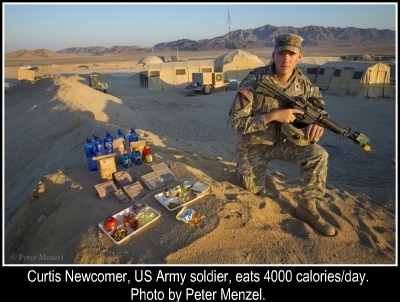
curtis newcomer

The book is organized by how many calories each person eats in a day. I really had no idea what the average calorie intake for an individual was before I started reading this book, but it seems like most people eat between 2200 and 3000 calories per day. Below 2000 calories is mostly athletes who need to be light (my aunt, a competitive rower, once told me she limited herself to 1200 calories a day during racing season--now I know just how low that is!), extreme dieters, workaholics who don't have time to eat, or people living in poverty. Even the fashion model Menzel and D'Aluisio photographed, Mariel Booth, eats 2400 calories a day. One might think that at the other end of the spectrum--people who eat 4000 calories or more per day--there would also be athletes who need energy. But actually, this group is almost entirely made up of men who work outdoors, particularly cold outdoors--with the notable exception of an English housewife who binge eats at 12,000+ calories.

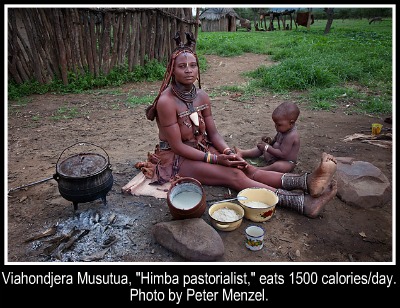
If there's one thing I've learned from this book, though, it's that how many calories you eat doesn't necessarily have a lot to do with how much you weigh, despite what we hear on television. Viahondjera Musutua from Namibia eats about 1500 calories a day and weighs 160 pounds, while João Agustinho Cardoso from Brazil eats more than three times as much--5200 calories a day--yet weighs twenty pounds less! How many calories a dish has and how much food you're actually getting through it also seems to vary wildly: even though extreme dieters Rick Bumgardener and Mackenzie Wolfson eat less than 2000 calories a day, there seems to be a lot more food in their calories than there is in Chinese student Chen Zhen's 2600.

Viahondjera Musutua

Part of the reason, as explained in Bijal P. Trivedi's excellent essay "The Agony and the Ecstasy of the Calorie," is that all calories are not created equal. When calories were "discovered" by Wilbur Olin Atwater in the 19th century, he was basically looking for a way to measure the amount of energy a person can get from food. But each calorie is made up of different values and behaves differently depending on what you do to it (processing, cooking, etc.), so what exactly goes into a "calorie" and how it will affect your body can be extremely variable.

There are several good essays in this book, which helps to mitigate the preachy tone I didn't like in What the World the Eats and elevates What I Eat to a more serious study of how humans relate to food. Trivedi's essay and Michael Pollan's "The End of Cooking," where he talks about the irony of America's obsession with foodie television and the fact that less and less people are cooking for themselves, were my two personal favorites.

Overall I found this to be a book worth tracking down and think it should definitely be of interest to anyone who likes reading about food. It would also be a great resource if you're planning a trip to any of these countries and want to find out what a typical meal might be.


Weekend Cooking is open to anyone who has any kind of food-related post to share: Book (novel, nonfiction) reviews, cookbook reviews, movie reviews, recipes, random thoughts, gadgets, fabulous quotations, photographs. If your post is even vaguely foodie, feel free to grab the button and link up over the weekend.

Saturday, January 7, 2012

Weekend Cooking Review: FED UP WITH LUNCH by Sarah Wu

fed up with lunch cover

You know those people who tweet about what they had for lunch? Well, Sarah Wu made a whole blog about it and then turned it into a book! Blogging "undercover" as the anonymous Mrs. Q, the elementary school teacher mobile blogged pictures of her and students' lunches every day for a year, along with descriptions of what the food was, how it tasted and looked. What did Wu learn from her Supersize Me-like experiment?

I had never visited (or even heard about) Wu's blog, Fed Up with Lunch, until this book came out; but in the interest of learning more about the author and where she's coming from, I looked over her lunch posts. I can definitely see why Fed Up with Lunch is so popular--the blog is really fun and interesting. Most of the attraction lies in Wu's photographs, which aren't professional by any means, but offer a fascinating glimpse into another world. Because most of the food is prepackaged or an appetizing shade of brown-ish, you have no idea what it is until she tells you. The writing itself is really lively and vibrant, but also short--probably about 100-300 words per post. It's said food is a window onto a culture--if that's the case, then the culture of the Illinois school system is like something out of the Jetsons. Their lunches are really bizarre and look like they came out of a space port.

Don't expect any of that from this book, though. This is a memoir of how and why Wu started the blog and her experiences with it, including meeting Jamie Oliver (she had the good fortune to start her blog just as Oliver was airing Food Revolution), being interviewed for Good Morning America, and so on. The pictures of food, which are the heart of Wu's blog, are reduced to 1-inch-square images so small you can't tell what you're looking at, and Wu actually doesn't describe the food she ate that much at all (with the notable and horrifying exception of a peanut butter and jelly sandwich).

Wu states in her book that she felt like a journalist, and I can see that on her blog, but it doesn't translate to this book. If this book is journalism, it's of the fluff variety. She says up-front she's not a food expert, which is fine, but it also shows in that the book reads more like the ruminations of a mom on how we need to watch kids' nutrition, etc. etc. While that's certainly true, as a call to action it's not terribly effective.

There was one really good chapter in the book based on Wu's experiences in the food industry. She worked for Kraft for several years (something she only bothers to mention in chapter seven?), and talks about how food corporations need to show an increase in sales to keep their stock prices up, even though food consumption naturally remains steady. That was really interesting and explained a lot about how food is produced in America.

If you watched Oliver's Food Revolution, you're probably aware that communities' reaction to changing their school food system tends to be met with anything ranging from apathy to antagonism. This book certainly doesn't do any better job than Oliver's TV show at changing that attitude--I have to admit, I'm kind of stuck on apathy at this point. If anything, I'm less inclined to care than I was before, and Wu's really preaching to the choir when it comes to me! While feeding kids freshly-made gourmet meals in cafeterias sounds nice in the abstract, in the concrete I have to wonder if, first of all, kids will actually eat this food; and second of all, who's going to pay for it? Wu didn't persuasively address either question in this book.

If anything, this memoir is an argument for parents to take a more active role in learning about food and cooking freshly prepared meals in their own home. If a revolution begins at home, then Wu did so with her own life, and I think Fed Up with Lunch may influence other parents to do the same.


weekend cooking gif
Weekend Cooking is hosted by Beth Fish Reads and is open to anyone who has any kind of food-related post to share: Book (novel, nonfiction) reviews, cookbook reviews, movie reviews, recipes, random thoughts, gadgets, quotations, photographs. If your post is even vaguely foodie, feel free to grab the button and link up anytime over the weekend.

Saturday, October 15, 2011

Weekend Cooking: WHAT THE WORLD EATS by Faith D'Aluisio and Peter Menzel

world eats cover

If there's a book just asking to be made into the PBS version of No Reservations, it's this one. Peter Menzel and Faith D'Aluisio go around the world and take photos of families with a typical week's worth of food, comparing diets, prices, and a bit about the food culture of the country.

Any foodie worth their salt is interested in what other cultures consider staple foods, so this book is really fascinating, just as I expected it to be when I read Natasha's review of it at 1330v. I was surprised at what parts I found most interesting, however. The variation in what a family spends on food in a single week, for example, can be really mind-boggling. One family in Bhutan feeds 13 people with a little over $5 USD a week; a family of four in France, meanwhile, spends close to $420 USD a week on food! Of course, the French shopping trip included things like wine, cheese, croissants, sausage, and other things I personally wouldn't want to do without. Big spenders on food also have a lot more variety in what they eat. And if there's one thing I've learned from this book, it's that meat is a big expense. Nearly a fourth of the French family's budget was spent on meat, while the Bhutan family only ever ate eggs and a small amount of dried fish for protein. In fact, almost all of the big-budget weekly meals devoted the majority of their money to meat.

I also loved the addition of the family members' favorite foods, just because something like that is always so personal and random. People tend to go either really broad ("everything") or really specific ("spaghetti carbonara"). Unfortunately, we don't get that information for every family, so that was a bit disappointing. The recipes were another odd addition, as the probability of me making something with ingredients I've even heard of, let alone can find, is pretty small.

On an ideological level, I had some issues. This book can get very preachy and the authors definitely have a point of view, one in which McDonald's and processed food is evol. No, I don't eat at McD's; and yes, I am one of those people that's all about fresh and seasonal food, but that's partly because my family is German and I was raised that way.

There's a reason processing and preservatives exist--because eating McDonald's is better than starving. Since the start of civilization, the fight against starvation has been one that requires a way to preserve food for a long time, and nowadays we're pretty good at it. Maybe it's not as healthy as eating everything fresh, but unless we're all going back to being hunter-gatherers (and I can tell you right now I'm not), that's reality. The authors rightly point out that there's a cruelly ironic dichotomy between the fight against obesity in the US and the fight against the hunger that exists in other parts of the world; but they seem more concerned with the former when one would think the latter is more important.

There's also a colonial tone of romanticizing the "primitive life" of non-Western cultures here, an "Oh, look how we're destroying the simple lives and eating habits of these people with our wickedly advanced grocery stores and fast food restaurants" message that I found to be annoying. And if Menzel and D'Aluisio think that this book doesn't invite generalizations (as they say in the introduction), they're deluding themselves; it's titled WHAT THE WORLD EATS, not What a Select Group of People Eats. Overall, though, I think this book is worth at least paging through if you're interested in food and culture. It contains a lot of good information, and the photographs are very interesting (Menzel and D'Aluisio should consider designing supermarket window displays). Plus this book inspired me to compose my own mini-photographic essay! Here is what I eat in a day:

Name: Tasha (31)
Favorite food: Miso soup


Breakfast:
IMG_0008
I'm not a big breakfast person and usually just have coffee with cream and peanut butter toast.

Lunch:
IMG_0009
Not a big lunch person, either. Today it was chicken enchiladas with what I have to say were some pretty sub-standard tortillas and Spanish rice.

Snacks!
IMG_0010
I ate three chocolate chip cookies. Munch munch munch.

Dinner:
IMG_0011
Dinner's my big meal. This chicken piccata with noodles and asparagus tips looks really unappetizing, but it tasted all right. I literally ate everything on this plate.

After dinner:
IMG_0012
I usually have some wine late at night. Also another snack, but tonight I wasn't that hungry.

Total cost: No idea, that would require way too much math. I do think we spend between $150-200 a week on food for four people, though.

To find out more about Menzel and D'Aluisio's current project, check out this lecture Menzel gave at EG4:


Mini-survey time! About how much does your household spend on food every week? What's your favorite food?


Weekend Cooking is open to anyone who has any kind of food-related post to share: Book (novel, nonfiction) reviews, cookbook reviews, movie reviews, recipes, random thoughts, gadgets, fabulous quotations, photographs. If your post is even vaguely foodie, feel free to grab the button and link up over the weekend.

Saturday, June 18, 2011

Weekend Cooking: 100 RECIPES EVERY WOMAN SHOULD KNOW: ENGAGEMENT CHICKEN AND 99 OTHER FABULOUS DISHES TO GET YOU EVERYTHING YOU WANT IN LIFE


I know what you're thinking right now: that's a long title. And also: everything you want in life?!? But you want so many things! Can food really get you all that? No, no it can't. Or can it????

Anyway, who cares, there's no harm in trying, right? *cough* Let's start with the recipe this book is built around: Engagement Chicken. Basically a lemon roast chicken, but with the added benefit/detriment (you decide) of making men fall in love with their stomachs... or you, the book doesn't really go into specifics. POINT IS, make this chicken for a guy, and bam! he'll ask you to marry him.

glamour cover<--This is what I look like while cooking, fyi.

I had several issues with the centerpiece recipe of this book, mainly because it was just way too general. How many people have roasted chickens in their lifetimes? Not me. Even one of the Glamour editors who tried this recipe said she had no idea what giblets were (which definitely puts these recipes in a new light). Yet the book never actually explains what giblets are, or has any technical instructions at all. Are they contractually obligated not to say, "Yo, giblets are..." whatever they are? Because if YOU wondered what giblets were, it's a fair bet that your readers might, too. Also, I'm pretty sure roasting a chicken involves some sort of tying of the chicken legs. I'm not exactly sure why or how this is done, but I clearly remember a French guy doing it on Anthony Bourdain. Yet does the recipe mention anything about tying chicken legs together? Nope. So if you were a newbie cook who'd never roasted a chicken before, you'd just plop that sucker into a roasting pan and who knows what might happen!

The rest of the recipes--i.e., recipes from Glamour that they renamed to fit in with the theme of the book--are a mixed bag. I skipped the breakfast and drinks sections, because I don't mix drinks and I sure as hell don't make breakfast. There are a few must-tries, like "Perfect Host Lobster Pie," which sounds like it's ridiculously easy to make and incredibly decadent at the same time (love that concept); and "Complexion Soup," which is really just a carrot soup. But then there are other recipes like "Broke and Fabulous Grilled Cheese." In case you're wondering, yes, it is just bread and cheese grilled.

My favorite two sections of the book were "Sides" and "Cheap & Easy Meals." Who doesn't need creative ideas for side dishes? I'm always buying something that I think will be great, like brussel sprouts, and then wondering what to do with them. The sides section contains a "Kitchen Basics" insert that has five recipes for vegetable sides, plus four recipes for toppings you can use on any veggie. In fact, the inserts are definitely the best part of the book--they cover things like basic pasta sauces, $5 chicken dinners, and making the perfect cheese plate.

I think overall this is a pretty good cookbook, although the packaging just bothers me. I know it comes from Glamour, which is a woman's magazine, but did they have to market it soooo aggressively as a cookbook for women??? What if I want a guy to make Engagement Chicken for me to convince me to accept his proposal? No guy is going to pick this book up. This gives me a sad. Also, there's this strange dichotomy between a circa-1950s assumption that women are the ones who cook in a relationship ("Let's not forget the cook's needs when we're thinking about the guy's needs!" "Get the man in your life to make this for you--the recipe is that easy." Are you freaking kidding me right now, Glamour?), and the fact that it's obvious none of the editors of Glamour actually live like this (prima facie evidence, the editor who didn't know what giblets were). Do they think the women "in the middle," living between LA and NYC, do? Because that's... kinda dumb.

Anywhosie, despite that, the recipes in the book are worth checking out. I think this would be a great cookbook to give to anyone who's starting out in their first kitchen. And if it's a guy, well... I guess you could just copy them down for him?

weekend cooking gif Weekend Cooking is hosted by Beth Fish Reads and is open to anyone who has any kind of food-related post to share: Book (novel, nonfiction) reviews, cookbook reviews, movie reviews, recipes, random thoughts, gadgets, fabulous quotations, and photographs.

LinkWithin

Related Posts Plugin for WordPress, Blogger...