Showing posts with label manet. Show all posts

Friday, January 4, 2013

Manet's OLYMPIA in Books and TV

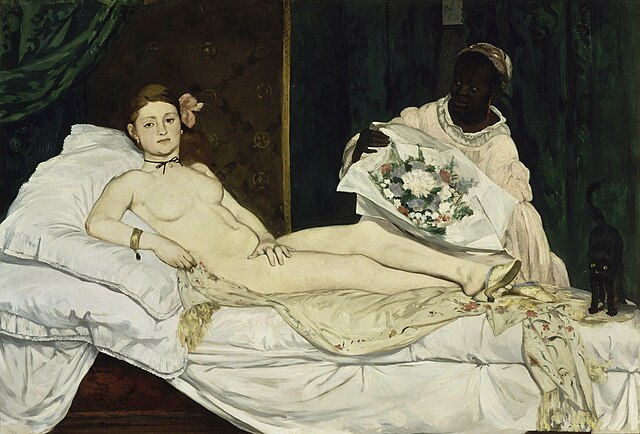
manet's olympia
Olympia, Edouard Manet, 1863, Musée d'Orsay, Paris.

Ahoy, mateys! Major rant ahead...

Edouard Manet is one of my favorite historical crushes. Just check out the interview I did with him if you don't believe me. A nineteenth-century avant-garde artist, Manet inspired the Impressionists and was one of the first modern artists. But he's definitely not as famous as any of the Impressionists, including his bestest frenemy, Edgar Degas. And that's perfectly fine with me. Manet is my historical crush; get your own!

It's kind of weird that in the past few months, I've seen Manet's Olympia given the art history shout-out treatment twice: once on TV and once in a book. And both times it was totally anachronistic. The first instance was on the BBC America series Copper, which is about the NYC police department during the Civil War. On the show, the wealthy Elizabeth Haverford has Olympia hanging in her drawing room. Okay, it's not the ACTUAL Olympia (I can just imagine what they'd have to pay the Musée d'Orsay to get away with that), it's just "very reminiscent of" Olympia according to the show's own blog.

elizabeth haverford's painting from copper
Screenshot of Elizabeth Haverford's painting. C/o BBC America blog.

I don't have a problem with a TV show creating its own version of a famous painting, but I do have a problem with Copper using Olympia. It's horribly anachronistic and drove me crazy. Yes, Copper is set in 1864 and Olympia was painted in 1863, but:

  1. Manet didn't exhibit it--in Paris--until 1865, so how would Elizabeth have gotten her hands on it, hm?
  2. Even ignoring the whole exhibition thing, seeing how the painting isn't "really" Olympia, in order to get a painting like it, Elizabeth would have had to travel to Paris. In the middle of the Civil War? I don't think so.
  3. When Olympia was first exhibited it was WAY avante-garde. It took the French public nearly 30 years to accept Olympia as a masterpiece. The US was generally about twenty years behind Paris in the visual arts (at least in the 19th century), so by my calculations there is no way an American would have anything resembling Olympia until the 1910s at the earliest. BUT...
  4. When I say "Americans" I actually mean American men, since if you haven't noticed there's a naked prostitute in that there picture (that's what made the painting scandalous, by the way--also, it's pretty badly painted). Not the sort of thing a respectable woman would own, let alone have hanging in her drawing room. Even William Bouguereau's Nymphs and Satyr was considered too risque for women to look at, for heaven's sakes!

For the above reasons, although I of course love Manet, I found the presence of Olympia on Copper very annoying. Whenever I saw the painting in Elizabeth's house I was thrown out of the story. Fortunately Corky got pissed off and slashed the painting near the end of the first season, so I won't have to look at it in season two. Yay!

The second instance was in The Importance of Being Wicked by Miranda Neville, which I'm currently reading. Naturally one cannot see paintings in a novel, but I'm pretty sure the portrait described at the beginning of the book is Olympia. It's of an "almost naked [later "stark naked"] woman, reclining on a satin-draped divan." The figure has short, red hair and a bold, direct gaze. Also: Caro wears a ribbon around her neck like Olympia. But most of all, the painting is modeled after a Titian. A Titian like this, for example?

the venus of urbino
The Venus of Urbino, Titian, 1538, Uffizi Gallery, Florence.

BOOM. Manet totally modeled Olympia after The Venus of Urbino. This is the only Titian where the subject is 1. a female nude who is 2. lying down, 3. a ginger, and 4. looking at viewer, so it must be the Titian Caro's husband bought and her friend Oliver later copied, using her as a model.

Again, while I enjoy art history shout-outs, this is pretty anachronistic. The Importance of Being Wicked takes place in 1811 at the latest (likely earlier), and again there's no way a woman of the time would have a painting like that hanging in her drawing room, no matter how daring she was.

What I wonder is, why Olympia? It's a pretty famous painting--even if you don't have an art history degree you've probably seen it--so it's not as if no one would recognize it. I get it, Elizabeth Haverford's a whore (like every single other female character on Copper) and that's why there's this ugly painting of her in the drawing room; but I'm pretty sure there's only about a bazillion paintings out there that could convey that fact more cleverly and effectively than Olympia AND be historically appropriate. Even a Madame X type of portrait would make more sense than Olympia.

With The Importance of Being Wicked, I don't have to look at the painting while I'm reading, so that makes it less annoying than Copper. But the characters show an anachronistic tendency towards "modern art" (term actually used in the book) by reviling the dramatic poses and allegorical works that were popular at the time. That just doesn't shake out in the context of the time period: what we consider "natural posing" doesn't make sense without photography. Not to mention, since the novel IS set in the late 18th century, that London was the Scandalous Portrait Capital of the World! For realz, it's not as if the most famous women in English history at the time had their portraits painted when they either wanted to become famous or shock their family, or both. OH WAIT they all did that, my bad. Modeling a portrait off one of the (many) paintings of Kitty Fischer, Sarah Siddons, Lady Sarah Lennox, or Lady Hamilton would make much more sense. It's not as if there isn't a lot of options to chose from.

Art is a reflection of its place and time, and thus is a great tool for writers and filmmakers to enhance the setting of their story and add depth to their characters (a great example is the use of the Bird Lady on True Blood). But not if the art used is inappropriate! In that case all one winds up with is a sad mess that doesn't mean anything to anyone, least of all to the people who might appreciate the reference the most (such as myself).


Further Reading:

Tuesday, April 6, 2010

I Interview Edouard Manet

edouard manet.

On Monday I posted a blog that was about Nana--the book by Emile Zola, and the painting by Edouard Manet.  But little did you know that only a few days prior I got to interview Manet himself!  Yes, it's true; Colleen from Bookphilia taught me how to interview dead people.  And I was super-excited to get the chance to talk to Manet--you'll see why.


Heidenkind: Bonjour, Monsieur Manet.  Je suis trés contente que vous pouvez joindre à moi!

Manet: Enchanté, Mademoiselle Heidenkind.  Thank you very much for inviting me.

Heidenkind: You can speak English?!?

Manet: Yes, I learned.

Heidenkind: Oh. Phew! My French is a little rusty.

Manet: Naturellement. You speak very well... for an American.

Heidenkind: Um, thanks. Monsieur Manet, I have to tell you that you're one of my all-time favorite artists.  But I've always wondered, do you consider yourself a great artist?

Manet:  Que?!  Il ne fait aucun doute que! 

Heidenkind:  But a lot of your work wasn't really successful...

Manet:  Sacrilege!  Am I to judge my work by the standards of those... pointilleux academicians who never want their heads stimulated by a thought?!

Heidenkind:  Well, you submitted to the Salons every year that they were held, so clearly you did want your work judged by the Academicians and believed in the Salon system.

Manet:  Hmph.  I knew they would hate much of my paintings, vraiment.  But as I say, they had no imagination.

Heidenkind:  You didn't expect them to hate Olympia, did you?

Manet:  *glares* Mademoiselle, I was a great artist, and any misunderstandings the critics labored under was their misfortune.  Now, shall we change the subject?

Heidenkind:  Very well.  What were your feelings for Berthe Morisot?

Manet:  *turning red* Brotherly affection, only!

Heidenkind:  Really?  Marni R. Kessler pointed out in an article in The Art Bulletin that your portraits of Morisot became increasingly unfavorable as her romance with your brother, Eugène, progressed; and your final portrait of her, created shortly after their engagement was announced, makes her face look like a skull.

Manet:  How very observant of this Monsieur Kessler.

Heidenkind:  I think it's a woman.

Manet:  Ha!

*long awkward pause*

Heidenkind:  Are you going to answer my question?

Manet:  I do not like to feed the romantic fantasies of young women any more than necessary; they are quite capable of doing that on their own, non?

Heidenkind:  Monsieur, I suspect that what you know about young women wouldn't fill a pin's head.  *smile smile smile*  Fine, what should we talk about next?  Your love/hate relationship with Degas, syphilis, or whether your adopted son was actually your son or your nephew or your brother?

Manet:  Mon Dieu, but you historiennes sont feuineuse!  How does one say--gossipy.  Why do you not ask me about my work?

Heidenkind:  Okay--why do so many of your paintings have such a sense of loneliness and isolation?  What was your message in Gare St. Lazare?  What do you think is your most important work?  Is The Absinthe Drinker a self-portrait?

Manet:  Are these the things you truly want to know?

Heidenkind:  Er, what do you mean?

Manet:  I can sense that you truly do not care about how I feel about my work, non?  You already have the answers to all your questions in your own mind.  So why, one must wonder, did you call me for this interview at all?  Perhaps you are interested in something else?

Heidenkind:  *blushing furiously*  How... why... uhmmmmmm....

Manet:  Please, mademoiselle, get to the point.  The afterlife is too short to beat around the bush.

Heidenkind:  *takes off glasses* Do you want to make out?

Manet:  *wolfish grin*

Heidenkind:  *swoon*


Okay, well, I don't think we need to see much more of that interview!  What, you never crushed on a dead person???


Powered by ScribeFire.

Monday, April 5, 2010

Nana and the Gaze

nana by edouard manet Nana, Edouard Manet, 1877


I've blogged about the Male Gaze before--today it seems like an intellectual term invented by feminist art historians, but it was an actual thing that existed in the late 19th century.  Men had the power to look, because by looking they owned what they saw, including women.  Women, meanwhile, were supposed to keep their heads down and be demure--but this rule didn't necessarily apply to those women who lived outside the rules of bourgeois society, namely courtesans and prostitutes.

Therefore it's no surprise that Emile Zola's Nana is full of looking--the men who feel free to look at every woman, and appreciate (read: lust over) Nana despite her lack of any discernible talent; the respectable ladies who are really only allowed to consume with their gaze at the Opera or Salons; and the courtesans/actresses who challenge male power by meeting their gaze full on. 

Nothing shows how the gaze equates ownership in Nana so much as some of the first scenes in the theater.  During intermission, the men discuss where they might have seen Nana before--on some street or cafe in Paris.  As readers, we assume that they probably haven't seen her--but by claiming that they have, they assert some ownership over her. 

This may all seem like a horrible objectification of women, and it is; but in Paris, this was the way a young woman could hope to gain wealth and fortune.  As critic Armand Silvestre said in 1888, "every woman who thinks herself beautiful imagines herself Semiramis or Catherine or Fredegonde or simply Olympia. The unfortunate adventure of Nana hasn't discouraged anyone."  Even Nana objectifies herself and her own beauty, owning it by looking at it, "absorbed in enraptured contemplation of herself."

Nana's avaricious gaze extends not just to herself and her audience, but at places--like the races--where any respectable lady would keep her gaze lowered.  Nana instead scans the field with a large pair of binoculars, and looks all the other ladies in the face.  Nana's gaze frightens and seduces men like Moffet, and threatens women like the Comtesse Sabine.

With all this talk about courtesans and looking, it's no wonder that artist Edouard Manet, the king of The Gaze, adored his friend Zola's Nana.  His most famous painting of a courtesan challenging the Male Gaze is Olympia (see the Silvestre quote above); but he also named a painting with similar themes after Zola's heroine.  The model is real-life grande cocotte, Henriette Hauser.  She stands in her underthings, applying make-up before a mirror while a gentleman (holding a cane in his lap--think cigars here, people) watches her in the mirror's reflection.  Nana--or Henriette--meanwhile, looks out at the viewer, the entire focus of the painting, seeming to defy the viewers' presumed right to observe her.  Even though women like Nana--as we see in the book--are seen as little more than sexual snacks, the woman in this painting dares you to objectify her--unless you want to be trapped in your own gaze, as the gentleman on the right seems to be.

Manet's Nana was rejected from the 1877 Salon, not surprisingly; in response, he displayed it in a gallery on the Boulevard des Capucines.  Not only that, but it was hung in a window, where the comely courtesan could gaze freely at every man, woman, and child who passed by on the busy street, thus causing more of a scandal than she probably would have in the Salon.

Even though prostitution was an accepted--desired, actually--part of Parisian society, it one that most of that same society refused to speak of.  Events like the theater, which we see in Nana, and the annual masked ball at the Opera (which Manet also painted) were well-known places where poor girls could hook up with wealthy gentlemen, all while said men-folks' respectable wives, sisters, daughters, and mothers mingled in the crowd.

As for the book, Nana, it's surprisingly enjoyable and readable.  Zola drop-kicks us into the middle of 1870's Paris, and you're suddenly surrounded by men in top hats, women with gigantic skirts, and the rush and insanity and craziness of the Variétés.  Can anything be better for a nineteenth-century geek like myself?  I can't believe it took me this long to try out Zola, and I highly recommend this novel for anyone with a passing interest in nineteenth century art or literature.


Powered by ScribeFire.

Thursday, July 16, 2009

Judging a Failure

Olympia by Manet

Youandwhosearmy has an interesting post up about failure and how artists fail intentionally.  This made me think of Edouard Manet and his most famous painting, Olympia.

Olympia is one of the landmarks of Modernism.  The critics reviled it, saying the woman looked like a common whore, she was ugly, her hand looked like a spider (it actually kind of does), and that the quality of the work was simply bad.  However, it served as inspiration to the next generation of Modernism giants like Cézanne.

For years it was assumed that Olympia was exactly the way Manet intended--that he painted his Venus the way he did to show truth (as Emile Zola put it), or that he was responding to what Charles Baudelaire had written in A Painter of Modern Life:

If a painter, patient and scrupulous but with only inferior imaginative power, were commissioned to paint a courtesan of today, and, for this purpose, were to get his inspiration (to use the hallowed term) from a courtesan by Titian or Raphael, the odds are that his work would be fraudulent, ambiguous, and difficult to understand. The study of a masterpiece of that date and of that kind will not teach him the carriage, the gaze, the come-hitherishness, or the living representation of one of these creatures that the dictionary of fashion has, in rapid succession, pigeonholed under the coarse or light-hearted rubric of unchaste, kept women, Lorettes.

The latter seemed the most possible, as Manet was a close friend and follower of Baudelaire's, and he did indeed base Olympia off of Titian's Venus of Urbino.  One imagined Manet deliberately taunting the critics and laughing with his other flaneur buddies over the private joke he had fashioned (in fact, this is how most of Manet's famous works are viewed--as giant in-jokes).

A new article at Nineteenth-Century Art Worldwide by Phylis A. Floyd, however, casts a completely different light on the painting.  According to letters Manet wrote, he didn't find the criticisms of Olympia funny at all--in fact, he was shocked, bewildered, and hurt at people's negative reaction to the work.  Floyd argues convincingly that the model for Olympia was not Victorine Meurent, as has always been assumed, but Marguerite Bellanger, the then-mistress to Napoleon III.  Apparently Manet wanted to court the emperor's favor by painting his version of Alexandre Cabanal's The Birth of Venus, which Napoleon III had bought the previous year.  But Manet failed to paint an attractive portrait, and instead was lashed with criticism for the work.

What does this say about Manet and Modernism in general?  Is the basis of Olympia's value as a piece of art in jeopardy if Manet did not intend it to fail as it did?  Because if that is the case--if Manet, the father of Modernism, was simply a bad painter--then that means all of modern painting is not based on clever in-jokes, challenging critics, and failing intentionally, but just on being a craptastic artist!

Manet did want to be one of great artists of his day, like Cabanal.  The only problem was, he couldn't paint like Cabanal.  When he tried to make a grand artistic statement, he usuall failed at it.  Does that make his paintings any less valuable?


Powered by ScribeFire.

LinkWithin

Related Posts Plugin for WordPress, Blogger...