Showing posts with label classic. Show all posts

Saturday, July 31, 2021

Review: Gawain and the Green Knight


the hunt in the forest by paolo ucello
The Hunt in the Forest by Paolo Uccello, c. 1470

I

Gather all and put much thought 
to a tale of noble Camelot.
On New Year’s Eve the court did gather 
With wine and beer and much blather
Ladies fair and knights bold 
Plus Gweneviere and Arthur, we are told 
When all at once, what should they see 
But a walking, talking Christmas tree! 

(Actually it’s a man) 

Yes, ’twas a man, but green 
hair green, skin green, tongue green
Of great stature and much mass
Even his horse was the color of grass
Everything green, but eyes that were red
Even an idiot could guess where this led
But not Arthur and his patriotic knights
Who thought the green man rather nice

(How stupid are they?)

The Christmas Tree spoke, and offered a game
To anyone brave enough to issue his name
Strike a blow against the green man, and when the time came
A year from the next day, the green man would do the same.
What’s in it for the knights, one might wonder
But Sir Gawain this did not ponder.
He accepted the ax, and the green man knelt
Then to his neck, a fatal blow Wawain dealt.

(He chopped the Christmas Tree’s head off)

The head rolled about, the court watching whence it should land
Dismissing the Green Man, and thinking the matter at an end
Green blood spurted out from the tree
And Gawain anticipated congratulations there’d be
But the Christmas Tree rose from where he sat
And calmly collected his body’s hat
Holding his head, he told Gawain the way to his home
To meet a year from then, and to come alone

After which, he left.

II

Despite that Gawain was not too bright,
Even he knew to do what was right
Honor and chivalry demanded
He meet the Christmas Tree and be beheaded
Thus he set out in the morning
Uncertain about where he was going
A year later, and with much apprehension
For a view of reaching the Green Man’s mansion

(Which I’m guessing is in a forest)

But alas our knight knew not left from right
(re: none too bright)
Far and wide our hero did bumble
Searching for Green Man’s Green Chapel.
He was cold, and hungry, and sad to boot
When what should he spy: a moat!
Connected to a grand castle with turrets and flags
And the friendliest host Gawain’d ever had.

(Almost TOO friendly.)

The man himself was handsome and wealthy
With two others in residence: an old woman quite stealthy,
And a wife so beautiful she left Gawain nonplussed;
They took one look at each other and fell into lust.
Then with Gawain, a bargain the host assayed
That he would go hunting during the day
Upon his return, his catch he would giveth
And Gawain his daily claims would returneth.

(Sounds like another sketchy deal to me.)

But Gawain, like an idiot, pronounced his agreement
And into more trouble our hero descendeth.
But I shall say no more of Wawain’s toil
For fear that his tale I will spoil
At first I thought this story difficult to read
I did not comprehend the why of the characters’ deeds
But then Gawain met the lady, sorely tempting
And things got MUCH more entertaining.

(But who doesn’t like a little romance, right?)

Tis clear that this tale is all about pursuit:
of animals, women, and bravery to salute.
For while the host was hunting game,
The hostess was chasing down Gawain
Quite a dilemma for him to be thinking about
But of course not much thinking is done by that clout
Still, there’s a twist that I thought was grand
For in everything, a famous woman has a hand.

Highly recommended!


Originally posted at Medieval Bookworm in 2010. So long ago!

Tuesday, April 7, 2015

THE LADIES' PARADISE Readalong: Chapter Two


the ladies' paradise emile zola book cover

All through the month of April, Evangeline from Edwardian Promenade and I are hosting a readalong of the Emile Zola novel, The Ladies' Paradise, which was the basis for the PBS series The Paradise. I'm listening to the book on audio, narrated by Lee Ann Howlett.

On Saturday, Evangeline recapped Chapter One, wherein we met our young heroine–Denise Baudu–and the site of her adventures, an alluring department store called The Ladies' Paradise. Check out Evangeline's post if you need to catch up!

In Chapter Two, Denise crosses the street to The Ladies' Paradise to apply for a job, and we discover working at TLP might not be as glamorous as its shiny window displays suggest. The owner, Octave Mouret, has created a small kingdom under its roof–his kingdom–separated into numerous departments, with almost its own social hierarchy. And while Mouret's not a micromanager, he's not exactly down with the bonhomie, either. When he reprimands the accounting department for joking around, they act like "whipped dogs," and he "plays upon the selfish instincts of his employees," setting them against one another and fostering an atmosphere of not-entirely-friendly competition. Probably why the sales clerks in the drapery department are such a bunch of catty bitches.

When it comes to Mouret, the term wolf in sheep's clothing definitely leaps to mind. He's always charming, he never raises his voice, and he appears to be quite the lover of women–after all, he built a store called The Ladies' Paradise!

mouret the paradise
Hey girl, I discounted silks because you look so pretty in them.


But in actuality, he's kind of a jerk with a massive ego who doesn't care about women at all beyond the money he can get out of them. Bourdoncle, one of Mouret's "lieutenants" and work BFF, predicts:

You know they'll have their revenge... the women. They will have their revenge; there will be one who will avenge all the others. It's bound to be.

FORESHADOW FORESHADOW FORESHADOW

the paradise denise
OMG so shiny.


Anyway, Denise walks into TLP after spending a good half hour giving herself a pep talk about acting confident, which only partially works. Almost as soon as she walks into the store, she's overwhelmed with the beauty of the merchandise. Mouret spots her and is enchanted by her enchantment with his goods. IF YOU KNOW WHAT I MEAN. Then Denise's eyes meet Mouret's, and she's like *blush*, and he's like, *smoulder*, and everyone else is like, *MASSIVE EYE ROLL*.

Once in the dress department, Denise can't get the catty bitches to tell her where Madame Aurélie, the manager, is or when she'll be back, or even acknowledge Denise's existence. Things aren't looking promising!

Finally Madame Aurélie shows up to reprimand one of the sales clerks and Denise gets her chance at an interview. She totally bombs it: she gets that whole dry mouth thing going, keeps repeating she's very strong for no good reason (you see a lot of weight lifting going on here, Denise?), and she's never worked in a Paris house before. Madame Aurélie is clearly thinking this one's a giant nope, up until Mouret slithers his way into the situation, intrigued by the fact that Denise's uncle owns the old-fashioned drapery shop across the street. You can practically hear the wheels clanking in his head.

Madame Aurélie gives her the "don't call us, we'll call you," line and Denise reluctantly leaves, crushed with how the interview went but not sure if she wants to work in such a place, anyway. On the way out, she meets the equally shy and timid Henri Deloche, also applying for a job at TLP, and they are adorkably awkward together. Is romance in the works? Will Denise get the job? (Probably, the book's titled The Ladies' Paradise and not Au Vieil Elbeuf. The Old Cloth, there's an attractive name for a store!) Questions.

Overall I enjoyed this chapter, although it was a little dry up until Denise walked into TLP and Mouret started making eyes at her. There was also a lot of talk about Jews. Mouret is apparently "a bigger Jew than all the Jews in the world." Yay?

Check out Edwardian Promenade on Friday to read Evangeline's recap of the next chapter in The Ladies' Paradise!


Discus this post with me on Twitter, FaceBook, Google+ or in the comments below.

Monday, July 21, 2014

4 Mini Book Reviews

neanderthal seeks human cover

Hi there one and all! I'm at Book Riot today reviewing four books for Buy, Borrow, Bypass:

  • Neanderthal Seeks Human by Penny Reid
  • Waking the Merrow by Heather Rigney
  • Patricia Brent, Spinster by Herbert Jenkins
  • Beautiful Ruins by Jess Walter


All of these books deserve longer, more thoughtful reviews, which I hopefully will be able to write soon. But since I recently took on another job (for those of you keeping track at home, that's three jobs), time is a bit at a premium nowadays, so I can make no promises.

If you've read any of these books, let me know what you thought here or over at Book Riot!


Discus this post with me on Twitter, FaceBook, Google+ or in the comments below.

Saturday, September 7, 2013

Review: ANIMAL FARM by George Orwell

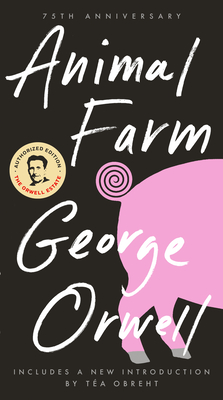
animal farm cover
It took me a ridiculously long time to figure out that pink shape was a pig.

The animals of Manor Farm are miserable. They're overworked, underfed, the farmer takes away their children, and they're killed when they're no longer "useful" to him. Then they get the chance to oust the farmer and establish their own farm, the Animal Farm, where all animals are equal! Only some animals fancy themselves more equal than others...

This is my first read by George Orwell, and it's terribly clever. It's short—just slightly over 100 pages—and the premise is simple. That's the genius of it: Animal Farm could be a parable about any uprising from the French Revolution, to the Bolshevik Revolution, to the Egyptian Revolution in 2011. Perhaps even the American Revolution. It was chilling yet totally convincing.

That's not to say the book is all political talk. It's also about society and economics and technology. But more than that, it's a great story that makes you think, and the animal characters are surprisingly sympathetic. Right from the beginning you feel for them, even though it's obvious their dream of a utopian society is NOT going to work. From the vain pony, Molly, to the cynical donkey Benjamin, the animals feel like characters you can identify with. I spent the entire book on the edge of my seat hoping the noble workhorse Boxer wouldn't die, even though I KNEW he would. And when it did happen, it was even more awful and cruelly ironic than I anticipated.

I was also surprised by the message of the novel. When I first started it, I figured the moral would be that the animals' idealistic society was doomed to fail because animals (read: people) were inherently selfish and out for themselves, but that wasn't the case at all. The majority of the animals were good, or at least good up to a certain point; they worked hard just on the basis of hope for a better life and that someday it would pay off. The reason Animal Farm failed was actually because it was modeled directly off of the human world and Manor Farm. The pigs got all their ideas from human books, even applying war maneuvers from Ancient Rome! Pretty soon some of the pigs were acting like Roman Emperors. It's the culture and system itself that supported exploitation and oppression, which is why it was nearly impossible to change.

Animal Farm entertained me while making me think about things in a different way. Just see if I don't start shouting, "Four feet good, two feet bad!" the next time I see a pundit on TV. I would recommend this novel as a must-read to everyone.


Discus this post with me on Twitter, FaceBook, Google+ or in the comments below.

Saturday, July 20, 2013

Review of THE LADY VANISHES by Ethel Lina White

cover of the lady vanishes book

(Actual title is The Wheel Spins, but Amazon and Goodreads have apparently decided to rename it. To be fair, The Lady Vanishes is a much better title.)

Iris Carr is a spoiled, wealthy young woman on holiday at some vaguely Alpine resort filled with English tourists. After catching the last train out to Trieste, Iris meets the bubbly Miss Froy, a middle-aged governess returning to England after years abroad. Iris decides to take a nap and when she wakes up, Miss Froy has disappeared. Even more strange is that everyone denies she was even on the train! Certain that something terrible has happened to Miss Froy, Iris enlists the help of the men folk, but they think she's crazy. After a while, Iris starts to wonder if they aren't right.

If you've seen the movie by Alfred Hitchcock, The Lady Vanishes, Ethel White's novel is very similar (in Fear in the Sunlight, Nicola Upson painted Hitch as someone who had no respect for the original work when adapting novels to film; she obviously knows shit-all about Hitchcock movies), right down to the time symbolism and British ethnocentrism. Honestly, the only difference between the book and the movie is that White gives us a ton of backstory about all the other English passengers on the train and why they don't mention they've seen Miss Froy, plus scenes of Miss Froy's family waiting for her in England. So we know from the outset that Miss Froy is real and not a figment of Iris's imagination, which kind of takes the fun out of the whole thing. I also really didn't care about the other English passengers. At all.

In other words, the movie is better than the book. Don't feel the need to read The Wheel Spins/Lady Vanishes, even if you love the movie.

That being said, I found the elaboration of themes in the novel interesting. You might be familiar with a story Hitchcock told François Truffaut in their 1962 interview about The Lady Vanishes and how it was based on a "true story" of a mother and daughter who traveled to Paris at the start of the Paris Exposition and checked into separate rooms in a hotel. When the daughter woke up from a nap, her mother was gone, her luggage had disappeared, and the room didn't appear to have been slept in. When the daughter asked the desk clerk, he said she'd checked into the hotel alone, and everyone else from the maid to the coachman who'd taken them to the hotel confirmed the desk clerk's story. People assumed the daughter was crazy. In fact, during the daughter's nap, her mother had died of the plague. The hotelier and city officials, fearing a plague scare would keep people away from the Exposition, decided to bury the body and pretend as if the woman had never existed.

That story is actually in the novel, along with several other urban legends that underscore how women are presumed to be neurotic and delusional until proven otherwise, and also how easily a woman's identity can be erased. I really liked that there are stories-within-stories in The Wheel Spins that served to create an atmosphere of paranoia on the train, although I don't think White cashed in on this as effectively as Hitchcock did.

Another thing I found interesting was the role of men in the story. There are only a few male characters, but the women are completely dependent upon them because only the men can communicate with the outside world (well, except for Miss Froy: she speaks 10 languages, although we never actually see her speaking any foreign language during the course of the book). The Professor and "Hare" (a reference to the white rabbit from Alice in Wonderland?), two Englishmen who help Iris, are both linguists and fluent in whatever language the locals speak; but even men who don't speak the language can communicate with the outside world. For example, the clergyman who stayed at the same hotel as Iris left every day to sit with the locals in the village, leaving his wife behind to remark that she didn't know how he communicated with them when he didn't speak one word of the language. A big deal is also made of the fact that Iris is absolutely terrible with languages, so that everything she says to local people on the train is interpreted through a male voice—and a misogynist male who thinks she's by turns annoying and delusional, at that. The Wheel Spins really underscores female dependency on men, much more so than The Lady Vanishes.

I actually did enjoy the first half of The Wheel Spins, but Iris started to get annoying because she constantly runs to either the Professor or Hare to fix things for her when that is CLEARLY not working. Why doesn't she do something herself? The second half is also filled with literally paragraphs upon paragraphs of exposition telling us about character motivation. TELLING, not showing. The conclusion of the novel was also a disappointment. I love the end of The Lady Vanishes movie because Miss Froy turns out to be a badass, and there are a ton of fun magic references and a shoot-out. That does NOT happen in The Wheel Spins. I won't spoil the ending for you, but it was really lame, drawn-out, and anti-climatic.

Basically, you could spend five hours of your life reading this book, or ninety minutes watching the movie. Not to mention the book isn't in the public domain (and yet the movie is... makes no sense), so you actually have to pay for it. Not worth it. I'd only recommend The Wheel Spins/Lady Vanishes to those with a vested interest in Pre-War women and literature.


Discus this post with me on Twitter, FaceBook, Google+ or in the comments below.

Tuesday, May 28, 2013

Armchair BEA: Classics

armchair bea button
Design credit: Sarah of Puss Reboots

This year for Armchair BEA we're being asked to write about genre fiction for our daily topics, and today we're addressing the issue of classics.

I used to avoid classics, especially after high school, because I was forced to read a lot of classics I didn't like and I thought they were hoity-toity and boring (except for the few I LOVED, of course, like Jane Eyre, Pride and Prejudice, and The Great Gatsby). Nowadays, I read so many classics I started a my own classics blog, The Project Gutenburg Project! So what changed? Basically, thanks in large part to Project Gutenberg, Librivox, and Redeeming Qualities, I realized that there were all these entertaining, fun classic novels out there, waiting to be rediscovered.

If you have a favorite genre, chances are you can find that genre as a classic. I've been exploring classic mysteries from Edgar Allan Poe's Inspector Dupin stories (considered the first mysteries), to Sherlock Holmes and Agatha Christie, and it's been soooo much fun. Or romance! Ivanhoe, Vera, or an Emilie Loring novel will hit the spot. How about adventure? You can't go wrong with Rafael Sabatini, The Three Musketeers, or The Thirty-Nine Steps. Sci-fi fan? Try Robert E. Howard or Edgar Rice Burroughs.

Second of all, classics are curious. There are a lot of similarities to modern literature and some differences that are just bizarre. And I LOVE the bizarre books most of all. A few years ago I couldn't stop reading romances, and now I can't stop reading classics. It's like a sickness.

Anyway, if you want some recommendations for classics, just ask me in the comments and I'll try my best to think of something. Or check out the recommendation flow chart I made up (and need to update).

And if you have a favorite classic you think I'd like please let me know!


Discus this post with me on Twitter, FaceBook, Google+ or in the comments below.

Sunday, May 5, 2013

Great Gatsby Readalong Chapters 5-6


How excited are you for The Great Gatsby movie on a scale of one to a bazillion? I swear Gatsby takes up 80% of my brain power right now. Anyway, as I mentioned last week, my friend Becky from One Literature Nut is hosting a readalong for The Great Gatsby in preparation for the upcoming film. This week, we're discussing chapters 5 and 6, wherein Daisy and Gatsby "reconnect." If the cottage is a-rockin' don't come a knockin'!

Questions:

I'm reminded of a psychology lesson I once learned, that states that the person with the least interest in the relationship, controls it. Is that person Daisy? Is she so "secure" with Tom that Gatsby could be no more than a momentary diversion from her unhappiness? The person with the least interest in a relationship controls it? Was this psychology teacher a frat boy, perchance? One of the authors of The Rules? I think that's called playing hard to get. BUT ANYWAY—I definitely don't think Daisy's as hung up on Gatsby as he is on her. He's set her up to be the be all and end all of his happiness, which is a lot for a person to live up to. But I'm not sure she controls the relationship or even recognizes the power she has over Gatsby.

Did you have any lines that jumped out at you in these chapters? The line that made me laugh was this one:
Gatsby, pale as death, with his hands plunged like weights in his coat pockets, was standing in a puddle of water glaring tragically into my eyes.
With his hands still in his coat pockets he stalked by me into the hall, turned sharply as if he were on a wire, and disappeared into the living-room. It wasn’t a bit funny.
Sorry, Nick, but that sounds hilarious. Gatsby is so funny.
Another line that stood out to me was when Nick tells Gatsby, "I wouldn't ask too much of her, you can't repeat the past." Someone's talking but Gatsby ain't listening to youuuuuuuu.

How has your opinion of Gatsby and Daisy changed now that they have finally met again? Hm, I don't know. On one hand, Gatsby is so vulnerable in certain scenes, like the one I quoted from above, that it's hard not to feel for the guy. But on the other hand I don't think Daisy necessarily brings out the best in him; he seems obsessed with appearances and material possessions after they hook up. As for Daisy, who knows? I don't know what to think about a woman who cries over shirts. These two might be better on their own than together.


Discus this post with me on Twitter, FaceBook, Google+ or in the comments below.

Monday, April 29, 2013

Great Gatsby Readalong Chapters 1-4

gatsby readalong button

Becky from One Literature Nut is hosting a readalong of The Great Gatsby before the movie starts. You can still join in if you like! I got kind of a late start because I was waiting for the audiobook from the library, but I finished the book this weekend and am ready to catch up.

Discussion Questions from Becky:


  • What role(s) do you see for the setting in the novel? Do you like this setting, and does it affect the way you read the story? I don't live on the East Coast so I have no opinion about the Hamptons--I mean, East and West Egg. The Eggs?--but I did notice that the Egg Gatsby lives on is the less fashionable one. He can't do anything right.
  • Since Nick is the narrator in this story, do you think it's possible he might be setting us up to like or dislike certain characters? Do you trust his retelling? I don't think Nick likes anyone in this book, including himself. I'm not sure he knows what "liking people" means. He just does things because it's expected, not because he likes or dislikes it.
  • What do you think of Tom, Daisy, and Myrtle? Tom's obviously an ass hole. Daisy thinks she's clever but only because she's around Tom too much, and Myrtle's just desperate.
  • What else stood out to you in these opening chapters? I kind of hate Nick. Everyone in this book is so conventional, they need someone to save them from themselves. And speaking of our savior...
  • What do you think of Gatsby's absence from his own parties? I think it's a metaphor for his life. The parties and the whole Great Gatsby persona are kind of hollow because they don't have anything to do with him, they're just a trap lure Daisy. He's not present in his own life just like he's not present at his parties.
  • Is Gatsby a character you feel sympathy or cynicism towards? I definitely sympathize with Gatsby--he's the only character in the entire book who has ANY imagination--but dang dude, take a pill and chillax. He's actually an awesome person, but he's trying so hard to be someone else and he's so awkward and desperate.
  • Are we supposed to feel for Daisy as Jordan does, and if she really wanted to meet up with Gatsby again, wouldn't she already have done it? I honestly don't feel anything for Daisy. She's hardly even a character, just a symbol. Eighty percent of what she does makes no sense.
  • Is there anything else that stood out to you or you questioned? I loved the scene in the library where the guy was like, "Real books, with pages and everything!" The moment when Gatsby and Nick first met also kind of made me hate Nick, because it seems like they could be friends and then Nick gets all Judgey McJudge and is like, "What a poseur." You're a poseur Nick! I don't see you being awesome.


Stay tuned next week when we discuss chapters 5-6, which hopefully I won't have completely forgotten by then.

Discus this post with me on Twitter, FaceBook, Google+ or in the comments below.

Friday, November 9, 2012

New to You: THE HUNTING OF THE SNARK by Lewis Carroll

hunting of the snark cover


They sought it with thimbles, they sought it with care;
They pursued it with forks and hope;
They threatened its life with a railway-share;
They charmed it with smiles and soap.
In the explicanation of all that is good, somewhat is left unsold. Your right brain, directing your speech, knows what you want to say, but your left brain doesn't know the words for it. What are you looking for? Be sure to write it down in soap.

In The Hunting of the Snark there are seven characters. One is a butcher but not a butcher and he makes friends with a beaver, which is what he hunts. Beavers are the only animals he kills. Then they hear a jubjub. They fear death and realize they've been friends forever. That was my favorite part.

Actually, I lied. There are ten characters. The best character is the baker, called "Hi," who forgets everything except the most important thing. He tries to warn the crew, but they don't listen, and he winds up being got by the very thing he feared getting.

Blah blah blah. Coming to the point, think of the words read and understand. Now open your mouth and say the first word that comes into your head. Those with a proclivity to one will say "read," while those with an inclination toward the other will say "understand." But only those who know what I'm getting at will say "runderstead."

I rundersteaded The Hunting of the Snark frumiously. The great thing about kids is they don't really care if something makes sense, because to them nothing makes sense. Nothing makes sense to adults, either, but they like to pretend it does. Therefore The Hunting of the Snark is beamish fun for multiple-aged persons!

In conclusion, be careful that your Snarks aren't Boojums.


This post was originally published on Project Gutenberg Project. I believe it's the best review I've ever written. Be careful your Snarks aren't Boojums--words to live by.

Monday, November 5, 2012

Mina Harker and Dr. Seward: So In Love.

mina harker and dr seward
Warning: there is going to be a lot of capslocksia going on in this post.

Sometimes, when I'm reading a book or watching a TV show, my brain gets really bored. As a result, I start inventing storylines in my head--and, since this is me we're talking about, the stories usually have something to do with a secret romance between two characters.

Some people call this shipping (for more about shipping and what it is, read "To Ship or Not To Ship" at Bookalico.us). I call it LOGIC. Or at least in this case I do.

See, lately I've been listening to Dracula on audiobook (it was free), and I swear to Gott--as Van Helsing would put it--that Mina Harker and Doctor Seward are in love. THEY ARE SO CUTE TOGETHER, YOU GUYS!!! Yet I can't find anything on the internet about their secret, burning romance. What the fridge? It's totally obvious.

Don't believe me? Here is my recap of how they fell in love, which seriously reads almost exactly like the start of a romantic comedy:


Meet-cute: Paddington Station. Mina recognizes Dr. Seward immediately from her friend's description of him. He blushes. She blushes. They go to the lunatic asylum where he lives for some reason (because he's crazy?). He's so excited he has to record his thoughts about their meeting IMMEDIATELY.

Mina knocks on the door.

*gasp* "Here she is!" (Seward literally says this--okay maybe not the gasp. But he's obviously P R E T T Y jazzed.)

And they fell in love: Mina walks in, wondering to whom Dr. Seward is talking, but he's alone. He really is crazy! No, he's just recording in his "diary," which happens to be a phonograph. Mina's all, "You keep a diary? I keep a diary!" (And for the same reason--to improve themselves. RME These two already clearly belong together.)

Mina's account:
I felt quite excited over it, and blurted out, "Why, this beats even shorthand! May I hear it say something?" 
"Certainly," he replied with alacrity, and stood up to put it in train for speaking. [Gawd they are so cute.] Then he paused, and a troubled look overspread his face. 
"The fact is," he began awkwardly, "I only keep my diary in it, and as it is entirely, almost entirely, about my cases it may be awkward, that is, I mean…" He stopped, and I tried to help him out of his embarrassment. 
"You helped to attend dear Lucy at the end. Let me hear how she died, for all that I know of her, I shall be very grateful. She was very, very dear to me." 
To my surprise, he answered, with a horrorstruck look in his face, "Tell you of her death? Not for the wide world!" 
"Why not?" I asked, for some grave, terrible feeling was coming over me. 
Again he paused, and I could see that he was trying to invent an excuse. At length, he stammered out, "You see, I do not know how to pick out any particular part of the diary." 
Even while he was speaking an idea dawned upon him, and he said with unconscious simplicity, in a different voice, and with the naivete of a child, "that's quite true, upon my honour. Honest Indian!" [Seward, you are so awkward. Adorbs.] 
I could not but smile, at which he grimaced. "I gave myself away that time!" he said. "But do you know that, although I have kept the diary for months past, it never once struck me how I was going to find any particular part of it in case I wanted to look it up?"

Don't worry, Seward. Mina won't just type up your diary for you, she'll index it according to patient, symptoms and illness.

Which brings me to another reason why Mina and Dr. Seward are in love: they need each other! Mina is so bored with Jonathan she's memorized the train schedules on his commute "just in case he's in a hurry." JESUS, MINA. Memorizing the schedule for your own commute is one thing, but another person's?! I'm guessing Jonathan is able to tell time, get a freaking grip. Dr. Seward, on the other hand, needs someone to help him with his research and, um, you know, play with his phonograph. His work is much more interesting than Jonathan's, and he doesn't commute--he lives at the asylum!

Anyway, Mina and Seward exchange diaries, which is like the cutest thing ever, and Seward gets so wrapped up in Mina's he almost forgets to eat. And Mina gets so wrapped up in Seward's diary she cries and tells him,
That is a wonderful machine, but it is cruelly true. It told me, in its very tones, the anguish of your heart.... See, I have tried to be useful. I have copied out the words on my typewriter, and none other need now hear your heart beat, as I did.
Aww. She can hear his heart beat.

Adjectives Mina uses to describe Seward: noble, good, thoughtful. Adjectives Dr. Seward uses to describe Mina: sweet, a brilliant mind, pretty, courageous. GAH HE'S SO IN LOVE. Dr. Seward also never refers to Mina as a child, unlike SOME people I could name (coughJonathancough).

After a few days at the lunatic asylum, Dr. Seward remarks that having Mina there has made it feel like a home for the first time ever. So cozy (too bad Jonathan Wet Blanket Extraordinaire is there). Then she decides to talk to Renfield, I forget why, and Seward--who's in the room to make sure she's safe--observes, "She came into the room with an easy gracefulness which would at once command the respect of any lunatic."

OHHHHHHH MAH GAWSH coming from Dr. Seward that's like a love poem! He might as well have said, "She walks in beauty, like the night." Even Renfield notices. He's all like, "Wait, are you two going out?"

You see? They're totally in love. So Jonathan's going to die at the end of Dracula and Dr. Seward and Mina are going to get married, right? Right guys?


Have you ever shipped any characters in classic novels?

Saturday, October 27, 2012

Movie Review: CAPTAIN BLOOD


Originally released: 1935
Starring: Errol Flynn, Olivia de Havilland, Basil Rathbone
Directed by: Michael Curtiz
Based on: the novel of the same name by Rafael Sabatini

Peter Blood is a peaceful country doctor, until he's arrested for coming to the aid of a wounded Monmouth rebel. Convicted of treason, he's shipped off to Jamaica as a slave. But Peter Blood isn't fate's bitch--he arranges an escape and becomes a pirate captain!

After I read Captain Blood (see my review at Project Gutenberg Project), everyone--by which I mean Ruth from Booktalk & More--wanted to know if I'd seen the movie. Well, I hadn't, but during an attack of the insomnias, I decided to give it a try. It was kind of strange watching Captain Blood after reading the book; usually I can separate a book and movie in my mind, but in this case it was almost like the book had come to life. It creeped me out a little, actually, but this movie is really really solid and sooo much fun.

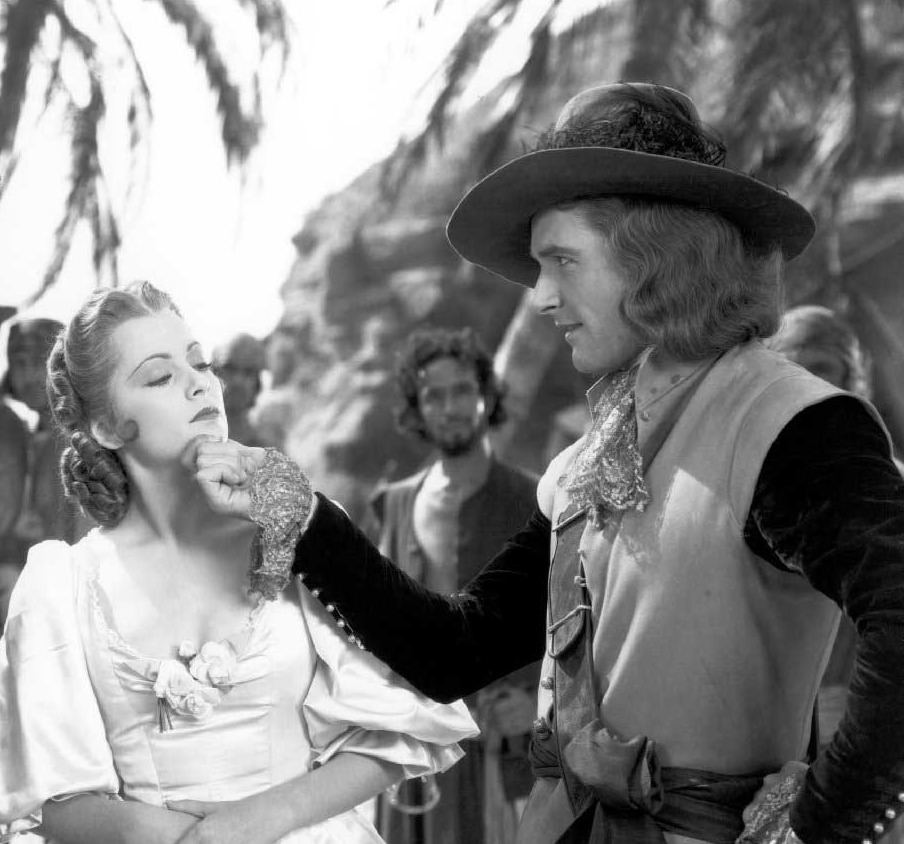
errol flynn and olivia de havilland in captain blood
The hat definitely needs to be bigger.

First of all, the performances--can a more perfect person to play Peter Blood exist other than Errol Flynn? Talk about dream casting! He seriously IS this character. And Olivia de Havilland does a fabulous job of playing Arabella--she actually makes her almost completely not-annoying! Her and Flynn have amazing chemistry together. I loved all their scenes. Basil Rathbone deserves a mention for coming up with a very silly French accent.

Second of all, the cinematography: I loved the use of shadows in this film, it was so fun and super creative. The battle- and sword-fight scenes were also perfectly shot with original cuts and framing to put you in the middle of the action. Did you know Captain Blood was nominated for Best Picture, and Curtiz almost won for Best Director just through write-in votes? So totally not surprised by that.

captain blood poster

The movie is a little too long, and the plot becomes quite garbled near the end, but who cares. Sword fights! Pirates! Hats with feathers! Do you honestly need a comprehensible plot with all that going on? I know you don't, because you went to see the last Pirates of the Caribbean movie. And Captain Blood is much better.

I think I've actually talked myself into loving this movie. LOV-ing. I seriously cannot stop thinking about it. I definitely recommend checking it out.

Wednesday, December 21, 2011

Virtual Advent: NUTCRACKER AND MOUSE KING by ETA Hoffmann

the nutcracker
"She tossed her little coat on and flung open the door. Little Nutcracker was standing outside, with his bloody sword in his right hand and a wax candle in his left hand." Illustrations by Artus Scheiner, 1924.

It's not Christmas without The Nutcracker Ballet, which my mom makes me watch every year (the Mikhail Baryshnikov version). Although I do enjoy it now, when I was a kid I thought it was a little boring. For one, why is that girl all into a nutcracker? If I'd gotten that for a present at seven years old, I'd have been like, "What am I cracking again?" For another, once the nutcracker turns into a prince and things FINALLY start to get interesting, there's just a bunch of nonsensical dancing by people who are NOT the prince and princess for an hour and half. Plus, it has the type of ending I hate, where the girl wakes from the dream and says, "It was so real! And you were there, and you were there..." GAH.

I could say the ballet all makes sense these days, but honestly I feel the exact same way. I appreciate dancing and costumes more than I did when I was a kid, but my opinion of the plot is still pretty much what it was when I was seven. The Nutcracker is something that sounds great on paper--something that I always thought would make an awesome story--but in the end the ballet's never really about the story, so I'm disappointed.

I'd been under the impression for years that The Nutcracker was something Tchaikovsky had made-up; so imagine my surprise (and excitement) a few weeks ago when I learned that the ballet's actually based on a book! By famed Gothic writer ETA Hoffmann, written in 1816. I had never heard this before--or if I had, it didn't sink in--but naturally I immediately had to check it out and compare the two. I love it when the things I think will make a good book are actually books!

Pate Drosselmeier
"Indeed, the godfather was altogether a very artistic man, who even knew a thing or two about clocks..."

Tchaikovsky's ballet is actually pretty similar to Hoffmann's original story, although a simplified version (I have to say, he did an excellent job of adapting it). It's about a little girl who gets a nutcracker for Christmas, saves him from an evil mouse king, and travels with him to another land where everything is made of candy, including his marzipan castle. But Nutcracker and Mouse King is a more cleverly told story, less linear and less fantastical than the ballet. In tone it's closer to the magical realism of something like Pan's Labyrinth--the magic isn't confined to dreams, it exists in the waking world and can bite you pretty damn hard in the ass.

What makes the book creepy are two things: first of all, no one believes Marie about the Mouse King. She's on her own trying to protect herself and the nutcracker. Second of all, there's Pate Drosselmeier, who is a benevolent character in the ballet, but not so much in the book. It's not that he's necessarily bad, or good, but that no one knows WHAT he is. He makes mechanical toys for the kids, but they're so delicate and sophisticated the children can't really play with them (and don't really want to). He mocks Marie one second and tells her stories about the nutcracker the next. He's not entirely trustworthy, which is terrifying because he seems very powerful.

marie and the nutcracker
"Actually, Marie didn't want to leave the Christmas table, for she had discovered something that no one else had as yet noticed."

The scary factor didn't have too much of an impact on me as an adult reader, but what I did really like about the book version much more than the ballet is that Marie's interest in the nutcracker here seems logical: he's not a Christmas present, just something she notices and gloms onto in the weird way kids have. Her dad tells her specifically he's not her present, but it becomes clear fairly quickly that she's adopted him anyway. Once the nutcracker starts coming to life, he shows a great deal of personality, has sparkling eyes, fighting skillz, and a romantic streak. Who wouldn't like the little guy?

The other thing that really fascinated me in this novel was, weirdly, the glass cabinet. The glass cabinet has all of Herr Drosselmeier's "presents" to the kids on the top shelf, and Marie's and Fritz's toys on the two bottom shelves, and it's where the nutcracker lives. I loved this because, one, the German propensity to collect knickknacks and then put them into cabinets never ceases to amaze me. You should see my grandparents' house, for realz. And two, this reminded me that as a little kid I was totes obsessed with all the things that were in my mom's and grandparents' glass cabinets. I wasn't allowed to touch any of them, which was guaranteed to make me wonder WHY and really want to look at them. The glass cabinets seemed like chests of tiny treasures, full of mystery and possibility, which was the perfect tone to strike in this story.

Finally, I really liked that Hoffmann's tale had a happy ending. In the ballet, it's all a dream, and Marie has to resign herself to a normal life after living in a fairy tale castle, which is a total bummer. But in Nutcracker and Mouse King, it's all real--and like Ofelia in Pan's Labyrinth, at the end she gets to return to the fairy tale castle with her prince.

dream
"Soon, rising like clouds of mist, Marie watched the silvery gauzes, in which the princesses, the pageboys, and Nutcracker swam."

This is definitely a story written to be read aloud to kids, and perfectly evokes the magic of Christmas from a child's perspective. There's not a much of a line between fantasy and reality, and Hoffmann makes no effort to draw one. The translation in my version was a little hinky (not that I have any of Hoffmann's other work to compare it to, whether German or English; but I'm going to go out on a limb and say he at least knew how to use pronouns correctly), but it was still a delight to read and reminded me what it was like to be a kid on Christmas Eve, which is awesome. I definitely recommend this book for kids of all ages!


Musical notes: "The Nutcracker Suite," of course!


virtual advent button
This post is part of the 2011 Virtual Advent Tour. Check out the website for more postings.

Saturday, October 29, 2011

Early Gothic Showdown: THE CASTLE OF OTRANTO versus VATHEK

Beckford vs Walpole

For the Classics Circuit: Gothic Lit Edition, I thought it would be fun to read two of the earliest examples of Gothic literature and compare them. I first heard about these crazy 18th-century kids when studying Gothic Revival architecture--Horace Walpole (right) built Strawberry Hill, arguably the first Gothic Revival house. The much more elegant William Beckford (left), built Fonthill Abbey and Lansdown Tower. Both were mad for collecting--Walpole, medieval art; Beckford, items from the Orient and Italian Quattrocento paintings (many of which you can now see at the National Gallery)--and were full of more than little hubris, which is reflected in their respective books.

All of this makes the novels sound hoity-toity, doesn't it? Let me assure you, they're not.

The Castle of Otranto by Walpole (1764)

It's difficult to summarize this book because it doesn't really seem to have a plot, but essentially it's purported to be a translation by Walpole of a 16th-century manuscript he found in Naples that recounts a story from the 12th century--or earlier!--about a prince named Manfred who was a total dick and eventually got hoisted in his own petard.

This is honestly one the most bizarre books I have ever read IN MY ENTIRE LIFE. If you want a story that'll give you the OMGWTFBBQ's, then you should definitely pick Otranto up, because it is alllll over that like sticky in honey peanut butter. It's like Walpole was sitting around writing and thinking, "Hey, you know what this story needs? A prophecy! A murder! A shrieking virgin! A lost son returned! A lost father returned! A secret passage! Knights! Saints! Clergy! A convent! Sword fights!" and on and on, every other paragraph. I've heard some people explain this by saying Walpole was writing a parody, but I really don't think so. This was apparently the first book of its kind, so what was he parodying? I think it just reads like a parody because it's utterly ridiculous.

Basically, the one redeeming factor of this book is that it's short and you can skim through it. The idea that Otranto sparked the creation of an entire genre of literature is MIND BOGGLING to me. Because I was thinking something like that would be, you know, good-ish. Is this what 18-century avant-garde writing looks like?

Vathek by Beckford (written in French, 1782; published in English, 1786)

Compared to Otranto, Vathek is pretty good (the key words in that sentence being "Compared to Otranto"). Written in a much different style but with a similar theme, Vathek tells the story of a caliph who's a sensualist and wants to know ALL THE THINGS. But the gods, they don't want the people to know ALL THE THINGS; that's the gods' job. Everything is going great until a few deities take notice and send a djinni to lure Vathek into a trap made mostly of his own ego. Ensue abuses of power, renouncing of Islam, foolish escapades, mass murder, etc., until Vathek eventually gets what's coming to him.

Vathek reads like a tale from the Arabian Nights (quite deliberately), and would actually be readable if one was able to root for Vathek at all. Instead, he's totally unlikable and TSTL to boot. It makes a lot more narrative sense than Otranto, but since I knew exactly where it was going and didn't care about the character enough to find out how it was going to get there, I got bored. I also don't know why this is considered a Gothic novel. I do have to say the ending where Vathek gets his just desserts was pretty satisfying, though.

Overall

Even though I wouldn't call it good, Vathek definitely wins over Castle of Otranto. I think Beckford's Ideas about power and human limitations, which really reminded me of Frankenstein, were much more elegantly and effectively conveyed than whatever Walpole was up-chucking. I find it REALLY interesting that both of these men--who were incredibly rich, knew everyone who was worth knowing (Beckford took music lessons from AmadeusfreakingMOZART, for god's sakes), and spent lavish amounts of money creating a world for themselves that reflected their fantasies--wrote books about self-centered egomaniacs who needed to be taken down a peg. That being said, from the viewpoint of literature, whyyy are we still reading these books???

Beckford and Walpole were fascinating men, but as far as the Gothic is concerned, their architectural contributions seem more successful to me than their literary ones.

classics circuit button

Thursday, September 29, 2011

Book Review: THE MYSTERY OF THE YELLOW ROOM by Gaston Leroux

yellow room cover

After a woman is mysteriously attacked in her own bedroom, with the door still locked from the inside, the police are baffled. Fortunately, Joseph Rouletabille, the most famous investigative journalist in the world, is on hand to solve the case.

The Phantom of the Opera is one of my favorite books of all times, but for some reason I never even wondered what other books Gaston Leroux might have written. Or if I did wonder, I forgot. But! When I saw a review for The Mystery of the Yellow Room and its sequel, The Perfume of the Lady in Black, at Cynical Optimism, I knew I had to give it try.

This is the first "locked room" mystery ever written. You can still find variations on this plot today--The Mentalist, for example, had an episode based on this idea. The linchpin question is, how did the murderer escape the room? In this case, the mystery is further complicated by the fact that the murderer doesn't escape once, but several times, something the police don't know and that Rouletabille has to figure out.

As far as the mystery goes, this book is excellent. I don't think I've ever encountered a more successful red herring in my life (perhaps Leroux invented red herrings, as well?). At first the story seems relatively straight-forward (aside from the problem of the room, of course), but it keeps twisting and twisting until the end when Rouletabille reveals the killer, which is the biggest twist of all--but also left me thinking, "OH DUH." As a reader, one definitely has all the information to solve the case, but Leroux is so skillful at distracting one with delicious Victorian drama that one doesn't realize it what the pertinent clues were until later.

I also loved the detective, Rouletabille. He's only eighteen, so he has wild mood swings, is very enthusiastic about everything, and is freakishly smart. His origin story is just bizarre, with him discovering an important piece of evidence when he was eight which led to a job at a newspaper. Apparently there's a whole series of books starring Rouletabille, one of which is the first espionage novel ever written.

That being said, my enjoyment of this book was tempered by the fact that I listened to it in an audiobook format from Librivox. Since the narrators for Librivox are all volunteers, it can be pretty hit-or-miss, and this novel had seven or eight different narrators, some of whom were pretty good and some who could use a little work. Hence I'm still really confused about some things, like who is telling the story? It's not Rouletabille, it's some other journalist, but I'm not sure who. Are we supposed to assume it's Leroux? Also, who is the Lady In Black? Still don't know, and a little freaked out by the fact that Rouletabille kept going on and on about her perfume, as I was reading Perfume: The Story of a Murderer at the same time. Also, for the first quarter of this book I thought the woman in the yellow room, Mlle. Stangerson, was dead; so you can imagine how confused I was when she started giving her statement to the police (?!). That's when I knew this audiobook wasn't working out very well. I'd like to reread the novel in actual text format before I move on to the next Rouletabille book, which I definitely plan to do.

If you enjoy Phantom of the Opera or turn-of-the-century mysteries, I definitely recommend you give The Mystery of the Yellow Room a try. Rouletabille may not be as awesome as Eric (who is?), but he's nevertheless a pretty great character, definitely right up there with other classic detectives like Sherlock Holmes and Poirot. And this novel has the same great mix of fun and suspense as Phantom.


Monday, February 21, 2011

I Will Repay by Baroness Emmuska Orczy

i will repay cover

Dear Ms. Orczy (or should I say, Baroness):

I enjoyed The Scarlet Pimpernel (who hasn't?) and looked forward to reading this follow-up, especially as it involved new characters and promised more of a romance-driven plot. However, after reading about half of the book, I started to get more than a little pissed at you, and here's why:

I hate Juliette.

I knew I was going to find her annoying after she fainted in the first chapter, and I definitely disliked her after realizing she was an air head in chapter two, but how dare you try to convince me to root for that evil bitch. You see, actions speak louder than words, and the Victorian drivel you threw at me about how she felt really really bad giving Paul Déroulède's name to the Committee for Public Safety after he saved her from a Parisian mob and let her and her maid live in his house for weeks on end failed to convince me that she was justified in her actions. I don't care if he killed her brother; as he explained to her, it was duel and a fair fight for which he'd already made amends. And if Juliette was at all capable of thinking instead of being a shallow brat, perhaps she'd be able to reach the conclusion that, hey, maybe her insane megalomaniac father shouldn't have even asked her to avenge her brother's death. But she didn't, because she isn't. And that's because you wrote her that way. I can never believe that Juliette would act any way other for her own self-interests, and I could never like her.

I could deal with Juliette, however, if she wasn't the "heroine" of this book. Anne Mie is smarter and a better person than Juliette is, but she's not the heroine. Why? Because she's not beautiful. And Déroulède falls in love with Juliette, whyyyy? Hint: it's not because of her sparkling wit. Yes, because she's beautiful! So basically Juliette is an awful person who just happens to be attractive, and Anne Mie is a great person who just happens to be unattractive, and yet I'm supposed to root for Juliette in this scenario and feel like Anne Mie's the villain? In what bizarro world are you living, woman???  I can't help but think of how much better this book would be if Déroulède realized there's nothing rattling around in Juliette's empty head--or soul--and that Anne Mie really was worthy of love, even if she wasn't pretty.

At least the heroine in The Scarlet Pimpernel had brains.

Don't even get me started on Déroulède. At first he seemed pretty awesome, but the fact that he falls in love with Juliette makes him officially too stupid to live. Not to mention that afterward he's all, "Oh, I wonder if I'll ever find out who betrayed me!" Yeahhhh, it's probably the person everyone (and by everyone I mean those who are borderline intelligent and actually care about you, like Anne Mie and Percy Blakeney) has been telling you is untrustworthy, namely the "saint" you're crushing on, helloooo. If Déroulède's such an idealist he should be able to look beyond a person's outer appearance and judge their character, don't you think? But maybe he doesn't think women have inner characters.

So, thank you, Baroness, for reinforcing the stereotype that all a woman needs in life is good looks. I don't know what happened with this book, but I get the feeling you betrayed yourself with the whole Juliette/Anne Mie thing. At the very least, I felt betrayed as a reader. I would tell you to go to hell but there's not much point in saying that to a dead person.

Sincèrement, moi.

Musical Notes: "Better than Revenge" by Taylor Swift


Powered by ScribeFire.

Tuesday, February 15, 2011

To Have and To Hold by Mary Johnston

to have and to hold cover

Musical Notes: I was on a Taylor Swift kick while I was reading this and thought "Love Story" made a great accompaniment.


Review:

This is a novel that has everything--sword fights! Pirates! Romance! Adventure! Runaway heiresses! Great villains! Daring escapes! Despite the vanilla title and the fact that it was written over a century ago, this book a manifesto on what an entertaining adventure novel should be.

The setting is colonial Jamestown, where Captain Ralph Percy has turned his fortunes from the sea to tobacco farming. One day Ralph decides, on the throw of a dice, that he should marry. Coincidentally, a ship has just arrived in Jamestown filled with fair young (and desperate) maids, all looking for a husband among the far more desperate male populace. Amidst the bawdy, lewd, and completely insane chaos of the women's arrival, Ralph spots one who is a unique beauty. Little does he know how unique she is, even after he realizes she traveled to Jamestown under a false identity.

It turns out Jocelyn, whom Ralph quickly marries, is actually the king's ward and betrothed to his highness' favorite, Lord Carnal. The beautiful and utterly amoral lordship quickly chases his prey down, arriving in Jamestown with a letter from the king demanding her return--and, should she be married, that her husband be put in irons and hauled off to The Tower to enjoy a long imprisonment and possible death.

Jocelyn is tee.are.oh.you.be.elle.ee, but luckily for her, Ralph is the sort of man who looks into the face of trouble and laughs. Laughs, I tells ye!!! Thus ensues many adventures where you will be wondering, "How is Ralph going to get himself out of this? OMG, how is Ralph going to get out of this?!?"

The language of the book is dense--it's written by an Edwardian trying to sound like a seventeenth-century colonist--but still very readable and actually kind of delicious. That and the incredibly visual descriptions really helps to bring Jamestown to life. Add in great characters and you've got a nearly perfect novel.

And now... CASTING CALL!

jonathan rhys meyers

I don't usually "cast" characters in the books I read, but with this one I couldn't stop myself. Lord Carnal is so obviously Johnathan Rhys-Meyers: the beautiful bad boy.

richard armitage

For Ralph, I've decided to cast The Armitage. Why? BECAUSE.

helena bonham carter

As for Jocelyn, I think she'd be charming played by a young Helena Bonham Carter. Even though Carter's roles are usually variations on Crazy Lady, she can play semi-normal people. Just look at A Room With a View (okay, maybe that's not the best example).

Of all the characters, Jocelyn is probably the weakest in terms of likability. She's definitely not a post-feminism romance heroine: she values her honor (read: virginity) above her life, is practiced at sitting around looking pretty, and is described and child-like several times. That being said, though, the woman's also got backbone. By the end of the book, I understood completely why Ralph loved her.

Overall this is a great adventure tale worthy of your time. And if I haven't done enough to convince you to pick it up, check out Melody's great review of it at Edwardian Promenade.

A Note About Indians

What would a novel about colonial Jamestown be without Indians? Not much of one, that's for sure. Going into this book, I was mainly worried about how the Indians would be portrayed from a 1900/colonial viewpoint. The fact that they would be stereotyped almost goes without question, but how and to what extent?

To tell the truth, for most of the book, the portrayal of Indians wasn't too bad. Percy hates them, of course, and thinks they're godless savages out to get him and every other Jamestown settler--but I wouldn't expect any less from a seventeenth-century European. Strangely, he also has friends among the Powhatans (the tribe that interacts most with Jamestown), namely Nantauquas, the brother of Pocahontas and brother-in-law to Ralph's besty, John Rolfe.

Then I came to the ending. The Powhatan chief, Opechancanough, decides it's time to drive the English colonists out and wages war against them. In the midst of the battle, suddenly the Powhatans go from just plain savage to noble savages, facing death bravely; and after the battle is finished, there is only one Powhatan left standing: Nantauquas.

The Jamestown citizens let Nantauquas go (Nantauquas can't die; we love Nantauquas!), but they might as well have killed him. After he leaves the fort, he becomes ghost-like, wandering around the forest like a specter, never interacting with words but only appearing in the corner of Ralph's eye. Indeed, it's as if he's been erased from existence; even Ralph doesn't say the name Nantauquas anymore, only referring to him as "the Indian." Nantauquas is quickly vanishing from memory, or at the very least importance.

So we have the two major stereotypes of American Indians in Euro-American literature and art being played out in this novel: the noble savage and the vanishing race. I can't help but wonder, though, if Johnston is more subversive of this trope than she lets on.  At one point, Opechancanough tells Ralph, "Opechancanough knows that they [English] are good and just, that they do not treat men whose color is not their own like babes, fooling them with toys, thrusting them out of their path when they grow troublesome." We know Opechancanough is being ironical, but the fact that Johnston must have known it too indicates that she at least recognized the racial tensions at the heart of these stereotypes. Which makes me wonder why she eventually capitulated to them. Did she not know what else to do with them? Did she perhaps think she was being original? (yeah right)

Whatever the reason, the treatment of Indians in To Have and To Hold was a blight on an otherwise perfect book. It definitely wasn't enough to make me dislike the book, but it was eye-roll educing. And I still feel bad for Nantauquas.


Powered by ScribeFire.

LinkWithin

Related Posts Plugin for WordPress, Blogger...