Showing posts with label dan brown. Show all posts

Sunday, June 9, 2013

Dan Brown's INFERNO Drinking Game

alcohol

You know how sometimes you don't realize you really wanted or needed something until someone gives it to you? Well, today I'm here to give you what you never realized you always wanted: the Inferno drinking game! So cuddle up with a bottle or three, a copy of Dan Brown's latest, and settle in for a drunk-ass weekend.

For this drinking game, I recommend Frangelico, a bottle of Scotch, and Doluca wine.

Drink:

  • Every time the provost drinks (obvs).
  • Every time Robert Langdon wants to do something frivolous like eat lunch, but realizes he doesn't have time because he's being chased (one of the more accurate depictions of a professor's life I've seen in these books to date, by the way).
  • For every plane, train, or boat. I'm on a boat!
  • Every time Langdon observes Sienna is a good actress.
  • When someone is drugged.
  • Whenever you wonder what art has to do with any of this.
  • For every tortured explanation of why Langdon can't recall something even though he has an eidetic memory.
  • Whenever you feel like you're in Assassin's Creed 2.


Start chugging:

  • During every scene on the Mendacium. Because holy crap, those were some boring, repetitive scenes.
  • When Langdon's inner monologue turns all tour-guide-y ("Above, you'll see the clock of St. Mark's Tower, which was featured in the James Bond film, Moonraker!").
  • During every lecture and/or flashback.


Take a shot for every...

  • Time information is repeated. Double shot if it's on the same page.
  • Secret passage.
  • Wanton destruction of artwork.
  • Chase scene.
  • Museum employee Langdon knows or who knows of Langdon.
  • Mention of eBooks.
  • Obvious anagrams.
  • Time Langdon mentions he was on some sort of VIP tour.
  • Non-sensical metaphor ("Langdon felt like he had awoken inside a Max Ernst painting." What? What does that even mean?).
  • Unnecessary adverb ("Thank you," he said politely).
  • Whenever someone searches the internet on their phone.


Discus this post with me on Twitter, FaceBook, Google+ or in the comments below.

Saturday, June 8, 2013

INFERNO by Dan Brown — Discussion

inferno cover

It's the middle of the night in Florence, Italy. Robert Langdon, Symbologist!, awakes in a hospital room with no idea of where he is or how he got there. The doctors fill him in: he stumbled into the hospital with a gunshot wound to the head and passed out, muttering incoherently. Robert's suffering from amnesia and the last thing he remembers is sitting at home in Cambridge, Mass., chilling with a bottle of Tanqueray and a novel by Nikolai Gogol. Or was it Bombay Sapphire and something by Dostoyevsky? Either way, the only thing any of us know is that Robert Langdon really needs to work on improving his social life, and possibly cutting back on the gin. Then someone walks into the hospital and starts shooting at him! What-the-what? Fortunately, Robert escapes with the help of an attractive female doctor. Now all he has to do is figure out how he got to Florence, why he's even there, and why someone is trying to kill him. Mysterious!

When I started Inferno, Anachronist from Portable Pieces of Thought asked me if I wanted to discuss it with her. Something you should know about Anachronist is that she hates Dan Brown novels (you can read her review of Inferno on her blog today, incidentally), whereas I tend to enjoy them even though I think they're ridiculous. So what did each of us think of Inferno? Read on to find out!

So, what did you think?

Heidenkind: Uhg. Well, I will say this: it was better than The Lost Symbol (my review), and the beginning was pretty strong. But by the end I was just SMH.

Anachronist: In my opinion it was the worst Dan Brown I’ve ever read. Either the editor was completely drunk/high while doing their job or...I dunno. It is almost fascinating to observe Mr. Brown going from bad to worse - like watching an accident and not being able to turn your head and walk on. I hated The Lost Symbol but this one I simply loathed.

Heidenkind: I had the same thought. Where WAS the editor? I have to say I was in a pretty foul mood by the time I finished this.

Anachronist: Small wonder.


What was your favorite part?

Heidenkind: The scenes where Langdon and Sienna (nice shout-out to Florence’s rival city there) were in the Palazzo Vecchio were really fun. I’m a total sucker for secret passages. I need to get on some of these VIP tours Langdon’s got going.

I also thought Florence was very well-utilized as a setting. The other two locales, not so much.

Anachronist: Florence scenes were nice, plus every mention of Vayentha, one of the secondary characters I felt in love with made me grin. She was of course killed. Murdered in fact. And she was INNOCENT, got it people? Completely innocent! Be warned: Brown murders innocent women in his books!

Heidenkind: At least she wasn’t bald. ;)

Anachronist: no, she was blond with short, spiky hair. I loved her motorcycle! I loved her! And then my least fav author simply finished her off. How not to hate him?


Problems?

Heidenkind: Well quite frankly, there were a lot. There were metaphors that simply made no sense, and the book needed to be edited down a lot. I don’t need to be told the same thing three or four times before I get it, you feel me? At some point I started wondering if Brown thinks his readers are idiots.

Also, the art history tie-in didn’t fit very well with the rest of the plot this time around. The Dante mask, which isn’t really a work of art, was fine, but I’m still confused as to why Zobrist would use a painting by Botticelli to send a coded message. Why not just send a code in a gene sequence or something? Also, that code was pretty lame.

And the descriptions. Holy Mother of God. It sounded like Langdon was leading a tour group. “Welcome to Istanbul. Today we’ll be following Kennedy Avenue, said to be one of the prettiest drives in the city. On the right, you’ll see the Blue Mosque, said to be the inspiration for Disney’s Cinderella castle!”

I’m sure I’ll come up with more as I think about it.

Anachronist: Problems? *Snort* There was one major problem: this book shouldn’t have happened. It should have been written with a better plot and the narration which actually made sense. I didn’t even feel like looking for blunders anymore - it would be like kicking a defeated opponent. Honestly, Mr. Brown, your style doesn’t even deserve that name. I’ve read many fanfics which were 200% better - like 99% of them. I might start to think English is actually your second, nay, third language. In fact some parts of your book read as if they were copied and pasted straight from the more horrible Wikipedia entries. I can’t believe it was edited at any point.

Heidenkind: It wasn’t THAT bad. lol Maybe Brown’s contract states that his manuscripts don’t need to be edited, because he’s a literary genius. ;)

Anachronist: oh it was that bad. Honestly, I rarely read such pathetic books and if I do it’s only because from time to time my inner masochist rears its ugly head and roar for food, hungry little monster.


Okay, let’s break down the problems into things that are more specific. What did you think of the twist?

SPOILERY TERRITORY

Heidenkind: I’m still trying to process it. Because on one level, I was like, “Okay...?” But when I really think about it I’m just like, “Wait... what?” It’s not that the twist didn’t make sense in the context of the book, because I can see that Brown set us up for it; it’s more that it was too incredible and complex to be believed. Also, even though I didn’t see it coming, I still wasn’t surprised by it, I think because Sienna is a sketchy character from the word go so I never trusted her like I did the yummy Camerlengo in Angels & Demons.

Anachronist: Sienna was bald. It was emphasized from the very beginning how bald she was - like completely bald and then some. It was done for a reason, folks. As far as I remember no bald Brown character has ever been up to any good so there was no twist in my opinion, not really. Think about the whole symbolism. A bald woman. Unnatural. A Freak. A Shocking beast. *nodding vigorously*


What about the conclusion with Zobrist’s “final solution?”

Heidenkind: Okay, I’m not a geneticist or virologist or anything, but this part really MAKES NO SENSE WHATSOEVER. Because people have more than one or two kids; that’s where overpopulation comes from! And infertile people still have surrogates carry their kids, or in vitro fertilization, et cetera. It’s not as if having a kid is like having a penis and you either get one or don’t depending on which chromosomes you inherit, so this plan to reduce the earth’s population has no chance of working. Unless Zobrist’s virus removed the biological imperative to procreate, in which case that would be cray.

I also liked how the director of the WHO was all, “Hey, that was actually a good idea! Why didn’t I listen to this mad scientist when I had the chance?” FAIL

Anachronist: FAIL, complete and total fail. You get it even if you know nothing about genetics and viruses. It was like Inferno which never managed to happen because wait, there is a sequel coming and our virile main lead, Saint Langdon the Sweetest, CANNOT BE sterile. Not before he gets a wife and a dozen kids. And he hasn’t married or engaged yet. And Sienna has to save the world somehow or die trying.

END OF SPOILERY TERRITORY


Conclusion

Heidenkind: I honestly wanted to like this book, but I just can’t. Like I said, it’s better than The Lost Symbol, but Brown was still really pulling his punches on this one, and that’s not going to work.

I think Dan Brown is a nice guy, and I think the controversy stirred up over The Da Vinci Code kind of traumatized him. And I don’t blame him for that. But that doesn’t mean one should write inoffensive literary pablum in response to it.

I just really wish he’d get pissed off about something and write about that so we’d have a book with some ideas and conviction.

Anachronist: I honestly wanted to hate this book and I wasn’t disappointed. My inner glee carried me through even the worst paragraphs and made me practically whistling with joy. Yes I enjoyed myself immensely thinking: “That’s it. Perhaps Dan Brown will get the message this time and leave the poor, tormented suspense and action literature be. It deserves better than that. It deserves a new Indiana Jones not Robert Langdon and his old tricks.”

I am not a delusional hater. I would shake hands with Dan Brown on the street. Maybe he is a good guy. Maybe he, like his favourite protagonist, professor Langdon, has a good heart (very deep down of course - look what he’s done to Vayentha!). He’s earned more than enough; I am sure any writer would be satisfied having such a bank account. Let him play golf and fly fish now. Let him crochet. His novels will be remembered - and loathed - forever. Imagine how many trees you can save by not publishing his next book.


Have any of you read Inferno? What did you think?

Discus this post with me on Twitter, FaceBook, Google+ or in the comments below.

Friday, September 9, 2011

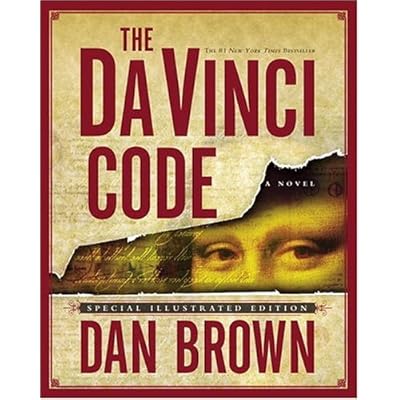
Book Review: THE DA VINCI CODE (Special Illustrated Edition) by Dan Brown

da vinci code cover

Recently, I had a strange urge to re-read The Da Vinci Code--strange, because while I did enjoy reading it the first time (around 2005-ish), I wasn't in love over it. This isn't the typical sort of novel I enjoy, and at 597 pages it was a near-miracle I even finished it, so I never saw myself rereading it. However, after reading a review of Rise of the Planet of the Apes (I can't find the link, sorry), I found myself re-intrigued with The Da Vinci Code.

The point of the review of Rise was that successful sci-fi movies resonate with contemporary social and political subtext (I'll let you guess as to the reviewer's opinion on how successful Rise was at doing that). That got me thinking about The Da Vinci Code because it obviously resonated when it was released, but with what? Whatever it was certainly didn't translate to the movie.

At its heart, TDVC is a quest, filled with a lot of traveling, symbols, and treasures like the Holy Grail. There are a lot of knight references in the book--not just the Knights Templar and Holy Grail, which are pretty obvious, but more subtle references like the statue of the knight in shining armor in Saunière's office, and Robert Langdon and Sophie Neveu going to a "knight," Leigh Teabing, for help.

Also as in many questing stories, the final goal isn't an object, even though the protagonist may not realize this. As Langdon reflects early in the book,
Rome [from Angels & Demons] had unlocked in him a longing he never imagined he could feel. His lifelong affinity for bachelorhood and the simple freedoms it allowed had been shaken somehow... replaced by an unexpected emptiness that seemed to have grown over the past year.
There's a lot to read into that sentence (no lifelong bachelor jokes, please--too easy). Is Langdon questioning his existential nihilism, looking for God, or love? Or all three? Either way, I think this gives the novel more of a romantic streak than your average thriller.

I don't believe the reason behind TVDC's massive appeal was a romantic quest, though. Aside from Langdon and Sophie's odyssey, the main message of the book is about the threats of extremism. The only part of the novel that was truly alarming was the idea that an organization like Opus Dei could not only exist in the modern Western world, but thrive. In a post-9/11 US, the notion of a very conservative monotheistic organization that wanted to severely suppress women's rights and was semi-secretly headquartered in New York City was not only more credible than it would have been previously, but more portentous. Just think of all the fuss that was stirred up a few months back over the building of a new Islamic community center. Because of 9/11, people were more wary of "hidden threats" and the knowledge that extremism was gaining a foothold in the US.

I'm not saying the plot of TDVC is anti-Islam, although it could probably be read that way--the novel does tend to treat anything east of Provence as suspect--but rather that it's anti-fundamentalist, arguing against simply accepting someone else's definition of what events mean or who is and isn't dangerous. In many ways, Langdon himself could be described as a monist: many paths can lead to the same answer. Unfortunately, anyone who's tried to avoid hearing about politics lately knows that message, if noted at all, clearly didn't stick.

book interior
Example from the interior of the book.

As for the writing, Dan Brown has gotten a lot slack for it (especially on The Colbert Report), and I have to admit the book was more cheesy than I remember it being. But on the plus side, the obscure product placements were kept under control, so that's good. The only thing Brown does that really drives me crazy is insert the characters' thoughts randomly in italics for no reason. It makes me go, Huh? Why do I need to know lovely little Silas is thinking that? It should be self-evident. And now Brown's got me doing it!! Aiee! 


TDVC has also been criticized for historical inaccuracy, which quite honestly makes me laugh. One, it's a novel. Look up the definition, please, then get back to me on why this is news. Two, historical accuracy or lack thereof not withstanding, Brown researched the ever-loving crapload out of this topic, and pulled it all together in a way that was really interesting and creative, so I think he deserves kudos for that.

As for the Illustrated Special Edition... uhg. The illustrations have an inconsistent, home PhotoShopped feel to them; and some of the things they chose to illustrate were just odd. The Olympic Rings, for instance--considering that most five-year-olds know what the Olympic Rings are, I don't think it's necessary to include a picture of them in this book. And even if it was necessary, they could have found a damn better example than the .gif-quality image that just about anyone could pull off the internet.

Overall I'm happy I decided to reread this book. It's definitely better than the movie (sorry, Tom Hanks, you just don't make a believable academic), and as a modern-day quest/thriller novel, I think it's pretty decent.


Musical Notes: I don't know why, but I had "Give Me Some Love" by James Blunt and "Your Song" from Moulin Rouge stuck in my head the entire time I was reading this.


Friday, October 9, 2009

The More You Wish You Didn't Know: How to Become a God

k1892, bowl featuring hero twins

In The Lost Symbol by Dan Brown, Professor Robert Langdon is submerged in water and total darkness for some time in a sensory deprivation chamber.  The baddy bad guy, Mal'akh, says "The secret is how to die," and seems to imply that Langdon will find some sort of enlightenment through the experience, the same way Mal'akh himself did. 

This reminded me of the Maya myth of Xbalanque and Hunahpu.  Known as the Hero Twins, these two get into many adventures in the Popol Vuh, the Maya version of Genesis.  In one story, the Twins descend into the underworld, Xibalba, to challenge the Xibalban lords to a ball game.  Through trickery and the help of animals, the Twins defeat the Xibalban lords and are resurrected back to earth--this time as gods.

Why did being submerged underwater remind me of that?  Hang on for a bit, this is going to be a long walk.... 

For the Maya, the Underworld wasn't just a mythical location; it was a literal one.  The Yucatan Peninsula where the Maya lived consists mainly of limestone.  Because the stone is so porous, rivers drill through the surface of the stone and run underground instead of above.  Sinkholes called cenotes allow acess not only to this water, but also to Xibalba. 

cenote sagrado

Every cenote is different--some are crystal-clear, some go down so far no one has ever found the bottom, and some are filled with plants and animals—waterlilies floating on the surface, trees that reach down with their roots, tiny fish that nibble on human flesh, and alligators lying in wait for thirsty prey.  But only one is as green as the forest, as green at the scales of a snake—the Cenote of Sacrifice at Chichén Itzá.

According to Spanish accounts written by Bishop Diego de Landa in the sixteenth century, the Cenote Sagrado was "the Jerusalem of the Maya," and used for human sacrifice, divination, offerings, and rituals for both Maya and Mexican peoples.  There were other cenotes that were used for these tasks, but the one at Chichén Itzá was the cenote with, apparently, the closest route to Xibalba.

Anyway, de Landa wrote that living people were thrown into the Cenote of Sacrifice, in the belief that they would come out again after three days (although, according to Landa, they never did).  In fact, it is theoretically possible for a person to travel through the networks of cenotes to another cenote, or even to the ocean, without modern diving apparatuses, as the underground passages can collect pockets of air.  Of course, such an endeavor would be incredibly dangerous and nearly impossible because
  1. The entire tunnel system is completely dark and you wouldn't be able to see where you were going.
  2. There would be no way of knowing where the air pockets were.
  3. Even if you somehow managed not to swim in circles, could hold your breath for an incredibly long time, and found air pockets, how would you find your way out of the labyrinth of tunnels and caves?  Even modern divers consider cenote diving dangerous.
So, it would be incredible if it was ever done, and of course there is no way of knowing if anyone ever did.  Hypothetically, however, if a person succeeded at diving through the cenotes and came out alive, he or she would become hero-gods in the styling of Xbalanque and Hunahpu after they defeated the lords of Xibalba.

So, that's why Langdon's extended underwater stay in the darkness of a sensory deprivation chamber reminded me of the myth of Xbalanque and Hunahpu.  And now you're probably wondering, does that mean Langdon is a god now?  Well, he wouldn't be the first professor to be convinced of his own omnipotence... but, not likely. (~_^)

the more you wish you didn't know

Stay tuned for the next TMYWYDK!


Powered by ScribeFire.

Thursday, October 8, 2009

The Lost Symbol

the lost symbol cover

The Lost Symbol by Dan Brown

In what I'm assuming is the last book in the Robert Langdon: Symbologist! series, Brown moves the reader from Europe to the US and takes us on a tour of the hidden world of Washington, DC.  Except the hidden world doesn't seem so hidden, and the secrets aren't very difficult to unravel.  Overall, the novel is just okay, and a far cry from The Da Vinci Code or Angels & Demons as far as story-telling is concerned.

I should probably preface this review by saying that I actually do think Dan Brown is a good writer (but then I read romance novels, so I'm sure the people who would say he's not a good writer would question my literary judgement anyway).  He tells a good story and he researches the hell out of his books, which is something I always appreciate.  I don't normally go for books like The Da Vinci Code or Angels & Demons, but I enjoyed them anyway for those two reasons.  And also cuz of the art history shout-outs.

In The Lost Symbol, Robert Langdon, professor of a fictional discipline at Harvard, receives a phone call early one morning from his insanely wealthy, smart, and influential friend--the best kind of friend to have!--Peter Solomon.  Pete wants Rob to hop on down to DC to give a lecture on symbols.  Well, of course Langdon agrees, except he never speaks to Peter himself, and the next thing he knows, he's staring at Peter's severed hand in the capitol building. 

You see, a man with many tattoos has decided he wants Langdon to uncover the Masonic pyramid that, legend has it, is hidden below DC and has bunches of secret knowledgy stuff.  If Langdon refuses to help, the bad guy will kill Peter.  Oh noes!  Langdon keeps insisting the pyramid is just a metaphor (rather comical coming from him, considering the last two books), but this isn't very helpful.  Meeeeeanwhile, people can affect the world around them with their thoughts.  So, all that negative stuff you keep thinking about?  STOP IT!!

Much of this book feels like a retread.  Newton plays a big role, again, and Langdon solves puzzles in much the same ways he did before, becoming embroiled in a "secret" organization and alternately chased/helped by law enforcement.  This wouldn't have bothered me too much--I'm not philosophically opposed to formulas--but the puzzles aren't puzzling, the hidden places are boring, and the twist was so obvious, when I got to that part I was like, "Oh, was that supposed to be the surprise twist?"

For example, one of my favorite parts of Angels & Demons is where Langdon goes into the secret Vatican archives.  How awesome is that! *geeking out*  In The Lost Symbol, Langdon goes into the Library of Congress... when it's closed... and rides the conveyor belt across the street.  With his eyes closed.  Woo freaking doo!  I did like some of the locations--the National Cathedral and the storage building for the Smithsonian, for instance--but it didn't feel like the locations were utilized to the best of their ability.  Same thing with the science of Noetics, which is where people can affect the physical world with their thoughts--that's kind of cool (and freaky), but at no point in the book did anyone try to utilize this science.  And I certainly didn't feel as if I was being shown a "hidden" Washington, DC.  Anthony Bourdain had a DC episode that was more illuminating than this book.

Another thing that was really lame in The Lost Symbol was the villain.  I apparently have a thing for Dan Brown villains--I wanted to cuddle Silas (and Paul Bettany was kick-ass when he played him in the movie), and I loved the yummy Camerlengo. *lick*  But the baddy in this book was just pathetic, from his motivation to his final goal.  Plus, the names he chose were insanely obvious--Dr. Abaddon, really?  If I know that's the name of a demon, it's got to be general knowledge.

By the time the conclusion of the book came around, I couldn't care less about whatever secret there was and blah blah blah.  I honestly wouldn't be able to tell you what the "lost symbol" is--it was probably revealed during the part I skimmed.  But I don't think it even matters anyway, so it's a moot point.

The reason why The Da Vinci Code was such a success was that it took real-life facts, places, people, and events, and fused them together in a very creative, imaginative way.  Even if I thought it was ridiculous, I was completely willing to let Dan Brown take me through the journey of the story.  But with The Lost Symbol, I don't feel like Brown took me anywhere.  It's like Dan Brown lite--lite on the research, plotting, creativity, and surprises.  And I can't help thinking it's because Brown really pulled his punches in this one.  The Masons are depicted as all-around good guys; Noetic science (am I the only one who thinks that's kind of creepy?) is given a thumbs-up; and even the CIA, which spends the majority of the novel completely trampling on the Bill of Rights, is shown to be justified in the end.  Personally, I was like, WTF?  None of this is good.  At the very least it's sketchy.  The Solomons use the quote by Newton--"If I have seen further it is only by standing on the shoulders of giants"--as a positive to show that humankind is evolving and becoming better in that evolution, because we can learn from those who have come before us.  But all I could think of when I read that was Malcolm from Jurassic Park berating the scientists by paraphrasing the same quote,
But scientific power is like inherited wealth: attained without discipline....  And because you can stand on the shoulders of giants, you can accomplish something quickly. You don’t even know exactly what you have done, but already you have reported it, patented it, and sold it.  And the buyer will have even less discipline than you. The buyer simply purchases the power, like any commodity. The buyer doesn’t even conceive that any discipline might be necessary. 
Through the course of The Lost Symbol, Langdon does exactly this: attains the super-secretest Masonic knowledge without the discipline and training of a Mason, and he unleashes both that and dangerous Noetic science onto the world.  And the last word in the book is hope? It should be, Save yourselves while you still can!

Anywho... although the beginning was promising, by the end the novel felt mediocre and difficult to buy into.


Other reviews:
Devourer of Books
S. Krishna's Books
My Two Blessings
MariReads
BiblioHistoria
Book Nook Club


Powered by ScribeFire.

Monday, October 5, 2009

The More You Wish You Didn't Know: Ciphers and Codes

In The Lost Symbol by Dan Brown, Robert Langdon compares the Masonic Cipher to "the Phaistos Disk, the Dorabella Cipher, the mysterious Voynich Manuscript."  What are these three things?  Obviously, they involve difficult (some say impossible) to decipher codes.

Phaistos Disk side B Side B of the Phaistos Disk

The Phaistos Disk
is an artifact that was found in a Minoan palace near Heraklion, Crete (Minoans again!).  It contains a series of symbols stamped onto both sides of the clay surface in a spiral pattern.  No one knows what these symbols mean--or if they mean anything at all.  Some people think this disk even represents the first example of movable type, 3000 years before Gutenberg was born.

dorabella cipher

The Dorabella Cipher was written in 1897 by composer Edward Elgar.  In addition to being a musician, Elgar was also a cryptologist; and this short note to his childhood friend, Dora Penny (whom Elgar called Dorabella), has been completely undecipherable to anyone but the writer and the recipient.  The strange thing is, there is actually a key to this cipher, but using it produces absolute nonesense.  Elgar and Penny were probably communicating in some sort of code known only to them, meaning this note will likely never be deciphered.

voynich manuscript

The Voynich Manuscript is a manuscript that is mostly famous for being unbreakable by famous WWII cryptographers.  The script looks vaguely Latin, but other things suggest its origin isn't European.  Is it a hoax?  An alchemical manuscript with a clever code?  No one knows.  The website for it from the Yale University Library is kick-ass, though.

the more you wish you didn't know

Stay tuned for the next TMYWYDK post!


Powered by ScribeFire.

Saturday, October 3, 2009

The More You Wish You Didn't Know: Savonarola Chairs

savonarola chair from Pelazzo Vecchio

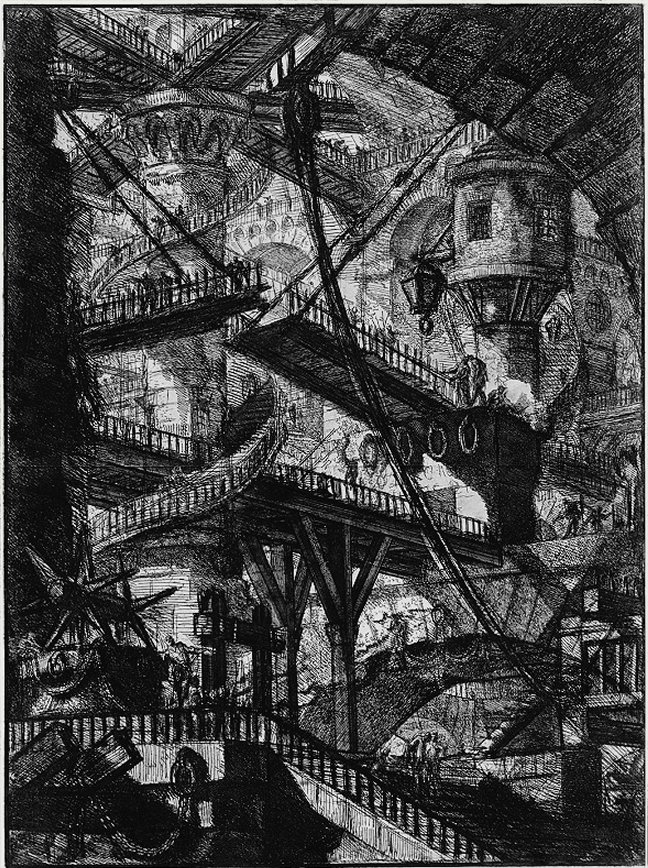
In The Lost Symbol by Dan Brown, the bad guy, Mal'akh, lives in a house with "a Piranesi etching, a Savonarola chair, a silver Bugarini oil lamp."

What the heck is a Savonarola chair???

Savonarola: Crazy priest who lived in 15th-century Florence, known for burning "immoral" books, dresses, and paintings.  That is, at least until the Florentines got tired of him and executed him.

A chair: Something you sit in.

How do these two things go together?  Well, it turns out they actually don't; the Savonarola chair is a fold-up wooden chair that dates back to Roman times and has been popular throughout Europe at various times.  But it was especially popular in Italy during the Renaissance, so it somehow acquired the "Savonarola" moniker.  They're also called Dante chairs or X-chairs.

As for the other items--Piranesi is a 19th-century artist famous for etching imagined prisons, or carceri, scenes; and Bugarini was a famous Italian silver smith who made neo-classical oil lamps, also during the 19th century.  So I guess the point of that sentence is... this guy is moneyed.  And also enjoys all things Italian.

the more you wish you didn't know

Next time... curious codes!


Powered by ScribeFire.

Thursday, October 1, 2009

The More You Wish You Didn't Know: The Tomb of King Mausolus

mausoleum Artist's rendering of the Tomb of Mausolus, c. 1500
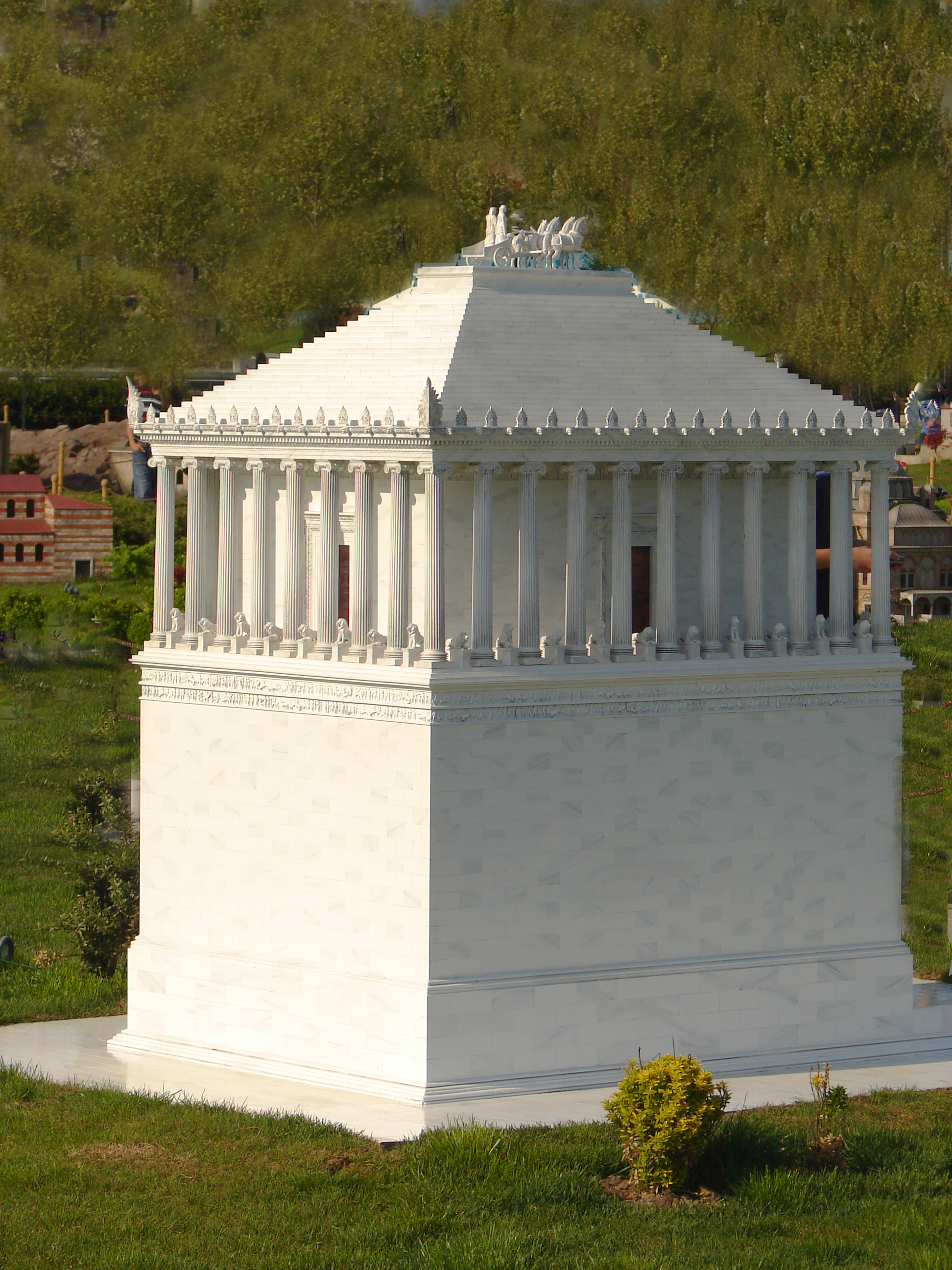
In The Lost Symbol by Dan Brown, the Masons gather in The House of the Temple near the White House, a building that is a replica of "the temple of King Mausolus, the original mausoleum."  Where was this ancient temple, and why was it so important and famous that it eventually became synonymous with tombs?

The tomb of Mausolus was built by his sister/widow, Artemesia, in the fourth century B.C.  It resided in Helicarnassus (modern-day Bodrum, Turkey) and was one of the Seven Wonders of the Ancient World until it was destroyed through a series of earthquakes and ransacking by pirates in the thirteenth and fourteenth centuries. 

scale model of mausoleum Modern-day scale model of the tomb.

Artemesia spared no expense in building the tomb for her brother, hiring four of the best Greek sculptors of the day to design it.  Like all Greek temples, it was surrounded by columns, much like the Parthenon, but set on a raised platform.  Steps guarded by lions led up to the top, where there were statues of Greek gods and goddesses.  The roof had bas-reliefs showing the battle of the Centaurs and Lapiths, and the Greeks battling the Amazons, a favorite subject for Greek temples.  And at the very top of the building, Mausolus and Artemesia occupied a bronze carriage pulled by four gigantic bronze horses.

Now, you may think this your typical Greek building; but in fact, at the time it was actually very, very STRANGE.  First of all, despite the fact that Mausolus' tomb was designed by Greeks and in the style of a Greek temple, Mausolus wasn't Greek.  He was an invader and conquerer of a few Greek Islands, and he admired Greek culture very much, but he wasn't Greek.  From the Greek perspective, he was an uncivilized, uncultured, barely human animal to be feared and loathed--exactly the type of person the Greeks liked to represent as Centaurs and Amazons, which makes the bas-reliefs on Mausoleus' tomb more than a bit ironic.

You can tell Mausoleus and Artemesia weren't Greek because the way they designed the tomb makes little sense, at least from a Greek perspective.  Greeks didn't bury their dead in or around temples; they marked their graves with Greek vases (and in fact, both Mausoleus and Artemesia were cremated, their ashes placed in Greek vases that were set inside this tomb--not that that makes much sense to the Greek mind, either).  The statues in the mausoleum ran the gamut of Greek deities; the Ancient Greeks would only honor one god or goddess within a temple.  And they certainly wouldn't have put a statue of a mortal man or woman (especially not a woman) at the very top of their temple.  Furthermore, the raised platform that lifts the temple and the pointed roof on top is reminiscent of Ancient Near Eastern temples (like the Tower of Babel), not Greek ones.

So what makes the Mausoleum of Mausolus truly significant is not the fact that it's "the first mausoleum," but rather that it's one of the first examples of the dissemination of Greek (and Near Eastern) culture into the rest of Europe.  The look of Greek temples was adopted for another type of building altogether; the stories of the Greeks were exhibited without knowledge (or at the very least, context) of some of their more subtle implications; and the style of Greek art was used to depict non-Greek people.  Mausoleus' tomb is the beginning of the story of how Greek art and architecture survived centuries, including the destruction of its original civilization, to be adopted by cultures as far afield as India and for uses as diverse as banking, religion, scholasticism, and government, just to name a few.

In fact, the House of the Temple, modeled after Mausoleus' hodgepodge of borrowed Greek culture, is probably the most appropriate building I can think of to grace Washington, D.C.--a city built on a hodgepodge of neo-classical ideas if there ever was one.

the more you wish you didn't know

Check back next time to learn more than you ever wanted to know about ancient goddess cults and their connection to YA book covers!


Powered by ScribeFire.

LinkWithin

Related Posts Plugin for WordPress, Blogger...