Showing posts with label time travel. Show all posts

Wednesday, February 22, 2017

Mini Reviews: 2 YA Fantasy Novels

mini book reviews of passenger and graceling

Sometimes I have some things to say about a book, but not enough for a whole post. Enter mini reviews! This week I'm reviewing two young adult fantasy novels that, on the surface, have a lot in common: Passenger by Alexandra Bracken and Graceling by Kristin Cashore. Both have one-word titles. Both are the start of a series (but then what book isn't these days). And both were kind of a mixed bag. However, I think one was slightly more successful than the other. Read on to find out which!


passenger
Passenger by Alexandra Bracken

A gifted violinist, 17-year-old Etta Spencer is eagerly awaiting her professional debut concert. But her career and everything else in her life is put on hold when she's literally shoved through time and into Revolutionary-Era America. Trapped aboard a pirate ship, Etta has to figure out how to get back to her own time and save her mom.

I can never say no to a story about time travel, especially when it involves romance, so when I saw this book on Booktalk & More Too, I immediately requested it at my library. I definitely enjoyed reading Passenger, but there were some inconsistencies and issues that kept pulling me out of a story I desperately wanted to be sucked into.

I loved the beginning of Passenger, where we get a peek into the life of a child prodigy and witness Etta's passion for violin. It reminded me of Mozart In the Jungle, which is one of my favorite TV shows ever. I also liked that Bracken didn't completely whitewash the past and that Nicolas was black (that said, I would have liked it even more if he wasn't the only black person in the book). The story itself was perfectly paced and it's the type of book you don't want to put down.

Unfortunately, Passenger also has some major weaknesses in regards to plausibility and continuity that made it a frustrating read, especially in the second half. I'm not talking about the time travel aspect–I don't expect that to make sense, and it doesn't–but character motivation and practical details that the author skips over or makes a hash out of.

For example, when Etta first time travels, she gets "Traveler sickness" and is unconscious for several days, allowing Sofia to take her from the time portal and deposit her on a ship. Okay, fine. But how did Sofia get Etta from the portal to the ship? Did she have someone carry her? Fireman's hold? Wingardium Leviosa? Teleportation? I guess we'll never know.

Then there's the romance, which I simply did not feel at all. It's one of those romances where they're attracted to each other as soon as they lay eyes on one another, but then spend 500 pages not doing anything about it BECAUSE REASONS. And let me add here that the male half of this equation is a pirate. I found his behavior distinctly un-piratical.

Add to all that long-ass passages of really headslappingly stupid exposition ("Marrying up was the only way that any number of women in history had escaped their pasts and whatever stations they’d been born into. They couldn’t work to improve their lives the way men did, and live by their own means. It was grossly unfair to them–" Thanks for that), and descriptions that are just a bunch of words strung together in sentences that honest to god mean absolutely nothing, and I couldn't work up more than a like for this one. But, it's a decent and fun time travel story, and if you enjoy shows like Timeless you'll probably enjoy this read.


graceling
Graceling by Kristin Cashore

In an alternate world, Katsa is graced with a powerful fighting ability, which her cousin and king exploits to his own advantage. But when she meets similarly graced Prince Po, he inspires her to rebel and set out on an adventure.

Graceling is another novel with a well-told story, but some problems that prevented me from really getting into it.

When I was reading reviews of this book on Goodreads shortly after I started it, I noticed that some people were grouchy about "the raging feminist agenda." And, about halfway through, I understood why. Graceling makes a big show of being "feminist," with a heroine who literally kicks people's asses. But when there's only one female character (aside from a maid whose only purpose in the narrative is to make Katsa attractive so she can attract boys) and the book doesn't even pass the Bechdel Test, the feminist agenda feels more like patronizing lip service than empowerment. I got pretty damn cranky about the whole thing myself, I have to say.

I also was not into the romance between Kat and Po. I did like that they were equals and Po treated her as such, but for me personally it's hard to wrap my head around a positive relationship built on fighting. And the sex scene was like something out of a different novel. A bad one.

But! In the last quarter of the book Po is out of the picture, and I have to say Graceling improved by about 1000 percent. More female characters showed up–a princess, who while a little kid is pretty smart; a sea captain; Po's mom–and since Po's not around, Katsa can do what she does best: survive against the elements and baddies.

I probably won't read the second book in this series, but Graceling was okay. I'm glad I finally got around to finishing this book that's been on my shelf for years.


Discus this post with me on Twitter, FaceBook, Google+ or in the comments below.

Saturday, August 2, 2014

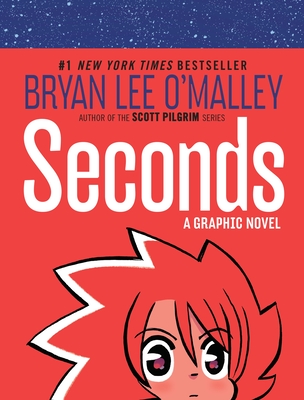
Review: SECONDS by Bryan Lee O'Malley

seconds cover

It's probably not totally obvious, but I am a huge Bryan Lee O'Malley fan. I loved his first graphic novel stand-alone, Lost At Sea, and I think Scott Pilgrim might have ruined me for all other graphic novel series. It was that amazeballs. So to say I was looking forward to Seconds would be putting it mildly—I've been wound up like a spring waiting for O'Malley's next project for YEARS.

Was it worth the wait? Well...

The start of the comic is actually pretty strong. The main character, Katie, is the head chef at a hip restaurant named Seconds. She's the queen bee of the place, but she wants more. To that end, she's opening another restaurant across the river, creatively named Katie's. However, the old building is a money pit and renovations are dragging on and on and on, so in the meantime Katie's stuck at Seconds.

Katie isn't the best person. She's selfish, oblivious to the people around her and their feelings, and like many people who work in top kitchens (I'm guessing, based on all the reality TV chef shows I watch), she's a ball buster. But O'Malley manages to make her sympathetic, especially when she uses the mushroom a house elf gives her to rewind time and save a shy waitress from a serious kitchen accident.

Of course, once Katie finds the elf's stash of mushrooms, she uses them to rewind time and erase really stupid stuff like staying up all night watching Breaking Bad on Netflix. Would any of us do any different? Probably, because I'm assuming y'all aren't assholes. But I think we can all understand the temptation, despite the fact that Katie's constant rewinding is obviously going to fuck up the space-time continuum.

Here's the thing with Seconds: it's good, because it's by Bryan Lee O'Malley. But it's not as good as either Scott Pilgrim or Lost At Sea. O'Malley's strength—aside from his visual style, which is slightly muted here but still evident—lies in creating characters that are at once really quirky and yet totally identifiable. As I said in my review of Lost at Sea, I KNOW these people. That's not the case in Seconds. Katie's well-drawn(ish), but the secondary characters? Not so much. I was particularly annoyed with the whole love triangle between Max, Katie's cool ex, and Andrew, the chef she trained to take over for her at Seconds. What either of these bozos see in Katie, or vice versa, I have noooo idea. Their personalities, if one could call them that, were interchangeable, and Katie didn't seem to think of either of them as more than convenient bed partners. I didn't care which guy she wound up with because it didn't really matter, and I was kind of irritated she did settle with one of them by the end of the book.

The story also starts getting really boring and repetitive about 2/3rds of the way through the comic, especially since the solution to the whole problem seems really obvious. Everything is fixed too easily, with too little consequences, and as a result the themes of Seconds—responsibility, patience, growing up—aren't effectively fleshed out.

There's also nothing original in Seconds like there was in Lost at Sea and Scott Pilgrim. It's very self-referential, which COULD be amusing, but turned out to be annoying instead. Just because a joke worked—and brilliantly—in Scott Pilgrim doesn't mean it will work here. There's not enough distance between the two comics that fans of O'Malley will pat themselves on the back for remembering the reference, which is really the only reason to insert jokes like this:

bread makes you fat joke in seconds
You should be sorry, O'Malley.

Keep in mind that I'm being hyper-critical here because I expect a lot out of O'Malley, and for good reason. Seconds is by no means a terrible comic. But does it stand up to O'Malley's previous works? In my opinion, no. If you're starting out with O'Malley, I wouldn't recommend Seconds; and if you're already a fan, you probably already bought it anyway. I just hope O'Malley can shake off whatever malaise he's got himself mired in and give us something with more energy and a more developed storyline for his next project.


Discus this post with me on Twitter, FaceBook, Google+ or in the comments below.
Sunday, November 3, 2013

J'ai Deux Amours, Neither of Which Are These Books


I really need to stop reading every book that crosses my path and has the word "Paris" in the title, you guys.

In the past two weeks I've read two books that both take place in pre-War Paris (well, kinda). And they both kind of sucked, although for different reasons.

bones of paris cover

The first was The Bones of Paris by Laurie R. King. It follows the walking and talking of Harris Stuyvesant, an itinerant PI who's trying to find a missing girl in what the author continually reminds us is 1929 Paris. As in, "But hey, it's 1929 Paris!" The "twist" is that Harris slept with Pip before she disappeared. Quelle horreur, y'all. As he follows Pip's trail, he discovers artists are assholes, and one of them might have killed Pip.

Now, I didn't pick up this book JUST because it had the word Paris in the title; I was also intrigued because I like King's Mary Russell and Sherlock Holmes novels (or I did, until I DNF'd two in a row because they were boring me). Based on those books I expected better research and writing from King than I got in this novel. It was almost as if she got all her research from watching Midnight in Paris and Discovery Channel documentaries: everything from the historical characters to the bone-filled catacombs has been treaded and retreaded a thousand times. Even the scenes with Sylvia Beach (whom Harris naturally knows, because I'm sure she loved hanging out with aging private investigators) are so obviously based on those two photographs of her that are in every documentary about Paris in the 1920s. And naturally Picasso, Salvador DalĂ­, F. Scott Fitgerald, and Cole Porter all have to be mentioned. Come on, I can get this stuff from any book. I had to roll my eyes when it turned out Harris knew Ernest Hemingway, and Kiki de Montparnasse (but never even heard of the guy Kiki lived with for nearly a decade, Man Ray? Makes no sense).

The lack of original and unexpected story lines wouldn't have bothered me too much if King actually brought the city and society of Paris to life, but she didn't. There was a whole lot of tell and not show going on—some passages read distinctly guidebook-y—and while King might have been going for a crime noir type novel, the tone of the writing was too light to pull it off. I was also a little bothered by the way some of the surrealists, like Man Ray and Lee Miller, were portrayed. But to be fair, that's probably because of my background in art history.

In the end The Bones of Paris just wasn't interesting enough to hold my attention. I only read it for a few days, but it felt like WEEKS because nothing happened and I didn't give a damn if Harris found Pip or not. Or if he threw himself into the Seine, for that matter. The Bones of Paris was a DNF, and I think it will also be the last book I read by King.


midnight train to paris cover

The second novel, Midnight Train to Paris, was originally released as a Kindle serial and is about a journalist whose twin sister is kidnapped from a train along with two other women. Just so happens, 75 years earlier three other women were taken from the same train, at the same place and time. Coincidence?! Soon Jillian is traveling to Switzerland with her ex-luvarh (who used to be in the CIA but is now a private super-investigator) to find her sister and solve both kidnappings, in both time periods!

There is sooo much going on in this book: corrupt US senators, child abuse, murrrrder, betrayal, scandal (sounds like an ABC lineup), art, time travel, train mysteries, castles hidden in the mountains, insanity... LORDY LORDY. I have to admit that I enjoyed it a lot more than The Bones of Paris because there was stuff going on (what a concept), even though the writing was much worse. For example, the author took care to describe, in detail, the driving routes her characters took to get from one place to another, yet didn't bother to research average weather patterns in the Alps or what people wear when it's cold outside. Hint: it's generally more than a pencil skirt, heels, and a light jacket.

Nevertheless, I was having fun reading it. But about halfway through Midnight Train to Paris, I started to lose interest because there was a complete lack of plausibility. Not just the inconsistencies in clothing, but in the characters' behavior and the numerous incredible coincidences. I didn't care if Jillian and her cookie cutter hero got together, if her sister would survive, or even if Jill would. When the hero and heroine traveled back in time and the heroine started getting messages across space-time from her sister, it got to be too much. I skimmed to the end, so trust me when I say it only gets more ridiculous as the book goes on. Also, there are only about three pages that actually take place in Paris. You can definitely feel free to skip this pulpy mess of a novel.


Have you read any good books set in Paris lately?


Discus this post with me on Twitter, FaceBook, Google+ or in the comments below.

Sunday, January 20, 2013

Review: ASHER'S DILEMMA by Coleen Kwan

asher's dilemma cover

Asher Quigley is a scientist who has created a time machine--I'm sorry, "chronometrical conveyance." After he drops something on it, he's accidentally transported back eight months, where he realizes his true love's existence is about to be erased! Can Future Asher convince Past Asher to destroy the chronometrical conveyance and save Minerva's life?

Even though I'm about to complain about it, Asher's Dilemma was okay. Someone who wasn't me might enjoy it more than I did; but then again, maybe Future Me would dislike it more than I did, especially after reading this review. You just never know! In any case, it started off as funny, although I have my doubts the parts I found funny were meant to be so. Then it turned into a slog and I HATED the ending.

The steampunk element was definitely there--not just in the inventions but also in the descriptions and the characters. For example, Mrs. Nemo (there's a subtle reference for you) was described as having "tuberose" perfume and a boneless way of moving. Um, ew. This would be cool if Mrs. Nemo had something else going on for her, but instead she came off as kind of cartoonish.

I was also expecting more wibbly-wobbly timey-wimey stuff. As the Doctor says, time is non-linear and non-subjective, and Asher's Dilemma was too little of both. Plus I found the interactions between Future Asher and Past Asher very unrealistic. If I met myself, I would probably find myself really annoying. I agree with Seinfeld on that one. Instead, Future Asher seemed to almost be crushing on Past Asher, which was SUPER awkward.

As for Minerva--UHG. At first she seemed kind of cool because her job was creating artificial limbs, but as Asher's Dilemma went on, I wondered if the "dilemma" was what do with Minerva, as she was definitely becoming TSTL. And isn't it kind of suspicious both her parents are crazy pants? By the end I didn't care if she was erased from existence or not. Actually I didn't care if ANY of these characters were erased from existence.

Still, I would have been more forgiving of all of this if Asher's Dilemma was a quick read (at less than 100 pages, one would think it would be), but instead it felt like it went on and on and ON. I think the denouement takes up twenty percent of the book; that's what it felt like, anyway. It either needed to be a lot shorter to speed up the pace of the story, or a lot longer to build a more complicated storyline and deeper attachment to the characters.

In any case, as I stated earlier, it was okay. I heard there was a prequel to Asher's Dilemma; maybe if I'd read that I'd have been more invested in the outcome.

Tuesday, November 20, 2012

Review: MISS PEREGRINE'S HOME FOR PECULIAR CHILDREN by Ransom Riggs


Instead of reading the prologue, you can just watch this book trailer!

Jacob grew up listening to his grandfather's stories of "peculiar children"--orphans who were rescued and sent to live on an island during WWII, one of whom was Jake's grandfather. Unlike most orphans, however, the orphans Jake's grandpa knew had strange powers and abilities, which were captured in photographs that his grandpa kept. After Jake's grandfather is murdered, he sets out on mission to find out the truth about his grandfather's odd stories.

miss peregrine's home of peculiar children book cover

Despite the fact that there are reviews of this book all over the freaking place, I started Miss Peregrine's Home for Peculiar Children with very little idea of what it was about. When I read the reviews, all I heard was: "Pictures! Creepy pictures of olde-timey kids being creepy!" That alone was enough to make me want to check Miss Peregrine's Home for Peculiar Children out, of course, but there's a lot more to the novel than just pictures, and honestly the creepy kid photos are probably the least-successful element of the book.

Not that they're UNsuccessful. I can see where Ransom Riggs (incredible name for a writer, by the way) was going with that idea, and I love it. But I'm not sure including the photographs in the text was necessary, and at times it felt gimmicky. Why are these kids running around taking pictures of themselves and then saving them all? Where are these photographs even developed in the time loop, hmmm?

I did adore Riggs' writing style and the voice of the main character, Jacob. As someone whose own grandparents come from Germany and lived through WWII, I really connected to all the generational things going on between Jake and his dad and grandpa. He also freaking TIME TRAVELS--I mean, come on. That's really the best part of the novel (although the entire time I kept thinking, "Nazis aren't enough, we need wights and hallows too?" A little OTT). Riggs can write creepy REALLY well. Honestly, for the first three-fourths of Miss Peregrine's Home for Peculiar Children, I didn't want to put the book down at all.

Then I hit the last quarter of the book and it started to literally put me to sleep. I think it's mainly because the "magical" elements of Miss Peregrine's Home for Peculiar Children aren't grounded enough in the world of the novel; or maybe they're just too obvious? It was as if Miss Peregrine's started off as magical realism and then switched to middle-grade fantasy. I pretty much lost all emotional investment in the story by the end of the book.

My feelings about Miss Peregrine's Home for Peculiar Children are very mixed at this point, but I have say it's interesting--and I mean that in a good way. Intriguing concept, unexpected story, and a writer who's not afraid to take chances. I love how Riggs took real photographs and quilted them together into a story with emotional depth. As I'm always willing to reward experimentation even if it doesn't quite hit the mark, I think this might be one of my more memorable reads of the year.


Thursday, January 12, 2012

Book Review: WHEN NIGHT FALLS by Jenna Ryan

when night falls cover

Remember a few months ago when I begged asked for help finding two books I'd read a really long time ago? Well, this was the first book! I actually found it!

When Night Falls
was published in 1993, which means I was either 12 or 13 when I first read it, and my recall of the details was actually pretty spot-on. Cassie, a crime scene photographer in London, follows a mysterious figure from the scene of brutal murder, straight into 1790. The man she followed, Anthony Lazarus Morgan, is a butler in the house of a baronet--and in his spare time, he travels through time investigating crimes. It turns out the murders in Cassie's London were committed by Jack the Ripper, who is also a time traveler, and he's now in 1790. Dun dun dun!

I'm happy to report that this book is as much fun as I remembered. Here are some of the things I heart about this book:
  • The hero is a butler. Morgan isn't a lord something-or-other (not even a secret one), or someone who is rich, but a butler. Hallefreakinglujah! A hero with an actual profession, can you imagine?!?
  • It's set in Georgian England! This is actually a little odd, because the atmosphere of the book feels very Victorian, and there are a lot of references in the book--everything from Charles Dickens to Courier and Ives--that come from the late 19th century. But I can see why Jenna Ryan pushed the setting back another century, because it gives a fresh twist to the whole Jack the Ripper plot thing.
  • Mystery! Although the mystery starts to seriously drag in the second half of this novel, it's my favorite part of the book. There are tons of suspects who are all interesting, and Ryan keeps you guessing as to which one is Jack the Ripper. Even having read the book before, I was surprised when the killer was revealed.
  • It's the heroine's story. This isn't the type of romance novel where it's all about the hero. The star of the show is Cassie, and it's upon her that the main action in the book hinges. She's smart, tough, quickly adaptable, and also the sexual aggressor in her relationship with Morgan.
Of course, there are some inconsistencies in the story I don't remember noticing when I was 12. Why is Morgan allowed at every crime scene and why do people keep asking his advice on how to investigate, for instance? I don't know! It's a time travel romance, maybe he altered time so that butlers are considered good crime scene investigators. It also bugged me that women of Georgian England kept being referred to as weak-willed and passive, especially when two of three Georgian-era females in this book were pretty damn bossy and clearly in charge of their own domains.

Overall, though, this is a pretty entertaining read. The romance is much more of a subplot than the mystery is, but it develops over the course of the novel and there's no instalove or -lust going on. Jack (the Ripper) also gets his own scenes, which are weirdly enjoyable because he's basically Norman Bates in the 18th century. I'm super-happy I found this book and I'm never letting it out of my sight again! Exclamation mark!


Musical Notes: There's really no logical reason for this, but "Walk Like a Man" by Frankie Valli and The Four Seasons kept running through my head while I was reading this.

Tuesday, June 14, 2011

Book Review: FLIRTING WITH FOREVER by Gwen Cready

Proposed alternate titles: Bumbling into Bernini, A Lay with Lely

flirting cover

Cameron is trying to get a book about Van Dyke published (because god knows the world needs another one of those) so she can become the director of a museum. Problem: her publisher wants her to "sex it up." But how to come up with these gossipy stories about Van Dyke? Answer: make them up! And also: travel back in time and sleep with another painter who met Van Dyke twice!

I know what you're thinking right now. You're thinking, "That doesn't make sense." You are correct. Why didn't Cameron sleep with Van Dyke? It just worked out that way. She was sent to sleep with the time period of Peter Lely, the official English court painter after Van Dyke. And she and Lely have awesome sex and then she comes back to the present--how I don't know--yet still insists on writing a biography of Van Dyke; then Peter travels to the present and becomes a modern artist. And that's just the first half! I would expand on the plot some more, but trust me when I say it's not worth it.

Despite the nonsensical plot--I mean, it's a time travel romance, so what do you expect?--my two main problems with this book were Cameron and the writing. Cameron was the dumbest heroine I've encountered in a long-ass time. Her idea of original research is doing a book search on Amazon. To fact-check herself, she goes to wikipedia. When she realizes she's going to have to back up her "research" with documents, she instead just decides to say it's all made up! And her version of art appreciation is any painting that makes her wet. I am not kidding. Honestly, the idea that a person like this would ever be a curator at a major museum, let alone the director of it, is galling. And if she's an academic, I'm Happy Pants McGee.

Furthermore, don't EVEN get me started on the writing. Oh lordy! There were moments when I was just like, "WTF please stop!!! My eyes, they are bleeding!" Basically any attempt by the author to describe a piece of art was hi-lariously awful. But beyond that (art descriptions are usually pretty painful, anyway, so I just skim over them), there were times when this book did not make sense because it was trying way too hard to be poetic. For example, Peter is described thusly: "The gentlest crurve of cheek hung by the corners of his mouth, a signal of middle-age in an artist unafraid of such trivialities." LOLwat? His cheek was hanging off his face? That sounds a little more than trivial. At one point Cameron's thighs were described as amorphous white blobs and her nipples like bas-relief sculpture. NEED I GO ON???

All that being said, I did finish the book, and in one day (there's no way I would have spent more than a day on it). I think it comes down to the fact that this is every art historian's dream! Honestly, do you know how many times I've imagined what it would be like to meet Giorgio de Chirico or Manet in person? Too many times. And Cameron actually gets to do it--of course, the opportunity is wasted on her because she's a dumbass, but whatever.

Another thing I liked about this book was Peter Lely. He was a great character and really the only thing that kept me reading. His regret over and struggle to right past wrongs in his life made him the most believable and sympathetic person in a book filled with shallow, selfish idiots. Another character I liked was Jeanne, Cameron's assistant, because she used her brain instead of her vagina to make decisions. Hooray for non-crotch-based decision making!

So, right. Why did I read this? I don't even know anymore. It was a train wreck, but of the fun escapist kind. Even if it drove me bat-shit crazy.

Musical Notes: "Breakin' Up" by Rilo Kiley

LinkWithin

Related Posts Plugin for WordPress, Blogger...