Showing posts with label hitchcock. Show all posts

Saturday, July 20, 2013

Review of THE LADY VANISHES by Ethel Lina White

cover of the lady vanishes book

(Actual title is The Wheel Spins, but Amazon and Goodreads have apparently decided to rename it. To be fair, The Lady Vanishes is a much better title.)

Iris Carr is a spoiled, wealthy young woman on holiday at some vaguely Alpine resort filled with English tourists. After catching the last train out to Trieste, Iris meets the bubbly Miss Froy, a middle-aged governess returning to England after years abroad. Iris decides to take a nap and when she wakes up, Miss Froy has disappeared. Even more strange is that everyone denies she was even on the train! Certain that something terrible has happened to Miss Froy, Iris enlists the help of the men folk, but they think she's crazy. After a while, Iris starts to wonder if they aren't right.

If you've seen the movie by Alfred Hitchcock, The Lady Vanishes, Ethel White's novel is very similar (in Fear in the Sunlight, Nicola Upson painted Hitch as someone who had no respect for the original work when adapting novels to film; she obviously knows shit-all about Hitchcock movies), right down to the time symbolism and British ethnocentrism. Honestly, the only difference between the book and the movie is that White gives us a ton of backstory about all the other English passengers on the train and why they don't mention they've seen Miss Froy, plus scenes of Miss Froy's family waiting for her in England. So we know from the outset that Miss Froy is real and not a figment of Iris's imagination, which kind of takes the fun out of the whole thing. I also really didn't care about the other English passengers. At all.

In other words, the movie is better than the book. Don't feel the need to read The Wheel Spins/Lady Vanishes, even if you love the movie.

That being said, I found the elaboration of themes in the novel interesting. You might be familiar with a story Hitchcock told François Truffaut in their 1962 interview about The Lady Vanishes and how it was based on a "true story" of a mother and daughter who traveled to Paris at the start of the Paris Exposition and checked into separate rooms in a hotel. When the daughter woke up from a nap, her mother was gone, her luggage had disappeared, and the room didn't appear to have been slept in. When the daughter asked the desk clerk, he said she'd checked into the hotel alone, and everyone else from the maid to the coachman who'd taken them to the hotel confirmed the desk clerk's story. People assumed the daughter was crazy. In fact, during the daughter's nap, her mother had died of the plague. The hotelier and city officials, fearing a plague scare would keep people away from the Exposition, decided to bury the body and pretend as if the woman had never existed.

That story is actually in the novel, along with several other urban legends that underscore how women are presumed to be neurotic and delusional until proven otherwise, and also how easily a woman's identity can be erased. I really liked that there are stories-within-stories in The Wheel Spins that served to create an atmosphere of paranoia on the train, although I don't think White cashed in on this as effectively as Hitchcock did.

Another thing I found interesting was the role of men in the story. There are only a few male characters, but the women are completely dependent upon them because only the men can communicate with the outside world (well, except for Miss Froy: she speaks 10 languages, although we never actually see her speaking any foreign language during the course of the book). The Professor and "Hare" (a reference to the white rabbit from Alice in Wonderland?), two Englishmen who help Iris, are both linguists and fluent in whatever language the locals speak; but even men who don't speak the language can communicate with the outside world. For example, the clergyman who stayed at the same hotel as Iris left every day to sit with the locals in the village, leaving his wife behind to remark that she didn't know how he communicated with them when he didn't speak one word of the language. A big deal is also made of the fact that Iris is absolutely terrible with languages, so that everything she says to local people on the train is interpreted through a male voice—and a misogynist male who thinks she's by turns annoying and delusional, at that. The Wheel Spins really underscores female dependency on men, much more so than The Lady Vanishes.

I actually did enjoy the first half of The Wheel Spins, but Iris started to get annoying because she constantly runs to either the Professor or Hare to fix things for her when that is CLEARLY not working. Why doesn't she do something herself? The second half is also filled with literally paragraphs upon paragraphs of exposition telling us about character motivation. TELLING, not showing. The conclusion of the novel was also a disappointment. I love the end of The Lady Vanishes movie because Miss Froy turns out to be a badass, and there are a ton of fun magic references and a shoot-out. That does NOT happen in The Wheel Spins. I won't spoil the ending for you, but it was really lame, drawn-out, and anti-climatic.

Basically, you could spend five hours of your life reading this book, or ninety minutes watching the movie. Not to mention the book isn't in the public domain (and yet the movie is... makes no sense), so you actually have to pay for it. Not worth it. I'd only recommend The Wheel Spins/Lady Vanishes to those with a vested interest in Pre-War women and literature.


Discus this post with me on Twitter, FaceBook, Google+ or in the comments below.

Wednesday, January 4, 2012

Mystery vs Suspense in THE MADNESS OF LORD IAN MACKENZIE by Jennifer Ashley

madness cover

One of the linchpins of a good story, I think, is the element of mystery, which obviously isn't the same as suspense. Mystery is more cerebral while suspense is more visceral. I think that's one of the reasons why suspense works so well in movies. You eat pictures with your eyes but you eat words with your brain, especially when those words are on paper.

In Little Women (the movie with Winona Ryder), Jo says something that has stuck in my head for years: books aren't about what you know, they're about what you don't know. You have to want to know about the characters or what's going to happen to keep reading. Unlike in movies, where information is limited to what's before your eyes, in books your mind has to be engaged. You have to wonder about something. That's why mysteries took off with the rise of the novel.

Unfortunately--I think probably because of the dominance of TV and movies in our lives now--this art of capturing one's interest and stringing it along with questions is really pretty rare in fiction these days. Most of the books I read seem to follow Hitchcock's edict that it's better to have an audience know about a bomb under a table for fifteen minutes than surprise them with an exploding bomb for five seconds. Of course, Hitchcock was making suspense movies, not writing books.

That's why it was nice to read The Madness of Lord Ian Mackenzie, because the author, Jennifer Ashley, does a great job of telling this story by building up the reader's questions about the Mackenzie brothers and then surprising us with turns in the story. "What is up with these Mackenzies, why are they all crazy?" you wonder soon after the story starts. Along with, "Why does Detective Fellows have it out for Ian?" The characters don't act like tropes, but like actual characters with motivation, and I loved how unconventional Ian and Beth were. Beth is a window who, through a series of unlikely events, has risen out of an East End London workhouse to become an elegant heiress. Ian, the younger brother of the Duke of whatever, probably has Ausberger's or a mild form of autism, and was institutionalized as a young boy. But he's not the only odd person in his family--all of his brothers are crazy and obsessive, and as the story unfolds we begin to understand why.

I really loved this book and can't believe I waited this long to pick it up! Even the murder mystery in the novel was very well-done and had me engaged and guessing until the end. The Madness of Lord Ian Mackenzie restored my belief that great story-telling is still to be had in historical romances.

Tuesday, May 10, 2011

REBECCA Old Timey Movie Review


Rebecca was Hitchcock's first Hollywood film, and won the Oscar for best picture in 1940. It tells the story of a meek and guileless young woman who meets the dashing Maxim de Winter, of the lots of monies and mysterious past. Their beautiful romance gets a harsh dose of reality when Maxim takes the young woman (who remains nameless throughout the story--I'll just call her Sweetie, shall I?) back to his family estate in Cornwall, Manderley. There Sweetie has to put up with damnable Mrs. Danvers, who is obsessed with the former Mrs. de Winter, Rebecca; not to mention Maxim, who starts acting distant and temperamental almost immediately. Sweetie begins to feel that Rebecca is haunting her and Maxim, and she is--but not for the reasons Sweetie thinks.

rebecca poster

This is absolutely one of the best adaptions of a novel, ever, and one of Hitchcock's best films. One of the things that struck me watching Rebecca this time around was how similar the characters of Sweetie and Maxim are to Bella Swan and Edward Cullen in terms of types: Sweetie is young and innocent, and Maxim is significantly older, handsome, rich, mysterious, and keeps warning her about how dangerous he is. But Sweetie doesn't care, because Sweetie loves him! (And it's not like she has anywhere else to go, let's be honest.) Yet she harbors all these insecurities that she's not good enough for Maxim because he is teh awesome. Have I mentioned the wealthy and handsome part? Yet he's also very intelligent, perceptive, a little snarky, and very interested in her and what her opinion is about things (this isn't as well expressed in the movie as in the book, but I think you still get that impression). It's kind of eerie how the two couples' personalities from this movie and Twilight mirror one another; I can't help but wonder if Stephenie Meyer is a fan of the book.

Danvers intimidating Sweetie
When wallpaper attacks....

Another thing that struck me watching Rebecca this time around is how it deals with femininity. I know I'm always going on and on about masculinity in books and movies, and I may at one point have said that there are no movies that treat femininity in a way comparable to masculinity--I was wrong. This movie totally does do that. Sweetie starts off the film as a little girl scared of the world, and has a definite idea of what the ideal woman is like: "I wish I were a woman of 36, dressed in black satin with a string of pearls!" she says at one point. Basically, Rebecca is the ideal woman, and Sweetie spends a good portion of the movie trying to be her, despite the fact that Maxim tells Sweetie to promise him never to be 35 and dressed in black satin. In fact, Maxim seems to take a vested interest in keeping Sweetie immature, calling her a child and telling her he never wants her to grow up (creepy!) even though he knows she will. Meanwhile, the "real" women in the film whom Sweetie might look up to and emulate are all evil bitches--well, except for Bea, Maxim's sister, who's not evil. But she's still a bitch. Aside from her, we have Edythe Van Hopper--evil bitch--Mrs. Danvers--scary evil bitch--and Rebecca, the bitch queen of Manderley. With all of these examples, is it any wonder Sweetie has trouble asserting herself? One could almost say that adult womanhood is villainized in this film.

Or maybe the movie is simply characterizing women who grasp for power they don't have as bitches. After all, Sweetie does eventually assert herself, once she knows she has Maxim's love, and seems much more grown-up, yet not bitchy, by the end. Mrs. Van Hopper, Danvers, and Rebecca are all women without character or true love in their lives, and none of them make their exit without conveying the sense of how empty and pathetic their lives really are.

In any case, due to Danvers' craziness, Manderley ends up being destroyed. I think for both Sweetie and Maxim, Manderley represents a loss of innocence, and perhaps that's why they never rebuild it. One can imagine them moving happily on with their lives without the weight of Manderley dragging them down. But in the book I got the impression that without Manderley, they live like exiles, feeling completely cut off from their true home. I prefer the movie's ending, because when you think about it, Manderley was beautiful but really not that great!


Powered by ScribeFire.

Sunday, May 1, 2011

ALFRED HITCHCOCK by Francois Truffaut

truffaut and hitchcock interview
François Truffaut talks to Alfred Hitchcock with the help of translator, Helen G. Scott.

In 1962, François Truffaut sat down with Alfred Hitchcock for hours upon hours to discuss Hitchcock's entire oeuvre. Truffaut was a filmmaker himself, and a total Hitchcock fanboy. The tapes where edited and broadcast on French radio (you can listen to them here), and turned into this book. Truffaut's interview with Hitchcock is now one of the most cited sources in books about Hitchcock, and for good reason: the director is astonishingly blunt and honest about his process and philosophy of filmmaking.

I ordered this book at the library because I was doing a paper on Hitchcock, but having difficulty finding the sorts of books and articles I needed. The lovely Colette from A Buckeye Girl Reads helped me out by tweeting for suggestions, and a few people recommended this. I'm very glad they did because it's not only a good resource, but a great read!

You wouldn't expect a book that's really a giant interview to be interesting, but Hitchcock is. For one thing, Hitchcock and Truffaut aren't just conducting an interview, but having a conversation about the nature of film and directing (you get an even greater sense of this in the tapes). At one point, Hitchcock asks Truffaut, "What's your opinion?" One gets the idea that Hitchcock is as open as he is because he respects Truffaut as a director.

Another thing that makes this book great is of course Hitchcock himself. I have to say, I was surprised by how inspirational I found this book to be as a whole. I don't think anyone would argue today that Hitchcock was a great artist, but that doesn't mean he started out as a film genius or never made mistakes, and he's completely up-front about admitting that. The important thing was he kept going--he kept making films, he kept trying new things, or going back to old methods when the new ones didn't work. I have great respect for Hitchcock after reading this book, not just as a director but as a creative person who could at any time have been defeated by self-doubt.

One of the things I found really interesting was what Hitchcock says about critics--not just because this a book blog that reviews books, but because Truffaut was himself a critic before he became a director, and he was realllly critical. He was so harsh, in fact, that he was banned from the Cannes Film Festival! Yet as soon as the subject of critics comes up, both Hitchcock and Truffaut start dumping on them. Here's an good bit (which I edited to make more good):

TRUFFAUT     It's sometimes said that a critic, by the very nature of his work, is unimaginative, and in a way, that makes sense, since imagination may be a deterrent to his objectivity. Anyway, that lack of imagination might account for a predilection for films that are close to real life....

HITCHCOCK     By the way, since we're being so critical of the critics, what line were you in when we met for the first time?

TRUFFAUT     I was a film critic. What else?

HITCHCOCK     I thought so.

Some magazines deliberately select critics who don't care about films, but are able to write about them in a condescending way that will amuse the readers. There's an American expression; when something's no good, they say, "It's for the birds!" So I pretty much knew what to expect when The Birds opened.

Basically, Truffaut and Hitchcock's frustration with critics stems from the fact that they approach movies not as a entertainment, but as a subject for their own ideas. I couldn't help but wonder if the same is true of my own reviews... I might as well admit that it is, although I don't make any of the claims to objectivity that Truffaut suggests.

But then I started thinking about this in regards to book blogs: bloggers review books (for the most part) because they love them and want to write about them, not because someone hired them to write and they may or may not like movies books. So does that make blog reviews different from print reviews?

I don't think so. It might seem ironic, particularly considering my current major, but I think a great work of art stands on its own no matter what people write about it. Yes, reviews and essays can enhance a person's understanding of it, or promote it, but ultimately the only thing that matters is the work of art itself, whether it's a painting or a movie or a book.

In any case, there's a lot of great ideas in this book and interesting conversation, and I'd recommend it for anyone interested in film.


Powered by ScribeFire.

Monday, April 18, 2011

ROPE Movie Review


Two high-society prep-schoolers murder someone just for fun, then hold a party with the corpse in the room. Will the party guests--most particularly their former professor--find them out? Or will they get away with murrrrrderrrr?

This is one of Alfred Hitchcock's lesser-known movies, but I think it's one his best. It's shot in an interesting way, is very suspenseful, and poses some interesting ideas related to nihilism and intellectualism run amok.

brandon and philip

Brandon and Philip went to prep-school together and obviously developed a very close relationship. And by close I mean I kept waiting for them kiss all during the movie. They stand really, realllly near one another. Oh, and when Philip decides he wants to kill someone just so he can see if he can get away with it (not that he has much doubt), Brandon of course agrees to help.

But Philip can't just kill someone; he has to tempt fate by hosting a party immediately afterward, to which he invites his victim's parents and girlfriend, and one of his old professors. In a way he's showing off what he did to the professor, who gave him all his highfalutin' ideas about superiority. In another way it's almost like a wake, with the corpse in the room and food being served on top of his coffin. The guests talk about the victim an awful lot, not that one notices in the movie, because David--the murderee--is at the forefront of one's mind. If they talked about something else, it would be boring!

As the soirée goes on, however, the professor (played by Jimmy Stewart) begins to suspect what Philip and Brandon have done. It's like Dumbledore realizing Tom Riddle is actually Voldemort.

In all honesty, Jimmy Stewart isn't that great in this. His character is supposed to be a super-intellectual professor who believes in Nietzsche's doctrine of the "superbeing"--people who are above morals and tolerance and things like that (naturally he thinks he's one of these superbeings). Plus Stewart's supposed to have had an affair with Philip and/or Brandon. But Stewart is such an aw-shucks boyscout you don't get any of that in the movie. He does make a great detective, though. I wonder why they didn't just change it so he was a DT Philip had cultivated for his eventual murderous triumph?

I really loved how this was shot. It was done entirely in "real time," something Hitchcock had been playing with since The Lady Vanishes. He did a series of "long shots," one after another, until a reel of film ran out (this is why some shots end focuses on strange objects, like the back of a jacket). I think this really added to the tension of the movie. Also, for much of the film the chest with David's body in it is placed just on the lower edge of the screen, so that it's always in view--and always on the viewers' minds.

Did I mention this was also Hitchcock's first color film? It's a strange choice for a first color film, because all you really see is the inside of the apartment, and Hitchcock kept the color deliberately muted. But the there's a large window in the apartment that looks out on a (obviously) miniature model of New York City, and it's fabulous! The New York City of dreams. The backdrop changes as it get progressively later to reflect the setting sun and that's mainly where we get to see the spectacle of technicolor--that backdrop would never work in a black and white film.

Hitchcock called Rope a stunt, but I think it's much more than that. It's a clever movie--with some serious over-acting at the end, it's true, but for the most part it's a lot of fun to watch and I highly recommend it.


Powered by ScribeFire.

Thursday, August 13, 2009

The New Biographical Dictionary of Film

new biographical dictionary of film

I read this book as part of My Friend Amy's "Fifty Books for Our Times" Challenge.  You see, Newsweek recently published a very odd list called Fifty Books for Our Times, and Amy wound up challenging book bloggers to read one book from the list and ask--is this a book for our times?  And why?

The book I chose was the last on the list.  What was Newsweek's justification for picking this tome?

If you don't argue with Thomson on just about every other page, then you aren't paying attention. In a world where film criticism is dying, Thomson make a case for it-eloquently and adamantly.

Film criticism is dying?!  OMG!  Has Newsweek heard of the intranets? 

Based on Newsweek's two sentences, I was expecting this book to be a collection of critical film essays.  But then the book arrived and I was like, "Ohhhh, it's a biographical dictionary."  Art historians use biographical encylopedias (or dictionaries) as resources all the time when trying to trace works by obscure artists.  They usually have place and year of birth/death, major works, and where the artist studied. 

After realizing that, I revised my expectations and thought the book might be very facty and dry.  Not to mention that it's a huge tome--over 1000 pages of entries on actors, actresses, and directors (that's as long as the health care bill!), all listed alphabetically.  I'm sure you're wondering if I read this entire book cover-to-cover.  Uhm, yeah, sure I did.  And while I was at it, I read the dictionary and banged my head against a wall, too.

No, I didn't read the entire book.  But I did read entries on my favorite actors and directors and read some randomly-picked entries.  And what I discovered was that this book isn't dry reading, or a traditional biographical dictionary, but a collection of critical essays organized in an alphabetical format.

Thomson is a great writer, and stylistically his words are beautiful.  That being said, I'm not entirely sure what they mean.  Take, for example, this part of the entry on Luis Buñuel:

And long before Warhol's cinema, the lovers in L'Age d'Or engage us in the epic awkwardness that afflicts love.  Could a film have been banned so long if its power was not in the explosive mixture of style and sense?  Could Buñuel have kept himself from directing for so long if he did not view the medium serenely?  Could assigned projects make so little difference to the art of a director if that art was not within his images?  Could anyone so sustain an inquiry into imaginative life and an unaffected account of externals if he was not a great filmmaker?

Could you get to the freaking point?!?! 

Fortunately, Thomson does have a point, which he gets to eventually, that Buñuel's movies can only be interpreted as a response to bourgeois tradition.  Not exactly a brilliant point, but he did have one.

One of the things that really bothered me about this book is that Thomson is critical of everyone.  I know that as a film critic this is his job (maybe?), but can the guy ever be happy?  With John Cusak, he says, "... when is he going to be emphatically grown up?" and, "Can he look forty?"  With Meryl Streep, he calls her dour and too serious.  The list goes on.  Take, for example, this section from Sir Alfred Hitchcock's entry:  "I do not see how a man so fearful, and so chronically adept at conveying fear, can be judged as a profound artist....  There is an artistic timidity in Hitchcock that, having put the audience through it, must allow them to come to terms with the experience.  But his own personality is withdrawn, cold, insecure, and uncharitable."  He also calls North by Northwest "a brilliant view of a frivolous Cary Grant being sobered by feelings" which an interesting summary.  Yet when he criticizes Hitchcock's later films, mentioning that something like Frenzy is almost a parody of a Hitchcock movie, Thomson never even touches upon the fact that the illness of Hitchcock's beloved wife, Alma, undoubtedly has a strong affect on his later work.

More enjoyably, Thomson fills his entries with gossip, such as Angelica Huston's relationship with Jack Nicholson.  But then he spoils it by asking if she was intimidated by his and her father's, John Huston's, acting skills.  Like what the hell?  I think Thomson might be just a bit of a sexist.

So is this a book for "our times"?  I would say emphatically no.  Thomson's writing style is reminiscent of art criticism of the 1950's--if I had to guess, I would say he's probably a big fan of André Bazin.  His essays sound great, but they don't say much.  Not that they don't say anything, but his criticism isn't precise and clear.  A lot of times it also feels as if he's only criticizing actors or films just to have something interesting to say--Newsweek is definitely right that it's impossible not to mentally argue with him every other page, and the reason for this is because his criticisms do not feel entirely justified, or seem to come out of nowhere.

Furthermore, Thomson's essays on film reflect a very singular viewpoint:  that of a white male.  While reading this book, it feels like the theory and criticism of the 1970's and onward has completely passed Thomson by without much acknowledgement by the latter.

Don't get me wrong--this is probably the most entertaining dictionary ever written.  It's a good book, and one every film buff should definitely take a look at; because if you don't enjoy it, at the very least it'll give you something to think about.  But does it reflect our times, and do I think it will hold influence over future film criticism?  I don't think so.  If this is modern film criticism, then yeah, it is dead.  This book doens't reflect the work of Laura Mulvey's article on visual pleasure, Mary Ann Doane, or Slavoj Žižek, and it doesn't reflect the current theories and practices of film criticism.


Powered by ScribeFire.

Tuesday, July 21, 2009

Spellbound

Spellbound from Eyegate

This week for My Friend Amy's Summer of Hitchcock, we watched Spellbound.  The movie stars a very handsome-looking Gregory Peck and Ingrid Bergman, who has the weirdest hair ever.  It's not even like hair, it's like playdough she just pushes around her head.  She's the only female psychoanalyst at a mental institution in Vermont, and is a tad bit uptight.  But then Mr. Tall Dark and Handsome shows up, and she's like, Rawr!!!  I want me some o' that! 

Unfortunately, Gregory Peck's chacter--who is alternately known as Dr. Anthony Edwardes, John Brown, and John Valentine--is a freakin' psycho.  Or maybe that's fortunate, since Bergman (aka Constance) is a head doc.  It turns out Dr. Edwardes isn't really Dr. Edwardes, but a patient of his with amnesia.  And... Edwardes is dead!  And Peck might have murdered him! 

This movie was surprisingly sexy.  Constance traipses into "Edwardes" room in the middle of his first night at the mental institution (they have their doctors living there? Yay. Sound like a great job.), and she's all like, "I'm here because... of this book?"  And he's all like, "I know why you're here *smirk*," and then they start making out.  There's another scene when they're staying overnight at Dr. Alex Brulov's as a supposedly married couple, and he asks, "Have you ever...?"  And Bergman says, "No, of course not."  Then Peck says (you're probably getting a good idea of why I don't write novels right about now), "Well, I don't remember anything, so as far as I know I've never, either."  Huh.  Thanks for putting that in there, Hitchcock!  Nice to establish both parties are virgins right before... they decide he sleeps on the couch?!?!?  Wat?!

Dr. Brulov and Constance try to crack a head

My favorite character was Dr. Brulov, Constance's mentor.  Pointy facial hair for the win!  I also appreciated the fact that he told Constance she was acting like an idiot.  Finally, a sane character!  He also gets the best lines in the film.  For example, "Vomen make the best psychoanalysts--until they fall in lofe.  Then they make the best patients.  Hohohoho!"  Ahhh, psychoanalyst humor.

The one other really interesting thing about this movie is the dream sequence, which was designed by Salvador Dalí.  This was the first time Surrealism was exposed to a wide, general audience.  If you had never seen a Surrealist painting before, I guess the scene would be pretty shocking.  Personally I was kind of underwhelmed by it.  Dalí basically quotes from his previous paintings and doesn't really use a lot of imagination.  It was a little too quote-y for me.  The eyes, the shadows, the melty wheel... yawn. 

In case you've never seen this movie or need a refresher, here's the dream sequence:


Other than the romance, Dr. Alex, and the dream sequence, this movie was actually pretty boring.  I didn't really like the characters except for Burlov and Peck's yumminess; and the story didn't really grab me at all.  Not to mention that Edwardes'/Brown's/Valentine's psychological breakthrough was way too easy.  This movie was 100x better than The Birds, don't get me wrong; but I still wasn't as involved in it as I was with Psycho or Dial M for Murder.


Powered by ScribeFire.

Friday, July 17, 2009

Take a Chance Challenge: The Birds

the birds poster

I watched the movie and read the short story The Birds (by Daphne du Maurier) for Amy's Summer of Hitchcock; but I decided it also could satisfy the requirements for the tenth part of Jenner's Take a Chance Challenge at Find Your Next Book Here:

take a chance challenge

Movie/Book Comparison
Find a book that you haven't read that has a movie based on it that you haven't seen. Read the book and watch the movie within a few days of each other. Write about your reactions to both the book and the movie and compare the two.

I read the story by Daphne du Maurier first, online.  It was incredibly creepy and atmospheric.  It takes place in post-WWII England, in a small farming villiage.  The main character, Nat, is retired but has two young kids and works on a farm part-time. 

The short story begins with Nat's tiny cottage being attacked by birds in the middle of the night.  The next morning, he goes to the farm to see if anyone else was attacked, but they hear his story with disbelief and incredulity.  However, it soon turns out Nat wasn't the only one who was attacked.  As he hears on the radio, birds gathered and attacked all over the country, perhaps even all over the world. 

As Nat hunkers down with his family in their cottage and services start to disappear, a claustrophobic feeling invades the story.  It's not so much a horror story as it is a struggle for survival against a completely unexpected and unstoppable enemy.  Birds, which no really notices that much in their daily lives, have suddenly become kamikaze terrorists attacking anything human with no concern for their own well-being or safety.  There's also a sense that they're doing this under the control of some higher power, following the tides and grouping together to attack specific places--what that higher power might be is never said.

After reading the story, I had high expectations for the movie, but Hitchcock basically changed everything.  He kept a lot of the arresting visuals in the short story, such as the black cloud of birds rising on the horizon; but instead of post-war England, we find ourselves in 1960's San Francisco, in a... bird store?  Huh.  Basically, Tippi Hedren (aka Melanie) is some sort of hieress, and she spends the first half hour of the movie chasing down this gross lethario named Mitch to a tiny seaside town so she can give him some lovebirds he ordered for his sister's birthday.  Um, one, why; and two, if he ordered the birds for his sister, why didn't he pick them up himself or make sure he was at his apartment when they were delivered?  I mean, that is just incompetent, not to mention a painfully weak opening for a movie.  So the characters have pointless conversations for about an hour and a half (or that's how long it felt), and then finally birds attack, and I'm like, "Yay!  Finally!"

Basically, the movie was full of lulz.  It was way too long, the "plot" was ridiculous, Hedren kept lolling her head about when there were no birds around at all, and the script was just lame.  Even though I had fun with the fake birds, there were hardly any bird attacks in the movie at all until the very end.  Overall, I was pretty disappointed.

summer of hitchcock

Next week on Summer of Hitchcock, we're watching Spellbound.  So start polishing up your Dr. Freud accents, everyone!


Powered by ScribeFire.

Sunday, July 12, 2009

The Sunday Salon

The Sunday Salon.com

I didn't get much reading done this week, what with job interviews and trying to throw together a presentation about Counter-Reformation art in a day.  I did finally finish Bound by Your Touch by Meredith Duran on Monday night.  It was a very good book that I would definitely recommend to anyone who likes historical romances (review forthcoming).  Then I started Kill the Dead by Tanith Lee.  I'm reading this book for the Take a Chance Challenge and it was due at the library about two days ago. =/  The guy who is in charge of Interlibrary Loans is going to kill me.  Did I mention he used to be my Earth Sciences teacher in high school?  Oh, yeah, and he also is a member at the bank my mom works at, and the last time I was late returning a book, he told my mom about it! o.O On the plus side, though, I always get the books order.

I don't know why, but it's been really difficult for me to focus on reading these past two weeks (hence the loooooong time it took to read Bound By Your Touch, even though it was a good book).  Maybe the heat is just getting to me and I can't concentrate.  Nevertheless, I still acquired my usual pile o' books the past two weeks.  I even bought some books (the first time I've bought a book since March--very exciting!).

Here's what I bought:
Here are the books I got at the library:
I also read "The Birds" by Daphne du Maurier for Summer of Hitchcock (review of both story and movie forthcoming).  And I won a contest at One Literature Nut.  Yay, me! ^_^

So hopefully this next week will see me out of the summer doldrums and I'll be able to get some serious reading done.  And hopefully I'll finished Kill the Dead soon, because I'm determined to do so before I return it.  Even if I risk the wrath of the librarians. :P

What did you read this week?


Powered by ScribeFire.

Tuesday, July 7, 2009

Psycho

psycho poster

This movie is really good and really scary. I think it shows just how much a great a director and talented actors can do with what could be termed a typical horror script.

Janet Lee is an attractive blonde named Marion who is in love with a guy named Sam. Aw. But he won't marry her because they don't have that much money. Doesn't he realize they can live off anything as long as they have each other?!?! Apparently not. So on a whim one day, Marion steals money from her prat employer and gets the hell out of Dodge (Phoenix, actually).

Since Marion didn't really plan this out at all, she behaves very suspiciously. Has she never seen a cop show? Now, I know you're thinking that's the biggest mistake of her life, BUT IT ISN'T! Her biggest mistake is staying at the creepy Bates Motel just outside of a small town, where the nice young man at the desk asks her if she'll have dinner with him (OMG don't do it!!!!!)

The Bates Motel

I need to take a quick aside to say that Anthony Perkins, who plays Norman Bates, is ah-may-zing in this picture. He has just the right balance of charm that makes you think he's harmless, and then he says something to get your alarm bells ringing. And then, just like that, he's back to being harmless and you're willing to trust him again. I could completely see why Marion would accept his usual offer to eat with him; and then still stay in the motel, even after he admitted he "likes to stuff things." O.O

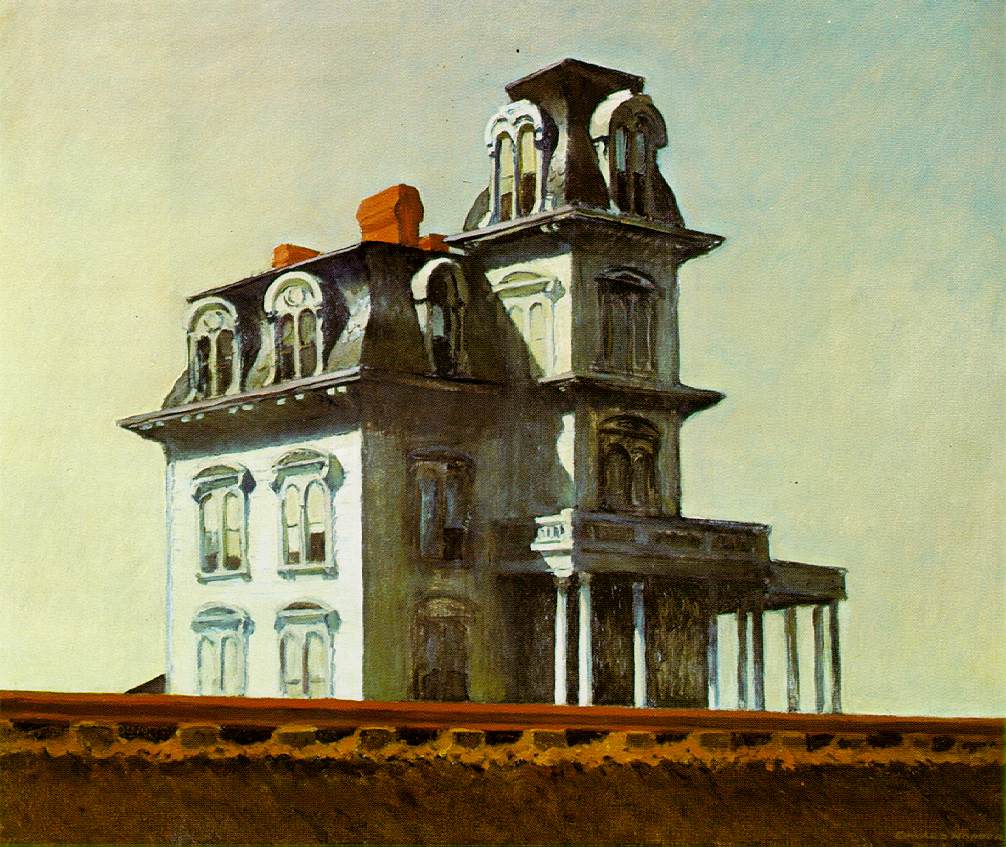
I also have to say... the Bates' house is hilariously Gothic. Yes, it is moody and atmospheric. But, um, this is the middle of Arizona? Two-story Victorians without air conditioning are not meant to be livable in that environment. No wonder Norman was crazy; his brains were cooked! (I also found out on Alberti's Window that the inspiration for the Bates' house came from House by the Railroad by Edward Hopper. Art historieeeeee!)

shower scene

So Marion goes back to her hotel room to take a nice, relaxing shower, and then--screech! screech! screech! She's stabbed by Norman's mother... or who we're led to believe is Norman's mother. My Friend Amy asked if the fact that Marion dies at this point made the narrative of the film lose energy. I don't think it did at all; Marion was resolved to go back to Phoenix and repent of her sins at that point. In effect, her narrative was already over. And our sympathies quickly shift to poor Norman with the psycho mother, as he tries to cover up her evil deed.

One thing I really liked about the movie--aside from the acting--was the sound track. It was flipping beautiful and perfect for the film. The composer was worth every penny Hitchcock paid him.

I think of all the Hitchcock movies we've watched so far, this one is the best. It is an absolutely gripping, perfect piece of story telling. Even though I knew pretty much what was going to happen, I was still shocked and scared. This is definitely a movie I'm going to be thinking about for a long time.

summer of hitchcock

Next week on Summer of Hitchcock, we're watching The Birds and twittering about it! The event will take place on Friday night at 9 PM EST. Amy will be giving away an Amazon gift card to the people who tweet the movie and read the short story by Daphne du Maurier beforehand.

But before I close this post, I have to ask: if you were on a road trip and ran across a hotel named The Bates Motel, would you stay there just for s&g's, or would you keep driving?


Powered by ScribeFire.

Tuesday, June 30, 2009

Rear Window

Rear window poster

I'm pretty sure everyone, even those who haven't seen the film, know the plot to Rear Window: photographer Jeffries (or Jeff) is holed up in his apartment with a broken leg. To pass the time, he watches his neighbors, and one day he starts thinking a man across the way has murdered his wife.

This is one of Alfred Hitchcock's most famous films, and one of his most admired--for good reason. The screenplay is spot-on and the direction is amazing. You know that old adage, show don't tell? Well, ever since cinema first got started, filmmakers have been obsessed with playing to the strengths of the medium and telling--or rather showing--a narrative purely through visual movement. That obsession didn't change with the arrival of talkies; it only became commercially more difficult! Rear Window is able to tell stories about Jeff's neighbors using almost no talking at all, just by showing them going about their business. I think that's part of the reason this movie is such a filmmaker's film.

One of the things I really like about this movie--that no one else has talked about yet, anyway--are the references to marriage and relationships. Both Jeff's editor and nurse (the always-fun Thelma Ritter) mention marriage to him at the beginning of the film. This is to set up for the entrance of committophobe Jeff's gf, Grace Kelly... or Lisa. Whatever (like how many people remember her character's name at the end of the film? I'm just saying). But I also think the idea of relationships is central to the voyeuristic aspect of the movie. The dynamics of relationships are almost impossible to understand unless you're actually in the relationship. Have you ever wondered how two people can possibly stay together; or thought of two people as the perfect couple, only to find out they're cheating on each other?

grace kelly and james stewart

And speaking of, one of the things I've never gotten about this movie is the whole relationship between Jeff and Lisa. Note to Jeff: you have a beautiful, rich woman who is at least fifteen years younger than you are (may actually be more like twenty--yikes!) throwing herself at you. It's not going to get any better than that, buddy. Wake up and smell the roses. And why in the world is Lisa so into him, anyway? o.O I do like how sexually aggressive Grace Kelly is in this movie, though. Go, Grace!!!

Anywho, this is a really good movie. It's the type of film you can watch over and over and not really get bored because you always notice something different. That being said, it's not one of my favorite Hitchcock movies. *ducks* The whole relationship between Lisa and Jeff just bothers my brain. And I spend most of the movie thinking, "Why don't these people close their curtains?" and being more annoyed with the fact that Jeff isn't minding his own biznass than how the guy murdered his wife (which I'm always quite skeptical about). But then I'm from the West where we try to ignore the fact that we have neighbors--if we have them--so maybe that's part of my problem.

But either way, this is a really great, classic, entertaining film that everyone should see.


Next week on My Friend Amy's Summer of Hitchcock, we'll be watching Psycho!


Powered by ScribeFire.

Monday, June 22, 2009

Dial M for Murrrrrrder

Dial M for Murder poster

On Sunday, I watched Dial M for Murder as part of My Friend Amy's Summer of Hitchcock.

I've actually seen this movie a few times before, and it's one of my favorite Hitchcock films. It's about a woman who is having an affair with an American mystery writer. Meanwhile, her husband, who is something of a ne'er-do-well, has decided to kill her. He hatches what he thinks is the perfect murder; but of course things happen that put all his carefully constructed plans to ruin.

This is not a mystery--we already know whodunnit before it's even done--but it does have a very Agatha Christie feel to it. I think that's because of the great characters and the claustrophobic feel of the film. Almost the entire movie takes place in the tiny flat that the Wendices call home. The setting can be mainly attributed to the fact that the movie was adapted from a play; but I also think it works to help tell the story and keep the narrative flowing. In the end, the resolution of the story rests on how one can get into the Wendices' flat.

The camera angles in this film are very interesting--there's always objects between the viewer and the actors. I didn't notice this too much until it was pointed out in the special features on the DVD, though. :) The reason was that Hitchcock originally shot this movie in 3-d, so he always shot with a foreground, middleground, and background, to enhance the viewers' sense of depth. Pretty ingenius if you ask me.

There are so many great actors in this film. By far my favorite is Ray Milland's performance as Tony, the homicidal husband. He's completely smarmy, but also weirdly charming. I also like the fact that he doesn't portray Tony as completely unfeeling; you can tell that he's not unaffected by the idea of his wife dying.

The other character I loved was the Inspector. He's smart, and he knows there's something fishy about the situation from the very first. It's so nice that a DI would care enough to follow up on a case even after it's been to trial. ;)

Some of the things I didn't like were that you never truly understand why Grace Kelly (aka Margot) married Tony in the first place. What was she smoking? They don't feel like much of a couple and there absolutely no chemistry between the two. Also, I'm not entirely sure that the Inspector's "proof" that Tony planned to kill his wife would stand up in court--but it's a great ending anyway.

Overall this is a great film that I would recommend to anyone who enjoys suspense or mystery movies.


Next up on Summer of Hitchcock is Rear Window. Feel free to join in!


Powered by ScribeFire.

LinkWithin

Related Posts Plugin for WordPress, Blogger...