Showing posts with label photography. Show all posts

Friday, January 13, 2012

Weekend Cooking Review: WHAT I EAT by Peter Menzel and Faith D'Aluisio

what i eat cover

Several months ago, when I reviewed What the World Eats by Menzel and D'Aluisio, Amanda Gignac suggested I try out What I Eat: Around the World in 80 Diets by the same authors. Although it contains similar content--photographs of what people eat from around the world--Amanda was totally right when she said that What I Eat is a lot better than What the World Eats. It has better photographs, essays, and doesn't have as many generalizations or preachy moments.

In What the World Eats, Peter Menzel and Faith D'Aluisio photographed families from around the world with a week's worth of food, focusing on how much each family spent. Although it was an interesting idea, the format invited large generalizations. By comparison, What I Eat focuses on individuals and what they eat during the course of one day. This is much better, because it connects food more specifically to a person's lifestyle rather than their nationality. A trucker, for example, logically gets most of his/her food from gas stations and fast food restaurants and needs something that can be eaten one-handed; a German biermeister is obviously going to drink a lot of beer!

curtis newcomer

The book is organized by how many calories each person eats in a day. I really had no idea what the average calorie intake for an individual was before I started reading this book, but it seems like most people eat between 2200 and 3000 calories per day. Below 2000 calories is mostly athletes who need to be light (my aunt, a competitive rower, once told me she limited herself to 1200 calories a day during racing season--now I know just how low that is!), extreme dieters, workaholics who don't have time to eat, or people living in poverty. Even the fashion model Menzel and D'Aluisio photographed, Mariel Booth, eats 2400 calories a day. One might think that at the other end of the spectrum--people who eat 4000 calories or more per day--there would also be athletes who need energy. But actually, this group is almost entirely made up of men who work outdoors, particularly cold outdoors--with the notable exception of an English housewife who binge eats at 12,000+ calories.

If there's one thing I've learned from this book, though, it's that how many calories you eat doesn't necessarily have a lot to do with how much you weigh, despite what we hear on television. Viahondjera Musutua from Namibia eats about 1500 calories a day and weighs 160 pounds, while João Agustinho Cardoso from Brazil eats more than three times as much--5200 calories a day--yet weighs twenty pounds less! How many calories a dish has and how much food you're actually getting through it also seems to vary wildly: even though extreme dieters Rick Bumgardener and Mackenzie Wolfson eat less than 2000 calories a day, there seems to be a lot more food in their calories than there is in Chinese student Chen Zhen's 2600.
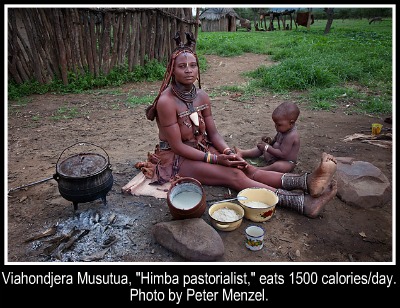
Viahondjera Musutua

Part of the reason, as explained in Bijal P. Trivedi's excellent essay "The Agony and the Ecstasy of the Calorie," is that all calories are not created equal. When calories were "discovered" by Wilbur Olin Atwater in the 19th century, he was basically looking for a way to measure the amount of energy a person can get from food. But each calorie is made up of different values and behaves differently depending on what you do to it (processing, cooking, etc.), so what exactly goes into a "calorie" and how it will affect your body can be extremely variable.

There are several good essays in this book, which helps to mitigate the preachy tone I didn't like in What the World the Eats and elevates What I Eat to a more serious study of how humans relate to food. Trivedi's essay and Michael Pollan's "The End of Cooking," where he talks about the irony of America's obsession with foodie television and the fact that less and less people are cooking for themselves, were my two personal favorites.

Overall I found this to be a book worth tracking down and think it should definitely be of interest to anyone who likes reading about food. It would also be a great resource if you're planning a trip to any of these countries and want to find out what a typical meal might be.


Weekend Cooking is open to anyone who has any kind of food-related post to share: Book (novel, nonfiction) reviews, cookbook reviews, movie reviews, recipes, random thoughts, gadgets, fabulous quotations, photographs. If your post is even vaguely foodie, feel free to grab the button and link up over the weekend.

Saturday, December 17, 2011

Book Review: HURRELL'S HOLLYWOOD PORTRAITS by Mark A. Vieira

hollywood portraits cover

When people think of Hollywood's "Golden Era," images of beautiful actresses and formidable leading men captured in a black-and-white that seems sharper and more brilliant than any color film dominates in one's mind. To a great extent, the definable "look" of Classic Hollywood is attributable to one man: photographer George Hurrell.

In this book, film scholar and photographer Mark A. Vieira discusses Hurrell's career and photographic techniques from 1925 to just before WWII. The book isn't as scholarly--or gossipy--as Sin in Soft Focus, also by Vieira, but it is the best book book about Hurrell that I've encountered so far. It's true that Vieira doesn't break a lot of new ground here (most of the information he gives about Hurrell's encounters with Hollywood's famous stars and his technique can be found in Hurrell Style), but he does present what he wants to discuss in a very readable and accessible writing style. There are several themes running through the book, but Vieira isn't heavy-handed with them, and for the most part this is a straight-forward mini-biography of a photographer. Also, the pictures in this book are very well-chosen to both illustrate the text and demonstrate the best of Hurrell's technique.

Hurrell's Hollywood Portraits sketches the story of an artist always impatient and on the move--Hurrell rarely stayed in one place more than two years before boredom had him dropping everything and moving on to something new, and that included college. Whitney Stine described Hurrell as a painter who turned his hobby of photography into a chance career; but the fact was that even though Hurrell went to school to be a fine artist, he had years of experience working as a retoucher and portrait photographer in Chicago. Even though he kept painting throughout his life, by the time he moved to California in the 1920s, he knew painting was too slow a process for him to make a career out of.

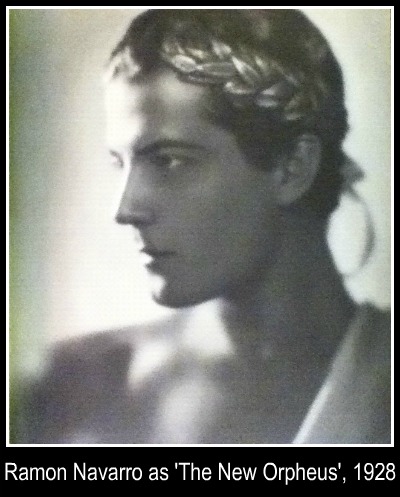
ramon novarro
Please note this caption contains a typo; the subject's name is spelled Novarro.


The distinctive "Hurrell style" was characterized by sensuality, what Vieira calls an "almost-scientific" clarity, and abstraction achieved through unique lighting and framing of his subjects. When Hurrell started in photography, portraits where based on paintings (logically enough) and were very stiff and posed. They were also typically in soft-focus: the popular photographic style at the time was pictorialism, also known as the fuzzy-wuzzy school. Although pictorialism was artistic, there were practical reasons for it as well, since negatives at the time weren't very light-sensitive. Photographing someone in soft-focus was much easier on both the subject and the photographer.

Hurrell changed the soft-focus, posed portrait, at least within Hollywood. Partly because of new film and lenses that made it possible to create very sharp images, partly due to his new lighting technique, and partly due to the retouching techniques he adapted for both. Of all three, the lighting was probably the most innovative: Hurrell designed a boom light (like a boom mic, except for lighting) that he could hold and use to highlight the subject from any angle.

Traditionally portrait photographers used three stationary lights to highlight the subject from the front, back, and to shine on the backdrop. Hurrell didn't bother lighting the background, used the boom light to highlight their hair, and then had a reflective surface or another boom light them from below. And because he could move the boom light anywhere he wanted, he could pose the stars wherever he wanted, including the floor (incidentally, photographs of actresses lying on the floor were called "oomph" shots--and if you want to get an idea of what Hurrell's sessions for an oomph shot were like, according to the studio publicity department anyway, all you need to do is watch this scene from Blow-Up).

Flexibility with lighting and more light-sensitive film also gave Hurrell the opportunity to abstract his pictures into patterns of light of dark. He refused to let the stars wear foundation make-up while photographing them because he wanted to sculpt their faces with highlights and shadows that make-up flattened out.

jean harlow

Vieira's descriptions of Hurrell's photographic technique are solid and well worth the read if you're interested in photography. Not surprisingly, though, I was left wanting in his analysis of the images. He only briefly touches upon the abstraction that Hurrell was aiming for, and doesn't go into too much depth in placing Hurrell within the broader context of American photography or fine art.

Vieira also argues in some places that Hurrell captured some of the inner emotions and true character of his subjects. But I think in this case he's being torn between admiration for Hurrell and trying to make him appealing given our culture's current obsession with verism. If Hurrell did happen to catch a star's inner character, then I suspect that it was totally by accident and incidental in any event. From the very beginning, what Hurrell was really gifted at was making fantasy seem like reality. When Ramon Novarro, Hurrell's first celebrity client, showed his series of photographs by Hurrell to his friends, one of them said, "This isn't you, Ramon." That was the point--Novarro wanted to move from silent films to opera because of he was afraid his accent would make him unappealing in 'talkies,' but how to convince people he'd believable as an opera star? The answer was to pose in various operatic roles and have Hurrell photograph him.

And it worked! When Novarro showed the photographs to a studio exec, he was immediately cast in a movie where he could sing four light-opera songs. Likewise, Norma Shearer, Hurrell's next celebrity client, was such a straight-arrow that her own husband didn't believe she could star as a vamp in The Divorcee, until Hurrell took a series of photographs of her in a silk kimono.

What Hurrell and the studio publicity departments fed the public wasn't reality--it wasn't anything close to reality. Take, for example, this photograph of Joan Crawford before and after retouching. Even taken with my crappy cell phone camera, you can see a dramatic difference in the two images. Before retouching, Crawford has wrinkles, sunspots, and freckles; after retouching, she looks not just twenty years younger, but probably better than she looked when she was twenty years younger! The Joan Crawford of Hurrell photographs never existed, and the images in his portraits are idealizations, not reality.

joan crawford retouched

In the opening paragraph of this book, Vieira wrote, "Hollywood aped our culture, fed our culture, and to certain extent was our culture." Considering that, one has to wonder if he's drunk a bit of the glamor koolaid. If he has, one can hardly blame him--everyone drank the koolaid, even the people who were actually living the reality! Hurrell himself said of pre-War Hollywood, "Those days were like a storybook.... We were the children of the gods." When Cecil Beaton visited Hollywood in 1930, he wrote, "Apollos and Venuses are everywhere. It is as if the whole race of gods had come to California. Walking along the sidewalks... I see classic oval faces that might have sat to Praxiteles. The girls are all bleached and painted with sunburn enamel." Ann Sheridan reflected, "There was a certain kind of fantasy, a certain imagination that is not accepted now. The world is too small."

I think Sheridan has the right of it: pre-War Hollywood was a time and place where the line between fantasy and reality was indistinct, maybe even non-existent, and the pictures--both still and moving--that were based on fantasy were so powerful they produced their own reality. It's said that a picture is worth a thousand words. That may not be true--in fact, photographs often need words in order to make sense--but I do know a picture, no matter how fabricated, is more memorable and convincing than any description in words. The stars of Hurrell's portraits were envisioned as eternally young, beautiful, and ready, and thus that's their enduring image.

Tuesday, September 20, 2011

Book Review: THE HURRELL STYLE, 50 YEARS OF PHOTOGRAPHING HOLLYWOOD by Whitney Stine

hurrell style cover

When George Hurrell came to California in the 1920's as an aspiring artist, his dream was to paint. Little did he know that his hobby of photography would quickly propel him into a career of photographing the world' most famous movie stars for Hollywood studios. From 1928 to 1978, Hurrell photographed for MGM, Paramount, Samuel Goldwyn, Twentieth Century-Fox, Warner Bros., and many other studios, capturing the likenesses of every actor from Ramon Navarro to Keith Carradine.

johnny weissmuller Johnny Weissmuller, photograph by George Hurrell, 1932

This is an odd book; it wasn't quite what I was expecting. It's more of memoir than a history, but it's organized by actor, chronologically, so there isn't really a narrative. I wouldn't say there's much of a focus, either; Stine gives us some background on the stars--especially the less familiar ones--and Hurrell tells stories about how he took the photographs, which may involve his technique or personal anecdotes about the stars themselves. I wouldn't say it's boring, because Hurrell's stories are really interesting; and although he is clearly recounting these incidents to Stine through a long series of interviews, you can tell he's quite the character.

tallulah bankhead Tallulah Bankhead, photograph by George Hurrell, 1936

To evoke different types of reactions in the actors, Hurrell would play music, dance around the studio while clicking away on his camera, or shout random phrases for no reason. Some of the stars he got to know really well and others he only met once, but his perceptive descriptions of their personalities is definitely of interest to anyone intrigued by movie history; and his descriptions of technique, such as how he framed the shots and developed some of the prints, is most certainly relevant for anyone who's serious about practicing, or likes to read about, photography.

anna may wong Anna May Wong, photograph by George Hurrell, 1938

That being said, the book as a whole just feels blah and is kind of tedious to read. For one, the organization of it into star-by-star essays makes reading it seem very repetitive. Here's this one actor Hurrell photographed, and here's this other actor, and here's this other famous actor. O-kaaay. For another, there is zero analysis in this entire book. I've read wikipedia entries with more insight than these essays. And it's a shame, because Hurrell's work wasn't just promotional pablum; some of the photographs in the book are freaking amazing. You can tell he's more interested in the abstract shapes of the shadows than making a portrait per se, and that's true to some extent of nearly all the really good photographs in this book. Unfortunately, the great stuff is watered down by a lot of Hurrell's more average work.

veronica lake Veronica Lake, photograph by George Hurrell, 1941

There's a lot to say about these photographs: how they played with the stars' image, issues of sexuality and exoticism, vanity; and the influence of Pictorialism, Japonisme, and abstraction in Hurrell's work. But you won't find any of that discussion here. I understand Stine is a film historian and not an art historian (I'm sure there's a HUGE difference), but even a half-assed attempt at addressing these topics would be better than nothing.

This book is a great resource if you're looking for basic information about Hurrell or classic Hollywood movie stars, but for something more in-depth I personally would search elsewhere.

Monday, August 15, 2011

Book Review: A YALE ALBUM: THE THIRD CENTURY by Richard Benson

yale album cover

As indicated by the title, this is a photographic history of Yale University from the nineteenth century through the 1990s.

To be honest, I wasn't expecting much from this book. I ordered it for a research project I was thinking of doing, but then lost interest in. I figured I might as well flip through it before I returned it to the library, and was surprised by the amount of great information and great photography that was contained in its pages!

For someone from Colorado, Yale seems pretty highfalutin. So you can imagine my surprise at seeing the nineteenth-century photographs of the university, which show practical, blocky buildings; tiny classrooms packed with cheap, very worn seats; and descriptions from undergrads stating they came to Yale expecting "an assemblage of Parthenons and cathedrals" and instead getting "rather dingy halls, [and] boxes...." Why, that sounds like the university I went to!

sterling law library under construction
Pictures of Sterling Law Buildings, Yale University, 1930-1960. Manuscripts and Archives, Yale University Library.

The architecture we now associate with Yale only came about in the twentieth century thanks to generous financial gifts and support from New Haven. This is the "New Yale," and includes iconic buildings like Sterling Memorial Library and Harkness Tower. The stone facades were artificially aged to look like they'd been standing since Yale's establishment in 1701 and hid the real architectural foundations, which consisted of twentieth-century-style steel construction.

The book isn't all about Yale's architecture, though; it's also about the "college experience" and how the university developed key aspects of its institutional character. There's an entire chapter on the arts, which is very interesting, and Paul Mellon looks super-nice and I want to give him a hug. There's also an entire chapter on the development of the library, which the book mentions frequently and definitely treats as the centerpiece of the school.

To be sure, this is a very pro-Yale narrative. Even the secret societies are painted as traditional and supportive rather than über-creepy (they still seem creepy, though--sorry, Benson); and unless you're specifically looking for it, you'll probably miss the fact that female undergraduates weren't accepted into the university until the '70s. The freaking nineteen-seventies!!!! Behind the times much, Yale? Although there is one picture of a black arts student and one or two of Asian students, I don't think anyone will be surprised that the portraits in this album are mostly of white males, despite the book's claim that, "the earlier conservative nature of the [university's] population had been transformed" in the 1960s. Yeahhh, still don't see Yale as a center of non-conformity, sorry. But going to Yale still looks like a total blast!

In spite of its one-sided nature, I think this book is great. It really does give one a sense of what going to Yale has been like through the last 100-ish years. The pictures are evocative of a privileged collegiate experience, and the descriptions are interesting and to the point. Overall this is a fascinating snapshot of one the US's greatest universities--minus most of the weirdness and snobbery that many might associate with it.

I definitely recommend this book if you have any interest in the subject.

Tuesday, July 26, 2011

Book Review: MAN RAY IN PARIS by Erin C. Garcia

man ray cover

Some people get all the luck, and no one's a better example of that maxim than Man Ray. An American painter, he hung out with 291 crowd and paid the bills with fashion photography. He met Marcel Duchamp in New York City after the Armory Show and the two quickly became besties. They couldn't talk, since Ray didn't speak French and I guess Duchamp refused to speak English (?); so they communicated through games like chess. Which quite frankly, is ADORKABLE. When Duchamp decided to return to Paris, Man Ray followed, and immediately found the perfect community of artists and intellectuals to hang with. Within a matter of weeks, he had his first gallery showing, was fluent in French, owned the perfect apartment and studio in Montparnasse, invented his own photographic process, and was flooded with commissions for photographic portraits and other projects.

rrose selavy
Rrose Selavy, Marcel Duchamp's feminine alter-ego. Photograph by Man Ray, 1921.

So basically Man Ray is pretty kick-ass and interesting. As for this book about him, well, it wasn't what I was expecting. I thought I would get a lot more out of it.

It's super-short and literally took me less than half an hour to read. For someone completely unfamiliar with Man Ray's work, this would be a good introduction, but for everyone else I think it's pretty sparse. It covers a very short biography of Ray, then dives right into his photographs, which are very interesting. But there isn't much information about them. And there's absolutely nothing about his interest in alchemy or how some of his photographs are homages to other paintings, or about the short films he made with the surrealists, or anything really.

It is cool to look at all the different processes Ray experimented with during his years in Paris, especially solarization and Rayographs. But really I think you could find a more informative book just about anywhere.

If you do want to check out Man Ray in Paris, I'd recommend getting it from the library.


I read this book as part of Paris In July, a challenge hosted by Book Bath and Thyme for Tea. Click on the button for more details.


Fun link of the day: l'Etoile de Mer, one of the many movies Man Ray directed in collaboration with the surrealists.

Wednesday, July 20, 2011

Book Review: GLAMOUR--WOMEN, HISTORY, FEMINISM by Carol Dyhouse

glamour cover

Say the word glamor, and immediately images spring to mind of Hollywood starlets in black and white photographs, wearing furs and gowns of silk and satin, with dark eyes and even more darkly painted lips. But glamour was a Scots word originally meaning magic; and the photographers and cinematographers of early Hollywood intuited the link between the magic of movies and the fashion and lifestyle of their stars so well, that eventually the two became inextricably linked in the American mind. Magazines like Glamor (US) started out selling sewing patterns based on the clothes seen in movies, and quickly moved to presenting the entire Hollywood lifestyle in its pages: fashion, cosmetics, hair, potions and lotions.

jean harlow
Jean Harlow. Photograph by George Hurrell.

As Dyhouse points out in this excellent book, glamor isn't always fashionable, and sometimes is quite unfashionable; but it and the start of beauty consumer culture are inextricably linked. For numerous reasons, but mostly thanks to old-timey Hollywood. Does this quest for beauty and glamor represent female empowerment, or the patriarchy of the male gaze? Are the women who actively participate in it laboring to achieve an unhealthy ideal of feminine perfection? Dyhouse addresses these complex questions through a study of glamor's visual and material culture from the early 1900s to the twenty-first century.

princess von furstenberg
Princess Ira von Furstenberg. Photograph by Cecil Beaton.

Although I focused on American glamor in the paragraph above, the majority of this book discusses British glamour. While both countries were influenced by Hollywood, in the UK glamour was regarded with more suspicion than in the US. The upper-classes had a long tradition of favoring reserve and conservatism in fashion, and the middle- and lower-classes likewise were partial to dressing with respectability and modesty (this explains so much about British fashion). Glamour was seen as lurid, the stuff of pin-up girls and pulpy romance magazines, and the complete opposite of English respectability--though luxurious and attractive, nonetheless. Think of the film Rebecca--British in all but its producer--and how the elusive title character is seen as a glamorous, ideal woman by the insecure and young protagonist. "I wish I were a woman of 36, dressed in black satin with a string of pearls!" she says at one point. But by the end of the film, Rebecca's glamor and beauty are revealed to contain only a heart of stone and the morals of an alley cat.

judy garland
Judy Garland. Photograph by George Hurrell.

In fact, it's surprising how unorthodox and non-conformist glamor's consistently been portrayed in the last century. In the '50s and '40s, it was associated with open--one might even say aggressive--sexuality; in the '60s, the decade of youth culture, it was seen as middle-aged; in the '80s, nostalgic. It's always been associated with beauty and fashion, but is much more abstract than either, and therefore can be more broadly applied. Whereas concepts of the former often exclude minorities and lead to "white washing," glamour tends to apply to women of all national and ethnic associations. It also seems to go hand-in-hand with feminism, although this is a problematic relationship--Dyhouse describes one Suffragette who wanted women to be less focused on their looks, but believed that in gaining legal and social autonomy they had become more so. There are also many modern feminist scholars who think glamor debases women.

marilyn monroe
Marilyn Monroe. Photograph by Cecil Beaton.

This study as a whole is really fascinating and well-written. Dyhouse takes a complex subject and analyzes it in a very clear, logical tone. Although it is super-repetitive, I didn't really get bored, possibly because the subject itself is so interesting and very pertinent to women today. How important should beauty and conforming to society's definition of an ideal woman be? This is something every woman must struggle with on a daily basis, as we grow up and as we get older. Dyhouse, however, concludes that whatever body or identity issues women have, glamor is not to blame. It is, first and foremost, about aspiration. Luxury, escape, and perfection can all exist within the enchantment of glamor, something many working-class women appreciate. It's all a temporary illusion, but an illusion that allows a woman to manipulate the world so that it sees her as she wants to be seen. In the end, glamor--even of the pedestrian cosmetic type--is still a kind of magic.

I highly recommend this book to anyone who is interested in the subject of 20th century visual culture or women's history! Thanks to Inbooks, Zed Books, and Three Pipe Problem for sending me a copy to review.


Musical Notes: "Which?" by Jeri Southern


Monday, June 20, 2011

Book Review: THE RUINS OF DETROIT by Yves Marchand and Romain Meffre


I have never been to Detroit, but of course there are things I associate with it--mainly Motown and cars. After reading this book, however, it will be difficult for me not hear the word Detroit and think of the crumbling ruins of capitalism and industrialization.

I first heard about this book from Natasha at 1330v. It's a photographic essay of a wide variety of abandoned buildings in the Detroit area in various stages of decay. Meffre and Marchand began photographing urban ruins in Paris, but with Detroit they hit a gold mine. This is more than just the few rotted-out buildings here and there that exist in every city; these are entire neighborhoods, abandoned as if the occupants just suddenly got up and left, with only the detritus of human existence--clothes, papers, books, toys--to acknowledge that these spaces were once occupied. It's like something straight out of I Am Legend.

ruins of detroit book cover
The abandoned Michigan Station serves as the cover for the book.

The book is more than just pictures, though, it's the history of Detroit from its beginnings as a French fur trapper rendezvous, to its peak as the machining capital of the US, and the decline that began with white families moving to the suburbs, essentially strangling the city center. In the 1980s businesses began to leave Detroit and the ruins of today took shape; but the ruins themselves aren't confined to the city center or businesses--they include the older neighborhoods and suburbs of Detroit, as well. The place where the industry for which Detroit became known, cars, began in Highland Park, where Ford started his first assembly line and Woodward Avenue became the very first paved mile. Today Highland Park is more a ghost town than not, with some houses literally taken over by trees, and no city services. The photographs of the Highland Park police station, completely abandoned, show the floors littered with files of murder victims and evidence of the man who killed them--some of the creepiest photographs in a book full of eerie and creepy shots. As Meffre and Marchand put it, "Everything began and everything seems to be ending in [Highland Park]."

The photographs themselves are, on one level, very beautiful--the framing and color is so intriguing, capturing the texture and romance of something that many would probably consider an eyesore. But there's also a sadness to them, especially coming in the wake of recent financial troubles all over the world. One can't help but finish this book and wonder, Is the American dream dead?

As someone who lives in Colorado, I've seen my share of ghost towns. But those are little mining shacks out in the middle of nowhere, relatively small boom towns completely stripped of clues as to what its inhabitants were like. Detroit is an entire city, with paved roads and beautiful architecture, that hosted a lot of big dreams, most of which (judging by these photos) have literally gone to seed. Residents of US are so rarely confronted with signs that civilizations don't last forever, but one can't help but consider as one reads through this book that this this what all our cities are going to come to eventually.

This is not a happy book. You will not feel optimistic about the future of America after reading it. But it is an excellent book, one that will stick with you, and one I highly recommend.

Note: I made the book trailer, above, for my own amusement.

Wednesday, April 28, 2010

Zola: Photographer, by Francois Emile Zola and Massin

zola photographer

ETA:  Emile Zola was a famous French writer in the latter half of the nineteenth century.  Although I'd heard of Zola (it's impossible not to when you study the time period, especially since he hung out with famous artists like Cezanne and Manet), I'd always avoided reading his books because they intimidated me.  But after picking up Nana earlier this month, I found myself fascinated by all things Zola, and checked out several books from library both by and about him.

This book, which is out of print, was a disappointment for me.  Considering the famous people Zola knew, I was expecting pictures of them (especially my boyfriend, Manet).  But most of the book is filled with photographs of Zola, his wife, and their children.  While these portraits were very candid and sweet, I'm not sure they're of much interest to the average person--i.e., myself.

There were a few interesting sections, however, especially photographs Zola took of the Crystal Palace and London (it's startling how different London looks from Paris in the photos), and scenes from the 1899 World's Fair in Paris, when the Eiffel Tower was erected. 

As for the text, there's not that much of it, and what is there isn't exactly gripping or illuminating.  Not that one reads these types of books for the text, mind, but more quotes by Zola himself and context for the photographs wouldn't have been remiss.

One of the weirdest photographs is of Manet's portrait of Zola.  Pictures of pictures always leave me with a sense of irony, but the fact that Zola would do it for some reason just strikes me as bizarre and a little wrong.  It feels oddly funereal to look at:

zola portrait

The death of painting?

And that is what I learned from this book.


Powered by ScribeFire.

LinkWithin

Related Posts Plugin for WordPress, Blogger...