Showing posts with label paula marantz cohen. Show all posts

Monday, September 6, 2010

What Alice Knew by Paula Marantz Cohen

alice cover

Immediately after I requested this book for review from Sourcebooks, I had a long pang of doubt--in my experience, novels that use Jack the Ripper in the plot are to be avoided.  However, I'm happy to say this book is an exception.

The unlikely hero of this tale is writer Henry James, who, along with his brother, William (a professor at Harvard and an early expert in psychology), and his sister, Alice, helps to investigate the Ripper murders.

This book is so much fun, mainly because of Henry.  One wouldn't expect someone like Henry James to be funny, but he really is--in a cute, bumbling sort of way.  Alice is another great character--she's smarter than both of her brilliant brothers (as she says at the end of Chapter 4, "I will review what you gather... and solve the case." There are a bunch of awesome one-liners in this book, btw), but remains largely bed-bound, viewing herself as an island of reason in an insane world.

Jack the Ripper has been done and re-done to death in books, movies, graphic novels--just about any format you can imagine.  In What Alice Knew, however, it doesn't even feel like the Jameses are investigating Jack the Ripper, because Cohen brings such a fresh spin to it.  And she uses the investigation to showcase numerous people and subjects: John Singer Sargent, Oscar Wilde, women's suffrage, photography, art (both academic and avant garde), social class, bigotry, religion, dinner parties, laudanum, theater, and just about anything else you can think of.  In fact, it reminded me of Drood in the way it seemed to submerge the reader completely in the world of the Victorians (except it's much better because it's about 500 pages shorter).

That being said, once the siblings' investigation got underway in earnest, the book ironically became a lot less interesting.  This was because the main suspect was so obvious, you knew he couldn't be the Ripper; but there really weren't any other leads to follow, which made the whole thing seem rather pointless.  The last one hundred pages seemed to drag by.  There were also two romances involving both Alice and William, respectively, which were absolutely delish in their Victorian subtlety and unspokeness; even though I enjoyed them, though, I think William's romance especially seemed like a tangent to the central plot of the book and slowed the narrative wayyyyy down. 

I also hated the ending.  While I can see, I think, where the author was going with it, it didn't feel supported by the rest of the book.  Cohen was trying to fit the ideas that you can never truly know another human being, all situations are about context, and did-they-catch-the-killer-or-didn't-they (?!??) into the last 10 pages of the book, and for me it really didn't work.

Overall, though, this was a very good novel--definitely one of the best Victorian-set historicals I've read in a long time, and the kind of book I would recommend unhesitatingly.  When I finished, I felt like the cloying atmosphere of Victorian London was physically clinging to me, and I do admit to still missing Henry.  If you're a nineteenth-century geek, you really, REALLY have to pick this one up!


Powered by ScribeFire.

Saturday, August 7, 2010

When Art Meets Life--and Murder

what alice knew cover

What Alice Knew by Paula Marantz Cohen "stars" Henry James and his two siblings, William and Alice, as the main characters.  It also prominently features their friend, John Singer Sargent, and several other artists and writers.  While reading the book I couldn't help but wonder which of the characters and paintings were real and which weren't.  This is just a small sampling of what I found.

henry james

Henry James (above) is obviously a real-life someone.  He and Sargent were great friends, but he had to have his portrait painted twice because the first one pleased neither the artist nor the subject.  I would love to get my eyes on that rejected work, but I have yet to find it.

I actually remember this painting from the first-ever art history course I took, although I didn't know it was of Henry James at the time.  The instructor used it as an example of Sargent's skill--to make the links in the watch chain, for example, he dipped half his brush in bright yellow paint, and the other half in a dark gold, then just painted the links--simple! 

I think this is a great portrait of James--you can see that he's always thinking and trying to be serious, but has an intrinsic humor; it looks like he's trying hard not to smile.  I kept picturing James like this in my mind while I was reading the book.

Alice James

I also really wanted to find a picture of Alice James, Henry's sister.  She spends most of her time in bed due to incapacitating headaches.  Unfortunately, I couldn't--but I did find a painting of William James' wife, who was also named Alice.  Doesn't she just look... yeah.  Poor woman.

Ellen Terry

The portrait above is of Ellen Terry, a famous dramatic actress in the Victorian era.  By painting her in the persona of Lady MacBeth, Sargent was following in the footsteps of famous eighteenth-century portraitists like Sir Joshua Reynolds.  The scene where Sargent paints this work is actually in What Alice Knew, and is so much fun!

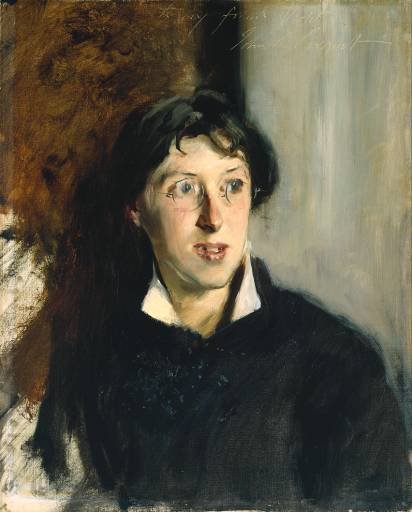
Vernon Lee

Another great scene in the book is the dinner party Henry and Alice throw to lure one of the murder suspects into questioning.  Among the other guests is famous actress Fanny Kemble, Constance Fenimore Cooper (whom I'm guessing is Constance Fenimore Woolson?), and Vernon Lee, whose portrait is seen here.  Her real name was Violet Paget, but, as the book put it, "had lately, in rebellion against her femininity, renamed herself Vernon Lee").  How cool is that?

Vernon Lee's portrait is actually one of my favorite Sargent portraits, just because you can practically see her personality, almost as if she's right there in front of you.  I also like it because Sargent painted it after he had sworn off portraiture, so you can tell it's a portrait of friendship and everything he likes about Vernon--who apparently was quite the irrepressible character.

daughters of edward darley boit

Another very interesting character in the book is Ella Abrams, the daughter of a prominent Jewish businessman.  I thought for sure she and her family were real historical figures, but so far I haven't been able to find them.  In the book she was painted several times by Sargent, as was her family.  I immediately thought of this work, The Daughters of Edward Darley Boit--probably just because it's one of his most famous pieces, but I also thought the familial atmosphere of the Abrams in the book and Boits in this work was very similar.

walter sickert

One person I did NOT expect to be a historical personage was Walter Sickert, mainly because he was the most obvious murder suspect in the book.  But, surprise, he was a real Victorian painter!  Here we see a photograph of him from 1911, around the time of the book's epilogue.  Does he look like a murderer to you?

jack the rippers bedroom

I was also surprised to find out the real Walter Sickert was tangentially involved in the Ripper murders--or so he believed--and that he's been accused of being the Ripper several times.  He claimed to have roomed with the Ripper briefly, based on some incidents related by his landlady, and painted a work he titled Jack the Ripper's Bedroom (pictured above).  Several writers have used this as a jumping-off point to argue he was the actual killer, including Patricia Cornwell, who supposedly bought up nearly all of his paintings and then destroyed them in the search for his DNA.  She denies this--although she does claim to have samples of Sickert's DNA, and that it matches samples found on the Ripper letters, soooo... how'd you get those samples, Cornwell?  Just sayin'.

camden town murder

More than likely, Sickert was simply a sensationalist capitalizing on the Ripper murders, just as he did with this painting, Camden Town Murders.  It was exhibited during a later period of London-based serial killings (c. 1911).  This work appears in the very last scene in What Alice Knew, along with the observation, "Perhaps Jack the Ripper is back."


What Alice Knew is an excellent book that's very well-researched and will submerge you completely into Victorian London.  It comes out September 7th--check back then for my review!


Powered by ScribeFire.

LinkWithin

Related Posts Plugin for WordPress, Blogger...