Sunday, July 22, 2012

TSS: It was like a movie

The Sunday Salon.com

Super-rambly and pointless post this Sunday: I've been thinking about reality versus art a lot this past week. What, really, is reality? This is something I wonder about a lot. How permeable is the line between ideas and actualization, and how do movies and books influence how we interact with the world, not just as individuals but as a society?

Last month we had devastating wildfires, and I remember the newscasters saying, "It's like watching a movie." Did they make this statement to separate themselves from what was really happening, because they couldn't believe what was in front of their eyes, or because of the voyeuristic experience of watching something happen on a screen? I think it was probably a combination of all three.

Just for the record, I am 100% in support of movies and books feeling "real," and the audience moving that story forward. That's the entire point of telling stories, isn't it? No one wants to make a movie where the audience leaves thinking it was completely unrealistic, or to write a novel where the characters stay firmly on the page. People want to be transported through art, and generally the success of a film or book depends on how much they can pull people into the story and make them feel a part of that of that world. But the important element is they reinterpret the original through their own experiences.

To be sure, there is an objective reality, and what we personally observe constitutes our immediate reality. Stories aren't "real," but the experience of becoming involved in them and the emotions of the characters can be. I think it's definitely a part of our reality--not necessarily the strongest or most important part, and definitely not the most stable. You can interpret events in a lot of different ways. The goal of life should be to look at it from as many viewpoints as possible, and art can help us do that.

Are people sometimes unable or unwilling to face reality? Yes, but I don't think art or stories have much to do with that; it has to do with the individual and their situation. Maybe they can't face a reality because they haven't seen something that opens their eyes to it yet.


How much do you think books or movies impact reality?

Tuesday, July 17, 2012

Book to Movie: IVANHOE


(Really a Mini-series)
Originally released: 1997
Directed by: Stuart Orme
Starring: Steven Waddington, Ciaràn Hinds, Susan Lynch, Christopher Lee
Based on: the novel of the same name by Sir Walter Scott

After spending about a month reading Ivanhoe (review at PGP), I really wanted to rewatch the 1997 miniseries starring Ciaràn Hinds as Sir Brian de Bois-Guilbert. Luckily, I had it on DVD!

If you haven't heard of the story before, Ivanhoe is about Wilfred of Ivanhoe, a knight who returns from the Crusades wanting to marry his true love and win the respect of his father.


ivanhoe and rowena

Ivanhoe has everything you could possibly want in a story about 12th-century Britain: jousting, Robin Hood, Prince John, Templar knights, Richard the Lionhearted. And the mini-series follows the novel pretty closely (at 5 hours, it should). But while there aren't any major plot differences, the miniseries creators did make some interesting choices in the way they altered the story.

  • Love Triangle--Who doesn't enjoy a love triangle? Probably just about everyone these days. In both the book and movie, Ivanhoe's true love since childhood is Rowena. In the novel, Rebecca (Jewish woman who's a doctor) develops a crush on Ivanhoe when they're imprisoned together and Ivanhoe is wounded, but it never goes farther than that, especially on Ivanhoe's end. In the miniseries, on the other hand, the writers give Ivanhoe and Rebecca a lot more scenes together and they definitely develop feelings for one another. Of course nothing can come from it, because Rebecca's Jewish. And even if she wasn't, Ivanhoe would honor his promise to wed Rowena because that's what he does. Ensue bitter-sweet ending.
  • Brian de Bois-Guilbert--Probably the biggest alterations between the miniseries the original story are points dealing with Brian de Bois-Guilbert, a Templar knight who's kind of a badass and kidnaps Rebecca. For some reason the miniseries creators decided to make him more of a villain, in that he betrays Richard the Lionhearted and lets Ivanhoe take the blame for it. SIR BRIAN WOULD NEVER DO THAT. For one, he values his honor as a knight more than anything. For two, if he did betray King Richard, he wouldn't lie about it. He'd be like, "Yeah, I made sure he landed in an Austrian prison. And I'll do the same to you if you don't stfu." As much as I love Ciaràn Hinds in this role, it seems like the script plus his performance really wiped out a lot of Sir Brian's personality. Hinds has two modes in this show: scowling while talking in a normal speaking voice, and shouting while stomping about. A lot of Bois-Guilbert's gentler and more honorable personality traits, meanwhile, were transferred to Maurice de Bracy--WHY I DON'T KNOW. I do like that Ivanhoe has to redeem his reputation and hide his identity because he's been wrongly accused of treason (which isn't in the book); I just think making Bois-Guilbert the person who betrayed the king is redic. Not that he isn't still awesome, of course.
  • A shout-out for the ladies--There aren't a lot of women in the novel Ivanhoe. Actually, there are two. I do have to give the miniseries creators some props for giving the female characters stronger roles, especially Rowena, who has an awesome scene in the first episode where she tells Brian de Bois-Guilbert off. However, making Rebecca more "modern" only made her more annoying and self-righteous (I wouldn't have thought that was possible); and while it was fun to see Eleanor of Aquitaine travel all the way to England to tell Richard and John off, 1. I don't think she would have done that and 2. I didn't see what the point of that scene was.
bois-guilbert and rebecca

Honestly, Ivanhoe is a pretty good miniseries--probably as good as 1995's Pride & Prejudice, although it seems a little dated now. But it's not as good as the book. And trust me, there were times when the book drove me CRAZY, and I'm so glad the filmmakers cut the crazy-making parts out. Still, even though the miniseries actually added a lot of plot to the story (because that's what Ivanhoe needs, more plot!), the book felt more complex because of the richness of the historical detail and the characterizations. The miniseries kind of feels like Ivanhoe Lite now.

Monday, July 16, 2012

Review: LE ROAD TRIP by Vivian Swift

le road trip cover

Are finances, family, or work preventing you from taking the vacation you so desperately need this summer? Then allow to me to humbly recommend this book.

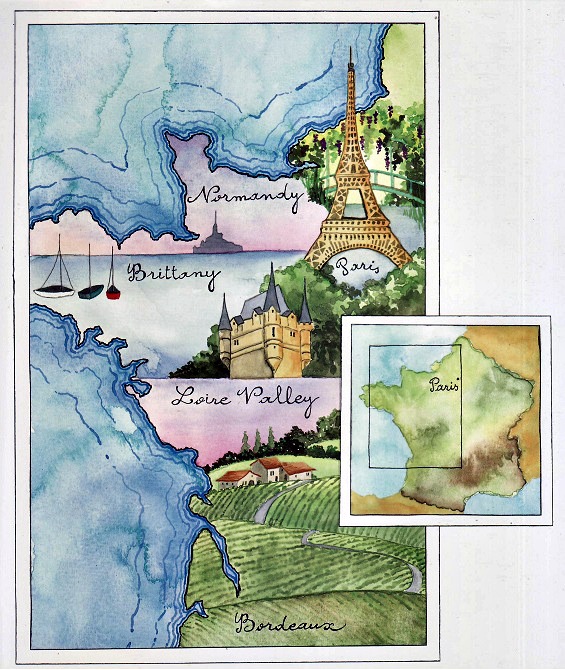
In 2005, Vivian Swift went on a honeymoon to France. Le Road Trip is a memoir-slash-sketchbook of her trip through Paris, Normandy, Brittany, Bordeaux, and the Loire Valley. I don't usually go for travel memoirs, but this one included illustrations, so I figured it was worth a try. Plus: France.

map of france from le road trip

Le Road Trip immediately won me over, before the book even started, with the fronticepiece where Swift warns, "This is not a book with a lot of really useful information in it... what--do I look like Rick Steves?" Swift states the purpose of Le Road Trip is to inspire people to plan their own adventure or remember previous trips, and in that the book succeeds completely. Swift's stories and illustrations brought back my own experiences traveling in France, and soothed the escapist fantasies I get some all a lot of the time. It really does feel like a travel sketch diary, and because of that, it seems as if you're in a conversation with the author.

For example, packing--I am a bit obsessed with the elusive perfectly packed suitcase, so I was immediately taken in by Swift's packing advice. We're both proponents of the single carry-on bag. I lived in Europe for a whole semester with clothes from a single carry-on. Not that I wasn't sick of my wardrobe before a week had passed, or that there were times when I was woefully unprepared for certain weather conditions, but the woes created by a small selection of clothes pale in comparison to the misery of jumping onto a midnight sleeper train with a suitcase the size of a small dresser and discovering you can't even get to your seat because the isles are packed full of stowaways and it will barely fit in front of the bathrooms at the end of the train, let alone in the hallway (yes, this happened to the woman I was traveling with. Never have I been so glad I packed a small bag. Also, never have I been so glad dogs like me, because the stowaways had a lot of them. Most hellish train ride ever!).

vineyards of bordeaux

Aside from the lovely watercolor illustrations, Swift's writing is fun and irreverent, interspersed with a few quotes and facts, but mainly focusing on her interactions with other people. I loved her "travel tips"--e.g., have a bottle of champagne waiting for you when you get home--and how she approaches travel. A lot of travel memoirs like this might draw pseudo-meaningful connections between travel and life, but Swift deliberately avoids this. She makes it clear she's on vacation as a tourist, trying to have fun and relax, and her experiences are ones nearly any tourist can relate to.

Not that there weren't some things that bothered me, of course. Swift does her fair share of perpetuating stereotypes--Parisians are more rude than New Yorkers? Color me doubtful on that one. And I have never heard of anyone having so much trouble with train station ticketers as she does. But when she isn't making sweeping generalizations about French people--and the incidents of that are pretty isolated--Le Road Trip is delightful and interesting, and gorgeous to look at. Definitely something I'd recommend for Francophiles or armchair travelers.

Sunday, July 15, 2012

TSS: Guilty Pleasures


Shumita at the beauty salon. Credit: Julie Moggan

The other night there was a documentary on PBS about "the deeper personal and social meanings of the [romance] genre's allure," with the unimaginative title of Guilty Pleasures. As much as the title gave me pause, I naturally got very excited--as I always do when books are discussed, but most especially romance novels. You'll probably be equally unsurprised at how annoyed I was at the documentary. Here are a few things that really struck me:
  1. Romance is a genre by, for, and about women. Yet the ONLY romance author featured in the entire documentary was a male. Now, said author (Roger Sanderson, writing under the pseudonym Gill Sanderson) seemed like a good guy and gave some sound advice about writing--other than the comment, "Women want to be told the same things over and over," which made me a trifle stabby--but in the only literary genre where women are both the primary consumers and producers, and damn proud of that fact, why would you choose to feature a male author? WHY WOULD YOU DO THAT? Because you don't really want to make a film about the romance industry at all? Gotcha.
  2. Moving on to the readers, the filmmakers once again made interesting choices in the subjects (or, as director Julie Moggen referred to them, "characters") they interviewed. Naturally, all the readers were women, and the world-wide appeal of romances was highlighted through a selection of women from the UK, India, and Japan. Despite their cultural differences, however, all these women seemed basically the same: they were all bored housewives. Or, if any of them did have jobs, they weren't featured doing them. They also had less than satisfactory love lives: Shumita, a rejected first wife, is dating a man-child more in love with his car than with her; Shirley is a housewife with a husband who's a manic-depressive bloke; and Hiroko is yet another housewife whose inadequate husband does not get her obsession with "ballroom dancing." Lonely, undersexed women of the world unite! Mommy porn, anyone?
  3. I know what you're totally not thinking right now and would never think: how do romance novels affect the men in their female readers' lives? Well, it's a good thing you don't give a rat's ass, because the filmmakers made sure to focus on that. Basically, the men-folk were left feeling isolated and mystified by their partners' interest in romances--even when they were more or less supportive of their partner's little hobby. In fact, I was a little perturbed by how the filmmakers implied the women's interest in romances--Hiroko in particular--was selfish and resulted in them neglecting their families. Hiroko's husband is the one shown parenting their children--even in the scenes where they're in the same room, Mr. Hiroko is playing with their kids while Hiroko herself ignores them. Other scenes show her watching dance videos on TV and lying on the couch reading, sans-offspring. Shirley is supposedly a mother as well, but I don't recall seeing any scenes of her with her kids. I do, however, remember her lying on a couch and eating bonbons.
  4. The filmmakers also implied the readers have trouble separating fantasy from reality (which I find ironic considering this entire documentary is a fantasy). Hiroko seems to conflate European (i.e., romance hero) looks with good dancing, is having an affair in her head with her dance instructor, and wants her husband to act out scenes from romance novels. Shirley is given kudos for not rejecting her hubby despite the fact that he's not perfect (like a romance hero), even though she had to think about it for a while.
  5. The male cover model--now I may be outlier here, but I really do not care about the models on the covers of romance novels. AT ALL. I try my best to ignore romance novel covers, and I don't see how the model is pertinent to this topic. Why not interview the paper supplier and the person who designed the book's font while you're at it?
  6. I did like how the conclusion of the documentary showed Hiroko's husband stepping up to the plate and learning how to ballroom dance so he could spend time with her, and Shirley's hubby going out of his way to make them a romantic dinner. That was really sweet. But notice it's the MEN going through a narrative evolution here, not the women.
Overall I found Guilty Pleasures to be an extremely lackluster and boring look at romance, because it relied on stereotyping and there was practically no research. I've seen better segments about romance novels on Nightline. NIGHTLINE--the show that cites The Daily Show with Jon Stewart as if it is a factual investigative source. Talk about having trouble separating fantasy from reality!

Guilty Pleasures did not reflect anything I personally know about the industry or the genre, such as the fact that people of both sexes read romance, and that romance readers come from all walks of life, careers, interests, education, religions, and so forth. A five-minute look at romance blogs should be able to tell you this much. But then Guilty Pleasures isn't really for romance readers; it's for suits who would never dream of picking up a romance. It wants to reinforce the stereotypes about romance readers, not shatter them, and chooses to treat the subject with sentimentality, not honesty. The final message seems to be, "Aren't romance lovers cute?"

At least they didn't refer to romance as porn--I suppose that's a step in the right direction?

Tuesday, July 10, 2012

Review: WAIT FOR WHAT WILL COME by Barbara Michaels

wait for what will come cover

Go to the western gate at set of sun
On Midsummer Eve, and wait for what will come.
Like most Americans, Carla Tregellas knows very little about her family's European roots--that is, until an unknown relative in Cornwall dies, leaving her an isolated and crumbling cliffside mansion. Carla knows she'll have to sell the property, but decides to visit before she does. Not a day into her arrival, she finds out the women of the Tregellas family are cursed--every 200 years, a demon rises from the sea to reclaim the soul of his ancient bride. And Carla just happens to be there on the 200th anniversary of the last Tregellas woman's disappearance. Dun dun dun! More importantly, there are a bunch of handsome and very available men hanging out in the village who are more than willing to show Carla the Cornish scenery. The list of available bachelors includes:
  • Alan: the Tregellas family solicitor, and the local catch. He drives a fancy car and is very handsome, but unfortunately is also a controlling chauvinist pig. Or as the heroine puts it, "masterful."
  • The Vicar: nice guy, is young for a vicar, and has an awesome house.
  • Simon: the village doctor and self-proclaimed expert on local folklore. Charming in a bumbling country doc sort of way.
  • Michael: (former?) ballet dancer and grandson of Carla's housekeeper, he's visiting for the summer to help out in the garden. Or so he says.
  • Tim O'Hara: a friend of Michael's, he's backpacking around Europe and taking advantage of few days weeks worth of free lodging.
It's been a while since I read Wait for What Will Come, which is one of my favorite books by Barbara Michaels. When I recommended it to Becky at One Literature Nut a few weeks ago, I suddenly realized that I really wanted to read it again. If you're looking for a great summer escape novel, you can't go wrong with Barbara Michaels; and you especially can't go wrong with this book, which transports you to an obscure little village in Pirates of Penzance country and introduces a young woman to a heritage that goes back to Ancient Rome. Literally, there is a Roman mosaic in her backyard.

I first read Wait for What Will Come when I was eight, and I've reread it so many times since then I'm not sure I can effectively review it for someone who picks it up for the first time. I have my favorite scenes and I basically just read those and skim the rest. But there were a lot of things that surprised me on this reread. For one, I found Carla to be extremely annoying--she's so smug about being practical and logical, and looks down her nose at anyone who believes in legends or stories. By the time I was about a quarter of the way into the book, I was pretty sick of her Holier-than-thou attitude, especially since all the other women in this book are treated as total neurotics who need medical attention. Also, the tricks played on Carla to scare her out of the house, which seemed very creepy to me as a kid, seem laughable now.

That being said, Wait for What Will Come is still very romantic--not in the boy-meets-girl kind of way, which is a pretty minor part of the book, but in the sense of Carla going to Cornwall and discovering her family's history and place in the world. As a kid growing up in the middle of Colorado, things like cromlechs (standing stone circles) and Roman ruins seemed impossibly exotic and fascinating. And they still do! It probably says a lot about this book that the food and history Carla encounters in Cornwall are the things I remember most from the story. The suspense may be a little flat, but as a romantic escapist novel, Wait for What Will Come definitely succeeds.

Monday, July 9, 2012

Movie Review: PERFECT SENSE


Originally released: 2011
Starring: Ewen McGregor, Eva Green
Directed by: David Mackenzie
Based on: the script by Kim Fupz Aakeson

It's the end of the world, but it's not happening in the way one would expect. Instead of fire and four horsemen, people are gradually losing their senses due to a strange and incurable disease. It starts with smell and burns through the other four senses from there. One of the people most effected by this epidemic is Michael, a chef at a fancy Glasgow restaurant. When he loses his sense of smell on the same night as Susan, a woman who lives across the alley from the restaurant, they form a bond. But will their relationship survive the loss of all their senses and the collapse of society?

perfect sense poster

I picked up Perfect Sense on a whim from the library. It was described as a "post-Apocalyptic love story," and if I expected anything it was for the film to be a little pretentious. But it had Ewen McGregor in it, so I decided to give it a try. I'm so glad I did! I have to say that I honestly loved this movie.

Ewen McGregor is adorable (when is he not?) as Michael, the nicest chef ever; and I loved the meet-cute scene between him and Susan and how their relationship developed over the course of the movie. The loss of her senses makes the normally prickly Susan vulnerable, and because of that she gives a nice guy like a Michael a chance she normally wouldn't. It was uber-romantic.

Even beyond that, though, I think this movie was so creative in how it reimagined "the end of the world." What does the world consist of but what you can see, hear, taste, touch, and smell? If you lose all of that, the world has effectively ceased to exist. To me Perfect Sense isn't just about what the world would be like without senses, but what the world would be like without art. No matter what, people need creativity: they need to be taken out of their own reality and transported into someone else's through art, and this is demonstrated strongly through Michael's job at the restaurant. When the movie starts, meals at the restaurant are about all the senses--texture, taste, smell, sound, and appearance. As people lose those senses, the restaurant simply relies more and more heavily on their remaining senses to fill in the gap of what they've lost. No matter what, they want to avoid what the restaurant owner calls "flour and fat," which is basically all people need in a diet in order to survive. But what they need to LIVE is beauty, music, creativity, and the connection with another human being that art provides. The sign that society has broken down completely is when people are shut away in their homes with nothing on TV but PSAs, as if there's nothing left to experience or share in the world.

Not that Perfect Sense is a perfect movie--there are segments full of stock footage that don't make any sense (Kim Jong Il, really? What does that have to do with anything?), and the whole "love is everything" message is a little heavy-handed. But I enjoyed the rest of the film so much that these flaws didn't really bother me. I thought Perfect Sense succeeded as both a romance and a very thoughtful and creative take a post-Apocalyptic story. If the premise sounds at all interesting to you, I highly recommend checking it out!

Sunday, July 8, 2012

TSS: Literary Heroes

The Sunday Salon.com

Guten Morgen, Sunday Saloners. I'm doing more of these posts lately, are you proud of me? You should be. It's finally July (I know we're a week in already, but to post this in the first week of July I would have had to write it in June, and I'm superstitious about celebrating that something's over before it actually is), and I think hope that the dog days of summer are finally past. It seemed like June would never end. My mom has a magnet that says, "Time flies whether you're having fun or not," and that might be true, but it certainly doesn't feel like it. What with wildfires, the absolute worst class I've ever had to teach in my entire life, and 14 straight days of 100+ degree temperatures, I'm just happy the month is over.

Today I want to talk about your first literary heroes. I'm not talking about the heroes of the books, but rather the people who write them. Right now I'm rereading Wait for What Will Come by Barbara Michaels, who was the first author I really glommed onto as a kid. My mom has tons of her books and I worked my way through them all during fifth and sixth grades. She's also the first author I wrote to. Basically, when I was a teenager, I aspired to be half as good a writer as Barbara Michaels.

But sometimes I wonder if my view of Barbara Michaels as The Greatest is really fair. For one, she basically wrote the same story over and over: young woman goes to a spooky old house, is threatened by mysterious people in a supernatural guise, falls in love with a mysterious man who might be a danger to her, and along the way learns about history. Of course, the stories vary from book to book, and to me--who loves reading genre fiction and seeing variations on a formula--this is what makes them interesting. I guess what concerns me is the idea that Michaels was selling out--rewriting the same book because she knew it would sell. On the one hand, they are good books; on the other hand, why so little variation? Two, she seems determined to under play the romantic element of her novels even though they ARE romantic novels and the romance is the only interesting thing going on! And three--is just me, or does every character have some connection to Sir John Smythe?

My point is on some level I know there are (probably) better writers out there, but because Michaels made such an impression on me as a kid, she set the standard for authors who are my literary heroes.

Who were some of your first literary heroes, and do you still think of them in same way?

LinkWithin

Related Posts Plugin for WordPress, Blogger...