Tuesday, July 31, 2012

Review: THE SUSPICIONS OF MR WHICHER by Kate Summerscale


On the morning of June 30th, 1860, a toddler named Savill Kent was discovered missing. Later that day, his body, throat slashed, was found on the grounds of the Kents' home. Suspicion pointed everywhere--including the parents--but the police were unable to discover who the murderer was. Enter Detective Inspector Jonathan Whicher, one of the stars of the newly formed Scotland Yard detectives division, who was assigned from London to close the case. Although Whicher believed he knew who killed Savill Kent, he was never able to prove it.

audiobook cover

The Suspicions of Mr. Whicher is a true crime book detailing a case from Victorian England that bears striking resemblances to the murder of Jonbenet Ramsey in our own time, including the media storm surrounding the investigation. I had a few problems with this book, and the major ones aren't really the book's fault. First of all, I listened to it audio. The reader, Simon Vance, did a great job of indicating imbedded quotes using accents and making the text interesting to listen to. But I don't read non-fiction books in the same way I read fiction books--I tend to read them back-to-front and out of order, so listening to a non-fiction book where I couldn't jump around from chapter to chapter at will was a little difficult for me. It also drove me CRAZY that I couldn't see citations (which I certainly hope Kate Summerscale included) or read footnotes.

Secondly, the subject. If anything else, The Suspicions of Mr. Whicher reminded me why I avoid true crime. Killing a toddler is some hardcore shit. For some reason I thought, since the murder was a really long time ago, it wouldn't be so bad; but trust me, it is. And if hearing every single detail about the death of a little kid doesn't depress you enough, Whicher's investigation will nicely send you over the edge. Summerscale invests a lot of time in making Whicher appealing--unfortunately, this case is what's called a career-ender, and it isn't likely to end happily or bring about justice for anyone. I suppose, being one of the first detectives to ever investigate a murder like this, Whicher didn't realize that; but still, it doesn't make for cheerful reading.

That being said, if you have any interest in the nineteenth century or Victorian detectives, you should consider picking up this book. There is a ton of delicious detail concerning Scotland Yard in the 1860s, what types of crimes they fought against, how they investigated, what a detective's work routine was like, and so on. Since I never got a look at Summerscale's footnotes or bibliography, I can't swear to the historical accuracy of The Suspicions of Mr. Whicher, but based on what I already know her research seems very solid and thorough.

That being said, some of her conclusions, particularly in regard to Whicher and his influence on Victorian literature, seem like a stretch. Summerscale draws connections between Whicher and detectives in novels by Wilkie Collins, Charles Dickens, and Arthur Conan Doyle. The Big Three of Victorian writers, no? While it seems likely Whicher might have provided some inspiration for some aspects of some of the detective characters in the authors' novels, the direct and pervasive influence Summerscale argues for in this book isn't backed up by solid evidence, in my opinion. Evidence of a solid and pervasive influence would include being close friends with the authors, meeting with them on a regular basis, and plot points in said authors' novels directly mirroring events in the detective's life--which IS the case with Eugène François Vidocq, the world's first private detective and several very popular writers in early 19th-century Paris (see my post about Vidocq at PGP). A random turn of phrase or investigative technique that was probably shared by all of Scotland Yard, on the other hand, isn't entirely convincing. One gets the feeling that if Summerscale would have logically been able to argue Whicher influenced Edgar Allan Poe's mysteries, she would have thrown him into the mix as well.

Meanwhile, her focus seems to be on the über-famous male writers of this era. I started reading Lady Audley's Secret by Mary Elizabeth Braddon around the same time I began The Suspicions of Mr. Whicher (completely by coincidence) and there are a lot of similarities between the Kent case and Lady Audley's Secret, as well--more direct similarities, it seems to me, than any novels by Dickens or Collins. Yet Summerscale only briefly addresses those parallels, I suspect merely because Braddon isn't as famous a writer as Dickens. Not to get all nitpicky or anything, but there are only 6 mentions of Braddon in the book, as compared to 46 mentions of Dickens and 24 mentions of Collins. Even Poe, who at the time of the Kent murder was long dead, receives over 20 mentions in the book. Based on these numbers, I think Summerscale's goal is to elevate the fame of Whicher, not truly investigate the Kent murder's influence on Victorian literature.

Other than that, however, I was impressed with the level of research in The Suspicions of Mr. Whicher. It's certainly not a book I would recommend to everyone--it is not history that reads like a detective novel. It's more of a true crime novel meets historical research. If you don't like true crime or those history books where there is massive infodump, you should probably not read it. But I did learn a lot and think it's a good resource and a fascinating case.

Sunday, July 29, 2012

TSS: Characters I'm Supposed to Hate but Actually Love

character collage


Hello, Sunday Saloners! I decided to go with something lighter this week, since I've been encountering a lot of characters in the past few weeks who are villains so awesome I kind of secretly root for them.

Do you have characters you know are loathsome but you still like them? Maybe the writer sets us up to sympathize with the devil, so to speak, or maybe there's just something about the character that you identify with. Either way, despite that fact that you know you're supposed to be rooting against the character because they do Bad Things, you find yourself disappointed when the story just kind of dumps in the dirt of Villain Hell and moves on.


  • Lady Audley from Lady Audley's Secret--Lady Audley is pretty evil. But I have to admit a part of me was kind of rooting for her. Can anyone really blame her for taking advantage of the men who treat her like a child? If it wasn't for one action--which I still don't quite believe--I would have been happy to see her get away with it all.
  • Brian de Bois-Guilbert from Ivanhoe--The book may be called Ivanhoe, but the character of Bois-Guilbert gets more page time and is more interesting than the hero. Despite the fact that Sir Brian participates in some questionable activity, he's really not a bad guy. His biggest mistake is falling for a woman who clearly isn't that into him.
  • Julian from The Forbidden Game trilogy by LJ Smith (also: every bad boy character from every LJ Smith novel)--I picked Julian because he was the character I was most flabbergasted didn't wind up with the heroine--whatever her name was--but this could really go for any bad boy in any LJ Smith novel. They're always more interesting than the do-gooder heroes.
  • George Wickham from Pride & Prejudice--Am I the only one who isn't convinced Wickham's that bad? Yes, I suppose by Mr. Highfalutin Darcy's standards he's super flighty, but maybe he just likes to have a good time and is misunderstood. I keep waiting and waiting for an Austen adaptation where Wickham's the hero and it never happens.
  • Bananach from Wicked Lovely--Bananach is the embodiment of war and discord, but practically speaking she's what the Beatles would call a mixer. She likes stirring things up. And that's what keeps the books interesting! Plus I think she's really funny.
  • Rumpelstiltskin from Once Upon a Time (yes, I know that's not a book, but it's a bookish character)--Rumple is the only person on this show who has any sense of humor. That's worth my loyalty right there. Plus he looks good in a suit.
And these are just the characters from the top of my head--I'm sure there are a lot more characters out there who are so bad they're good. What are some of your favorites?

Tuesday, July 24, 2012

A Star Flickers: COUNTRY STRONG and MY WEEK WITH MARILYN

I watched two movies last weekend that took on the similar subject of a fragile, aging female star. One was excellent, the other less so. Can you guess which one I preferred?

COUNTRY STRONG


Originally released: 2010
Starring: Tim McGraw, Gweneth Paltrow
Directed by: Shana Feste
Based on: the script by Shana Feste

A country singer named Kelly, who OF COURSE has alcohol problems, gets out of not-rehab to go on tour with her husband; the Luke Bryan wanna-be she's sleeping with, Beau, whose beard looks like it got chewed on by a squirrel; and the Taylor Swift wanna-be her husband is probably sleeping with, named Chiles (that's Chiles as in child, not Chiles as in chiles that you eat). Then not-Luke-Bryan and not-Taylor-Swift start sleeping together, but Kelly and her husband don't, because that would solve all the problems. Then everyone's like, "Fame! I'm gonna live forevaaar!" and the most ridiculous yet predictable things you can imagine happen.

beau
Is my fake beard in the right place? It keeps moving.

You know that movie about Johnny Cash, Walk the Line? That was a good movie. If you have the urge to watch Country Strong, I recommend skipping it and going straight to Walk the Line instead. I'm still wondering what Tim McGraw was doing in it and why he didn't say, "Hey, you know, not ALL country singers are major drinkers or think they can solve problems with their vaginas/penises." Or, "Most tours make more than three stops in the space of a month and it doesn't take THAT long to drive across Texas." Or, "Where the heck are they finding the time or the studios to make records while they're on tour?" Or, "What is my character's motivation, because it seems like I just do whatever will be most convenient for this ridiculous plot." Or, "You do realize I'm the only person with actual musical talent in this entire movie, yet also the only person NOT singing, right? Does that make any sense to you?"

Did I fast forward through all the songs and some of the conversations in Country Strong? Yes, I did, especially the duet between Beau and Chiles, because that song is not good enough to be heard three times in the space of an hour. I also couldn't help but notice that whenever Gweneth Paltrow sang, her voice was either really soft or drowned out by shouting fans.

ANYWAY. This movie was über cliched and unrealistic, except for the part where Kelly's husband makes it clear that she's not getting any younger and she's a failure because she can't pop out the babies. But instead of getting pissed off, Kelly's like, "You're right, life ends at forty." The end. What a great movie! /sarcasm


MY WEEK WITH MARILYN


Originally released: 2011
Starring: Michelle Williams, Eddie Redmayne, Kenneth Branagh, Dominic Cooper, Dougray Scott, Emma Watson
Directed by: Simon Curtis
Based on: The Prince, the Showgirl and Me and My Week with Marilyn by Colin Clark

I usually avoid movies about Marilyn Monroe because it seems like even in death she can't get away from being objectified. But I was bored, so I checked this one out from the library. I was really pleasantly surprised! My Week with Marilyn isn't just about Marilyn Monroe, it's a coming of age story story that captures the atmosphere of the British film industry in the '50s.

Colin Clark is the youngest in a family of overachievers, and somewhat of a disappointment. So at twenty-three he decides to "run away and join the circus"--i.e., get involved in movies. Through sheer doggedness he gets a job as the third assistant director on The Prince and the Showgirl, an absolutely horrible movie starring Laurence Olivier and Marilyn Monroe, and then becomes Olivier's assistant as well. Through the filming, Colin witnesses first-hand the glamor and troubles that surround Monroe, including her sycophantic acting coach, narcissistic hubby, and controlling manager. Even her driver gives her pills "to keep her quiet." Who knew a cooing blonde could be so troublesome? Eventually Colin and Monroe develop a relationship of sorts, and Colin tries to be her knight in shining armor. I really don't want to speculate on how much of a man Monroe actually makes out of him, but I'm going with "admired from afar" for the sake of my own ick factor.

I loved this movie! The performances were absolutely great. Kenneth Branagh, who played Olivier, and Dougray Scott, who played Arthur Miller, both seemed to be channeling their respective characters from beyond the grave (weirdly, Branagh as Olivier reminded me of a depressed Gilderoy Lockhart). I also thought the portrayal of Monroe was really nuanced and thoughtful. Yes, she is still pretty much objectified, but even with her status as a screen goddess, there is some sense of her as a real person who knows beauty doesn't last forever. Early on the film Vivienne Leigh tells Colin, "I'm forty-three, darling, no one's going to love me for very long," and that sense of insecurity when you believe looks is all you've got sets the tone for the entire film, especially Monroe's desire to be a Great Actress.

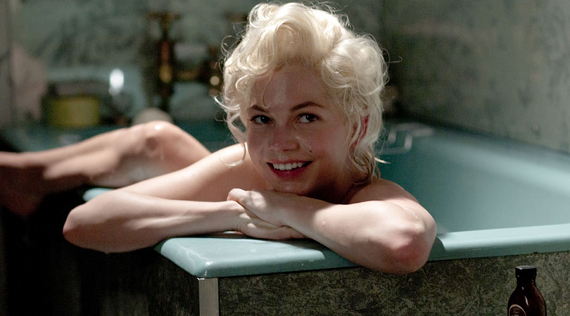
marilyn monroe in a bath
Let me just roll around naked in this tub with the door open. *giggle*

Monroe remains a mysterious figure, however--how much of her act was an act? Obviously she wasn't an idiot, but then why did she continue in a situation that made her miserable? Why did she surround herself with the people she did? Was she using Colin for her own ends? The movie leaves these questions open-ended and I think does a fab job of showing how no one knew the "real" Marilyn Monroe, possibly not even Marilyn Monroe herself.

My Week with Marilyn was a brilliant movie--entertaining, great performances, fascinating story, and it really makes you think. Definitely worth a rewatch!

Monday, July 23, 2012

Review: ENCHANTMENT by Thaisa Frank

enchantment cover

Thaisa Frank's Heidegger's Glasses was one of my favorite books of 2010 (review here), so I happily accepted Enchantment: New and Selected Stories for review, despite the fact that I usually avoid short story collections. If I had to compare the tone of Enchantment to something, I'd say it's similar to the HBO series Carnivàle (IMDb page): there's a strong sense of nostalgia, the wonderful and marvelous, dark humor, and just a hint of the supernatural.

The stories in Enchantment deal with themes like death, transformation, and trying to find meaning in life--which makes them sound a little stuffy, but they're really not pretentious at all (I am allergic to pretension, anyway). A few of my favorite stories were "The Cat Lover," "The Girl with Feet That Could See," about a circus that bloggers become obsessed with because it has actual magic; "Poland," and "The Dungeon Master's Mother," which is about a woman who turns herself into a dog after reading her son's D&D books. There are also some interconnected short stories in the second half of Enchantment that you could read as novellas.

My favorite, however, is the title story, which is about a woman who orders an enchanted prince from a catalog. His name is Lars, he's from England, and he comes with instructions like, "Mist me twice a day." I loved this story because it was fun, but at the same time you could read it in different ways. Since I watched Guilty Pleasures (post here) around the same time, I naturally thought of how Lars is like a hero in a romance novel, the kind of fantasy that can supposedly keep women from being good wives and mothers. And in fact the heroine of the story IS resisting marriage to her partner, a man who has completely given up on his ideals and now sells cell phones because it makes money. Not exactly Prince Charming material. Really, "Enchantment" is about the struggle between romanticism and enlightenment, idealism and practicality, and I love that it entertains while still making you think.

I really enjoy Thaisa Frank's writing and can't wait to read whatever she comes up with next! Thanks so much to Julia Drake PR for sending me a copy of Enchantment to review.

Giveaway

To win your own copy of Enchantment, fill out the form below or go here.

Guest Post and Giveaway: NURSING SECOND CHANCES by Maggie Greene

Maggie greene tour banner

Today Maggie Greene, author of Nursing Second Chances, is here writing about the appeal of small-town romance and offering a giveaway basket! Go to the end of the post for giveaway information.


Why I Love Small Town Romances


I admit to being a city girl. I might have grown up in middle-of-nowhere Wyoming, but my dream was always to get out. At eighteen, I moved to Seattle for college and never looked back. Since then, I’ve lived in a couple big cities and can’t dream of living somewhere small again.

I’ll tell you a secret though. I love small town romances. There is something about the dynamics of a small town that are perfect for love stories. There is always lots of gossip, plenty of strange characters and a few surprises.

The best part, to me, is that everyone thinks they know everyone in a small town. That’s why love should be difficult to find. If you’ve already met everyone, then who’s left? Then one day, they run across that person they’ve never met before. The one didn’t know was in town. Maybe they just moved there or maybe they’ve been there all along, but either way there is an instant attraction. The only thing the author has to do is sit back and allow things to run their course.

**Why do you love small town romances?**


Giveaway

All right, time for the fun part. I’m having a large giveaway as part of my blog tour. Comments on each of the stops will count as an entry in the contest. Winners will be drawn on August 1st and will receive a gift basket from me complete with some book swag, bath products, and honey. For more details (and chances to enter), you can visit my blog (http://www.authormaggiegreene.com). Please make sure you leave an email address.
(I.e., comment on this post for a chance to win. Winners will be chosen and contacted by the author, not myself.)

Sunday, July 22, 2012

TSS: It was like a movie

The Sunday Salon.com

Super-rambly and pointless post this Sunday: I've been thinking about reality versus art a lot this past week. What, really, is reality? This is something I wonder about a lot. How permeable is the line between ideas and actualization, and how do movies and books influence how we interact with the world, not just as individuals but as a society?

Last month we had devastating wildfires, and I remember the newscasters saying, "It's like watching a movie." Did they make this statement to separate themselves from what was really happening, because they couldn't believe what was in front of their eyes, or because of the voyeuristic experience of watching something happen on a screen? I think it was probably a combination of all three.

Just for the record, I am 100% in support of movies and books feeling "real," and the audience moving that story forward. That's the entire point of telling stories, isn't it? No one wants to make a movie where the audience leaves thinking it was completely unrealistic, or to write a novel where the characters stay firmly on the page. People want to be transported through art, and generally the success of a film or book depends on how much they can pull people into the story and make them feel a part of that of that world. But the important element is they reinterpret the original through their own experiences.

To be sure, there is an objective reality, and what we personally observe constitutes our immediate reality. Stories aren't "real," but the experience of becoming involved in them and the emotions of the characters can be. I think it's definitely a part of our reality--not necessarily the strongest or most important part, and definitely not the most stable. You can interpret events in a lot of different ways. The goal of life should be to look at it from as many viewpoints as possible, and art can help us do that.

Are people sometimes unable or unwilling to face reality? Yes, but I don't think art or stories have much to do with that; it has to do with the individual and their situation. Maybe they can't face a reality because they haven't seen something that opens their eyes to it yet.


How much do you think books or movies impact reality?

Tuesday, July 17, 2012

Book to Movie: IVANHOE


(Really a Mini-series)
Originally released: 1997
Directed by: Stuart Orme
Starring: Steven Waddington, Ciaràn Hinds, Susan Lynch, Christopher Lee
Based on: the novel of the same name by Sir Walter Scott

After spending about a month reading Ivanhoe (review at PGP), I really wanted to rewatch the 1997 miniseries starring Ciaràn Hinds as Sir Brian de Bois-Guilbert. Luckily, I had it on DVD!

If you haven't heard of the story before, Ivanhoe is about Wilfred of Ivanhoe, a knight who returns from the Crusades wanting to marry his true love and win the respect of his father.


ivanhoe and rowena

Ivanhoe has everything you could possibly want in a story about 12th-century Britain: jousting, Robin Hood, Prince John, Templar knights, Richard the Lionhearted. And the mini-series follows the novel pretty closely (at 5 hours, it should). But while there aren't any major plot differences, the miniseries creators did make some interesting choices in the way they altered the story.

  • Love Triangle--Who doesn't enjoy a love triangle? Probably just about everyone these days. In both the book and movie, Ivanhoe's true love since childhood is Rowena. In the novel, Rebecca (Jewish woman who's a doctor) develops a crush on Ivanhoe when they're imprisoned together and Ivanhoe is wounded, but it never goes farther than that, especially on Ivanhoe's end. In the miniseries, on the other hand, the writers give Ivanhoe and Rebecca a lot more scenes together and they definitely develop feelings for one another. Of course nothing can come from it, because Rebecca's Jewish. And even if she wasn't, Ivanhoe would honor his promise to wed Rowena because that's what he does. Ensue bitter-sweet ending.
  • Brian de Bois-Guilbert--Probably the biggest alterations between the miniseries the original story are points dealing with Brian de Bois-Guilbert, a Templar knight who's kind of a badass and kidnaps Rebecca. For some reason the miniseries creators decided to make him more of a villain, in that he betrays Richard the Lionhearted and lets Ivanhoe take the blame for it. SIR BRIAN WOULD NEVER DO THAT. For one, he values his honor as a knight more than anything. For two, if he did betray King Richard, he wouldn't lie about it. He'd be like, "Yeah, I made sure he landed in an Austrian prison. And I'll do the same to you if you don't stfu." As much as I love Ciaràn Hinds in this role, it seems like the script plus his performance really wiped out a lot of Sir Brian's personality. Hinds has two modes in this show: scowling while talking in a normal speaking voice, and shouting while stomping about. A lot of Bois-Guilbert's gentler and more honorable personality traits, meanwhile, were transferred to Maurice de Bracy--WHY I DON'T KNOW. I do like that Ivanhoe has to redeem his reputation and hide his identity because he's been wrongly accused of treason (which isn't in the book); I just think making Bois-Guilbert the person who betrayed the king is redic. Not that he isn't still awesome, of course.
  • A shout-out for the ladies--There aren't a lot of women in the novel Ivanhoe. Actually, there are two. I do have to give the miniseries creators some props for giving the female characters stronger roles, especially Rowena, who has an awesome scene in the first episode where she tells Brian de Bois-Guilbert off. However, making Rebecca more "modern" only made her more annoying and self-righteous (I wouldn't have thought that was possible); and while it was fun to see Eleanor of Aquitaine travel all the way to England to tell Richard and John off, 1. I don't think she would have done that and 2. I didn't see what the point of that scene was.
bois-guilbert and rebecca

Honestly, Ivanhoe is a pretty good miniseries--probably as good as 1995's Pride & Prejudice, although it seems a little dated now. But it's not as good as the book. And trust me, there were times when the book drove me CRAZY, and I'm so glad the filmmakers cut the crazy-making parts out. Still, even though the miniseries actually added a lot of plot to the story (because that's what Ivanhoe needs, more plot!), the book felt more complex because of the richness of the historical detail and the characterizations. The miniseries kind of feels like Ivanhoe Lite now.

LinkWithin

Related Posts Plugin for WordPress, Blogger...