Showing posts with label brian selznick. Show all posts

Thursday, November 5, 2015

Review: THE MARVELS by Brian Selznick

the marvels

Who are the Marvels? I'm glad you asked. The Marvels are a family of actors, ruling over the Royal Theater in London across generations, until one them decides he doesn't like acting. Did he and his family survive the burning of the famous theater? Meanwhile, in the 1990s, a young boy named Joseph runs away from school to the home of his uncle, who lives in a mysterious house frozen in time. How are the Marvels and Joseph's uncle connected? With the help of an odd new friend named Frankie, Joseph aims to find out before his uncle sends him back to boarding school.

I loved Wonderstruck and The Invention of Hugo Cabret, so when The Marvels came out I was pretty durned excited. As always, Selznick combines art and story in The Marvels in a way that's not-quite graphic novel, nor quite illustrated text. However, unlike in his previous two books, I didn't feel like the art was well integrated with the secondary narrative (or at all, really), and the story was kinda boring.

The first half of The Marvels is really a GIGAAAAAAANNNNNNNNTIC, image-only prologue about the family the Marvels: who their founder was (a lone 18th-century shipwreck survivor named Billy) and their looong history with the theater. Y'all know how I feel about prologues, especially prologues disguising themselves as actual beginnings of a book, but this part of the book didn't annoy me *because* it was a prologue.

No, what annoyed me was the complete lack of anything resembling a story or character development. The art was fantastic, of course (Selznick can really tell a story through images; he should take up film directing), but it was basically like a giant book of begats. You know, the part of the Bible where it's all like, "This guy married this woman and begat so and so, he begat so and so, and then he begat another blah blah blah, and blah blah blah married what's-her-face and begat yada yada," and it goes on and on and on. The first half of The Marvels was really exactly like that: Billy Marvel adopted whomever (I forgot his name, something theatrical), and he married an actress and they had a baby, then that baby grew up and slept with some woman, and they had a baby, then THAT baby, miracle of miracles, also got married and had a baby, and I'm like:

bored
(Except not actually, because unlike Mrs. Hudson my parents are very strict about in-home firearm discharge.)


The second half of the book is pretty much all text, like a regular book, and has an actual plot. So, plus side! At first it's also a pretty good story: there are Questions, like what happened to Joseph's friend at boarding school, who is this weird kid running around chasing after a dog constantly, and why does his uncle live in a house that looks like the Victorian family it really belongs to just stepped out of a holiday party to go caroling?

Yes, these are intriguing questions. If only the answers to them were half as interesting. If I was a middle-grade reader the case might have been different, but as it was I found myself pretty bored and skimming to get to the end. There is a twist, but I felt like it made the book lamer rather twisty and interesting.

The Marvels isn't awful, but compared to Selznick's other novels it felt uninspired and rushed. I don't know why he didn't break up all those damn begats, but he should have; that would have helped a lot. Or, you know, just write a novel using words! That would have worked too. Either way, I think this book misses the mark.


Discus this post with me on Twitter, FaceBook, Google+ or in the comments below.

Tuesday, January 17, 2012

Book Review: WONDERSTRUCK by Brian Selznick

wonderstruck cover

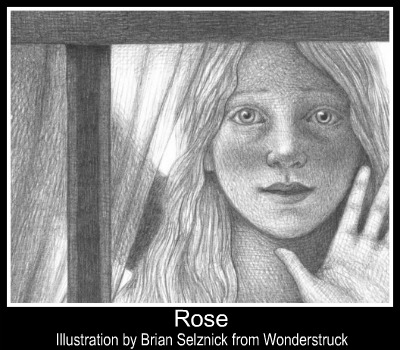
After reading The Invention of Hugo Cabret, was there any question of me picking up Brian Selznick's next book? Not really. Wonderstruck has very similar elements to Hugo Cabret: once again there's an orphan boy alone in a city, looking for answers about his father, and receiving help from another child. But in this case the setting is the American Museum of Natural History in 1977, not a 1930's Paris train station. Juxtaposed against Ben's story is that of Rose, a girl in 1927 New Jersey who runs away to New York City. Her story is told mostly in pictures.

rose

Wonderstruck isn't as charming and doesn't have the same fantastical feel as Hugo Cabret, possibly because the setting is much more modern and closer to home (at least for this American reader). But I also think the way Selznick tells this particular story is grittier and more grounded in reality than Hugo Cabret was. We're more directly confronted with the death of Ben's mother than we were with that of Hugo's father, and the tools and clues Ben uses to reconnect with his father's past are much more practical. That's not to say I didn't enjoy Wonderstruck, but the tone is definitely different. While we can imagine Hugo and Isabelle cavorting among the stars in the bright lights of Paris, these characters remain firmly in the gutter, so to speak.

wolves

I loved the opening sequence of this book simply because it highlights what is so great about Selznick's novels: the illustrations aren't afterthoughts or superfluous, they really are an essential part of the book. In this case the illustrations at the beginning did a great job of pulling me right into the story, which I finished in about two hours. Selznick keeps you reading by switching between Rose's and Ben's story at the just the right moments so you want to find out what happens next, but not so often that you start to feel whiplashed.

One of the themes in Wonderstruck is that of collections and how they tell a story about the person who owns them. They're called mini-museums, and collectors are amateur curators. Ben owns a box filled with "treasures" that he carries with him and that reveals stories about his past. That made think about my own collections--to be honest I don't collect that much. I don't like spending money on things with no practical purpose; plus I never saw the point of gathering things that are just going to collect dust. The one notable exception is images--I "collect" images of St. George and the Dragon, for example, not by actually buying them (unless it's a postcard), but by writing down where I saw it and/or taking a photograph of it. It also seems like most of the trips I take develop image themes. The image theme for my trip to Washington DC, for instance, was boats. I suppose in a sense I am curating an museum of images in my mind, although I thought of it like that before.

In any case, I think this novel will inspire readers (adult readers, anyway) to look at their collections in different ways, and I do think it's a good book that's worth reading. I definitely wasn't disappointed.


Thursday, June 2, 2011

Book Review: THE INVENTION OF HUGO CABRET by Brian Selznick

hugo cabret cover

Hugo Cabret is an orphan living by his wits in a train station in 1930s Paris. His most prized possession is a mostly-broken automaton, which he believes carries a secret message from his father. All he has to do is fix the machine and he will know what to do next. When he starts stealing repair parts from a toy shop, however, Hugo unknowingly sets in motion a revelation of secrets for the toy shop owner and his family.

I first heard about this book from Sandy at You've Gotta Read This, and immediately knew that, yes, I did have to read it. It's like a graphic novel in that it's told with both words and pictures, but this isn't set up as a comic--it's proto-cinematic, the pages surrounded by black as if you're sitting in a theater, and includes not only illustrations, but film stills and photographs. The introduction states, "I want you to picture yourself sitting in the darkness, like the beginning of a movie," and the book is kind of like reading a movie--which sounds very awkward, but totally works.

The story is absolutely charming and sweet, but also intense. In a lot of ways it reminded me of Amelie. It's all about magic and dreams, but in this case the magic comes to the characters through movies and machines such as clocks and wind-up toys. At one point Hugo says machines are always made for a specific purpose, which is why broken machines make him sad--they represent unfulfilled potential. Similarly, unseen movies created by the machine of the camera have lost their purpose to entertain and transport people to another world.

I really liked the inclusion of Georges Méliès into the book, too, mainly because I already knew a little bit about him from a class I took on Cinema and Painting. In film studies, Méliès is kind of a Big Deal. According to Natasha Staller (another Natasha, yay!), Picasso was influenced by Méliès when he created his first Cubist paintings. There was also an exhibit all about Cubism's relationship to early cinema at the Pace Wildenstein Gallery in 2007. If you check out this interview Charlie Rose conducted with the curators and skip to the 19 minute mark, you can get a quick tour of the exhibit and see some clips from Méliès' movies.

This is a great book I highly recommend, especially if you love movies. Even though it doesn't take a long time to read, it has a lot of heart and a tiny, perfect little twist at the end. Loved it!


, ,


Powered by ScribeFire.

LinkWithin

Related Posts Plugin for WordPress, Blogger...