Showing posts with label guest review. Show all posts

Monday, August 24, 2015

Review: BANQUET OF LIES by Michelle Diener

banquet of lies

Guest review by Anachronist of Portable Pieces of Thought.

Synopsis (from Goodreads):

A Secret Treaty and a Secret Life
LONDON, 1812: Giselle Barrington is living a double life, juggling the duties of chef with those of spy catcher. She must identify her father’s savage killer before the shadowy man finds her and uncovers the explosive political document her father entrusted to her safekeeping.
Posing as a French cook in the home of Lord Aldridge, Giselle is surrounded by unlikely allies and vicious enemies. In the streets where she once walked freely among polite society, she now hides in plain sight, learning the hard lessons of class distinction and negotiating the delicate balance between servant and master.
Lord Aldridge’s insatiable curiosity about his mysterious new chef blurs the line between civic duty and outright desire. Carefully watching Giselle’s every move, he undertakes a mission to figure out who she really is—and, in the process, plunges her straight into the heart of danger when her only hope for survival is to remain invisible.

My impressions:

I might surprise you with this statement but historical romances written by Michelle Diener have several serious assets. Firstly, as far as I know, every one of them is based around a Regency historical event, be it the assassination of the British Prime Minister, a French plot to bleed British gold out of the country or, as it was this time, a secret change of alliances between Russia and France in the middle of the Napoleonic wars. As a result (and secondly) the characters have something more to do than to attend parties, woo the people they fancy and defeat their romantic rivals. In my humble opinion it makes the reading far more enjoyable.

I also appreciate the fact that Diener’s romantic heroines are usually independent, intelligent women who usually have a set of interesting skills apart from just being pretty. In the case of Gigi, the female lead of Banquet of Lies, it was her cooking skills, especially when it comes to gourmet French cuisine. I admit I warmed up to her from the first chapter and I wasn’t surprised Lord Aldridge, her male love interest, was so taken with her instantly. Insta-cooking-love is far more palatable than any other kind of infatuation and the girl in question could cook and bake like an angel (or rather like a three-star Michelin chef) – who wouldn’t love to have such a wife/husband/partner?

Let me also say that the lack of any explicit sex scenes actually improved my reading experience: mainly because I wasn’t ‘treated’ by different artificially ‘historical’ terms describing male and female sexual organs *shudders*; I also found it closer to the beginning of the 19th century’s standards.

Still there were problems which decreased my reading pleasure.

It grated a bit that, despite well-rounded characterizations I appreciated and enjoyed so much, all main characters were just obnoxiously handsome and/OR pretty (I bet you can be handsome and pretty at the same time, right?). I am really sick and tired with a message most of romantic fiction books try to convey: esthetics means EVERYTHING; if you are nice to look at you’ll be loved, happy and successful. Alternatively you might be an illegitimate daughter of a whore, with the whole street of potential candidates for fatherhood, or a thieving son of a gangster but, as long as you look nice people will give you second, third or even fourth chance. SO. NOT. TRUE.

nope gif


My other issue concerned the way these Regency lords and ladies thought and behaved in this one. It was so strange to find out all of them had a quite modern mindset, not influenced by religion or any other prejudices so typical for those times. It reminded me of the fact that in Persuasion by Jane Austen, a Regency novel written actually in Regency times by a Regency author, it was a quite important issue for Anne Elliot, the main heroine, that her cousin who courted her for some time dared travel on Sunday and didn’t attend church. Well, in Ms. Diener’s Regency novels virtually nobody attends church or thinks about religion at all – go figure.

look at your life look at your choices gif


What's more? Here is a quite juicy tidbit: after Giselle Barrington's diplomat father is murdered at the beginning of the story, Giselle, a young girl, travels from Sweden to England with all her bags and whatnots completely unattended. Mind you nobody seems to care or notice that a respectable miss goes on such a long distance trip without a chaperone, a maid or a male relative in tow. What's even stranger, none of the super-duper kick-ass-and-kill-on-the-spot spymasters in this book has ever heard of ship manifests, let alone checked one to find out whether the girl actually left the countr. Hmmm...let me quote here Mr. Eastwood who expresses my feelings the best:

get off my lawn gif


Oh, and as I've already started to complain: I would love to learn more about Mr Edgars who had such a potential (underdeveloped unfortunately) that he could have overshadowed both bland Aldridge and the rest of secondary characters...

The cover: somehow bland. Show me your face, pretty lady, and then show me your cooking, not just your tits...ehem, bosom...

Final verdict:

Despite its shortcomings one of better historical romance novels I’ve stumbled across. If you like Regency England, secret plots, secret services and no-nonsense heroines you might want to try this one.


Discus this post with me on Twitter, FaceBook, Google+ or in the comments below.

Monday, April 27, 2015

Movie Review: THE IMITATION GAME


Originally released: 2014
Starring: Benedict Cumberbatch, Keira Knightley, Matthew Goode
Directed by: Morten Tyldum
Based on: (loosely) Alan Turing: The Enigma by Andrew Hodges

Guest review by Anachronist from Portable Pieces of Thought!

the imitation game


Synopsis:

Based on the real life story of legendary cryptanalyst Alan Turing, the film portrays the nail-biting race against time to break the code of Enigma.

During the winter of 1952, British authorities entered the home of mathematician, cryptanalyst and war hero Alan Turing (Benedict Cumberbatch) to investigate a reported burglary. They instead ended up arresting Turing himself on charges of 'gross indecency', an accusation that would lead to his devastating conviction for the criminal offense of homosexuality - little did officials know, they were actually incriminating the pioneer of modern-day computing. Famously leading a motley group of scholars, linguists, chess champions and intelligence officers, he was credited with cracking the so-called unbreakable codes of Germany's World War II Enigma machine.

My impressions:

It is one of these movies which seem to be aimed at ignorant people – the less you know about the historical Bletchley Park and breaking the code of the German encryption machine the more you will enjoy it. Some might call it easy entertainment I call it a dumbed-down, run-of-the-mill hogwash, at least when it comes to the historicity.

I grant it – the director had several good ideas. One of them was showing how in times of war ordinary people were forced to play God, deciding whether others should live or die. What is better: to doom the whole nation or the crews of several ships? How to measure the value of life? Few psychopaths enjoyed that insane power but the majority of ‘normal’ people, caught in it, were left scarred and disgusted by themselves permanently because the answer to such a dilemma is never clear or easy.

mark strong
Mark Strong enjoying a doorframe.


Another highlight was the fate of Alan Turing, played brilliantly by Cumberbatch - it proved again that if you know how to count, count on yourself only, your country won’t move a finger unless they need you very badly. What else? Mark Strong, playing the all-powerful MI6 director leaned against door frames in a very compelling manner. Oh, and I must add that children-actors in the flashbacks to Turing’s boarding school years (Alex Lawther and Jack Bannon) were wonderful. Now I can return back to carping and let me assure you, I hardly know where to start.

keira knightly


Should I bash the director for casting Keira Knightley, a lady whose facial expressions remind me strongly of Tom Marvolo Riddle a.k.a Lord Voldemort, the main baddie from Harry Potter books? As long as she doesn’t smile she looks lovely but when she smiles she sneers, there is no kinder word for it. Anyway she made Joan Clarke look shallow and vapid. Or maybe I should focus on the fact that this movie, set in a place where the majority of employees, about 75% or more, were women still somehow failed to pass the famous Bechdel test? When the movie Joan Clarke finally talks to one of her female colleagues in a pub they talk of course about men *rolleye*. Serious matters are just for their male counterparts. You see? Spoiled for choice, that’s what I am.

turing's cohorts


Turing's one-dimensional cohort of cryptographers was a compilation of cliches without one interesting feature (you get the cocky, handsome one, the nerdy, antisocial one, the intelligent, delusional Russian spy etc, etc). The screenwriter’s decision to employ a time-shifting structure contributed heavily to the film's been-there-done-that atmosphere, while the inclusion of needless obstacles within the narrative's back half served little purpose other than to pad out the already a bit overlong running time.

bletchly park codebreakers
Photo of actual codebreakers working at Bletchley Park.


Now the main lead. Turing was a brilliant mathematician, a crucial figure in the theorization and engineering of digital computing; and the biggest brain in Bletchley Park’s Hut #8, the unit in Britain’s World War II intelligence hub that succeeded in breaking the German’s Enigma code, thus shortening the war by as much as two years, give or take, and saving as many as twenty-million lives, perhaps more. Still the movie shows not enough of his thinking and reasoning, it focuses on his quarrels and romance with Clarke. Overall I felt the movie sentimentalized and simplified Turing, who, as far as I know, sometimes wished he was a machine and probably preferred the company of his digital creatures to any of his many lovers, whether casual or serious. That there is no sign of any of these lovers in the film is another failing – there are just empty accusations and an unbelievable confession, heard by a deus-ex-machina police detective (Rory Kinnear). How could the director dumbed down Turing so much? Had his character really told the detective what he did at Bletchley, he would have been guilty of a crime far more serious than homosexuality. He would have committed high treason for violating the Official Secrets Act. It was still a hanging offense.

In 1952 Turing was convicted of engaging in homosexual acts, for which he was sentenced to chemical castration (the option he preferred to two years in prison). As a result not only were his brain and body messed up by high dosages of estrogen, he also was barred from the government funding he needed to continue his life’s work on artificial intelligence. His death, just a few days before his forty-second birthday, from arsenic poisoning was most likely a suicide although possibly an accident or even an assassination. Instead of exploring the mystery of that tragic event the director decided to show a pointless, stunted investigation which led nowhere and a pair of cops whose role was to emphasize British prejudices.

Final verdict:

As much as I wanted to suspend my disbelief and take pleasure in the actors’ brilliance, I found The Imitation Game lacking credibility on every level. The historical accuracy was nowhere to be seen and the big emotional revelations at the story's conclusion fell completely flat. Pity.


Discus this post with me on Twitter, FaceBook, Google+ or in the comments below.

Thursday, February 13, 2014

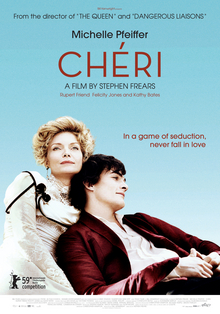
Movie Review: CHERI


Originally released: 2009
Starring: Michelle Pfeiffer and Rupert Friend
Directed by: Stephen Frears
Based on: The novel of the same name by the inimitable Colette.

Review by the lovely Bridget of Portable Pieces of Thoughts.

Synopsis:

France, the beginning of 20th century, just before the WWI. Lea de Lonval (Michelle Pfeiffer) is a beautiful but ageing Parisian courtesan, currently without court. She doesn't complain. As she’s been very successful and quite business-savvy, she managed to put a lot of money aside. Now she is financially independent, able to live like an aristocrat; still she is almost completely friendless. Small wonder, a prostitute, rich or poor, doesn’t really belong anywhere. Lea feels she is condemned to a company of her colleagues and former colleagues – not exactly friends, rather uneasy allies, like inmates. One of them, Charlotte Peloux (Kathy Bates) a one-time competitor and shameful gossip, has a young son, Fred nicknamed Chéri (“darling” in French). Charlotte and Lea have known each other for years as their careers have been very similar; that’s why Lea was constantly in the life of Chéri, being even his godmother. One day, Madame Peloux comes to her and asks her to take in the boy as a lover and teach him about life.

Chéri is far from being a virgin, but it is obvious he needs some reining in or he’ll turn into a blasé addict or worse. He also has to know how to treat a woman. Lea agrees to be his tutor without much reluctance – the boy is handsome enough to tempt even a courtesan. Despite the age disparity Cheri accepts Lea’s saddle quite willingly. What begins as simple lovemaking, no strings attached, quickly becomes a six-year long love affair. Lea and Chéri float in a perfumed world of opulent comfort, with the older woman paying all the bills so her darling boy has no worries in the world. Still the clock is ticking. How will it end? Not well – you might bet on it.

cheri movie poster

My impressions:

I wanted to see that movie so much and, even if I know it is not wise, I expected a real feast. How not to? Stephen Frears reteams with his Dangerous Liaisons (1988) screenwriter Christopher Hampton and supporting actress Michelle Pfeiffer for an adaptation of two novels from Colette, the famed French author I adore for her intelligence and sense of humour. What’s more, it’s a Belle Epoque drama set in Paris. Was I left disappointed? Not really but the movie was hardly brilliant.

The movie is based on two novels Chéri and La Fin de Cheri written by Colette, known for the air of describing familiar lives with detached regret and a good dose of humour. Her books seemed to reflect well the real-life experience of the author herself. After leaving an unfaithful first husband, Colette, already a successful novelist, supported herself also as a music hall performer because being a writer was never quite a profitable job. That’s how she knew many courtesans in the era of La Belle Epoque , being sometimes close to them. She had affairs with both men and women, shocked tout le monde with the first onstage kiss between two women like any demimondaine worth her salt. Then she married the editor of Le Matin and was divorced at 51 after she had an affair with his 20-year-old stepson. I bet she wrote Chéri as a kind of therapy - a confession and an explanation. In those times an older woman taking a younger lover was not unheard-of but much frowned upon. Enough about Colette and her problems, let’s asses the film itself.

In short I could say the success of Stephen Frears’ "Chéri" begins and ends with its casting. Near the beginning of Colette’s novel Lea gives her young lover a necklace with 49 pearls. We can imagine there is one pearl for every year of her age. Michelle Pfeiffer, as Lea de Lonval, is still a great beauty, but nearing that age when a woman starts counting her pearls if she is fortunate enough to have them. Her lover is 24 years younger than she. Six years pass and, in a way, the whole movie is about how 25 and 49 are not the same as 31 and 55, especially if a woman is the older part of that inequality Lea is much more intelligent than her friends and also tragically self-aware: while enjoying afternoon tea with some former colleagues, which tends to be an amusing, banter-filled affair, she shudders with revulsion at the sight of a portly woman of about her own age — although less well preserved — clutching what looks to be a teenager to her décolletage. It is obvious she doesn’t wish a similar fate but she can hardly fight her own heart.

cheri film still


Rupert Friend, playing Lea’s lover, the title Chéri, is 27 and looks younger. They are both accomplished actors, which is important, because "Chéri" tells a story of nuance and insinuation, concealed feelings and hidden fears. If you look for action, well, look elsewhere - it is not a rollercoaster movie. Kathy Bates as Charlotte, the robust mother of Cheri, delivers a performance that's almost exaggerated, but her spark and jibes are much needed and appreciated throughout – without them the movie would turn into a boring melodrama.

Lea knows sooner and Chéri later that what they had was invaluable and irreplaceable. Cheri is about learning to love and accepting one's age and the consequences of both once realization truly sinks in. However, I couldn't help but feel like the story was simply going through the motions, never really surprising me or moving me one way or another. I would have thought Frears would play up the romantic angle a little more, especially considering we are talking about the city of lights here.

Of course the point of the film is not necessarily about the romance between the two leads per se, but giving the audience a stronger emotional connection to the two of them would have only made the final minutes that much more effective, not to mention the rest of the movie on a whole. I also caught myself wishing to see more of the Belle Epoque settings. Lea’s residence was nice, but it was really strange that I never saw her go out and enjoy herself; I understand she wasn’t invited to private balls and official functions but what prevented her from going, for example, to a theater or an opera or even a cafe de nuit? When I come to think about it she never even went shopping. I suppose it was influenced by the budgetary limits and costs of preparing appropriate sets and it is a pity - in my opinion the movie would be better, more interesting to watch, if it included some of those scenes, as expensive as they go.

Final verdict:

Overall, Cheri is a perfectly enjoyable film, but one you probably won't take much away from or lose much sleep over discussing. Still I don't regret watching it - what does remain is an overall sense of beauty, both in the film and the face of Michelle Pfeiffer, a woman seemingly shot, at times, without a trace of makeup and still looking at least 10 years her younger. I kept thinking the director was definitely kinder to Lea than her creator, Colette – in her books the heartbroken prostitute aged with less grace, getting soon overweight and ugly to a point that, in the end, her beloved Cheri didn’t recognize her anymore.


Discus this post with Bridget on Twitter or in the comments below.

Sunday, April 21, 2013

Movie Review: COMPLIANCE


Originally released: 2012
Starring: Ann Dowd, Dreama Walker, and Pat Healy
Directed by: Craig Zobel
Based on: the strip-search prank scam in Mount Washington, Kentucky


Review by the lovely Bridget of Books as Portable Pieces of Thoughts

Synopsis:

A very busy fast food joint, somewhere in one of the unnamed towns of the USA. The manager, a middle-aged woman called Sandra, is having a really bad day: due to a screw-up by her underlings, almost $1,500 worth of bacon has been ruined, and she is now conscious of needing some extra effort to please her bosses. All of a sudden she gets a call from a cool, authoritative man who identifies himself as Officer Daniels; he claims one of her employees, a pretty twenty-something blonde called Becky working on the till, has stolen some money from a customer's bag.

Very distressed and very busy, Sandra more or less meekly comply with every request of that man, although they are just talking on the phone. Afer all he wants her to avoid the worst - an unnecessary delay and scandal, tarnishing the reputation of the whole joint and herself as an efficient manager. First she search Becky's bag, then she strip-searches the girl and keeps her almost naked in the back office, under the 'surveillance' of several men. Becky is to be isolated and effectively imprisoned and helpless until the squad car arrives. The results of Sandra's decisions are disastrous. Soon most of the staff are involved in demeaning, humiliating and compromising activities. How will it end?

compliance film still

My impressions:

This chilling film, written and directed by Craig Zobel, is based closely on the true story of a serial phone-prankster sociopath in the US who, for a decade, got away with a bizarre repeated hoax. His daring escalated and in 2004 he brought off his masterstroke of insidious evil. The con trick was a very sadistic demonstration of the weakness and suggestibility of human nature, more devastating than anything in the well-known Stanford and Milgram experiments (testing individuals' response to authority in the 60s of 20th century) because real lives were wrecked.

From different optical illusions like Escher’s impossible labyrinths to unsolicited emails from rich and generous African officials who offer us a fortune for a very small favour, common sense has us hard-wired to reject the implausible. We should be able to do it in our best interest. Unfortunately sometimes we fail. Believe me, it is a movie which will drive a cruel punch to your gut far more effectively than any thriller or slasher because it will make you ask yourself: what would I do in such a situation? It is a cold, hard, shrewd film: satire with a drop of cyanide. The set and decorations match that : filth and grease set the scene for human sliminess.


That doesn't look good.

What Compliance shows, however, is how very important it is that "Officer Daniels" targets a fast food chain. A fast food joint is a place to lower your guard as well as your standards. Here is where the real degradation can flourish because a chain is always conscious of a menacing corporate authority somewhere above them: branch managers, regional managers, people who might only reveal themselves as a voice on the phone. Obedience and badly suppressed fear are the order of the day, especially on the unthinkable subject of hurting your milking cow, a customer. Relinquishing your free will and simply going with the flow is part of the process for all concerned. So when some brazen authority figure on the phone knocks everyone with some new situation, submitting is the natural way to react. Your inner voice might nag you, suggesting that something is very wrong and yet at any time, in any period, when people supposedly in authority tell us what to do – more often than not we do it. Without thinking about the consequences. Without thinking at all.

One weakness of this low-budget film is that the characters — though realistically acted — are a bit too shallow and generic. It’s also a mistake, in my opinion, to keep cutting away to the prankster but without showing his inner self. I WANTED to know what made him tick and my questions weren't answered - not really. I also have to say it seemed to me that Zobel didn’t sell the idea, just the outrage: The more indignities and violations Becky endured at the hands of people who were supposed to be her friends and co-workers, the more it felt like a hollow provocation. As things went from bad to horrible, I got the urge to walk into that back room where Becky was being interrogated and start yelling, “What’s wrong with you people? Are you a bunch of puppets? Switch on your brains! Take a moment and call somebody, like the actual freaking police!”

Final verdict:

A competently crafted film, telling a very chilly story - undoubtedly one of the toughest sits of the movie year 2012. Still sometimes it is good to be reminded how we are programmed to do things that go against our natural instincts as long as we believe we have the law on our side.


Discus this post with Bridget on Twitter or in the comments below.

Saturday, October 13, 2012

Guest Review: REFLECTED IN YOU by Sylvia Day

reflected in you cover

I have a surprise for you all today: I received, unsolicited, Reflected In You from Penguin UK, and could tell immediately from the cover it was a Fifty Shades of Grey cash-in novel. Since we all know how I feel about Fifty Shades (review here), I didn't have much interest in Reflected In You. However, my mom enjoyed Fifty Shades, so I asked her if she wanted to read this book, and then if she wouldn't mind writing a review of it for my blog. She agreed, yay!


Christina's review of Reflected In You by Sylvia Day:

Having read all 3 of the Fifty Shades books, I started reading the 2nd book from Sylvia Day, Reflected in You. I enjoyed the Fifty Shades series quite a bit. The female protagonist was at least her own person. In Sylvia Day’s rendition, the female is whiny and annoying. Plus, the male lead is absent most of the 2nd book. Altho Sylvia Day is an astute writer, her series is whiny and annoying. Who would want to listen to all that angst??? And why can’t all the writers submitting their own renditions of E L James’ 50 Shades come up with their own story line?????


There you have it! Thank you to my lovely mom for reviewing this book for me. :)


Thursday, December 15, 2011

Guest Review II

romance month button

Hello, everyone! Just a heads up that Violet Crush has a post about Lisa Kleypas' Hathaway series up in honor of Romance Month. Check it out!

Monday, December 12, 2011

Guest Review: PERSUADE ME by Juliet Archer

persuade me cover

Today we have a guest review from blogger and author Margay Leah Justice. The novel, Persuade Me, is an adaptation of Jane Austen's Persuasion and sounds quite excellent. Welcome, Margay!


I consider myself a romantic at heart. I like to watch romantic comedies, I get sappy at Happily Ever Afters, and I re-read tried and true romances to remind myself that they do exist – if only in the pages of beloved books. So it’s no surprise that I have a special affinity for Jane Austen. I love her stories, her affinity for recording the foibles of humans who dance the dance of love – and the idiosyncrasies of all the secondary players who make the heroes and heroines what they are. My one problem with Miss Austen is that she didn’t write enough stories! I feel like her main six are just a teaser – but oh, what a tease! So, to fill in the empty spaces left behind by what could have been had she written more, I like to read adaptations of her stories.

In my quest to get more of Jane Austen and the wonderful characters and worlds she created, I read just about every adaptation I can get my hands on. Some have been good, some not so much. But there’s a rare few that take my breath away and make me want to read them again. One of those stories is Persuade Me by Juliet Archer.

Persuade Me is a modern retelling of Persuasion and it has just enough quirks to make it original. The main characters, Anna and Rick, met and fell in love in France, but she, on the advice of an old family friend, broke it off, convinced it was a poor match, and then was whisked back to England by a father who can hardly bear the sight of her. Flash forward some years later and Anna has developed into a self-assured woman with a degree in Russian Literature and Rick is a marine biologist living in Australian who is making a splash in the world of literature having written a book with a somewhat provocative title. During his book tour – which inevitably leads him back to England – Rick crosses paths with Anna once again and the adventure begins.

I have to admit that Persuasion is one of my favorite Austen stories, so I was excited to read an adaptation of it. I don’t think it receives the attention Pride and Prejudice does, but it deserves it. This is such a classic story of lost love and second chances, ripe with likable characters and despicable ones and it translates well to modern times. In Ms. Archer’s hands, the story shines, taking on its own relevance and leading the reader by the hand through the story to the inevitable conclusion in such a way that, if one hadn’t read – or was even aware of – the original piece, it wouldn’t matter. They would still be enthralled by this story. Indeed after reading it, one might be encouraged to read the original to see how it compares.

I must admit that, sometimes, I’m hesitant to read adaptations because I’m afraid they won’t measure up to the original, but Persuade Me does not disappoint. It hits all the key points – the love story between Anna and Rick, the influence of the family friend, the despicable natures of Anna’s father and older sister, and the clingy, whiney nature of her younger sister – in the original, but does it in a way that makes it seem fresh. The idea of Rick being a biologist and writer rather than a captain is a stroke of genius. Anna being more self-reliant and not so much under the thumb of her family is a welcome relief. The book tour is a brilliant way to get all of the other key elements together and make it the author’s own. I had so much fun reading this book, I can’t wait to read it again. But first, I want to check out the first book in the Darcy and Friends series, The Importance of Being Emma.

Final verdict: Extremely enjoyable and I would recommend it to any Austen fan and anyone who just loves a darn good story.

A little more about it (from the author’s website):

Boy meets girl, falls in love and asks her to sail round the world with him. Girl loves boy - but listens to The Voice of Reason, an old family friend, and says no…

The words ‘forgive and forget’ are not in Rick Wentworth’s vocabulary. The word ‘regret’ is definitely in Anna Elliot’s.

When they meet again ten years later, he seems indifferent and intent on finding happiness elsewhere. Can she convince him that their lost love is worth a second chance?

Persuade Me, JA’s modern version of Persuasion, will be available in September 2011. In the meantime, you can read the prologue and first chapter here or feast your eyes on a certain Captain Wentworth.

JA says: Just as I felt Knightley needed updating for a 21st-century audience  in The Importance of Being Emma, I’ve given Anne Elliot similar treatment in Persuade Me. My Anna leads her own life and is financially independent of her father, although there’s enough baggage between them to fill an airport carousel! I’d love to know what you think of the extract - email me at juliet@julietarcher.com.

Thank you, Margay! That sounds like a great book.
Margay Leah Justice is the author of
Sloane Wolf, available at museituppublishing.com. You can also find her on FaceBook, Moonlight, Lace and Mayhem, Twitter, MySpace, and the Jane Austen Society Pages.


Wednesday, December 7, 2011

Guest Review!


Hello, everyone! Maria from A Passion for Books & Real Life is doing a review of Omega Mine by Aline Hunter today as part of Romance Month. Please stop by her blog and check it out!

LinkWithin

Related Posts Plugin for WordPress, Blogger...