Showing posts with label peter menzel. Show all posts

Friday, January 13, 2012

Weekend Cooking Review: WHAT I EAT by Peter Menzel and Faith D'Aluisio

what i eat cover

Several months ago, when I reviewed What the World Eats by Menzel and D'Aluisio, Amanda Gignac suggested I try out What I Eat: Around the World in 80 Diets by the same authors. Although it contains similar content--photographs of what people eat from around the world--Amanda was totally right when she said that What I Eat is a lot better than What the World Eats. It has better photographs, essays, and doesn't have as many generalizations or preachy moments.

In What the World Eats, Peter Menzel and Faith D'Aluisio photographed families from around the world with a week's worth of food, focusing on how much each family spent. Although it was an interesting idea, the format invited large generalizations. By comparison, What I Eat focuses on individuals and what they eat during the course of one day. This is much better, because it connects food more specifically to a person's lifestyle rather than their nationality. A trucker, for example, logically gets most of his/her food from gas stations and fast food restaurants and needs something that can be eaten one-handed; a German biermeister is obviously going to drink a lot of beer!
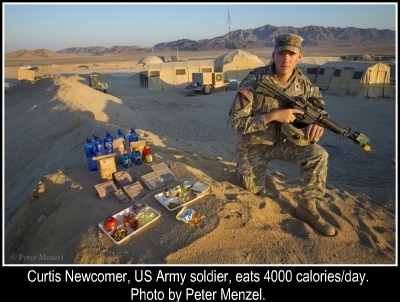
curtis newcomer

The book is organized by how many calories each person eats in a day. I really had no idea what the average calorie intake for an individual was before I started reading this book, but it seems like most people eat between 2200 and 3000 calories per day. Below 2000 calories is mostly athletes who need to be light (my aunt, a competitive rower, once told me she limited herself to 1200 calories a day during racing season--now I know just how low that is!), extreme dieters, workaholics who don't have time to eat, or people living in poverty. Even the fashion model Menzel and D'Aluisio photographed, Mariel Booth, eats 2400 calories a day. One might think that at the other end of the spectrum--people who eat 4000 calories or more per day--there would also be athletes who need energy. But actually, this group is almost entirely made up of men who work outdoors, particularly cold outdoors--with the notable exception of an English housewife who binge eats at 12,000+ calories.

If there's one thing I've learned from this book, though, it's that how many calories you eat doesn't necessarily have a lot to do with how much you weigh, despite what we hear on television. Viahondjera Musutua from Namibia eats about 1500 calories a day and weighs 160 pounds, while João Agustinho Cardoso from Brazil eats more than three times as much--5200 calories a day--yet weighs twenty pounds less! How many calories a dish has and how much food you're actually getting through it also seems to vary wildly: even though extreme dieters Rick Bumgardener and Mackenzie Wolfson eat less than 2000 calories a day, there seems to be a lot more food in their calories than there is in Chinese student Chen Zhen's 2600.
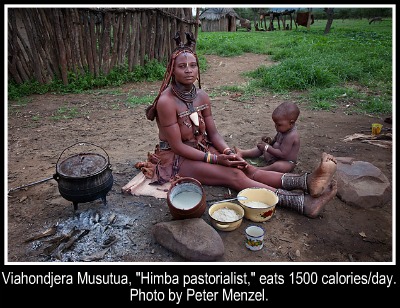
Viahondjera Musutua

Part of the reason, as explained in Bijal P. Trivedi's excellent essay "The Agony and the Ecstasy of the Calorie," is that all calories are not created equal. When calories were "discovered" by Wilbur Olin Atwater in the 19th century, he was basically looking for a way to measure the amount of energy a person can get from food. But each calorie is made up of different values and behaves differently depending on what you do to it (processing, cooking, etc.), so what exactly goes into a "calorie" and how it will affect your body can be extremely variable.

There are several good essays in this book, which helps to mitigate the preachy tone I didn't like in What the World the Eats and elevates What I Eat to a more serious study of how humans relate to food. Trivedi's essay and Michael Pollan's "The End of Cooking," where he talks about the irony of America's obsession with foodie television and the fact that less and less people are cooking for themselves, were my two personal favorites.

Overall I found this to be a book worth tracking down and think it should definitely be of interest to anyone who likes reading about food. It would also be a great resource if you're planning a trip to any of these countries and want to find out what a typical meal might be.


Weekend Cooking is open to anyone who has any kind of food-related post to share: Book (novel, nonfiction) reviews, cookbook reviews, movie reviews, recipes, random thoughts, gadgets, fabulous quotations, photographs. If your post is even vaguely foodie, feel free to grab the button and link up over the weekend.

Saturday, October 15, 2011

Weekend Cooking: WHAT THE WORLD EATS by Faith D'Aluisio and Peter Menzel

world eats cover

If there's a book just asking to be made into the PBS version of No Reservations, it's this one. Peter Menzel and Faith D'Aluisio go around the world and take photos of families with a typical week's worth of food, comparing diets, prices, and a bit about the food culture of the country.

Any foodie worth their salt is interested in what other cultures consider staple foods, so this book is really fascinating, just as I expected it to be when I read Natasha's review of it at 1330v. I was surprised at what parts I found most interesting, however. The variation in what a family spends on food in a single week, for example, can be really mind-boggling. One family in Bhutan feeds 13 people with a little over $5 USD a week; a family of four in France, meanwhile, spends close to $420 USD a week on food! Of course, the French shopping trip included things like wine, cheese, croissants, sausage, and other things I personally wouldn't want to do without. Big spenders on food also have a lot more variety in what they eat. And if there's one thing I've learned from this book, it's that meat is a big expense. Nearly a fourth of the French family's budget was spent on meat, while the Bhutan family only ever ate eggs and a small amount of dried fish for protein. In fact, almost all of the big-budget weekly meals devoted the majority of their money to meat.

I also loved the addition of the family members' favorite foods, just because something like that is always so personal and random. People tend to go either really broad ("everything") or really specific ("spaghetti carbonara"). Unfortunately, we don't get that information for every family, so that was a bit disappointing. The recipes were another odd addition, as the probability of me making something with ingredients I've even heard of, let alone can find, is pretty small.

On an ideological level, I had some issues. This book can get very preachy and the authors definitely have a point of view, one in which McDonald's and processed food is evol. No, I don't eat at McD's; and yes, I am one of those people that's all about fresh and seasonal food, but that's partly because my family is German and I was raised that way.

There's a reason processing and preservatives exist--because eating McDonald's is better than starving. Since the start of civilization, the fight against starvation has been one that requires a way to preserve food for a long time, and nowadays we're pretty good at it. Maybe it's not as healthy as eating everything fresh, but unless we're all going back to being hunter-gatherers (and I can tell you right now I'm not), that's reality. The authors rightly point out that there's a cruelly ironic dichotomy between the fight against obesity in the US and the fight against the hunger that exists in other parts of the world; but they seem more concerned with the former when one would think the latter is more important.

There's also a colonial tone of romanticizing the "primitive life" of non-Western cultures here, an "Oh, look how we're destroying the simple lives and eating habits of these people with our wickedly advanced grocery stores and fast food restaurants" message that I found to be annoying. And if Menzel and D'Aluisio think that this book doesn't invite generalizations (as they say in the introduction), they're deluding themselves; it's titled WHAT THE WORLD EATS, not What a Select Group of People Eats. Overall, though, I think this book is worth at least paging through if you're interested in food and culture. It contains a lot of good information, and the photographs are very interesting (Menzel and D'Aluisio should consider designing supermarket window displays). Plus this book inspired me to compose my own mini-photographic essay! Here is what I eat in a day:

Name: Tasha (31)
Favorite food: Miso soup


Breakfast:
IMG_0008
I'm not a big breakfast person and usually just have coffee with cream and peanut butter toast.

Lunch:
IMG_0009
Not a big lunch person, either. Today it was chicken enchiladas with what I have to say were some pretty sub-standard tortillas and Spanish rice.

Snacks!
IMG_0010
I ate three chocolate chip cookies. Munch munch munch.

Dinner:
IMG_0011
Dinner's my big meal. This chicken piccata with noodles and asparagus tips looks really unappetizing, but it tasted all right. I literally ate everything on this plate.

After dinner:
IMG_0012
I usually have some wine late at night. Also another snack, but tonight I wasn't that hungry.

Total cost: No idea, that would require way too much math. I do think we spend between $150-200 a week on food for four people, though.

To find out more about Menzel and D'Aluisio's current project, check out this lecture Menzel gave at EG4:


Mini-survey time! About how much does your household spend on food every week? What's your favorite food?


Weekend Cooking is open to anyone who has any kind of food-related post to share: Book (novel, nonfiction) reviews, cookbook reviews, movie reviews, recipes, random thoughts, gadgets, fabulous quotations, photographs. If your post is even vaguely foodie, feel free to grab the button and link up over the weekend.

LinkWithin

Related Posts Plugin for WordPress, Blogger...