Wednesday, December 5, 2012

Tasha's Random Awards Results!

random choice awards

GoodReads announced the 2012 winners of their Choice Awards today, which reminded me I started this survey several weeks ago. After many entries, here are the results!

Best Romance: The Madness of Lord Ian Mackenzie
Runners-up: On the Island, The Amorous Education of Celia Seaton, Austentatious, The Siren, Family Album, The Mistborn Trilogy, Rakes & Radishes

Best Mystery: Anything by Agatha Christie (via write-in votes!)
Runners-up: A Discovery of Witches, Silent in the Grave, Gone Girl, Gentlemen and Players

Best YA: Leviathan
Runners-up: Seraphina, Wonderstruck, There Is No Dog, Code Name Verity, A Million Suns, Rotters

Best Manga: The Arrival
Runners-up: Bride of the Water God, A Bride's Story, Vampire Hunter D, Dramacon

Best Non-Fiction: Le Road Trip and The Homemade Pantry (tie)
Runners-up: The Suspicions of Mr. Whicher, Lost in Shangri-La, The Omnivore's Dilemma, The Psychopath Test

Best Humor: Fifty Shames of Earl Grey and The Ghost and the Goth (tie)
Runners-up: My Third-World Girlfriend, Trail of the Spellmans, The Melancholy Death of Oyster Boy

Thanks to everyone who participated and wrote in entries like a boss! What do you think of the results?

Sunday, December 2, 2012

Virtual Advent: Favorite Not-Holiday Movies

scott pilgrim

Hello, everyone! It's time for this year's edition of Favorite Not-Holiday Movies. These are films I think of as necessary viewing during the holidays, even though they have very little (if anything) to do with the holidays. Be sure to check out my list of not-holiday movies from 2010 and 2011 if you need a refresher on the other films I consider my not-holiday favorites.

  • Hugo--This is a beautiful film about a little boy in Paris who finds a family and discovers an old toy maker's secrets. Although I had some issues with Hugo (review here), overall it was a delightful way to spend two hours, and definitely heart-warming enough for any not-holiday movie.
  • Dark Shadows--Barnabus Collins, a vampire, returns to the family mansion to battle his evil ex, the witch Angelique. I know this movie is painfully dumb, and it seriously has NOTHING to do with Christmas, but for some reason I really enjoy it and it gives me the warm fuzzies. Maybe I just have a thing for Johnny Depp in make-up, who knows.
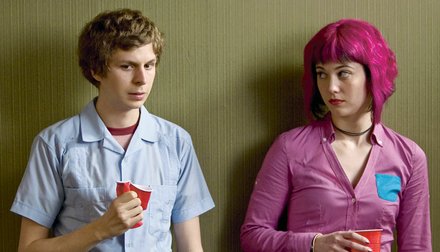
  • Scott Pilgrim vs the World--I wouldn't have called this a not-holiday movie last year, even though I really love it; but I've been feeling the need to watch it lately, which automatically qualifies it as being a "holiday" movie in my book. Basically it's about Scott Pilgrim, who has an awesome life, is 23 years old, and falls in love with a woman named Ramona. But to keep dating her, he has to battle her seven evil exes. It's totally hip.
  • Inception--Is there a more Christmasy movie than this labyrinthine mind fest of twisty turns? If there is, I can't think of one! Leonardo di Caprio plays a thief who descends into dreams to steal people's idears (my review here).
  • Casino Royale--You guys knew I couldn't have a not-holiday movie list without a few shootings and car chases, right? Plus Daniel Craig... rowl. And he's in a suit, so that's practically thisclose to getting dressed up for a holiday party.
Now it's your turn! What are some of your favorite not-holiday movies?


virtual advent buttonThis post is part of Virtual Advent. For more holiday-related posts, visit adventblogtour.blogspot.com.

Friday, November 30, 2012

Ode to DNFs

nope

To all the books I tried to read
Only to abandon with varying speed
Maybe I was hasty, maybe I was rash
Maybe you got really good in the second half

It wasn't you, it was me. Okay I'm being wry
But I promise I did try
I wasn't in the mood, I don't like prologues
Whatever the reason, they were good ones

I'm sure there are others who appreciate
A slow-moving novel with twists that aren't great
Clothing descriptions that last forever
And circular conversations about the weather

A closed book is like a mystery
You don't know if it's good or crummy
So many books, so little left on the meter
I'd rather take a chance the next book will be better

Wednesday, November 28, 2012

New to You: SHERLOCK HOLMES Short Stories by Arthur Conan Doyle

scandal in bohemia

I wasn't going to write reviews for these short stories, but then the second season of BBC's Sherlock started, and I thought, why not? For those of you who don't watch the show, each episode of the second season of Sherlock was based on the three most popular Sherlock Holmes mysteries: A Scandal in Bohemia, The Hounds of Baskerville, and The Final Problem.

As I've said before in my review of The Sherlockian (Truth, Beauty, Freedom, and Books), I'm not a big fan of Sherlock Holmes mysteries, and it all started with The Hounds of Baskerville. We had to read it in sixth grade English and I was SUPER excited because 1. I'm a dork that way; and 2. I loved mysteries as a kid. And Sherlock is supposed to be the greatest mystery solver of all time, right? So imagine my disappointment when I was kind of bored with the book. There were no interesting female characters, and Sherlock himself was an arrogant ass. I'm aware that that's the entire point of Sherlock, and it wouldn't even have bothered me too much if he'd had one or two redeeming qualities, but he didn't. So I decided 'twas not for me and moved on with my life.

Fast forward a decade or *cough* two, and I've gradually warmed up to Sherlock Holmes. In other people's work--not Arthur Conan Doyle's. Him I'm still prejudiced against. But A Scandal in Bohemia was one of the selections in a Librivox short mystery collection I downloaded, and I thought it wouldn't hurt to give it a try.

A Scandal in Bohemia is famous for marking the appearance of Irene Adler, the only person to have ever bested Sherlock Holmes. The King of Bohemia comes to Holmes asking for help in the return of a set of letters, which detail his affair with Irene, to whom he was engaged but dumped in favor of marrying a princess. Holmes, naturally, has a plan, but Irene Adler is one step ahead of him.

I wasn't expecting much from A Scandal in Bohemia or Irene Adler--I anticipated Conan Doyle would either make her a vamp or a victim, and how much can one build of a character in a single short story anyway? However, I was pleasantly surprised. Holmes starts off being his know-it-all self, but then Irene shows up and things get a helluva lot more interesting. Conan Doyle did a good job of making Irene a believable, feminine character who is admired for her intelligence, not her boobage, and who has her own motivations in the story. She's not just there for the guys to lust after. I loved the end where the King of Bohemia declares, "What a woman!" and in response Sherlock says something to effect of, "Well, you're an idiot and you never deserved her anyway." Aw.

A Scandal in Bohemia definitely challenged my notions about Conan Doyle's writing being chauvinistic, and I now completely understand why the fascination with Adler's character persists. This was a great story!

final problem


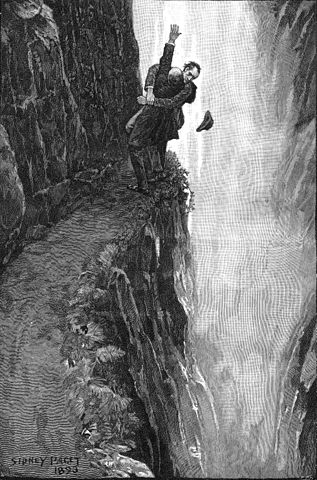
The Final Problem is famous as the story where Conan Doyle killed off his most beloved character. I decided to read--well, listen to--it after seeing the last episode of Sherlock, "The Reichenbach Fall." Again, as with Scandal in Bohemia, I was surprised by how much I enjoyed this short story.

The Final Problem opens with Watson in his medical office. He hasn't seen a lot of Sherlock since he got married, and this gives him the sadness. As if conjured by his thoughts, Sherlock shows up, acting even stranger than usual. It turns out the net is finally closing around his arch-nemesis, Professor Moriarty; and after receiving a visit from Moriarty at 221 Baker Street, Sherlock has decided he should leave the country until the master criminal is safely behind bars. Of course, Watson's game for an adventure, and soon they're setting out for Switzerland.

This was a very well-written story. Watson--or Conan Doyle, rather--sets us up for Sherlock's death from the first page--and it's a good thing, too, because otherwise his death would be too hard to take. Then we're taken on a fun cat-and-mouse chase through Europe, until the story's tragic conclusion.

I have, on occasion, accused Conan Doyle's writing of being emotionless, but that wasn't the case in The Final Problem. Not that it's sentimental or histrionic--far from it. But I felt so sorry for poor Watson at the end and it was very sad, even knowing that Sherlock isn't "really" dead. I can appreciate Watson's value as a relatable character in this series--we've all had friends we've lost, either permanently or just drifted away from, and The Final Problem resonates with that common experience. For that reason I think this story is one that's accessible to people who people who aren't fans of mysteries or Sherlock Holmes.

What I wonder is, did Conan Doyle plan on bringing Sherlock back at some point? I know the popular opinion is that he hated Sherlock and was happy to be rid of him, but the way he killed the guy off does leave open the possibility of Sherlock's (and Moriarty's, for that matter) return. Maybe the final problem isn't defeating Moriarty, but finding out what happened to Sherlock.


empty house

Ten years after killing Sherlock, Conan Doyle brought him back in The Empty House. It's a bit of mystery--har har--why he did so, but everyone is happy he did; and after the double whammy of The Reichenbach Falls and The Final Problem, I needed a pick-me-up.

Watson is carrying on, when one day Sherlock appears in his office. Watson faints. When he comes to, he's like, "Sherlock, is it really you?" etc. etc. I'm sure you can fill in the conversation for yourselves. Point is, for the last few years, Sherlock has been wandering around Europe, with the assistance of his brother, doing odd jobs and pretending to be dead. But he's been a little bored lately; and since England is the only place where interesting mysteries happen, Sherlock has decided to return.

I honestly could not tell you anything about the mystery in this story, but does it really matter? The point is, Sherlock's back! And he's wearing disguises! And Watson still can't recognize him when he's in a disguise. Seriously, I can't even see Sherlock and I'm still like, HELLOOO, WATSON, THAT'S OBVIOUSLY SHERLOCK IN DISGUISE. And he's tricksing people with his smarts and making wax casts of himself and going, "See what I just did there? No? Sorry, I forgot how slow you are."

The Empty House was not as good as A Scandal in Bohemia and The Final Problem. It seriously felt phoned-in. And Watson seemed to accept Sherlock's return way too easily. After the fainting spell, he's pretty laissez-faire about the whole thing. If one of my friends whom I thought was dead suddenly showed up at my house and was all, "Sorry I didn't write," I'd be PISSED. I'd want to either hug them or punch them in the face, and possibly both. Watson just shrugs it off and goes back to business as usual, as if he finds out dead people are actually alive on a semi-annual basis.

Anyway, The Empty House was okay. I don't think Conan Doyle was as psyched about bringing Sherlock back as he was about killing him off, but maybe it says something that after ten years, it feels like the detective never left.


For the most part, these stories have really improved my opinion of Conan Doyle's mysteries and writing. I'm NOT going to reread The Hounds of Baskerville, but I might consent to read more Holmes mysteries in the future. Do you have any favorites?


Originally published on Project Gutenberg Project.

Monday, November 26, 2012

Movie Review: LOST IN TRANSLATION


Originally released: 2003
Starring: Bill Murray, Scarlett Johansson
Directed by: Sofia Coppola
Based on: the script by Coppola

Once upon a time, there was a princess named Charlotte who lived at the top of a skyscraper hotel overlooking the city of Tokyo. Although the princess could leave her tower, she always felt isolated from everyone else, until an unlikely knight errant named Bob Harris crossed her path. He brought her down from the tower and helped her feel like a part of the world again.

lost in translation movie poster

The summary of Lost In Translation (not the one I just gave, the official one), always put me off. So basically it's movie about a pair of rich people who are bored and kind of get together but not really? FASCINATING. Not. Plus it stars Scarlet Johansson, who really annoys me (the only movie I can stand her in is Midnight in Paris because she's supposed to be annoying). But then Bridget at Books as Portable Pieces of Thought assured me it was a good movie, and that there was an awkward sex scene (yay?), so I figured I would give it a try, hate it, and then cleanse my mind with something else.

What actually happened was that I didn't hate Lost In Translation--I LOVED it! I think what Sofia Coppola was trying to do with this film was capture experiences. When you're living in a different country, you don't just miss your friends and family, you miss your entire culture. Things that you take for granted suddenly become problematic. What do you do for entertainment or to unwind at the end of the day? What if you get sick and need to see a doctor? How do you order from a menu when you don't read a language? Even the things from your own home are tweaked to local tastes so that they come out not quite right. Coppola did a brilliant job of showing us these experiences in the movie: the New York Bar with the cheesy lounge singer, Charlotte and Bob ordering at a restaurant, or going to the hospital.

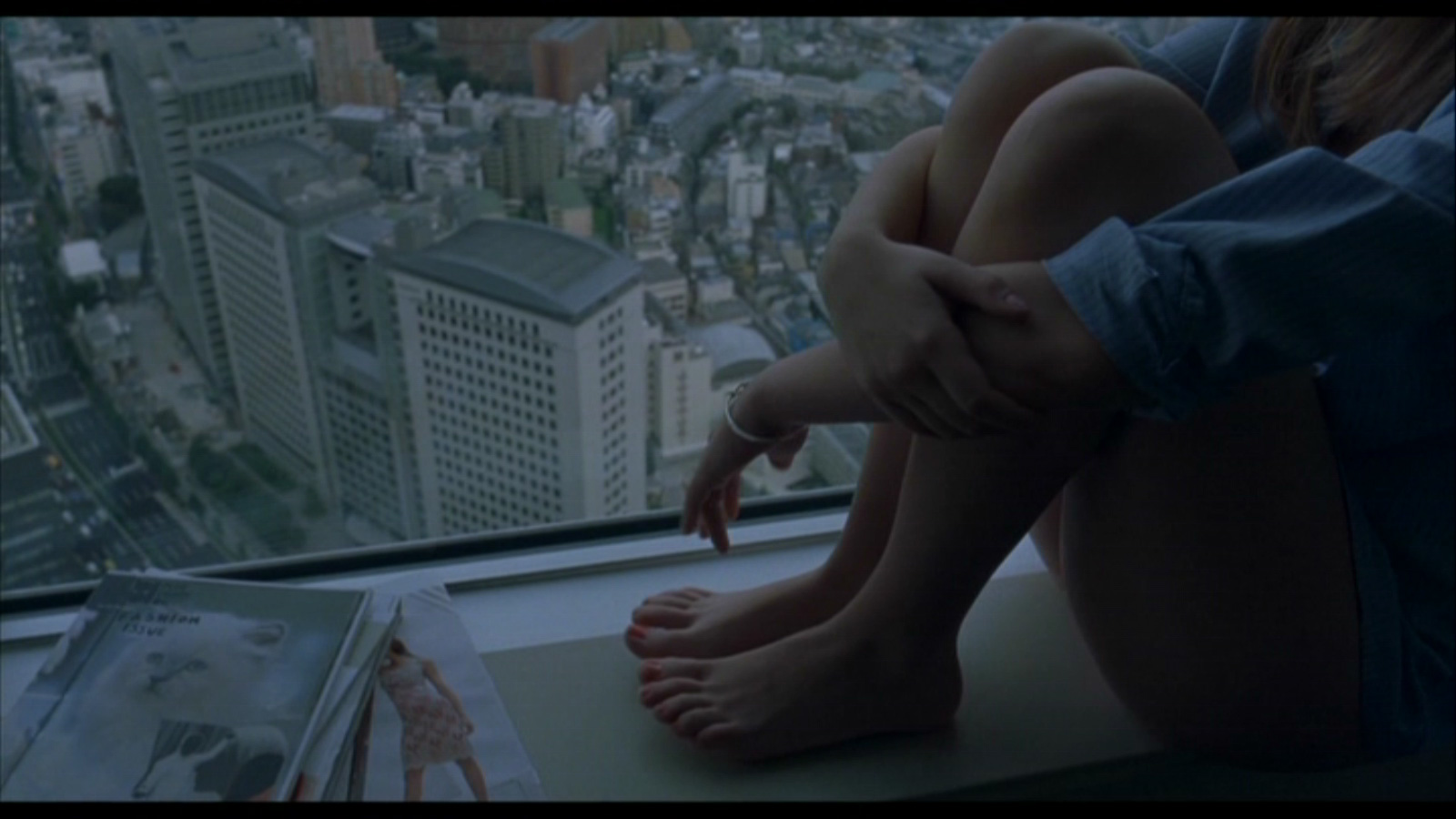
But whether you hate or love the culture of the country you live in, you have to adapt to it. You have to listen to the music, eat the food, and learn to communicate with people in order to survive. After a while, although you're not truly a part of the culture you're living in, you're not a part of the country you're from, either. Your "home" might even start to feel like the foreign country. I think that was the point of the painful phone conversations Bob and Charlotte had with the people they love back in the US. I also think the Tokyo street scenes did a great job of conveying that feeling of being in limbo--physically being somewhere, but not really a part of it.

tokyo street scene


It's interesting to compare this movie to Marie Antoinette, also directed by Coppola. They're both about poor little rich girls who aren't sure how their world works or what their place is in it. I think Lost In Translation is more hopeful, though, because first of all it's really funny. I laughed my patootie off during the awkward sex scene, and all the cocktail lounge scenes are hilarious. I particularly enjoyed the rendition of "Scarborough Fair." And Bill Murray was adorbs; he has some great one-liners in this movie ("I don't get that close to the [whiskey] glass until I'm on the floor.")

Second of all, the film is really romantic. Not in a rom-com sort of way, but in the traditional Romanticism sense of the word, with an emphasis on emotion and experience, and the struggle of the individual to find their own way in the face of society. If Bob and Charlotte do have a romance between them, it's of a courtly kind.

Basically, this movie is REALLY good. It's entertaining and great to look at, but also stays with you and gives you a lot to think about. The take-away message I got from Lost In Translation is that Bob and Charlotte might be lost, but maybe that's a good thing--the only way they can ever see or find what they truly want. Thanks to Bridget for encouraging me to watch it!


Friday, November 23, 2012

Holiday Giveaway: NUTCRACKER by ETA Hoffmann and Maurice Sendak

nutcracker cover

Now that Thanksgiving is over, it's officially time to start the holidays! And what better way to start the season than with a gift?

Last year for Virtual Advent, I reviewed Nutcracker and Mouse King by ETA Hoffmann (post here). This is the short story Tchaikovsky's ballet was based on, and is honestly the most perfect Christmas story I can imagine. It has all the elements you want in a Christmas tale: magic, mystery, presents, danger, and wonder. Plus the story's ending is A LOT better than the ballet's.

Because I am a big pusher of this book, I was thrilled when Random House offered to send me a new reprint of Maurice Sendak's illustrated version to give away to my blog readers. You definitely need this book on your shelves and it's a perfect Christmas gift (to yourself--ha ha). To enter, just fill out the form below or go here. This giveaway will run from November 23rd-30th.

Here are some samples of the illustrations in the book to whet your appetite:

the mouse king
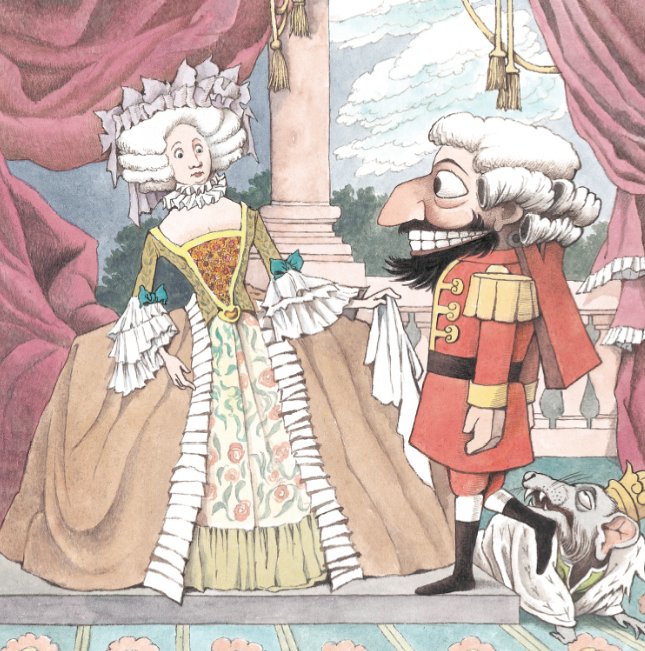
The Mouse King with seven heads.

the nutcracker prince
A prince is cursed to look like a nutcracker.

Tuesday, November 20, 2012

Review: MISS PEREGRINE'S HOME FOR PECULIAR CHILDREN by Ransom Riggs


Instead of reading the prologue, you can just watch this book trailer!

Jacob grew up listening to his grandfather's stories of "peculiar children"--orphans who were rescued and sent to live on an island during WWII, one of whom was Jake's grandfather. Unlike most orphans, however, the orphans Jake's grandpa knew had strange powers and abilities, which were captured in photographs that his grandpa kept. After Jake's grandfather is murdered, he sets out on mission to find out the truth about his grandfather's odd stories.

miss peregrine's home of peculiar children book cover

Despite the fact that there are reviews of this book all over the freaking place, I started Miss Peregrine's Home for Peculiar Children with very little idea of what it was about. When I read the reviews, all I heard was: "Pictures! Creepy pictures of olde-timey kids being creepy!" That alone was enough to make me want to check Miss Peregrine's Home for Peculiar Children out, of course, but there's a lot more to the novel than just pictures, and honestly the creepy kid photos are probably the least-successful element of the book.

Not that they're UNsuccessful. I can see where Ransom Riggs (incredible name for a writer, by the way) was going with that idea, and I love it. But I'm not sure including the photographs in the text was necessary, and at times it felt gimmicky. Why are these kids running around taking pictures of themselves and then saving them all? Where are these photographs even developed in the time loop, hmmm?

I did adore Riggs' writing style and the voice of the main character, Jacob. As someone whose own grandparents come from Germany and lived through WWII, I really connected to all the generational things going on between Jake and his dad and grandpa. He also freaking TIME TRAVELS--I mean, come on. That's really the best part of the novel (although the entire time I kept thinking, "Nazis aren't enough, we need wights and hallows too?" A little OTT). Riggs can write creepy REALLY well. Honestly, for the first three-fourths of Miss Peregrine's Home for Peculiar Children, I didn't want to put the book down at all.

Then I hit the last quarter of the book and it started to literally put me to sleep. I think it's mainly because the "magical" elements of Miss Peregrine's Home for Peculiar Children aren't grounded enough in the world of the novel; or maybe they're just too obvious? It was as if Miss Peregrine's started off as magical realism and then switched to middle-grade fantasy. I pretty much lost all emotional investment in the story by the end of the book.

My feelings about Miss Peregrine's Home for Peculiar Children are very mixed at this point, but I have say it's interesting--and I mean that in a good way. Intriguing concept, unexpected story, and a writer who's not afraid to take chances. I love how Riggs took real photographs and quilted them together into a story with emotional depth. As I'm always willing to reward experimentation even if it doesn't quite hit the mark, I think this might be one of my more memorable reads of the year.


LinkWithin

Related Posts Plugin for WordPress, Blogger...