Monday, January 14, 2013

When Series Jump the Shark

jumping the shark

Some series end too soon and never fulfill their potential. Other series go on so long at some point they just go overboard and you have to dump them.

In US parlance (and maybe other places as well?), "jumping the shark" means a series has completely lost you. It comes from Happy Days where Fonzie literally jumps a shark. I guess this was lame; Happy Days was way before my time. Point is, I think we've all come across a series where we were kind of teetering on the edge of giving up (or not), and then something happened and we were DONE. Toss that book on the floor and move on to something else.

Behold! A short list of scenes where long-running series jumped the shark for me:

  • When Anita Blake and Richard slept together in Blue Moon. I was never that into Richard, but the way Anita and Richard hooked up in Blue Moon totally put me off. It was like the Anita Blake series was just becoming an agent for vicarious sexual thrills... OH WAIT, it was.
  • We find out Yuki Cross and Kaname Kuran are brother and sister in Vampire Knight. Incest is one of those things that's guaranteed to make me lose interest in a story, even if I'm enjoying said story, which was the case here. I just can't buy into it. And it's too icky.
  • Acheron by Sherrilyn Kenyon. Kenyon stated that she foresaw Acheron's book as being the last of the Dark Hunters series, but moved it up because fans wanted his story soooo much. Um, who's the writer here, Kenyon or "the fans"? Anyway, I liked Ash's book, and after I finished it I had no more questions about the series. So I guess it was a good ending (even though the Dark Hunter series and its plethora of spin-off continues).


What scenes jumped the shark for you in a series?

Saturday, January 12, 2013

Review: THE IMPORTANCE OF BEING WICKED by Miranda Neville

importance of being wicked cover
Look, kids, another great cover from Miranda Neville! Joke. Just ignore it.

Although the Duke of Castleton and Caroline Townsend are of completely opposite dispositions--he, being proper and conventional; she, determined to live with no regard for society's rules--they both find themselves in similar financial straights due to the irresponsible behavior of other people. When Castleton sets out to court Caro's wealthy cousin, he finds himself attracted to the bohemian widow and is quickly drawn into her misadventures.

The Importance of Being Wicked has a lot of problems, but I ended up enjoying it anyway. Problem the first is some pretty dodgy history. If you're the type of person who's driven crazy by historical inaccuracies, just walk away right now. I already discussed the novel's questionable use of art here, but honestly that's the just the tip of the iceberg. Castleton is alternately addressed as "Your Grace" and "Duke" by the same people, sometimes within the same sentence (only social equals addressed dukes as "Duke," everyone else used "Your Grace;" it wasn't interchangeable); and the characters say things like, "Uhg," and "true blue" (which referred to one's political leanings, not the nature of one's character). Honestly I was a bit taken aback by the careless use of terms and disregard of historical context in this novel, considering that Miranda Neville's last two books were impressively researched--as far as I noticed, anyway--but fortunately I'm not one of those people who demand historical accuracy in order to enjoy a work of fiction. All right, I'll admit the whole Duke/Your Grace thing was a bit crazy-making, but not so much that I couldn't still enjoy the story.

Problem the second was the plot, if one can call it that. It was really thin and not enough to hold the book together. As a result The Importance of Being Wicked felt episodic, especially in the second half. There were a lot of threads going on in this story--the painting by Titian, financial hardship, the whole thing with Castleton's mother, Caro's pregnancy, etc.--that just sort of waved around in the wind and then ended without ever being tied together. The pacing of the story also slows way the heck down in the second half of the book; but then I'm of the once-they-get-married-let's-wrap-the-book-up school of thought.

Those problems aside, however, I really enjoyed The Importance of Being Wicked. I liked it a whole heck of a lot more than Confessions from an Arranged Marriage (post here), and I think the main reason was that I loved the two main characters. Was Caro a bit unbelievable as an eighteenth-century daughter of an earl? Yeah, but I still liked reading about her adventures and sympathized with her actions throughout the book. Castleton was also a fun character because he was so easily shocked by everything and, though he prided himself on being level-headed, spent an awful lot of time threatening to punch people in the face. He had me at the first K-O.

punch in the face gif

Also, I can forgive a lot in a romance novel as long as the hero and heroine have chemistry, and that was totally the case in The Importance of Being Wicked. I loved Castleton and Caro together and thought the way they fell in love was really delightful (I am, incidentally, a complete sucker for opposites attract romances, so that was basically a sure bet for me from the beginning). I also really appreciated the fact that neither Castleton nor Caro were ridiculously wealthy: usually in romance novels (I'm tempted to say ALL THE TIME WITHOUT ANY EXCEPTION, but I won't) the hero is rich. He can be ugly, he can be socially awkward, he can be a dishonest asshole, he can even smack the heroine around a bit or be not-a-peer, but he's ALWAYS rich. Not in this case! The fact that Castleton, who as a duke had huge financial responsibilities, was willing to marry Caro and take on her additional debt made The Importance of Being Wicked very unusual and added a sweetness and believability to their romance that I fell for completely.

Would I recommend The Importance of Being Wicked? Yes, although I can see where it might disappoint some people or just not be their cuppa. It's not a perfect book by any means, but I think if you're partial to romance there are enough things to like that outweigh the negatives. For the most part I had a great time reading it. Thank you to the publisher for providing me with a copy to review! And in the future please give Miranda Neville better covers.


Thursday, January 10, 2013

Austentatious Bad Boys

george wickham
Consider yourself smirked. Among other things.

Alfred Hitchcock once said "The more successful the villain, the more successful the picture," an axiom that is equally true for many books. Jane Austen, on the other hand, never really had any Hitchcockian-style villains in her novels; but she did write several bad boy characters who make the books they're in that much better.

stay away from teenage girls gif

Personally, my two favorites are Wickham and Willoughby. If you're a fan of bad boys, Wickham has many laudable qualities: one, he's an officer. That means he wears a fancy uniform (hot), he's automatically dashing, and he moves around a lot--the perfect answer to any woman's escapist fantasies. He's also super-smirky, and as we all know from reading Fifty Shades of Grey, women can't resist The Smirk. Oh no. If only he'd stop running off with teenage girls and plying them with his wicked ways.

dominic cooper as willoughby
Is it hot in here suddenly? *fans self*

Right now I'm reading Sense & Sensibility for Reading with Analysis' Jane Austen January, and I have to say that I LOVE Willoughby. Unlike Wickham, Willoughby is über-romantic, like Heathcliff come to life! Who would blame Marianne for falling for his I'm-so-into-you schtick? Not me. His OKCupid profile probably reads, "I like long walks, collecting locks of your hair, and I'll write you a song." I'd be all over that. I bet he even quotes poetry. *swoon*

Even his name sounds romantic, like a sigh of longing echoing across the moors. "Willoughby! Caw, caw!" Honestly, the fact that he's a playa playa doesn't really cut down on the appeal that much. I mean, is he really that different from the sainted Edward, other than the fact that Edward is not at all charming or interesting? They both snatch locks of hair, mislead the Dashwood sisters, form secret engagements, cause a scandal, and lose all their money. Taken from that perspective, Willoughby is really the better bet. Right? Right, guys?


Who's your favorite Austen bad boy?


Tuesday, January 8, 2013

Books Characters from Downton Abbey Should Read

ethel reading

Lady Mary--Pride & Prejudice by Jane Austen
Mary should have no problem connecting to the story of sisters who need to marry or find themselves penniless and homeless. She could also stand to think a bit about being too proud.

Mr. Bates--Psycho by Robert Bloch
If nothing else he'll finally figure out why The Bates Motel is a really bad idea.

Thomas--The Prince by Machiavelli
He's going to need all the help he can get if he keeps up the feud he has going with O'Brien.

Edith--Miss Pettigrew Lives for a Day by Winifred Watson
Hopefully Edith would find this ugly duckling story inspiring--as long as she doesn't take it too far (she totally would). Alternate read would be Stranger In My Arms by Lisa Kleypas if that Canadian "Patrick" guy comes back.

Carson--The House of Mirth by Edith Wharton
You know Carson's really a romantic at heart, but his sense of social hierarchy and propriety probably makes him a bit of pessimist. Enter Edith Wharton!


What books would you recommend for Downton characters?

Sunday, January 6, 2013

Harry Potter and the Grand Tour

cover of harry potter and the deathly hallows
US cover of Harry Potter and the Deathly Hallows, with Roman arches and columns.

It's been a while since I wrote a Harry Potter post, and something must be done about that! Actually I was watching part one of The Deathly Hallows during Christmas, and I realized that Harry's, Hermione's, and Ron's last year of education is similar to the English tradition of the Grand Tour.

The Grand Tour started in the mid-17th century and, by the 19th, was considered a necessary part of every young man's education (at least if you were part of the upper-class). After studying the classics, the civilizations of Greece and Rome, and reading about the art of Michelangelo and Raphael, the best way to conclude one's schooling was by seeing the art and the ruins of these civilizations for oneself. Obvs, since they didn't have the intrawebs or photography back then, the only way to do this was to travel.

Like Ron, Hermione, and Harry, travelers on the Grand Tour would take EVERYTHING with them. I don't know about you guys, but when I go somewhere, even for a really long time, I pack ONE bag. If I need more clothes, I can buy them when I get there. For travelers on the Grand Tour, though, they packed like they were going to the moon and included every single thing they could possibly need, in quantities to last them the years it would take before they returned to England. Unlike the Harry Potter People, however, they didn't have a bottomless purse to stuff everything in, so they had to hire carriages and porters to carry it all. Not to mention guards to keep from being robbed by unscrupulous highwaymen!

More importantly, people on the Grand Tour had a typical set of destinations that defined it as "the" tour. They went in search of specific objects, places, and knowledge. Like, you HAD to visit Paris and sleep with a prostitute, or else what was the point? Haha. They also typically visited the Vatican, saw the Sistine Ceiling and paintings by Raphael, saw an opera, and sketched the Roman Forum. The itinerary for the Grand Tour wasn't too different from the typical modern tourist's to-do list in Italy, actually.

Of course, Harry, Ron, and Hermione don't go to Italy, but they do take a "tour" of sorts of the British Isles, and this is further emphasized in the locations of the films. They visit the Giant's Causeway, Buckinghamshire, Yorkshire, Suffolk, and Wales, among other locations. Also, although Harry isn't technically traveling to "finish" his education, he does learn a lot about himself and the past--especially the past of his hero, Dumbledore. He also collects objects (the Deathly Hallows), similarly to how people on the Grand Tour collected souvenirs.

What would a Grand Tour look like for you?


Friday, January 4, 2013

Manet's OLYMPIA in Books and TV

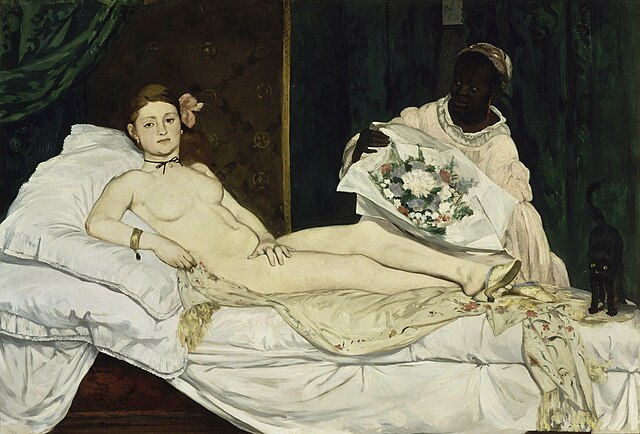
manet's olympia
Olympia, Edouard Manet, 1863, Musée d'Orsay, Paris.

Ahoy, mateys! Major rant ahead...

Edouard Manet is one of my favorite historical crushes. Just check out the interview I did with him if you don't believe me. A nineteenth-century avant-garde artist, Manet inspired the Impressionists and was one of the first modern artists. But he's definitely not as famous as any of the Impressionists, including his bestest frenemy, Edgar Degas. And that's perfectly fine with me. Manet is my historical crush; get your own!

It's kind of weird that in the past few months, I've seen Manet's Olympia given the art history shout-out treatment twice: once on TV and once in a book. And both times it was totally anachronistic. The first instance was on the BBC America series Copper, which is about the NYC police department during the Civil War. On the show, the wealthy Elizabeth Haverford has Olympia hanging in her drawing room. Okay, it's not the ACTUAL Olympia (I can just imagine what they'd have to pay the Musée d'Orsay to get away with that), it's just "very reminiscent of" Olympia according to the show's own blog.

elizabeth haverford's painting from copper
Screenshot of Elizabeth Haverford's painting. C/o BBC America blog.

I don't have a problem with a TV show creating its own version of a famous painting, but I do have a problem with Copper using Olympia. It's horribly anachronistic and drove me crazy. Yes, Copper is set in 1864 and Olympia was painted in 1863, but:

  1. Manet didn't exhibit it--in Paris--until 1865, so how would Elizabeth have gotten her hands on it, hm?
  2. Even ignoring the whole exhibition thing, seeing how the painting isn't "really" Olympia, in order to get a painting like it, Elizabeth would have had to travel to Paris. In the middle of the Civil War? I don't think so.
  3. When Olympia was first exhibited it was WAY avante-garde. It took the French public nearly 30 years to accept Olympia as a masterpiece. The US was generally about twenty years behind Paris in the visual arts (at least in the 19th century), so by my calculations there is no way an American would have anything resembling Olympia until the 1910s at the earliest. BUT...
  4. When I say "Americans" I actually mean American men, since if you haven't noticed there's a naked prostitute in that there picture (that's what made the painting scandalous, by the way--also, it's pretty badly painted). Not the sort of thing a respectable woman would own, let alone have hanging in her drawing room. Even William Bouguereau's Nymphs and Satyr was considered too risque for women to look at, for heaven's sakes!

For the above reasons, although I of course love Manet, I found the presence of Olympia on Copper very annoying. Whenever I saw the painting in Elizabeth's house I was thrown out of the story. Fortunately Corky got pissed off and slashed the painting near the end of the first season, so I won't have to look at it in season two. Yay!

The second instance was in The Importance of Being Wicked by Miranda Neville, which I'm currently reading. Naturally one cannot see paintings in a novel, but I'm pretty sure the portrait described at the beginning of the book is Olympia. It's of an "almost naked [later "stark naked"] woman, reclining on a satin-draped divan." The figure has short, red hair and a bold, direct gaze. Also: Caro wears a ribbon around her neck like Olympia. But most of all, the painting is modeled after a Titian. A Titian like this, for example?

the venus of urbino
The Venus of Urbino, Titian, 1538, Uffizi Gallery, Florence.

BOOM. Manet totally modeled Olympia after The Venus of Urbino. This is the only Titian where the subject is 1. a female nude who is 2. lying down, 3. a ginger, and 4. looking at viewer, so it must be the Titian Caro's husband bought and her friend Oliver later copied, using her as a model.

Again, while I enjoy art history shout-outs, this is pretty anachronistic. The Importance of Being Wicked takes place in 1811 at the latest (likely earlier), and again there's no way a woman of the time would have a painting like that hanging in her drawing room, no matter how daring she was.

What I wonder is, why Olympia? It's a pretty famous painting--even if you don't have an art history degree you've probably seen it--so it's not as if no one would recognize it. I get it, Elizabeth Haverford's a whore (like every single other female character on Copper) and that's why there's this ugly painting of her in the drawing room; but I'm pretty sure there's only about a bazillion paintings out there that could convey that fact more cleverly and effectively than Olympia AND be historically appropriate. Even a Madame X type of portrait would make more sense than Olympia.

With The Importance of Being Wicked, I don't have to look at the painting while I'm reading, so that makes it less annoying than Copper. But the characters show an anachronistic tendency towards "modern art" (term actually used in the book) by reviling the dramatic poses and allegorical works that were popular at the time. That just doesn't shake out in the context of the time period: what we consider "natural posing" doesn't make sense without photography. Not to mention, since the novel IS set in the late 18th century, that London was the Scandalous Portrait Capital of the World! For realz, it's not as if the most famous women in English history at the time had their portraits painted when they either wanted to become famous or shock their family, or both. OH WAIT they all did that, my bad. Modeling a portrait off one of the (many) paintings of Kitty Fischer, Sarah Siddons, Lady Sarah Lennox, or Lady Hamilton would make much more sense. It's not as if there isn't a lot of options to chose from.

Art is a reflection of its place and time, and thus is a great tool for writers and filmmakers to enhance the setting of their story and add depth to their characters (a great example is the use of the Bird Lady on True Blood). But not if the art used is inappropriate! In that case all one winds up with is a sad mess that doesn't mean anything to anyone, least of all to the people who might appreciate the reference the most (such as myself).


Further Reading:

Wednesday, January 2, 2013

Review: ICED by Karen Marie Moning

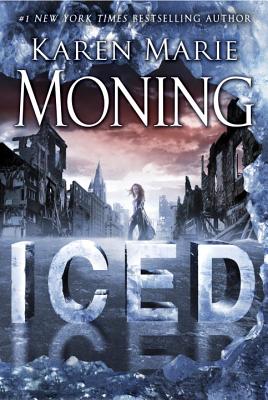
iced cover


It's the Ryodan Show! Welcome to the Ryodan Show, where the world revolves around Ryodan, the most interesting man in the world. Ryodan knows mostly everything, but there's one thing he doesn't know: who, how, what, and why is freezing Unseelie in his club. For some reason he thinks Dani Mega O'Malley, a fourteen-year-old who fancies herself a superhero[ine], will be able to help him figure it out.

I was kind of excited about Iced, the first novel in a new series that takes place in the same world as the Fever series, Karen Marie Moning's über-successful PNR novels about a post-Apocalyptic world in Dublin. I loved the Fever series, which concluded last year. Dani, supposedly the main character in Iced and a supporting player in the Fever books, wasn't the most interesting person, but I wasn't opposed to her getting her own book.

Guys, I had so many problems with this novel. Whereas the Fever series felt like it knew exactly where it was going, and I could relate to the characters, Iced seemed like Moning was making it up as she went along. And I could not connect to Dani at all. Let's break it down a little, shall we?


  • Dani--First and foremost, Iced does not feel like Dani's story. I'm honestly not sure whose story it is (Moning switches points of view a lot), but even though Dani gets most of the page time, I never got the sense I was reading her story. Secondly, she was completely unbelievable as a character. I was annoyed by Mac sometimes, but I was able to buy into her emotions and predicament. With Dani, I was just annoyed. She was way too OTT, from her crappy childhood to her reactions to EVERYTHING, to the fact that she didn't act like a believable fourteen-year-old. I can see where Moning was trying to make her *seem* like a teenager, but it didn't work for me. And speaking of age, this may be a stupid question, but why is Dani fourteen? Normally I don't care about characters' ages, but Moning makes a point of mentioning Dani's age (or lack thereof) every ten pages, and it doesn't contribute to the story at all. In fact, it works against the believability of the story pretty severely. 
  • Chapter titles--All of the chapter titles are song lyrics. Now, quoting song lyrics in novels is generally a bad idea (they never mean the same thing to you as they do to other people, trust me on this), but using them as chapter titles wouldn't bother me if it wasn't symptomatic of the central problems with Iced. None of these characters are musicians. OR EVEN LISTEN TO MUSIC. There's no music in this book, which is set in an alternate world *in Dublin* anyway, so why are the chapters referencing contemporary and classic American rock? Makes absolutely zero sense.
  • Ryodan and Christian--Ryodan was an okay character in the Fever series. I didn't give two shits about any of the Keltars, but that's probably because I didn't read that series by Moning set in Scotland, whatever it was. ANYway. My point here is this: Ryodan in Iced is boring. The way he ended every question with a period drove me bonkers. And the way he kept petting Dani was P R E T T Y creepy, almost as creepy as Christian stalking her. Especially considering she's four freaking teen. 
  • Story and pacing--You know how I'm always harping on when the pirates go back to the island in Pirates of the Caribbean? Now imagine the entire movie where they just keep going back to the island. Iced is kind of like that; except instead of an island, Dani keeps going back to Chester's. It's like this: Chester's, plot; leave Chester's so we can get adventures and pointless backstory; go back to Chester's so we can get back to the plot. FOR THE LOVE GOD, this book could have been wrapped up in 250 pages if Dani'd just stayed in Chester's!


Basically I really did not get Iced. At all. It just seems like a really weird, meandery book where the author didn't fully think everything through and then the editor didn't ask the right questions. But obviously that's just my personal opinion. And on the plus side I don't have to buy any more books in this series, yay!


LinkWithin

Related Posts Plugin for WordPress, Blogger...