Friday, June 10, 2011

Book Review: WHAT ANGELS FEAR by CS Harris

what angels fear cover

Nobleman Sebastian St. Cyr stands accused of murder in nearly-Regency England, and to dodge the charges he decides to investigate! With his two trusty sidekicks, Tom the pickpocket and Kat, the courtesan who broke his heart, he goes from this London house to that London house, and asks questions. And then he does it again. And again. Until the murderer says, "Lookie here, I'm the killa killa!!! Come and get me!" and then the light bulb finally goes off and Sebastian saves the day.

I've been hearing about this book from some of my favorite bloggers for years, and they all seem to love it. Unfortunately, I'm not quite as enthusiastic. I realized early on that this novel is basically a re-make of The 39 Steps, only set in the 19th century and 300 pages longer. You've got your dashing hero, with an uncanny ability to don disguises and escape pursuit, being accused of a crime he didn't commit and giving the authorities a merry chase, all while uncovering looming political plots and foreign spies. Except whereas Richard Hannay uses his wits to keep abreast of pursuit, Sebastian uses his nightvision and superhearing.1

Personally, I would rather have wit.

I actually really liked the beginning of this novel and the fact that I could identify what type of story it was right off the bat. It feels wonderfully atmospheric and Sebastian is honestly a pretty great character--although my favorite is Tom. He's a right plucky 'un! as I might say if I was in a production of Oliver. He's also ten times smarter than the guv'nor and could probably wrap this mystery up in 200 pages or less.

No, what got to me was that 1. this book takes itself way too seriously; and 2. the investigation became really repetitive. After Sebastian lines up the initial list of suspects, he just keeps visiting them over and over and over. I love it when the characters say to him, "Oh, you again!" (and they all do at some point). Yes, YOU... AGAIN. Maybe we should have been able to solve this thing a long time ago, hm? It felt like he was doing an awful lot of running around for zero information.

Furthermore, the political stuff is ridiculous, as it usually is. No one cares; it's the MacGuffin! But apparently the author thought I would care because she kept boring me with it. And then there's the ending, which did not impress me with its "moral ambiguity."

This isn't the worst mystery I've read, but honestly, I'd rather just reread The 39 Steps. Buchan knew what he was doing with that book. That being said, I'm willing to give the next book in this series a shot, just for the characters and the atmosphere--and the fact that the next book is shorter.


Musical Notes: "Boys of Summer" by Don Henley


The jumping men make me lawl.

  1. No, he's not a vampire. He has a genetic disorder called Bithil Syndrome that originated in Wales and comes from humans having babies with aliens. For more on this subject, see: Torchwood.

Wednesday, June 8, 2011

The Better to Hold You With: About KRAKEN: THE CURIOUS, EXCITING, AND SLIGHTLY DISTURBING SCIENCE OF SQUID by Wendy Williams

kraken cover
Note: This post contains some images which may be NSFW (yay, my first NSFW post!).

A not-so-secret: I love squids. OMG, love! They are my favorite animals. There are so many cool things about squids: they're super-intelligent, for one, and there lots of different kinds, and they're very mysterious.

ANYwayyyy, that's why I leaped upon Kraken when I saw it offered for review. I was blissfully excited about learning more about squid. However, for some completely illogical reason, I thought it was going to be about the cultural history of squid as opposed to the sciency stuff (which is pretty silly considering the word "science" is right there in the title). Not that the science of squid can't be interesting, I just don't want to read a whole book about it.

One of the more fascinating themes in the book--though I'm not sure it's intentional--is how squid are often reviled and hated by humans. In the introduction, Williams describes the first deep-sea exploration vehicle, built in the 1930s by William Beebe and Otis Barton. Using this submersible, they were able to see a vampire squid--so-called not because it drinks blood (it feeds off plankton), but because of its red skin and eyes--in the wild. Beebe said it was, "very small but terrible," with "sinister arms."

vampire squid
Vampire squid comin to get ya

But the vampire squid isn't disgusting; it's cool! It's a squid and an octopus in one! Its huge blue eyes can turn bright red in an instant, no one knows why. And if a predator is chasing it, it chews off one of its little feet and the bio-luminescent lights that covers it lures the predator away.

(Actually, now that I think about it, the vampire squid is kind of like an underwater Cullen, isn't it? Sparkly, blood red eyes...)

I found that part really interesting. But Williams quickly moves on from there to devote most of the rest of the book to modern-day scientific discoveries. To be honest I 1. don't really care about the sciencey talk, especially when I feel like I'm rereading my middle school biology textbook; and 2. get a little touchy when it comes to scientific experiments on my favorite animals. Why can't you bastards just leave the squid alone???? WHY.

See, if I was writing this book, I might have looked at the long history of human revulsion for and fear of squid, and speculated on its causes. Is it because squid are as smart as humans? Because they don't have skeletons?

octopus stirrup jar
Octopus stirrup jar, Mycenaean, c. 1200 BC (in The Metropolitan Museum of Art)

One might also theorize that cephalopods represent a certain femininity that frightens the bejeezus out of men in patriarchal societies. Hence sailors' fears of a giant squid attacking them, and Beebe's antagonism toward them. Even if octopi don't represent femininity, they definitely seem to be associated with female sexuality.

hokusai print
Katsushika Hokusai, Dream of the Fisherman's Wife, c. 1820

When a portfolio of Katsushika Hokusai's prints, featuring erotic scenes with female divers and octopi, arrived in Paris, it became enormously popular in certain circles (as one can imagine) and influenced artists like Picasso, Rops, and Rodin to create similar images. A recent Picasso exhibition had an entire room that was grouped under the theme of "tentacles."

octopussy
Picasso sketch, not sure of date or title.

It would be a mistake, though, to say our illogical fears of squid belong solely in the past. Williams actually demonstrates this effectively with her stories of contemporary research into cephalopods. Popular culture reflects this as well--there's a pest control commercial that likens octopi to roaches; and let's not forget the ever-popular Cthulhu or Ursula, the baddy bad woman from The Little Mermaid.

So that's what I felt was really missing from this book--I wanted more history and less science, because that's what I'm interested in. Kraken is still worth a peek if you like squid, of course; but it didn't rock my world with its awesomeness and I think overall probably has a limited audience.

Tuesday, June 7, 2011

Book Review: KILLER STUFF AND TONS OF MONEY by Maureen Stanton

killer stuff cover

Confession: I've never been to a flea market. Or an antiques show or a garage sale. I've never even watched Antiques Roadshow. My grandmother hates "old stuff," and my mom doesn't want "other people's junk." I didn't even realize average people (i.e., not museums or historic houses) bought old furniture until I was, like, twenty, and that was only because I started watching Martha Stewart. So why did I decide to read this book? I'm not sure... but I'm really, really glad I did.

Killer Stuff and Tons of Money is about the sub-culture of the American antiquities trade, from open-air markets like Brimfield to high-end indoor shows such as Boston Antiques Weekend; from eBay to Antiques Roadshow. There's even a chapter on antique forgers. The hero of the tale is Curt Avery, a mid-range dealer with an amazing amount of knowledge who works his ass off hauling thousands of dollars worth of antiques in his truck from show to show.

The name of the antiques game is caveat emptor: buyer beware. As long as you're a knowledgeable dealer, like Avery, you know what's valuable and what isn't; what's fake and what's rare. Knowledgeable dealers feed off of those who don't know what they're selling, turning what seemed like junk into treasure. The problem is, no one can know everything, and what people want to collect is always changing. Even the best dealers might come across a piece that they know is old, but they don't know how old or how valuable. Furthermore, as Avery explains in the book, by the time you've educated yourself on what the public wants to buy--weather vanes, for example--the taste has already shifted and all that knowledge (and inventory) is pretty much worthless.

I had a history professor once who told us, "Americans LOVE their stuff," and behind every dealer in this book--even the forgers--is a fascination with and love for American stuff. Stanton demonstrates how the entire evolution of our culture can be found in these material goods, from the tines of a fork to a stitching sample. It seems poetic, then, that the trade in these objects is even more a reflection of our culture--as Stanton puts it, "This is capitalism down and dirty." Dealers take advantage of buyers, sellers, and even each other, netting possibly thousands of dollars in profit off of other people's ignorance. At the same time, they could lose thousands if they fail to recognize the value of an object. Most of the dealers Stanton interviews in the book confess to feeling bad about taking advantage of other people this way, but as one man put it, "These pieces are there for the taking. If I don't take them, someone else will." In the antiquities trade, you can sense a similar economic philosophy to that of Goldman & Sachs or Gordon Gekko. At least Avery and the other dealers in the book are ennobled by their honest appreciation of these objects as pieces of history.

It's very rare that I pick up a non-fiction book and read it cover-to-cover, but with this one I did. Stanton's writing is so clear, and the story she tells so fascinating, that I was thoroughly entertained even while I was learning about this culture of antiques. This book was so good, and goes much deeper than just antiques: in the story of Avery and his pursuit of that one big ticket item, the find of a lifetime, I could hear echoes of Moby Dick, The Maltese Falcon, and the ending of The Great Gatsby. He's haunted by the idea that "the one" might have slipped through his fingers for a few hundred dollars. And even if he did find "the one," would he be able to call it quits and give up the gamble of the antiques trade? Probably not.

This is one of those books that I want everyone to read. If you have any interest at all in history or objects, I highly recommend it.

Monday, June 6, 2011

Book Review: CAT O' NINE TAILS by Julia Golding

cat o' nine tails cover

Sadly, this is the most disappointing Cat Royal novel I've read so far.

Cat now lives with the Duke and Duchess of Avon, and spends much of her day sitting around indoors while Frank, Pedro, and their friends are out doing fun things like hunting. Cat doesn't say she's bored, but how can she not be? Then Syd's family writes asking if she and Frank can help search for him in Bristol, as he's mysteriously disappeared. Sure enough, Syd has been kidnapped by the Press Gang to work in His Majesty's Royal Navy, and the trio of Cat, Frank, and Pedro aren't too far behind him.

My main problem with this book is that Cat just doesn't act like Cat. It should have been obvious who the baddy bad guy was, but she didn't figure it out. AT ALL. Also, I know she's been chillin' in drawing rooms wearing pretty dresses for the past few months, but it seemed she was oddly unprepared for the challenges of living as a cabin boy, considering her previous adventures have set her up pretty well for exactly this type of thing. I expected her be a little more plucky about the whole situation because of that, but instead she went the I'm-just-weak-little-girl route. Come on, Cat, it's not as if you haven't climbed a rope before.

Aside from that, the book itself wasn't particularly interesting. There were no awesome new characters as there was in Den of Thieves, and I felt like the level of research compared to the other books was minimal. Something that really bothered me was that one of the American Indians Cat met was named Tecumseh. I know this is super-nitpicky, but since Tecumseh was an actual historical figure during this time period (not to mention pretty well-known), I find it strange that Golding moved him from Ohio, where he really lived, to Georgia, and changed his tribal affiliation from Shawnee to Wind Clan. Um? If it's not supposed to be the same Tecumseh, then why use that name at all? That's like having a character in a book set in Elizabethan England named William Shakespeare, but living in Bath and working as a cartographer, and not explaining, "Oh, this isn't THAT William Shakespeare." If it's just because Golding thought Tecumseh was a cool name, then that's pretty effing lazy research!

Anywhosie, this book just doesn't have the wit and sense of adventure of the last three novels, and I can't even really say it advanced the characters at all, since they didn't act like themselves. And an even more depressing thing is, this is also the last book published in the US. If I want to read the rest of the series, I'll have to order the books from the UK! Sadface.


, ,


Powered by ScribeFire.

Sunday, June 5, 2011

BOOK ARTS: Su Blackwell


I like doing projects in the summer, and this summer I decided it would be fun to do a series of posts about artists who use books in their work. I can't think of a better artist to start off with than Su Blackwell.

little red riding hood
Su Blackwell, Little Red Riding Hood, 2010

Blackwell's delicate book sculptures are the perfect metaphor for the tales they represent, offering a visual correlation between the potential magic and secrets that might be found in every book.

Blackwell says she grew up playing in the woods, where she would pretend the trees and birds were her friends. Her art projects reflect this childhood reliance on nature, but also contain a very grown-up sense of isolation and danger. In Little Red Riding Hood, for example, Red's being lost in the trees seems almost more threatening than the shadow of the wolf with in them--possibly because he's turned away from her.

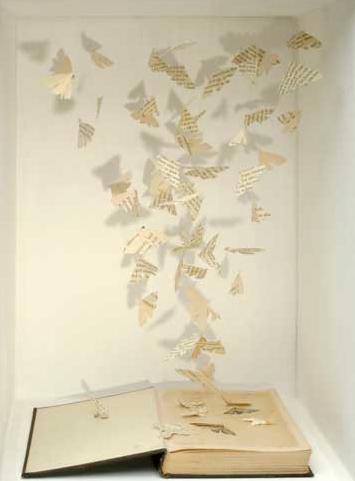
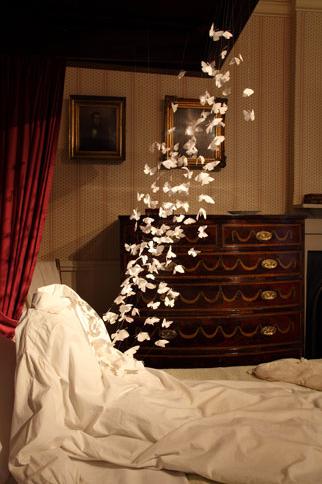
mr. bronte's bedroom
[left] The Quiet American, 2005
[right] Mr. Brontë's Bedroom. Part of "Remnants" installation at the Brontë Parsonage Museum, Haworth, 2010


Blackwell's work also deals with themes of transition and transformation, from one world or form into another. This was evident in her first book sculpture, The Quiet American, which she created after her father passed away: she cut moth forms out of a book she bought in Thailand, referencing a Chinese legend about two lovers who are reunited after their deaths. Mr. Brontë's Bedroom, an installation created several years later, similarly has moths (or butterflies?) emerging from a pillow empty of everything but the impression of an absent body, suggesting the ghost of Mr. Brontë passing from one world into the next. The Secret Garden, meanwhile, is a book Blackwell has reinterpreted in her art several times, always focusing on the door between the enchanted garden and the other world.

the secret garden
[left] The Secret Garden, Finding the Door, 2007
[right] The Secret Garden, 2006


Blackwell's book sculptures remind me of one of my favorite artists, Remedios Varo, in that they are very narrative and fantastical, and balance the comfort of childhood with the psychological fears of adults.

If you want to learn more about Su Blackwell, watch the video at the beginning of this post or check out her website, which has a lot more images of her work: www.sublackwell.co.uk

Thursday, June 2, 2011

Book Review: THE INVENTION OF HUGO CABRET by Brian Selznick

hugo cabret cover

Hugo Cabret is an orphan living by his wits in a train station in 1930s Paris. His most prized possession is a mostly-broken automaton, which he believes carries a secret message from his father. All he has to do is fix the machine and he will know what to do next. When he starts stealing repair parts from a toy shop, however, Hugo unknowingly sets in motion a revelation of secrets for the toy shop owner and his family.

I first heard about this book from Sandy at You've Gotta Read This, and immediately knew that, yes, I did have to read it. It's like a graphic novel in that it's told with both words and pictures, but this isn't set up as a comic--it's proto-cinematic, the pages surrounded by black as if you're sitting in a theater, and includes not only illustrations, but film stills and photographs. The introduction states, "I want you to picture yourself sitting in the darkness, like the beginning of a movie," and the book is kind of like reading a movie--which sounds very awkward, but totally works.

The story is absolutely charming and sweet, but also intense. In a lot of ways it reminded me of Amelie. It's all about magic and dreams, but in this case the magic comes to the characters through movies and machines such as clocks and wind-up toys. At one point Hugo says machines are always made for a specific purpose, which is why broken machines make him sad--they represent unfulfilled potential. Similarly, unseen movies created by the machine of the camera have lost their purpose to entertain and transport people to another world.

I really liked the inclusion of Georges Méliès into the book, too, mainly because I already knew a little bit about him from a class I took on Cinema and Painting. In film studies, Méliès is kind of a Big Deal. According to Natasha Staller (another Natasha, yay!), Picasso was influenced by Méliès when he created his first Cubist paintings. There was also an exhibit all about Cubism's relationship to early cinema at the Pace Wildenstein Gallery in 2007. If you check out this interview Charlie Rose conducted with the curators and skip to the 19 minute mark, you can get a quick tour of the exhibit and see some clips from Méliès' movies.

This is a great book I highly recommend, especially if you love movies. Even though it doesn't take a long time to read, it has a lot of heart and a tiny, perfect little twist at the end. Loved it!


, ,


Powered by ScribeFire.

Wednesday, June 1, 2011

Completely Ridiculous Christopher Gorham Post

Warning: this post is utterly pointless and there is no excuse for it.

christopher gorham shirtless

Sooooo, I don't know if you all know this about me, but I am totes obsessed with Christopher Gorham. If you don't know who Gorham is, then we can't be friends, so I'll just tell you: It all began with Jake 2.0, which was kind of like the CW version of Chuck, except MUCH BETTER because Gorham starred as the geek who is integrated with computery stuff to become a super-spy (sorry, Zach Levi, you're cute but you don't hold a candle to Gorham). I also really liked the supporting cast, especially Jake's doc, Diane. Jake 2.0 is like my favorite show evar, btw.

jake 2.0
Gorham creeping around like a ninja in Jake 2.0.

RIGHT. And then he was in Ugly Betty as Henry, an accountant and Betty's sometimes-boyfriend, which wasn't a role with a lot of substance, but whatevs.

henry
So cute!

henry shirtless
Wowsa.

After Ugly Betty started to tank, Gorham wisely left the show to star in Harper's Island, which at first seemed really lame but grew on me. I began the series thinking, "Wouldn't it be funny if nice guy Henry (Gorham's character) turned out to be the serial killer?" Haha.

scary gorham
Scary Gorham in Harper's Island. It's a good think he wasn't around when Hitchcock was casting Psycho....

AND NOW he's in Covert Affairs, where he plays Auggie, the blind tech guy (this gives him an excuse to stare broodingly off-camera). The second season starts June 7th and I am totally psyched!!!!11!! Thank god Gorham is in this show, because without him it would be like watching The Bachelorette trying to be a spy, for realz. Here are some more gratuitous pics:


christopher gorham shirtless kitchen

Hmmm, let me get up and walk around my kitchen in the middle of the night for no reason other than to show off my beautiful body. Drink! (What I have to wonder is, why does Auggie have fancy art in his apartment if he's blind? And who picked it out?)

day mode
Day mode.

kitchen 2
Night mode.

You're welcome!


Powered by ScribeFire.

LinkWithin

Related Posts Plugin for WordPress, Blogger...