Thursday, February 13, 2014

Movie Review: CHERI


Originally released: 2009
Starring: Michelle Pfeiffer and Rupert Friend
Directed by: Stephen Frears
Based on: The novel of the same name by the inimitable Colette.

Review by the lovely Bridget of Portable Pieces of Thoughts.

Synopsis:

France, the beginning of 20th century, just before the WWI. Lea de Lonval (Michelle Pfeiffer) is a beautiful but ageing Parisian courtesan, currently without court. She doesn't complain. As she’s been very successful and quite business-savvy, she managed to put a lot of money aside. Now she is financially independent, able to live like an aristocrat; still she is almost completely friendless. Small wonder, a prostitute, rich or poor, doesn’t really belong anywhere. Lea feels she is condemned to a company of her colleagues and former colleagues – not exactly friends, rather uneasy allies, like inmates. One of them, Charlotte Peloux (Kathy Bates) a one-time competitor and shameful gossip, has a young son, Fred nicknamed Chéri (“darling” in French). Charlotte and Lea have known each other for years as their careers have been very similar; that’s why Lea was constantly in the life of Chéri, being even his godmother. One day, Madame Peloux comes to her and asks her to take in the boy as a lover and teach him about life.

Chéri is far from being a virgin, but it is obvious he needs some reining in or he’ll turn into a blasé addict or worse. He also has to know how to treat a woman. Lea agrees to be his tutor without much reluctance – the boy is handsome enough to tempt even a courtesan. Despite the age disparity Cheri accepts Lea’s saddle quite willingly. What begins as simple lovemaking, no strings attached, quickly becomes a six-year long love affair. Lea and Chéri float in a perfumed world of opulent comfort, with the older woman paying all the bills so her darling boy has no worries in the world. Still the clock is ticking. How will it end? Not well – you might bet on it.
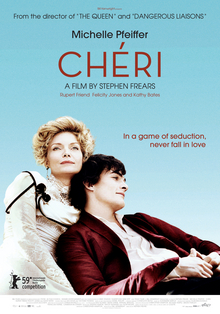
cheri movie poster

My impressions:

I wanted to see that movie so much and, even if I know it is not wise, I expected a real feast. How not to? Stephen Frears reteams with his Dangerous Liaisons (1988) screenwriter Christopher Hampton and supporting actress Michelle Pfeiffer for an adaptation of two novels from Colette, the famed French author I adore for her intelligence and sense of humour. What’s more, it’s a Belle Epoque drama set in Paris. Was I left disappointed? Not really but the movie was hardly brilliant.

The movie is based on two novels Chéri and La Fin de Cheri written by Colette, known for the air of describing familiar lives with detached regret and a good dose of humour. Her books seemed to reflect well the real-life experience of the author herself. After leaving an unfaithful first husband, Colette, already a successful novelist, supported herself also as a music hall performer because being a writer was never quite a profitable job. That’s how she knew many courtesans in the era of La Belle Epoque , being sometimes close to them. She had affairs with both men and women, shocked tout le monde with the first onstage kiss between two women like any demimondaine worth her salt. Then she married the editor of Le Matin and was divorced at 51 after she had an affair with his 20-year-old stepson. I bet she wrote Chéri as a kind of therapy - a confession and an explanation. In those times an older woman taking a younger lover was not unheard-of but much frowned upon. Enough about Colette and her problems, let’s asses the film itself.

In short I could say the success of Stephen Frears’ "Chéri" begins and ends with its casting. Near the beginning of Colette’s novel Lea gives her young lover a necklace with 49 pearls. We can imagine there is one pearl for every year of her age. Michelle Pfeiffer, as Lea de Lonval, is still a great beauty, but nearing that age when a woman starts counting her pearls if she is fortunate enough to have them. Her lover is 24 years younger than she. Six years pass and, in a way, the whole movie is about how 25 and 49 are not the same as 31 and 55, especially if a woman is the older part of that inequality Lea is much more intelligent than her friends and also tragically self-aware: while enjoying afternoon tea with some former colleagues, which tends to be an amusing, banter-filled affair, she shudders with revulsion at the sight of a portly woman of about her own age — although less well preserved — clutching what looks to be a teenager to her décolletage. It is obvious she doesn’t wish a similar fate but she can hardly fight her own heart.

cheri film still


Rupert Friend, playing Lea’s lover, the title Chéri, is 27 and looks younger. They are both accomplished actors, which is important, because "Chéri" tells a story of nuance and insinuation, concealed feelings and hidden fears. If you look for action, well, look elsewhere - it is not a rollercoaster movie. Kathy Bates as Charlotte, the robust mother of Cheri, delivers a performance that's almost exaggerated, but her spark and jibes are much needed and appreciated throughout – without them the movie would turn into a boring melodrama.

Lea knows sooner and Chéri later that what they had was invaluable and irreplaceable. Cheri is about learning to love and accepting one's age and the consequences of both once realization truly sinks in. However, I couldn't help but feel like the story was simply going through the motions, never really surprising me or moving me one way or another. I would have thought Frears would play up the romantic angle a little more, especially considering we are talking about the city of lights here.

Of course the point of the film is not necessarily about the romance between the two leads per se, but giving the audience a stronger emotional connection to the two of them would have only made the final minutes that much more effective, not to mention the rest of the movie on a whole. I also caught myself wishing to see more of the Belle Epoque settings. Lea’s residence was nice, but it was really strange that I never saw her go out and enjoy herself; I understand she wasn’t invited to private balls and official functions but what prevented her from going, for example, to a theater or an opera or even a cafe de nuit? When I come to think about it she never even went shopping. I suppose it was influenced by the budgetary limits and costs of preparing appropriate sets and it is a pity - in my opinion the movie would be better, more interesting to watch, if it included some of those scenes, as expensive as they go.

Final verdict:

Overall, Cheri is a perfectly enjoyable film, but one you probably won't take much away from or lose much sleep over discussing. Still I don't regret watching it - what does remain is an overall sense of beauty, both in the film and the face of Michelle Pfeiffer, a woman seemingly shot, at times, without a trace of makeup and still looking at least 10 years her younger. I kept thinking the director was definitely kinder to Lea than her creator, Colette – in her books the heartbroken prostitute aged with less grace, getting soon overweight and ugly to a point that, in the end, her beloved Cheri didn’t recognize her anymore.


Discus this post with Bridget on Twitter or in the comments below.

Saturday, February 8, 2014

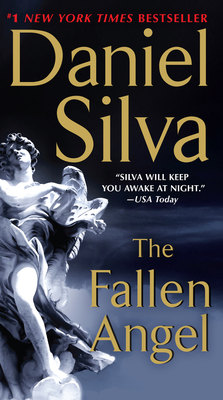
Review: FALLEN ANGEL by Daniel Silva

fallen angel cover

Gabriel Allon, the most famous retired spy in the world, is restoring a Caravaggio for the Vatican Museums when a museum employee is found dead, an apparent suicide, in St. Peter's Basilica (there's blasphemy for you). Luigi Donati, the Pope's secretary, asks Gabriel to look into the matter on the DL, and Gabriel agrees even though Luigi obviously knows more than he's telling. Soon Gabriel isn't just investigating a woman's death, but an art crime ring, the mafia, Hezbollah, and sundry threats against Israel.

Fallen Angel is the novel preceding immediately preceding The English Girl. I didn't know this when I started it, and I didn't mean to read this series backwards, but apparently it's happening. In any case, I wasn't as impressed with Fallen Angel as I was with The English Girl, although the novel was still entertaining and I'm increasingly fascinated by the character of Gabriel Allon.

Fallen Angel has the same basic structure as The English Girl: the story starts with a very specific, localized mystery, then expands to international threats. I loved the beginning of the book—it had the flavor of a Dan Brown novel, only really smart and well-written. I thought Fallen Angel was going to be all about art crime and I was super excited! (Side note: I always thought it would be awesome to be part of the FBI Art Crime Team.)

Unfortunately, I started having trouble with Fallen Angel in the transition from Rome and the art crime mystery to Allon and his team moving against Hezbollah. There basically was no logical transition, it was just like, "Oh Hezbollah's behind everything somehow (???), and we have to stop them RIGHT NOW!" I am still unclear as to what exactly one had to do with the other, and how the characters arrived at this conclusion. Because the change was so abrupt, I was thrown out of the story. It felt like the Rome section of the book and everything else belonged in two separate novels. Good novels, mind you, but narratively they didn't fit together.

I also found myself very annoyed with Chiara, Allon's second wife. She wasn't in The English Girl much, and apparently that was all for the best, because in Fallen Angel I found her to be whiny, clingy, and a bit pointless. The scene that really made me roll my eyes was when she nobly waited in the hotel room while Gabriel bounced off to assassinate terrorists, and strained to hear the sound of sirens so she'd know he was alive. Because that was what Gabriel told her to do. EYE ROLL.

Even when Chiara was annoying me or the story was jumping around, though, Allon was such a compelling character that there was no way I would have even considered not finishing this book. And the climax in Jerusalem was perfectly done: intense, suspenseful, and completely over the top—but in a really fantastic way.

Bottom line: this is a very solid, intelligent thriller; it just doesn't have the epic scope that The English Girl does. It's quieter, less ambitious. Allon is a man haunted by his past in every city he visits, not so much fallen as trapped in Purgatory, but Fallen Angel isn't the novel that gives him a new start.

I will definitely be continuing with the series and am looking forward to spending more time Gabriel Allon.


Discus this post with me on Twitter, FaceBook, Google+ or in the comments below.
Sunday, February 2, 2014

TSS—Books About Books

harry potter reading tom riddle's diary

After finishing The Salinger Contract by Adam Langer, I was reminded of how much I adore books about books. I mean, reading a book while reading about books??? So meta.

One of the more interesting themes to me in books about books is books are usually presented as dangerous. They tend to lead people to places they never intended to go, take over their lives, or unleash evil onto the world. I think this is a reflection of the fact that you never know what a book is going to be until you start reading it. Every unread book represents unlimited possibility, and that can be scary.

Another theme I discovered while compiling this list: a lot of books about books have really long and tortured titles.

Here are a few books about books that I've read. Are there any books about books that you've enjoyed? Share 'em in the comments!

harry potter and the chamber of secrets cover
Harry Potter and the Chamber of Secrets by JK Rowling

Chamber of Secrets is my favorite of all the Harry Potter books, mainly because it's about a book. But also because it has a hilarious Valentine's Day scene that makes me rotflmao every. single. time.

(Actually, now that I think about it, Order of the Phoenix, which is my second-favorite Harry Potter book, also has a hilarious Valentine's Day scene. Hm.)

Incidentally, if you missed it on Twitter yesterday, in an interview with The Sun Times, JK Rowling said she wished she'd hooked Harry and Hermione up rather than Ron and Hermione.


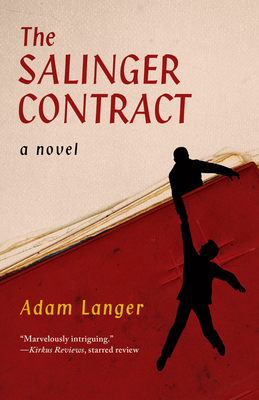
salinger contract cover
The Salinger Contract by Adam Langer 

A thriller about a millionaire who spends his money commissioning writers to pen books just for him ("What else am I going to spend my money on?"). But then he, like, DOES THINGS with them.


discovery of witches cover
A Discovery of Witches by Deborah Harkness

A witch and historian recalls a manuscript from the depths of the Bodleian Library, only to discover that the manuscript is so magic much evil, and she's the only person who's been able to recall it since it disappeared hundreds of years ago.


the thirteenth tale cover
The Thirteenth Tale by Diane Setterfield

A bookish person is hired by a reclusive, famous writer to tell her life story.

Not every book about books is a good book. I actually did not like this novel. At all. I tried to read it several times; the last time was for a book club I was in with Colette from A Buckeye Girl Reads. We were both just like, "Yeahhh. Nope."


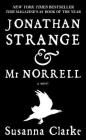
jonathan strange & mr norrell cover
Jonathan Strange & Mr. Norrell by Susanna Clarke

Goodreads tells me this a book about a book, but I just seriously do not remember. I think I tried to erase this book from my mind.


guernsey literary and potato peel society cover
The Guernsey Literary and Potato Peel Society by Mary Ann Shaffer and Annie Barrows

This is another book that I read for Colette's book club. Unlike The Thirteenth Tale, though, I very much enjoyed it. It's about people who use books to survive the German occupation in WWII.


Discus this post with me on Twitter, FaceBook, Google+ or in the comments below.

Sunday, January 26, 2014

Mini-Bloggiesta Finish Line!

bloggiesta finish gif


Another Bloggiesta is over. If you read my starting post this Friday, you know my goal this weekend was to get my professional writer website set up. I'm happy to say I completed my goal and natashabrandstatter.com is now live!

woohoo confetti
Yay me
I even managed to complete Monika's mini-challenge by making an image map for my social media contact links. If you have the time and inclination to check out my site, let me know what you think and if you have any suggestions.

Thanks to the Bloggiesta team for another successful blogging fiesta!


Discus this post with me on Twitter, Facebook, Google+ or in the comments below.

Friday, January 24, 2014

Mini Bloggiesta To-Do List

mini bloggiesta button

It's Bloggiesta again, just a short one this time, which will last over the weekend. Bloggiesta, if you don't know, is a chance for bloggers to get together, party, and maybe work on their blogging to-do lists if there's time after that.

I wasn't planning on joining in Bloggiesta this weekend, but then I decided to start a new blog/site. YES, ANOTHER ONE. But this one is my writer website, with its own domain name and everything. Just like a real writer!

I signed up for the domain and managed to get Blogger and my domain host to talk to each other without bursting too many blood vessels of rage this afternoon, so now all I have to do is polish the site up with links and images and about pages, etc. I'm pretty excited! I've never had my own domain before. Here's my to-do list:


  • Create an awesome about page.
  • Create a contact page.
  • Curate a list of my best work.
  • Polish up the design so it looks sleek and professional.
  • Decide what, if anything to post??? I honestly have no idea.


I might also check out a few mini-challenges if I have time. Are you joining in Bloggiesta this weekend?


Discus this post with me on Twitter, FaceBook, Google+ or in the comments below.

Thursday, January 23, 2014

Review: THE SALINGER CONTRACT by Adam Langer

the salinger contract cover

I received a digital copy of The Salinger Contract for review consideration, which didn't influence my opinion of the book in any way.

Adam Langer is an emasculated writer playing house husband in Bloomington, Indiana. His life revolves around laundry, dirty dishes, and his daughters' ear infections. Adam hasn't finished writing a story in YEARS--creatively, he's impotent. But all that changes when he happens to meet up with a fellow author, Conner Joyce, a best-selling writer of thriller novels whose star is on the wane. At least, until he's approached by a bespoke Waldo Lydecker type named Dex. Dex has an offer Conner can't refuse: write a novel just for Dex, for two and a half million dollars. The catch? No one else can ever know about the novel or their deal. Of course, Conner accepts. But it isn't long before he suspects he's made a deal with the devil and turns to Adam for help.

Basically, I loved this novel. When I started it I was in one of those Simon Cowell moods. You know, when everything you pick up makes you go, "BORRRRING. Next!" Or maybe that only happens to me. ANYWAY, The Salinger Contract managed to capture and hold my attention from page one despite my mood. It's fast-paced, unputdownable, and positively delightful, especially if you're a fan of olde-timey crime novels or film noir movies.

Like his friend, Conner, Adam uses an excess of detail to make what would be an otherwise outlandish plot convincing. Thankfully this detail does not involve unnecessary clothing descriptions or other crap I don't care about; instead, the details focus on books, which apparently does not bother me at all. For example, instead of reading his kids an unnamed book before bedtime, Adam reads them Lyle, Lyle, Crocodile. Love that. I also found the portrait Langer paints of life in a small university town to be wry, cynical, and dead-on accurate. One of the university professors Langer describes is so exactly like a former professor of mine that I actually checked to see if he ever taught in Indiana (he hadn't).

Adam's portion of the book was so realistic and pitch-perfect that when Conner's completely bizarre story began, I was 100% ready and willing to be sold on it. The only glitches that niggled at me were Conner's hesitation in signing Dex's contract—I'd be like, "Givemethatthankyoubyenow." And also, it didn't sound like Conner put any money aside for taxes. I think the IRS would probably notice if your bank account suddenly went up by 2.5 million, don't you? I'll also say that I saw all the twists coming pretty early in the novel. But neither that, nor my little niggles about the tax thing, prevented me from thoroughly enjoying The Salinger Contract and wanting to know what happened next.

The thing about this novel is that it tells the type of story that any author or reader would WANT to be true. I mentioned at the beginning of this post that Adam starts the story as emasculated, incapable of creating anything. The same could be said of the other major character, as well: Conner is having problems with his wife, looking at having to sell his house and car, and feeling like his entire career consists of rewriting the same book over and over. Then he agrees to write a novel for Dex and suddenly everything's coming up roses, and not just in the financial department: he's full of inspiration, writing constantly, and his wife and he start trying for another baby. Likewise, in listening to and then telling Conner's story, Adam finds a way to save his family from destitution and discovers who he is—again, not just through money, but by using stories. The Salinger Contract isn't just a fast-paced thriller (though it is that), but a book about the power of stories to inspire people to the point that they're empowered to act out those stories in their own lives.

It's also about the connection between an author and reader that's formed through books. It's one the author's usually completely unaware of and not responsible for; but for the reader it feels very personal, possibly because it says more about them than the book. It's that relationship that gives a story life, and one that every author wishes for their work.

If you're a reader (and since you're visiting this blog, I'm going to assume that you are) who enjoys mysteries, thrillers, or books about books, I would definitely recommend The Salinger Contract. Oh, and I'm totally drinking at the Coq d'Or the next time I'm in Chicago. Cuz you never know.


Discus this post with me on Twitter, FaceBook, Google+ or in the comments below.

Thursday, January 9, 2014

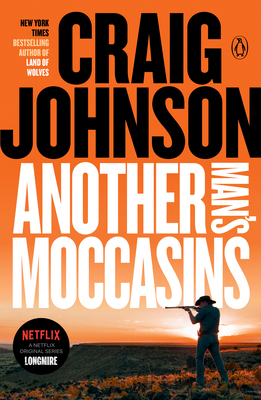
Review: ANOTHER MAN'S MOCCASINS by Craig Johnson

another man's moccasins cover

When the body of a young woman is found off of I-25, within spitting distance of an underpass where a homeless man with obvious psychological problems is hiding, the murder seems like an open-and-shut case. But not to Sheriff Walt Longmire. Despite the fact that the man in question, Virgil White Buffalo, attacked him, Walt isn't so sure Virgil would kill anyone without a reason. And when a photograph of Walt taken in Vietnam is found among the victim's possessions, he knows there's something more to the woman's story—he just has to figure out why she's in Wyoming and how she's connected to his past.

This is the fourth (I think? Yes, fourth) book in the Walt Longmire series by Craig Johnson, and it's a quick read. I enjoyed it, even though I do have to admit I completely skipped the backstory scenes set in Vietnam. You know me—I don't have the patience for backstory. I did read the first few, and young-Walt and -Henry were adorbs, but I have to say the novel didn't suffer for my having skipped over those scenes at all.

Okay, I'm about to get spoilery, so if you can't handle gigantic hints about who the murderer is, skip the next paragraph.

Another Man's Moccasins is one of those mysteries where whodunnit is obvious pretty early on, but Johnson tricks both Walt and the reader into questioning their instincts by using their insecurities and sympathies against them. I have to say, it was pretty well-done. All of the main suspects are strangers, people passing through Absaroka County on their way to somewhere else. All of them have some history with violence, and two of them are part of racially discriminated groups—Indian and Vietnamese. Is Walt targeting the other two suspects more than Virgil because he sympathizes with a fellow Vietnam vet (as Henry says after Virgil's arrested, "He's one of us," and he doesn't mean Indian. Cue band of brothers reference), or because his experiences in Vietnam have prejudiced him against Vietnamese people? Some of the new guys on Walt's staff assume it's the latter, which kind of hurts his feelings. So he spends the rest of the book asking his friends if they think he's prejudiced, and I would be tempted to say the novel is about prejudice if the mystery hadn't shook out the way it did. Instead, I think the point is that you shouldn't judge someone's reactions as unreasonable or crazy or prejudiced until you know where they're coming from.

Anyway, the mystery in Another Man's Moccasins is pretty straight-forward, which is probably why this book is so short. Even if you don't skip the Vietnam scenes, it's still less than 300 pages. But it gives Johnson an opportunity to explore the effects of war on Walt, his BFF Henry Standing Bear, his mentor and the former Absaroka County sheriff, Lucian, and Virgil.

Another of the things I really enjoyed about Another Man's Moccasins is that Johnson's background in playwriting really shines through, especially in the second half of the book. The climax is perfect: spooky, dramatic, with an almost Shakespearean conclusion. And the book plays around with concepts of perception and knowledge that demonstrates a more sophisticated use of storytelling than in the previous Longmire books.

So as Walt would say, Yep. Another good book in the series.


Discus this post with me on Twitter, FaceBook, Google+ or in the comments below.

LinkWithin

Related Posts Plugin for WordPress, Blogger...