Tuesday, January 31, 2012

Jane Eyre Approximately

Team Edward  ROCHESTER

There haven't been a lot of Jane Eyre adaptations (thank god) when compared to other classic novels like Pride & Prejudice; but there are a few! Here are some I've personally come across:

jenna starborn cover
Jenna Starborn by Sharon Shinn
Sharon Shinn is one of my favorite authors, and Jane Eyre is one of my favorite books, so you can imagine my excitement when I heard about this novel. If you just read the summary and not the book itself, it might seem like Shinn did a good job of adapting Jane Eyre to a sci-fi setting; but in practice I didn't see what the point of Jenna Starborn was, because it was so similar to the original.

nine coaches waiting cover
Nine Coaches Waiting by Mary Stewart
This is probably one of the best adaptations I've read, although it still falls short of the original. One of the reasons it's good is that Stewart is a neogothic writer, so her writing style is already perfectly suited to an adaptation of Jane Eyre. Another point in her favor is that she definitely puts her own spin on the story and adapts it to a contemporary (at the time) setting.

rebecca cover
Rebecca by Daphne du Maurier
Du Maurier is another neogothic suspense novelist whose style is perfectly suited to putting her own twist on Jane Eyre. Rebecca is more of an "inspired by" than "copied after" adaptation. Like Stewart, du Maurier lets her own characters and setting move the story, not the original Jane Eyre.

Jane cover
Jane by April Lindner (review here)
In this version, Mr. Rochester is a rock star. It's very Jane Eyre-lite, but was enjoyable, if totally ridiculous.

Jane Slayre cover
Jane Slayre by Sherri Browning Erwin
I've seen this book around and have managed to avoid it. I suppose I could be persuaded to try it if someone told me it was good, but I haven't seen any reviews of it.

flight of gemma hardy cover
The Flight of Gemma Hardy by Margot Livesey
This is another novel where I'm not really sure what the point of writing it was. It's very similar to Jane Eyre in the plotting, but with none of the great characters and emotions that come with the original.


Have you read any adaptations of Jane Eyre?


Saturday, January 28, 2012

Weekend Cooking: Cheese Please!

a mouse's dream

According to Chuck Hughes from Chuck's Day Off, there is a renaissance of artisan cheese making happening in America right now, and I really have to agree with him. In the '80s it seemed like there were only three kinds of cheese: Velveeta, Kraft, and Philadelphia. Admittedly I was pretty young in the '80s, so my recollection might not be that great, but nowadays you can get so many different specialty cheeses in the grocery store. That definitely wasn't around when I was a kid.

When I was living in Oklahoma, there was a fromagerie--aka cheese shop--in the town I lived in, and I started to become obsessed with all trying all the different types of cheeses that were available. Then, while watching The Big Cheese one night, I started to wonder if there was a way to make cheese in a home kitchen. Although I doubted it (I figured you needed raw milk and specialized equipment I definitely wasn't going to buy), I put the question out on twitter. I probably could have googled it, but sometimes I just like to ask questions on twitter to see what will happen. Sandy from You've Gotta Read This said she'd just gotten a book called Artisan Cheese Making at Home that looked like something I'd be interested in.

artisan cheese making cover

My library had it. Yay! This book has absolutely fabulous, delicious-looking photographs that make me crave cheese like a crazy person, and recipes for everything from marscapone cheese to Stilton; as well as yogurt, butter, and recipes for dishes to make with your home-made cheeses. It's also very informative about the types of cheeses you can make and starts out with the easier stuff (ricotta, butter, yogurt, etc.).

That being said, I had the same problem with this book that I did with many of the bread-making books I looked at last year: even though the recipes are scaled-back for home kitchens, they still require a lot of special equipment and ingredients. In other words, it's written by a chef (Mary Karlin, in this case) who is writing what are "simple recipes" from the perspective of a chef, which is still way more time, money, and work than the average person wants to put into it.

pear galette

Just for example, Karlin's recipes are in what she calls "small batches" of ONE OR TWO POUNDS of cheese. Do you know how long it would take my family to eat a whole pound of cheese, assuming they would even agree to eat it? That is not a practical-sized batch for the average household. Another pet peeve of mine: her butter recipe requires a food processor, which 1. isn't listed in the required equipment chapter, probably because she just assumes EVERYONE must have a food processor; and 2. is something I don't have. Even Karlin's simplest recipes require ingredients I've never heard of. Take the ingredients for her ricotta recipe, one of the first in the book:
1 gallon pasteurized or raw whole cow's milk
1/2 cup heavy cream
1 teaspoon citric acid powder
2 teaspoons kosher salt
What the heck is citric acid powder? How many people just have that sitting in their cupboard? The recipe also calls for sterilized equipment, nonreactive-strainers, -bowls, and -pots, and butter muslin instead of cheese cloth. Cuz that's totally necessary.

Fortunately, Sandy also gave me a link to a simpler ricotta recipe she found in Food & Wine magazine by Helm Sinskey; otherwise I never would have attempted to make cheese. By comparison, this recipe uses easily-found ingredients and the batch is 1/2 the size of Karlin's:

Ingredients:
    1.    2 quarts whole milk, preferably organic
    2.    1 cup heavy cream, preferably organic
    3.    3 tablespoons white vinegar
    4.    1/2 teaspoon kosher salt

Directions:
    1.    In a medium pot, warm the milk and cream over moderately high heat until the surface becomes foamy and steamy and an instant-read thermometer inserted in the milk registers 185°; don't let the milk boil [note: at high altitudes, milk will boil at this point. wah-wah]. Remove the pot from the heat. Add the vinegar and stir gently for 30 seconds; the mixture will curdle almost immediately. Add the salt and stir for 30 seconds longer. Cover the pot with a clean towel and let stand at room temperature for 2 hours.

    2.    Line a large colander with several layers of cheesecloth, allowing several inches of overhang. Set the colander in a large bowl. Using a slotted spoon, transfer the curds to the colander. Carefully gather the corners of the cheesecloth and close with a rubber band. Let the ricotta stand for 30 minutes, gently pressing and squeezing the cheesecloth occasionally to drain off the whey. Transfer the ricotta to a bowl and use at once, or cover and refrigerate.

Make Ahead The fresh ricotta can be refrigerated for up to 4 days.
Notice that this recipe also uses less salt and more cream than Karlin's. I followed this recipe (halving it), and it turned out fabulous! Very fluffy and creamy. It takes about three hours to make, but only thirty or so minutes of that requires your attention. Here are some pictures:

Making the cheese:

making cheese

Of course, once I'd made the ricotta, I had to figure out what to do with it. Here are some of my recipe attempts:

toasts

I decided to make this after Memory from Stella Matutina said she liked ricotta with honey. This has honey and pepper sprinkled over it. It was okay, but a little bland, and not very filling.

pasta

I got this recipe from Real Simple. It's ricotta, butter, lemon zest, parsley, tarragon, and chives. I added a ton of herbs and pepper, but it was still very bland--okay, but definitely missing something.

bruschetta

This bruschetta was pretty good. I squeezed out the tomato's juices into the bread, then chopped the tomatoes, which made them easier to eat. The basil and prosciutto added a lot of flavor.

pizza

This is a pretty similar recipe to the bruschetta, but adapted for pizza. This was by far the best of the snacks I made. The only thing I would change is to add more tomato paste.

I also wanted to try making a dessert with the ricotta, and chose this recipe from Noshtopia for ricotta chocolate pudding. I had my doubts about turning cheese into a chocolate pudding, but it was really good!


So that was my cheese-making experience. It went pretty well (I count any cooking experiment that doesn't end with me in the ER a success at this point), and I am definitely encouraged to try to make different cheeses and butter. However, I don't think I'll be trying the recipes in Artisan Cheese Making at Home any time soon. They probably do taste better than the very basic cheese and butter recipes I've found so far, but I'm looking for easy at this point. It's a great resource if you're an experienced cook ready to put a lot of time, patience, energy, and money into making cheeses; but I think for the average person it's more like a book of food porn than something for practical use.

Weekend Cooking is open to anyone who has any kind of food-related post to share: Book (novel, nonfiction) reviews, cookbook reviews, movie reviews, recipes, random thoughts, gadgets, fabulous quotations, photographs. If your post is even vaguely foodie, feel free to grab the button and link up over the weekend.

Thursday, January 26, 2012

Love Is a Leap


Does anyone besides me remember The Butcher's Wife (the trailer is too cute!)? It's a romantic comedy from the '90s starring Demi Moore and Jeff Daniels. Demi plays a clairvoyant named Marina who travels to New York City with her new husband, a butcher. Her husband is freaked about Marina's ability to see into the future, so he sends her to a psychiatrist played by Jeff Daniels. It has so many elements that I love in a story: charm, humor, a sense of community, destiny, clairvoyance, self-discovery, and love of course. It's what so many romcoms strive to achieve but never do.

There are tons of great lines in this film, but the one that's stuck in my head the most is "Love is a leap that won't be denied." TOTALLY CHEESY, I know, but it must have permanently affected my prepubescent brain, because I completely buy into that concept. Not necessarily in real life--the jury's still out on that one--but narratively? Heck yeah.

the butcher's wife

Think about it: how much does denial really build romantic tension in stories? Personally, I hate that trope, especially when the characters deny their attraction for no good reason. Then eventually all obstacles are removed and they still STILL deny it (I'm looking at you, Castle and Bones), because the writers are under the mistaken belief that if their characters don't get together, then all romantic tension will be lost.

The thing is, people in general want to do things to ensure their own happiness. And typically being in a loving relationship does equate to happiness on some level. Ipso facto, one expects characters to take the chance on love at some point no matter the obstacles, external or internal, put in their path. There comes a point where the dithering grows tiresome and they have to either leap or find new fuel for the fire, and if that point passes with no action on the characters' part, the "romantic tension" becomes bullshit no one can buy into anymore.

I think that's one of the things I like most about The Butcher's Wife--the characters leap. Sometimes in the wrong direction, but they take chances because they think it will make them happy. Occasionally I worry that we've become a society so afraid of taking chances, we're even too afraid to write about what might happen when you do.


What words of wisdom have you taken away from romantic comedies?

Tuesday, January 24, 2012

Book Review: SILENT IN THE GRAVE by Deanna Raybourn

silent in the grave cover

"To say I met Nicholas Brisbane over my husband's dead body is not entirely accurate. Edward, it should be noted, was still twitching upon the floor."
Thus begins Silent in the Grave, a book that people have been recommending to me for years. It took a while, but I finally got around to it and they were right--Silent in the Grave is exactly the kind of novel I enjoy.

Lady Julia Grey is a young widow. When Nicholas Brisbane approaches her to suggest that her husband, who had always been sickly, was murdered, she dismisses the idea immediately. Almost a year later, however, she finds a threatening note in her husband's office and realizes Brisbane was right. Can she and Brisbane manage to find out who poisoned Lord Edward with almost no clues to speak of? It wouldn't be much of a mystery if they didn't, now would it?

The beginning of Silent in the Grave was fabulous--very atmospheric and morbid, but in a humorous way, like an Edward Gorey painting. I loved Lady Julia's voice (the novel is told in first person), and I am a total sucker for books where the hero and heroine argue, which Julia and Brisbane did quite a lot of. I had no idea how they were going to discover the murderer, but I wanted to find out!

That being said, the book started to lose me in the middle. I guessed who the killer was less than a third of the way into the story; Lady Julia began acting inconsistently, occasionally behaving like an idiot for the sake of dragging out clue reveals; and I didn't get any chemistry between her and Brisbane once they stopped fighting. WHY do they always have to stop fighting? Plus, Julia does tend to go on a bit. I started to skim through some sections.

brisbane
Toby Stephens as Brisbane?

Brisbane is an interesting character, kind of a combination between Sherlock Holmes and Heathcliffe. But for some reason he didn't really interest me that much. Mainly all he does is brood (I'm sure he does other things, but while he's on the page it's mainly brooding). The clairvoyance struck me as cheesy rather than mysterious, and I guessed at his origins almost immediately.

Julia, meanwhile, is supposed to be going through a transformation into her own woman and all that good stuff, but I found the evidence of this was pretty shallow. A deep-cut dress does not a liberated woman make; just ask Marilyn Monroe. For the most part Julia remains as conventional as she was at the start of the story. I did like that she found nearly all the clues in the investigation; but then she does live in the house, and it took her long enough. Her family and her servants, on the other hand, were hilarious and awesome, and I wish they had had a more active role in the investigation.

So there were definitely some weak points in the story, and I'm not sure I want to continue reading the series--not because the book was bad, by any means, but because at this point I'm still not invested in Julia and Brisbane as characters, and I'm not sure I can handle another round of Julia wanting-Brisbane-to-pay-attention-to-her-but-really-not-that-much-attention. For the most part, however, I did enjoy this novel, if only for the fabulous Victorian feel of it, and I'm really glad I finally took the time to read it!


Musical Notes: "Blue Jeans" by Lana del Rey

Saturday, January 21, 2012

Weekend Cooking Review: THE FOUNDING FOODIES by Dave DeWitt

founding foodies cover

I was SO excited about Founding Foodies when I first saw it. I heart cultural history of any sort, whether it addresses dance, art, cooking, literature, film--you name it. Not to mention that one of my favorite things to eat is mac & cheese, and one of my favorite things to think about while making it is that Thomas Jefferson served the first dish of macaroni and cheese. How cool is that? In a way it ties me and Thomas Jefferson together. As a result, I've always been curious about Jefferson and his pals, and how their legacy can be found in food as well as politics. Since many of the men involved in the American Revolution were tavern owners and farmers, it stands to reason they knew their food.

Founding Foodies purports to tell us about the beginnings of "America's diverse food culture," as well as give us original Founding Father recipes like George Washington's beer and Martha Washington's fruitcake. How fun is that?! Unfortunately, the answer is not very fun at all, because this book fails on practically every level imaginable.

My high expectations of Founding Foodies started to plummet in the introduction. Perhaps it's just my years of being in school, but I expect the introduction of a non-fiction book to summarize the topic, lay out the central argument or point of the book, and provide a brief run-down of how that point is going to be made. What was in Dave DeWitt's intro? First, he talks about why he likes Jefferson (he went to the University of Virginia), and then he spends the rest of the introduction defining the terms "foodie" and "founding father." This was worrisome because both of these terms are generally understood by the North American public; so either we as readers are being talked down to, or DeWitt does not know what the fridge he is talking about.

Things, shockingly, did not improve from there. The first chapter doesn't start with the Founding Fathers at all, but with Sir Walter Raleigh, and it takes PAGES before food is even mentioned. The timeline jumps all over the place, from 1492 to 1850, and there is no central argument or point to be had anywhere in this book. Take the chapter on Thomas Jefferson, for example (I was sure DeWitt would at least manage a solid on this one, since he was such a self-professed Jeffersonian), which goes something like this: Thomas Jefferson, man of the world and lover of different cultures, founding foodie extraordinaire. Let's talk about him! Wait, let's talk about his slaves. He fed them! What a guy! Wait, let's talk about tomatoes. Now let's talk about ice cream, but let's discuss muffins while we're talking about that. Now let's talk about Jefferson's garden. What was his favorite vegetable? The debate rages. And why didn't we talk about tomatoes in this section? I don't know! UHG.

Even if there had been a point DeWitt was trying to make, the book is way too generalized to make it. Hey, did you know they served food at the White House? And people ate corn? It's true. They ate corn. I did like that DeWitt included a lot of information about what the slaves ate, but like much of the information in The Founding Foodies, it lacked a whole lot of context.

Furthermore, I really don't think DeWitt has any clue to what someone who would pick up a book like this would be looking for. Just as an example, at no point does he address the famous macaroni and cheese dish. If I've heard about it, it's got to be well-known; and it's one of America's favorite meals to this day. Yet there's NOTHING. ABOUT IT. ANYWHERE, other than a small note in the recipe section that Jefferson did serve a pasta dish with Parmesan cheese. No recipe, no date, no discussion. Does DeWitt know anything about his audience? Anything at all?

LOLcat

Frustrated, I flipped to the bibliography (there isn't a conclusion, which is probably for the best), and realized that was what I should have done in the first place, because many of DeWitt's sources are Wikipedia pages. HE LITERALLY CITES WIKIPEDIA AS A MAJOR SOURCE IN HIS BOOK! Not just a few times, but regularly. In the intro to the bibliography, DeWitt tries to excuse himself by saying he fact-checked Wikipedia to make sure it was correct. Oh, really?! You fact-checked Wikipedia? Why didn't you just use the sources you found while making sure Wikipedia was accurate then, hmmmmm?

To make it matters even worse, the writing style is stupefyingly boring. If I wasn't going to be put off by the total lack of logical organization and saddest excuse for research I have ever come across in a published book, the writing would do it. It's like reading the narration to a History Channel special, and I do not mean that in a good way.

So just to summarize: this author wrote a book that he basically researched using Google. And now we know why it sounds like he doesn't know what he's talking about: HE DOESN'T.

There are some books that make me wonder how on earth people get published, and this is one of them. Even the index is a piece of crap, that's how bad this book is. You can do better. Might I suggest Wikipedia?


Weekend Cooking is open to anyone who has any kind of food-related post to share: Book (novel, nonfiction) reviews, cookbook reviews, movie reviews, recipes, random thoughts, gadgets, fabulous quotations, photographs. If your post is even vaguely foodie, feel free to grab the button and link up over the weekend.

Thursday, January 19, 2012

Bookshelf Boredom

lolcat shelf

I was contemplating my bookshelves the other day (as I do every day), and I suddenly realized two things: one, I'm running out of space. Again. And two, my unread shelves hadn't really changed all that much since I did my last book purge/donation to the library, and it's beginning to look like it's time to do another one.

But why are my unread shelves so static? I don't read as much as some, certainly, but I do go through the books. One would think there'd be at least some change in my shelves. Then it hit me: most of the books on my bookshelves aren't books I bought. They're either books someone has loaned or given to me, or books I got for review. The books I most want to read and are excited about are usually books I get from the library (indeed, I'm reading a library book right now) because I can't afford to buy books.

Of the dozens of unread paper books I own, only a few are books I've bought for myself, and none of them are purchases made in the last year--maybe even longer than that. If I happen to buy a book these days, it's a 99-cent or $1.99 eBook (or, even better, a free eBook).

This is quite sad, no? It's no wonder I'm feeling bored with my bookshelves lately. But what should the solution be? Should I focus on reading all the books I've bought for myself and then weeding out the loans and gifts? I've already done that three or four times, and I do want to read most of the books people get me... eventually. There just aren't any books that I'm dying to read in my collection and it doesn't seem like there will be for a while.

What do your bookshelves consist of? Library books, books you own, or books people have given you?

Tuesday, January 17, 2012

Book Review: WONDERSTRUCK by Brian Selznick

wonderstruck cover

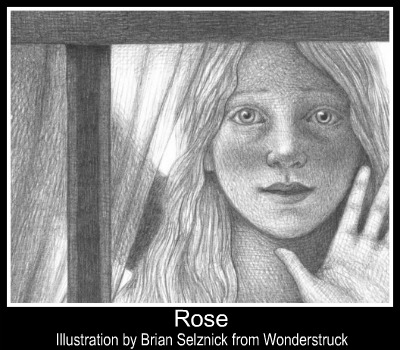
After reading The Invention of Hugo Cabret, was there any question of me picking up Brian Selznick's next book? Not really. Wonderstruck has very similar elements to Hugo Cabret: once again there's an orphan boy alone in a city, looking for answers about his father, and receiving help from another child. But in this case the setting is the American Museum of Natural History in 1977, not a 1930's Paris train station. Juxtaposed against Ben's story is that of Rose, a girl in 1927 New Jersey who runs away to New York City. Her story is told mostly in pictures.

rose

Wonderstruck isn't as charming and doesn't have the same fantastical feel as Hugo Cabret, possibly because the setting is much more modern and closer to home (at least for this American reader). But I also think the way Selznick tells this particular story is grittier and more grounded in reality than Hugo Cabret was. We're more directly confronted with the death of Ben's mother than we were with that of Hugo's father, and the tools and clues Ben uses to reconnect with his father's past are much more practical. That's not to say I didn't enjoy Wonderstruck, but the tone is definitely different. While we can imagine Hugo and Isabelle cavorting among the stars in the bright lights of Paris, these characters remain firmly in the gutter, so to speak.

wolves

I loved the opening sequence of this book simply because it highlights what is so great about Selznick's novels: the illustrations aren't afterthoughts or superfluous, they really are an essential part of the book. In this case the illustrations at the beginning did a great job of pulling me right into the story, which I finished in about two hours. Selznick keeps you reading by switching between Rose's and Ben's story at the just the right moments so you want to find out what happens next, but not so often that you start to feel whiplashed.

One of the themes in Wonderstruck is that of collections and how they tell a story about the person who owns them. They're called mini-museums, and collectors are amateur curators. Ben owns a box filled with "treasures" that he carries with him and that reveals stories about his past. That made think about my own collections--to be honest I don't collect that much. I don't like spending money on things with no practical purpose; plus I never saw the point of gathering things that are just going to collect dust. The one notable exception is images--I "collect" images of St. George and the Dragon, for example, not by actually buying them (unless it's a postcard), but by writing down where I saw it and/or taking a photograph of it. It also seems like most of the trips I take develop image themes. The image theme for my trip to Washington DC, for instance, was boats. I suppose in a sense I am curating an museum of images in my mind, although I thought of it like that before.

In any case, I think this novel will inspire readers (adult readers, anyway) to look at their collections in different ways, and I do think it's a good book that's worth reading. I definitely wasn't disappointed.


LinkWithin

Related Posts Plugin for WordPress, Blogger...